Blog Archives
Q: What’s on the easel today?
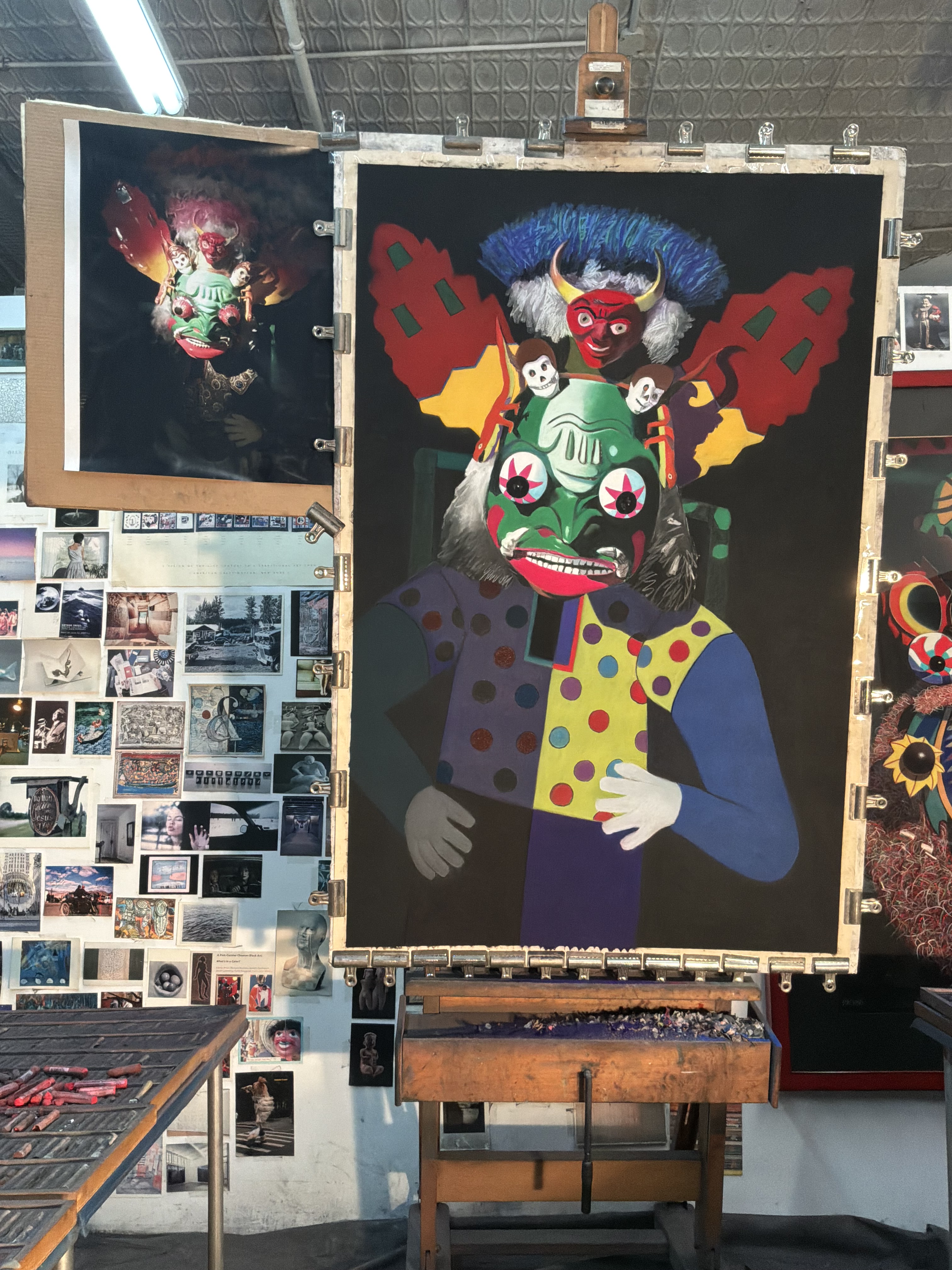
Work in progress
A: I continue working on “Gatecrasher,” soft pastel on sandpaper, 58” x 38.” In February I was privileged to visit this mask on exhibit at MUSEF La Paz in Bolivia. It was my second visit to the museum; the first was in 2017. Even more so this time, I was bowled over with how spectacular this particular mask is in person. Plus, I had forgotten its huge size. So I am absolutely determined to bump up my game and even more inspired to make this painting as strong and powerful as I possibly can!
Comments are welcome!
Q: You started the Bolivianos series in 2017. It has been 8 years since you created The Champ. This endeavor of focussing on a series for almost a decade’s timeline shows that you embody stability as against many artists who tend to hop on to the next inspiration they find. How has discipline, stability, focus and punctuality defined your works apart from being inspired by Bolivian culture for the series Bolivianos? (Question from Vedica Art Studios and Gallery)
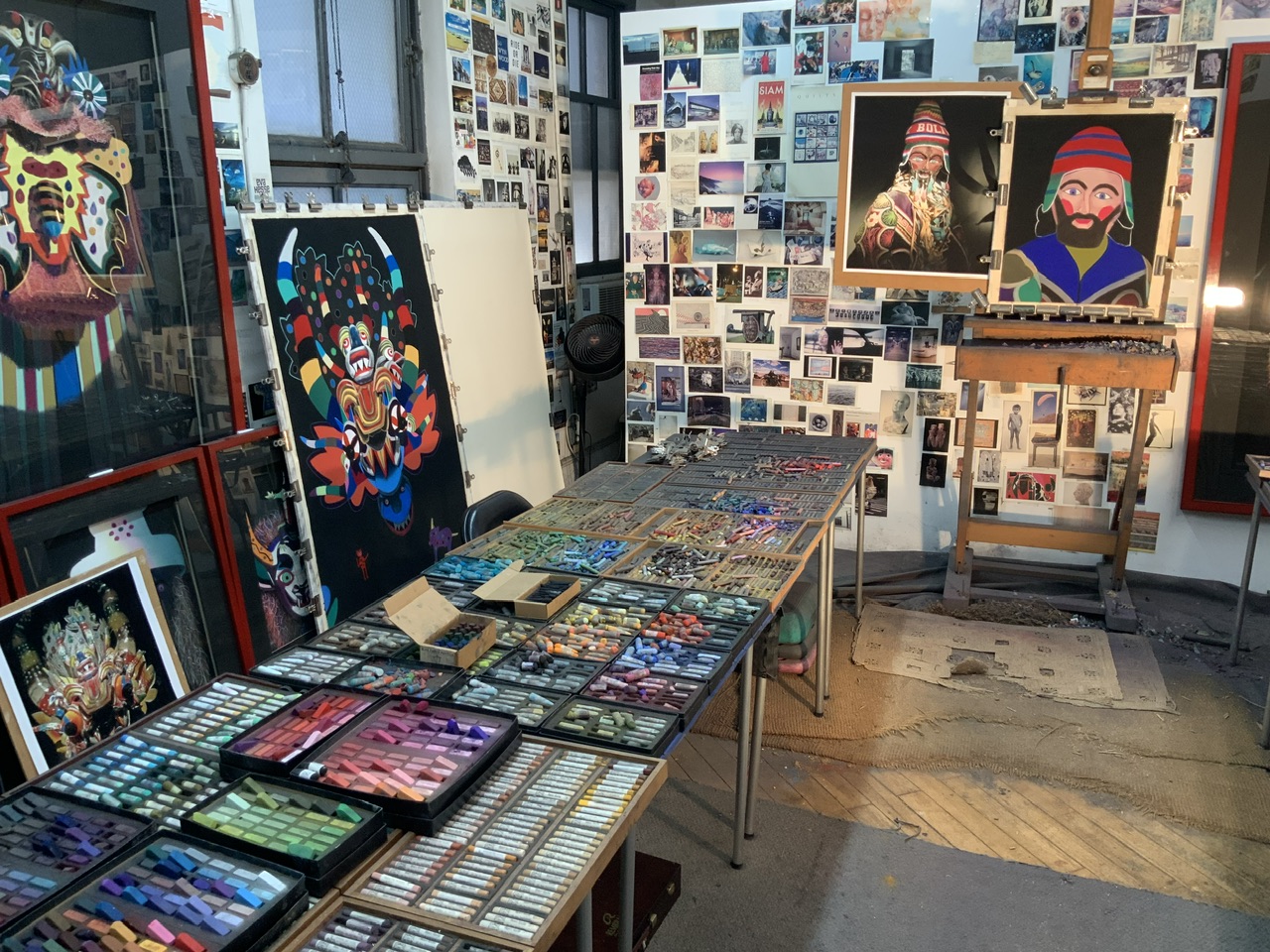
A: My first series, Domestic Threats, lasted fifteen years, and my second, Black Paintings, lasted ten. Stability and related qualities are likely natural parts of my personality, reinforced by my previous professional life. My prior careers as a Navy Commander, commercial pilot, and Boeing-727 Flight Engineer undoubtedly helped develop discipline, stability, focus, and punctuality. Details matter deeply to me; as a Naval Officer for twenty-one years, “attention to detail” was paramount. From my earliest days as an artist, I have been meticulous and dedicated to inventing new techniques and refining the craft of soft pastel.
I dislike wasting precious time. As a goal-oriented person, I continually strive to accomplish as much as possible. These qualities were influenced by my Navy career and further deepened by the tragic loss of my husband onboard the plane that crashed into the Pentagon on 9/11. I understand firsthand that life can change in an instant. Whenever I finish one task, I immediately look around and ask, “OK, what’s next?” I devote my studio time to pushing myself and pastel to new technical heights. There’s always more to accomplish as an artist!
Comments are welcome!
Q: Over your 40-year career as an artist, you have managed to keep presentation, technical, subject matter, conceptual consistencies in your art practice and work. How do you manage to filter out inspirations that might be luring at that moment but do not support your art practice? For example, you master pastel works. There must have been moments when you might have been inspired to make oil works. How do you keep such inspirations aside. (Question from Vedica Art Studios and Gallery)

A: About thirty-five years ago, when my pastel paintings were becoming larger—around 60” x 40”—I had to choose between transitioning to oil on canvas or continuing with pastel. Framing was the main concern. I wasn’t certain large pastels could be framed, and even if they could, the cost might be prohibitive. However, I had already fallen in love with pastel and knew no other medium could offer such vibrant colors or velvety textures. Determined, I resolved the framing issue (art-making is fundamentally problem-solving), committed myself fully to soft pastel, and have continued inventing and refining techniques ever since.
My goal from the beginning has always been improvement as an artist. If an activity doesn’t contribute to my growth—as a person or as an artist—I typically don’t pursue it. Time and energy are finite resources, so I try to use them wisely.
Comments are welcome!
Q: Would you please share your current bio?

A: Here it is.
Barbara Rachko, born in 1953 in Paterson, New Jersey, is a contemporary painter based in New York City, renowned for her large pastel-on-sandpaper paintings inspired by Bolivian Carnival masks. With nearly 40 years dedicated to revolutionizing pastel as a fine art medium, Rachko’s influential blog, Barbara Rachko’s Colored Dust, has garnered over 229,000 subscribers. She is the subject of the acclaimed documentary “Barbara Rachko: True Grit,” available on YouTube, and her ebook “From Pilot to Painter” captures her inspiring journey from a former pilot to an accomplished artist.
Rachko’s work explores the vibrant cultural heritage of Bolivian Carnival masks, and Mexican and Guatemalan folk art. Her meticulous attention to detail is showcased in notable series such as Bolivianos, Black Paintings, and Domestic Threats. In 2023, she was featured in a documentary that premiered at the Newport Beach Film Festival, earning the Audience Award and Best in Category Award, further cementing her impact on contemporary art.
Her solo exhibitions include the Joy Pratt Markham Gallery at Walton Arts Center (AR), Louise Jones Brown Gallery at Duke University (NC), Olin Gallery (VA), and La MaMa La Galleria (NY). She trained in photography at the International Center of Photography in New York and studied drawing and pastel techniques at the Art League School in Alexandria, VA. Her works are held in private collections worldwide and have been showcased at prestigious art fairs, including Art Basel Miami, Moon Art Fair in Hamburg, and Art Busan in Korea, affirming her global influence in pastel painting.
Comments are welcome!
Pearls from artists* # 606

Barbara’s Studio
*an ongoing series of quotations – mostly from artists, to artists – that offers wisdom, inspiration, and advice for the sometimes lonely road we are on.
The most ephemeral thoughts and feelings are gradually shaped into hard copy that is worked over, painted over, edited, and refined before the public sees it. This is where the sculptor cuts away and polishes the stone, where the painter covers the beginnings of the image with layer upon layer of enriching re-vision.
The muse presents raw bursts of inspiration, flashes, and improvisatory moments in which the art just flows out. But she also presents the technical, organizational job of taking what we have generated, then filing and fitting and playing with the pieces until they line up. We arrange them, cook them, render them down, digest them. We add, subtract, reframe, shift, break apart, melt together. The play of revision and editing transforms the raw into the cooked. This is a whole art unto itself, of vision and revision, playing with the half-baked products of our prior play.
It is essential to perform that secretarial labor in a way that is not mechanical. Editing must come from the same inspired joy and abandon as free improvisation. Stravinsky tells us, “The idea of work to be done is for me so closely bound up with the idea of the arranging of materials and of the pleasures of the actual doing of the work affords us that, should the impossible happen and my work suddenly be given to me in a perfectly completed form, I should be embarrassed and nonplussed by it, as a hoax.”
Stephen Nachmanovitch in Free Play: Improvisation in Life and Art
Comments are welcome!
Pearls from artists* # 560

*an ongoing series of quotations – mostly from artists, to artists – that offers wisdom, inspiration, and advice for the sometimes lonely road we are on.
In describing her technique, Joan [Mitchell] once said, “I don’t go off and slop and drip. I ‘stop, look, and listen!’ at railroad tracks. I really want to be accurate.” One can imagine every stroke applied, every drizzle of pigment – both those visible in the finished work and those buried beneath its many layers – being the result of just such consideration. The majesty of Joan’s painting, which she would call City Landscape, was a quality it shared with all great art – the sense that it had always existed, and that during one inspired moment it had been dredged from the subconscious depths by a hand and mind graced with the talent and vision to retrieve it for the rest of us. That revealing work, so exuberant, so deep, so masterful, and so unlike the shards and violent explosions that had been her signature, was the result of Joan’s having survived a personal hell and her own imperfections. It was her prize for having persevered, and all who saw it were the beneficiaries.
Mary Gabriel in Ninth Street Women
Comments are welcome!

Pearls from artists* # 421
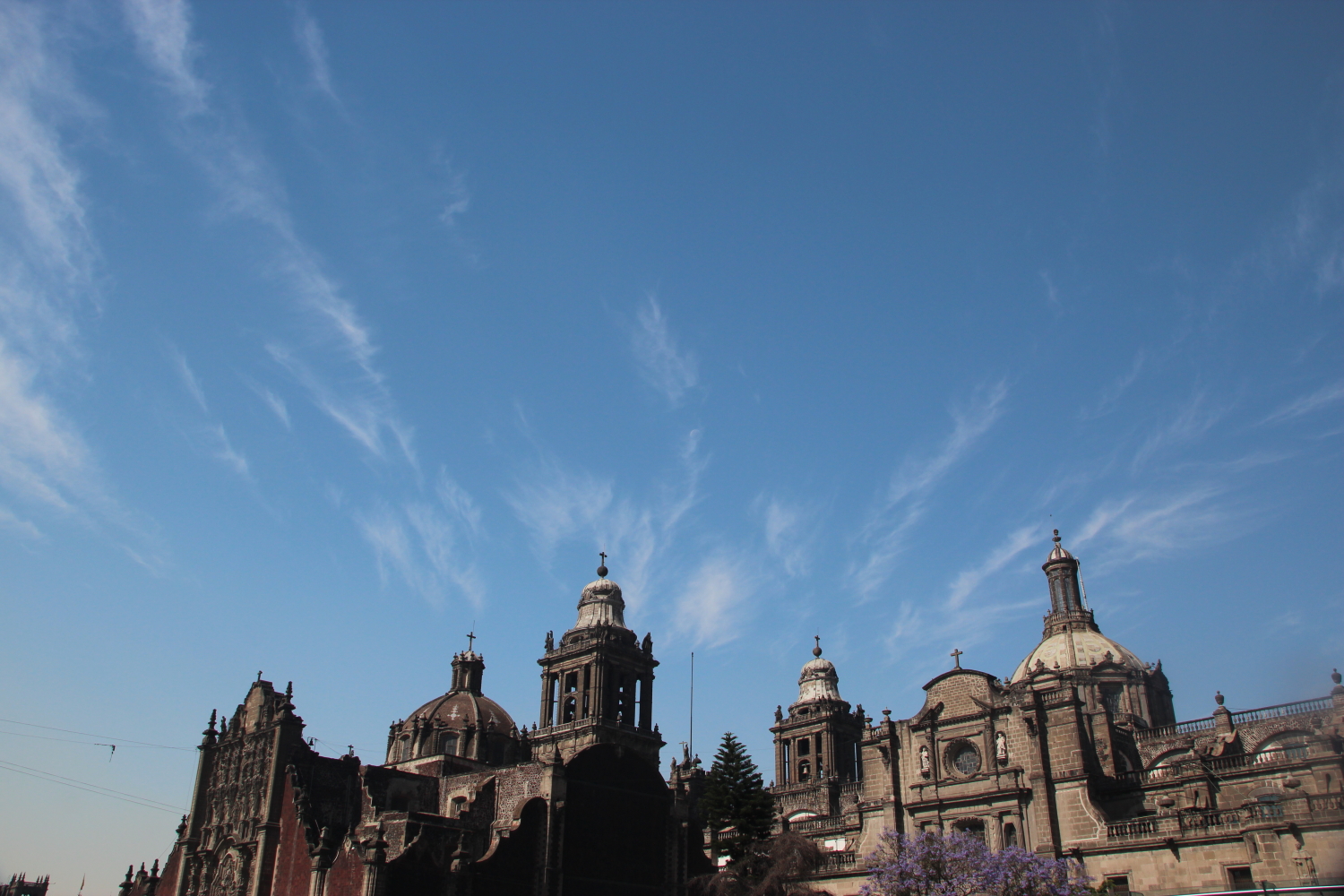
Mexico City
*an ongoing series of quotations – mostly from artists, to artists – that offers wisdom, inspiration, and advice for the sometimes lonely road we are on.
The economic meltdown that followed the crash of the U.S. stock market in 1929 shattered the country’s faith in itself. With one third of the country unemployed and droughts devastating the Midwest, many Americans doubted their ability to endure and triumph. More than ever, as the American novelist John Dos Passos asserted, the country needed to know “what kind of firm ground other men, belonging to generations before us, have found to stand on.” Guided by the Mexican muralists, whose art they had ample opportunities to study in reproduction and exhibition, American artists responded by seeking elements from the country’s past, which they mythologized into epics of strength and endurance in an effort to help the nation revitalize itself.
Thomas Hart Benton led the charge. Long a vociferous critic of European abstraction as elitist and out of touch with ordinary people, Benton hailed the Mexican muralists for the resolute public engagement of their art and for portraying the pageant of Mexican national life, exhorting his fellow American artists to follow their example in forging a similar public art for the U.S., even as he firmly rejected the communist ideology that often inflected the Mexican artists’ work. African American artists were likewise inspired by the Mexican muralists’ celebration of the people’s fight for emancipation. In creating redemptive narratives of social justice and liberation, artists such as Charles White and Jacob Lawrence transformed that struggle for freedom and equality into a new collective identity, one that foregrounded the contribution of African Americans to national life.
Vida Americana: Mexican Muralists Remake American Art, 1925 – 1945, edited by Barbara Haskell
Comments are welcome!
Q: Can you briefly explain how the Bolivian Carnival masks you depict in your work are used?

Museum of Ethnography and Folklore, La Paz, Bolivia
A: The masks depict important figures from Bolivian folklore traditions and are used in Carnival celebrations in the town of Oruro. Carnival occurs every year in late February or early March. I had hoped to visit again this year, but political instability in Bolivia made a trip too risky.
Carnival in Oruro revolves around three great dances. The dance of “The Incas” records the conquest and death of Atahualpa, the Inca emperor when the Spanish arrived in 1532. “The Morenada” music and dance style from the Bolivian Andes was possibly inspired by the suffering of African slaves brought to work in the silver mines of Potosi. The dance of “The Diablada” depicts Saint Michael fighting against Lucifer and the seven deadly sins. Lucifer was disguised in seven different masks derived from medieval Christian symbols aor totemic animals that became nd mostly devoid of pre-Columbian elements (except that became attached to Christianity after the Conquest). Typically, in these dances the cock represents Pride, the dog Envy, the pig Greed, the female devil Lust, etc.
Comments are welcome!
Pearls from artists* # 373
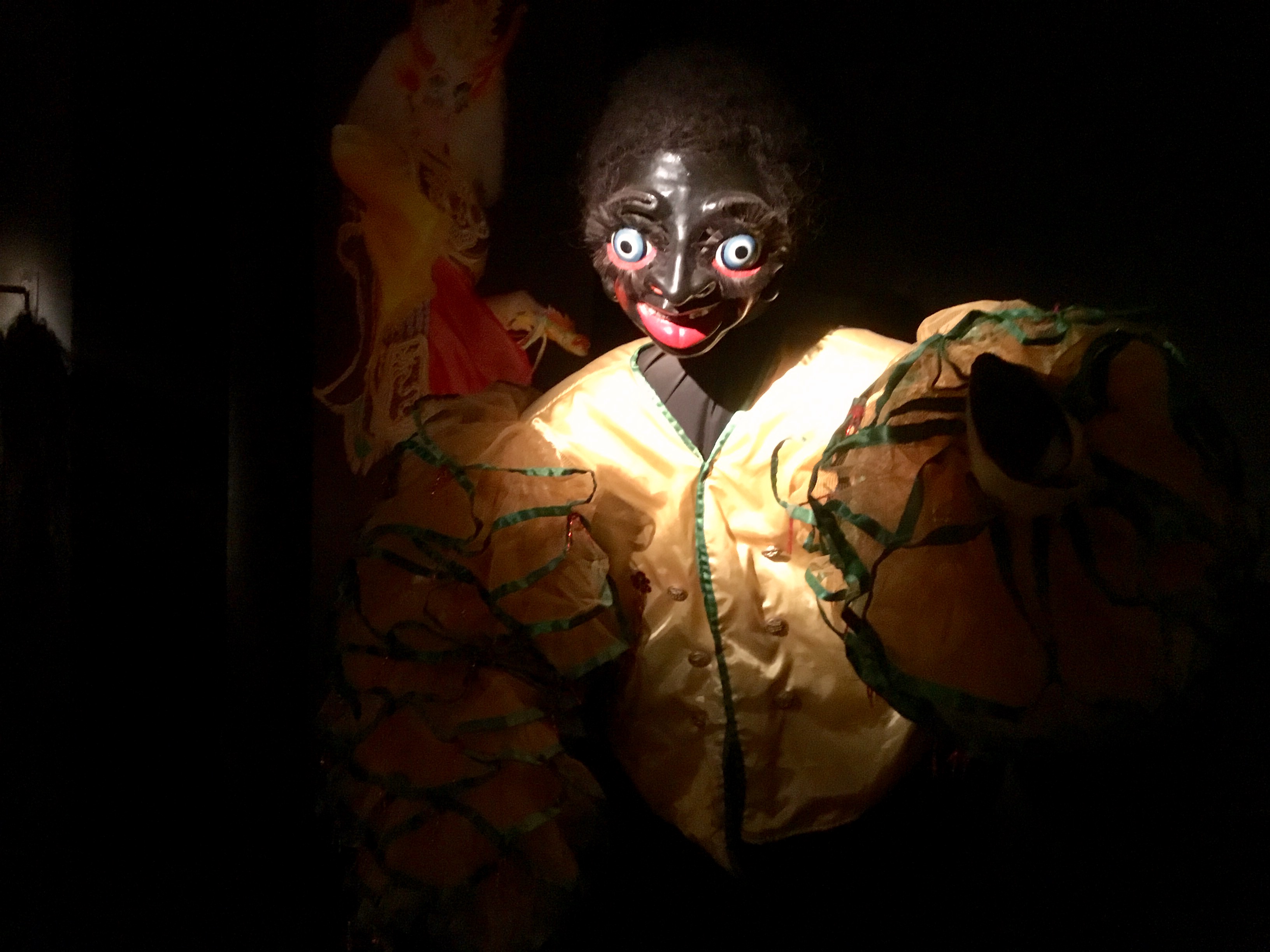
Source material for “Danzante”
* an ongoing series of quotations – mostly from artists, to artists – that offers wisdom, inspiration, and advice for the sometimes lonely road we are on.
“I need to be inspired by my own work,” he said. “There’s no point in being inspired by Picasso. It’s OK, but it doesn’t help you. If you’re an artist you have to thrive on what you do and believe in what you do and be obsessed by it.”
Roger Ballens quoted in A Puzzle with No Solution: Roger Ballen’s Quest for Meaning Through Photography, by Jordan G. Teicher, New York Times, April 24, 2018.
Comments are welcome!


 barbararachkoscoloreddust.com