Blog Archives
Q: Would you please share your current bio?

A: Here it is.
Barbara Rachko, born in 1953 in Paterson, New Jersey, is a contemporary painter based in New York City, renowned for her large pastel-on-sandpaper paintings inspired by Bolivian Carnival masks. With nearly 40 years dedicated to revolutionizing pastel as a fine art medium, Rachko’s influential blog, Barbara Rachko’s Colored Dust, has garnered over 229,000 subscribers. She is the subject of the acclaimed documentary “Barbara Rachko: True Grit,” available on YouTube, and her ebook “From Pilot to Painter” captures her inspiring journey from a former pilot to an accomplished artist.
Rachko’s work explores the vibrant cultural heritage of Bolivian Carnival masks, and Mexican and Guatemalan folk art. Her meticulous attention to detail is showcased in notable series such as Bolivianos, Black Paintings, and Domestic Threats. In 2023, she was featured in a documentary that premiered at the Newport Beach Film Festival, earning the Audience Award and Best in Category Award, further cementing her impact on contemporary art.
Her solo exhibitions include the Joy Pratt Markham Gallery at Walton Arts Center (AR), Louise Jones Brown Gallery at Duke University (NC), Olin Gallery (VA), and La MaMa La Galleria (NY). She trained in photography at the International Center of Photography in New York and studied drawing and pastel techniques at the Art League School in Alexandria, VA. Her works are held in private collections worldwide and have been showcased at prestigious art fairs, including Art Basel Miami, Moon Art Fair in Hamburg, and Art Busan in Korea, affirming her global influence in pastel painting.
Comments are welcome!
Q: Would you share a bit more about yourself? (Question from “Bold Journey”)

A: I am an American contemporary Master Pastel Artist who divides my time between residences in New York City and Alexandria, VA. I am best known for my pastel-on-sandpaper paintings, my eBook, “From Pilot to Painter,” and my popular blog, “Barbara Rachko’s Colored Dust,” which currently has more than 125,000 subscribers. I am proud to be represented by Apricus Art Collection (US), Art Client Services (US), Galleria Balmain (UK), Emillions (US), Interstellar (IN), and Galleri SoHo (SE). I am a member of the International Association of Visual artists.
I travel regularly to Mexico, Central America, South America, and Asia. Since 2017 I have been creating “Bolivianos,” a painting series based on an exhibition of Carnival masks I photographed at the Museum of Ethnography and Folklore in La Paz.
My life has been called “extraordinary and inspiring.” I learned to fly when I was 25 and became a Commercial Pilot and Boeing-727 Flight Engineer before joining the Navy. As a Naval Officer I spent many years working at the Pentagon and retired as a Commander. On 9/11 my husband Dr. Bryan Jack was killed onboard the plane that crashed into the Pentagon. Ever since that awful day, I have worked hard to overcome my husband’s tragic loss. Now I enjoy a thriving career as an internationally-known professional artist.
Comments are welcome!
Q: How do you work and approach your subject? (Question from “Arts Illustrated”)
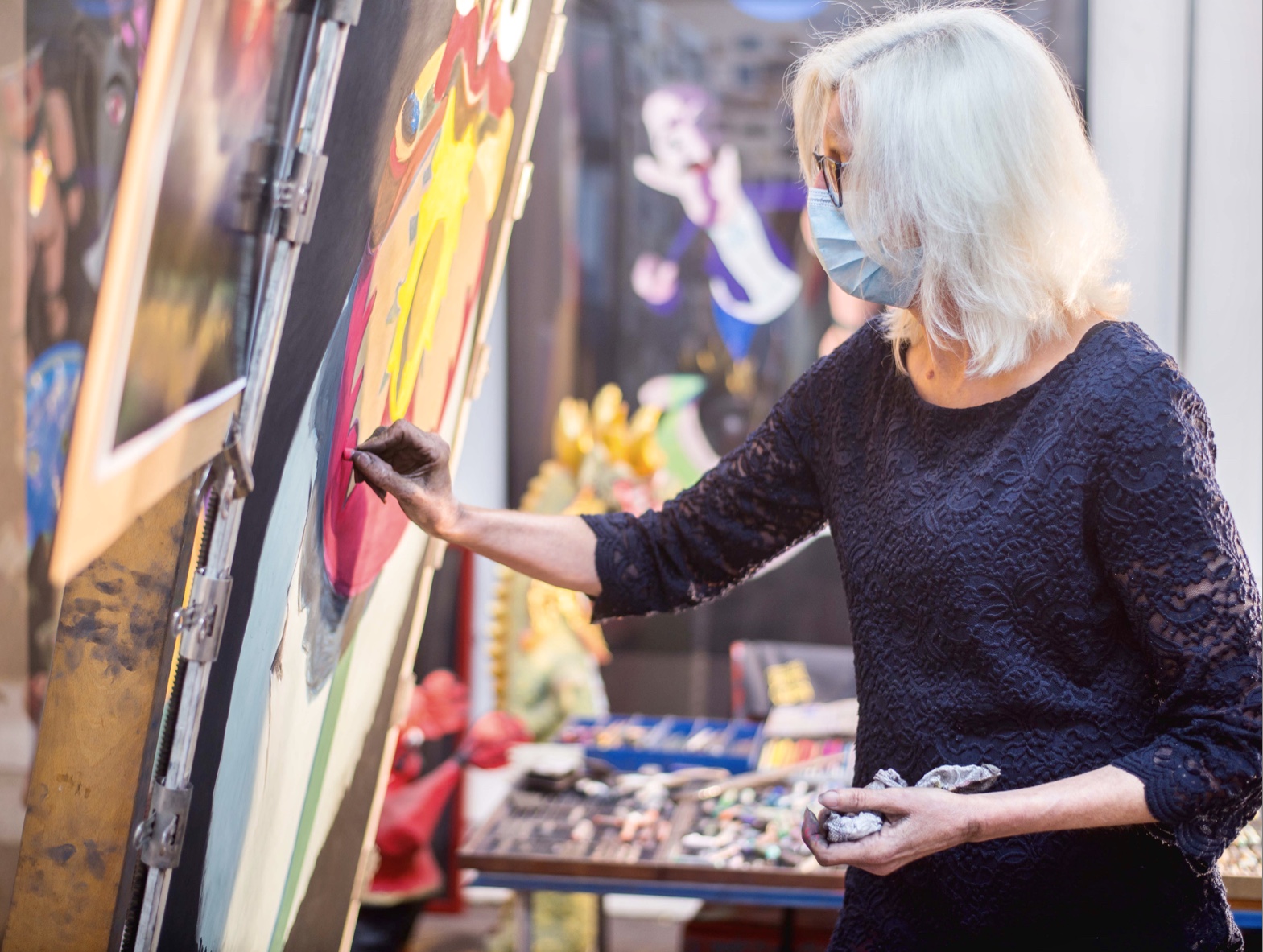
A: Undoubtedly, I could not make my work without UART sandpaper since my entire pastel technique evolved around it. I use 400 0r 500 grit. My favorite thing about it is its ‘tooth’ (i.e. texture or roughness).
Over the many months I spend creating a pastel painting, I build layer upon layer of soft pastel. Because the paper I use is relatively “toothy,” it accepts all of the pastel the painting needs. And as many people know, I own and use thousands of soft pastels!
Many layers of soft pastel and several months of studio time go into creating each painting. My self-invented technique is analogous to the glazing techniques used by the Old Masters, who slowly built up layers of thin oil paint to achieve a high degree of finish. Colors were not only mixed physically, but optically.
Similarly, I gradually build up layers of soft pastel, as many as thirty, to create a pastel painting. After applying a color, I blend it with my fingers and push it into the sandpaper’s tooth. It mixes with the color beneath to create a new color, continually adding richness, saturation, and intensity to the piece. By the time a pastel painting is finished, the colors are bold, vibrant, and exciting.
From the beginning in the 1980s I used photographs as reference material and my late husband, Bryan, would shoot 4” x 5” negatives of my elaborate setups with his Toyo-Omega view camera. In those days I rarely picked up a camera except when we were traveling. After Bryan was killed on 9/11, I inherited his extensive camera collection – old Nikons, Leicas, Graphlex cameras, etc. – and I wanted to learn how to use them. In 2002 I enrolled in a series of photography courses (about 10 over 4 years) at the International Center of Photography in New York. I learned how to use all of Bryan’s cameras and how to make my own big color prints in the darkroom.
Along the way I discovered that the sense of composition, form, and color I developed over many years as a painter translated well into photography. The camera was just another medium with which to express my ideas. Astonishingly, in 2009 I had my first solo photography exhibition in New York.
It’s wonderful to be both a painter and a photographer. Pastel painting will always be my first love, but photography lets me explore ideas much faster than I ever could as a painter. Paintings take months of work. To me, photographs – from the initial impulse to hanging a framed print on the wall – are instant gratification.
For several years I have been using my iPad Pro to capture thousands of travel photographs. Most recently, I visited Gujarat and Rajasthan in India. I have never been inclined to use a sketchbook so composing photos on my iPad keeps my eye sharp while I’m halfway around the world, far from my studio practice.
My blog, “Barbara Rachko’s Colored Dust,” continues to be a crucial part of my overall art practice. Blogging twice a week forces me to think deeply about my work and to explain it clearly to others. The process has helped me develop a better understanding about why I make art and, I like to think, has helped me to become a better writer.
Comments are welcome!
Q: Can you give us your current elevator pitch?
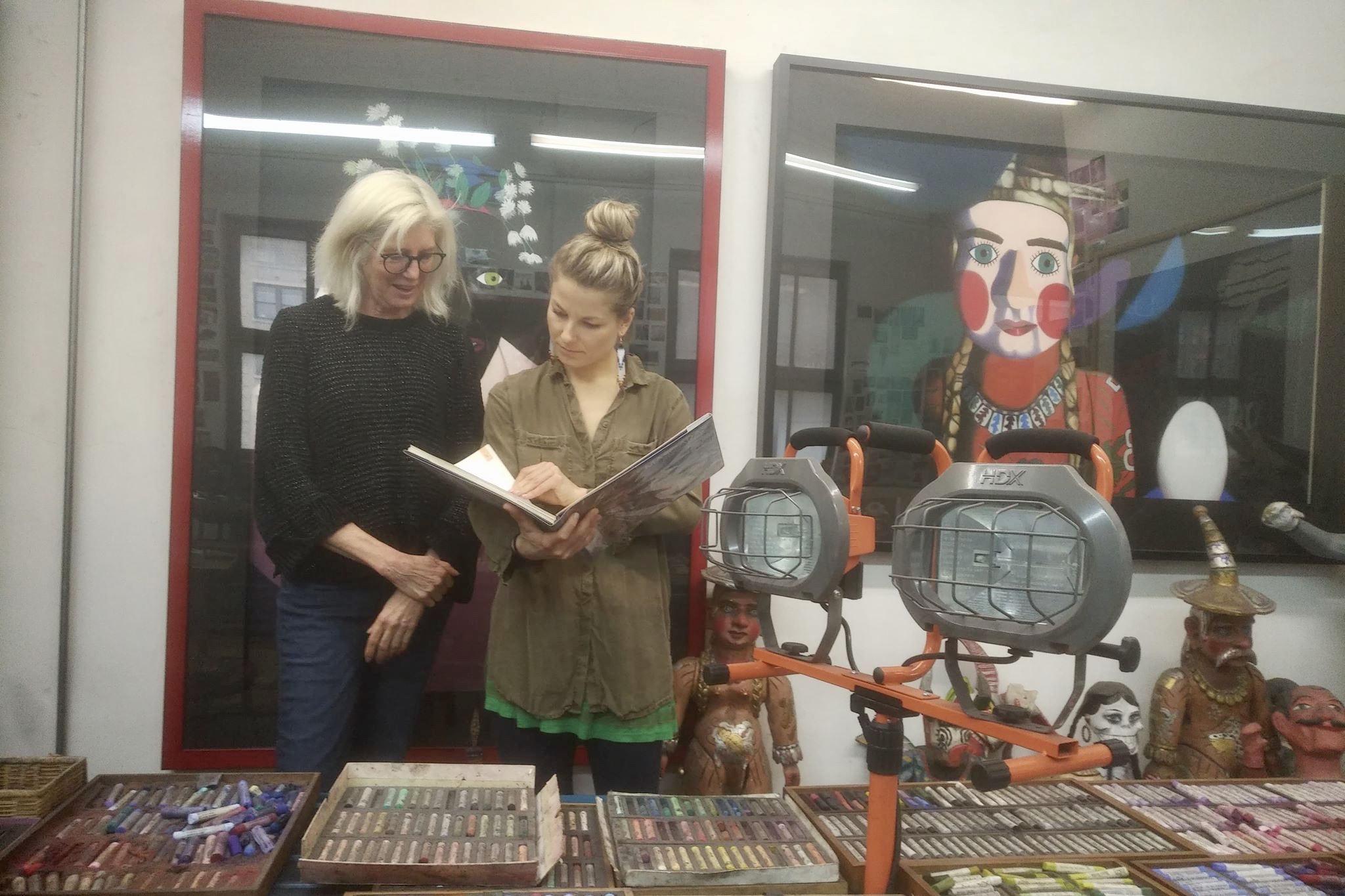
Discussing Bolivian masks with Nika, Photo: David De Hannay
A: Here it is:
I am a New York visual artist, blogger, and author. For thirty-four years I have been creating original pastel-on-sandpaper paintings that depict my large collection of Mexican and Guatemalan folk art – masks, carved wooden animals, papier mache figures, and toys. “Bolivianos,” my current series, is based on a mask exhibition I saw and photographed in La Paz in 2017 at the National Museum of Folklore and Ethnography.
My technique is self-invented and involves applying dozens of layers of soft pastel onto acid-free sandpaper to create new colors directly on the paper. Each pastel painting takes several months to complete. Typically, I make four or five each year. I achieve extraordinarily rich, vibrant color in pastel paintings that are a unique combination of reality, fantasy, and autobiography.
My background is unusual for an artist. I am a pilot, a retired Navy Commander, and a 9/11 widow. Besides making art, I am a published blogger and author best known for my popular blog, “Barbara Rachko’s Colored Dust” (53,000+ subscribers!) and my eBook, “From Pilot to Painter,” on Amazon and iTunes.
Please see images and more at http://barbararachko.art/en/
Comments are welcome!
Q: You are a multi-talented woman! Tell us about your book, “From Pilot to Painter,” and how writing, for you, compares to painting and photography. Which do you prefer?
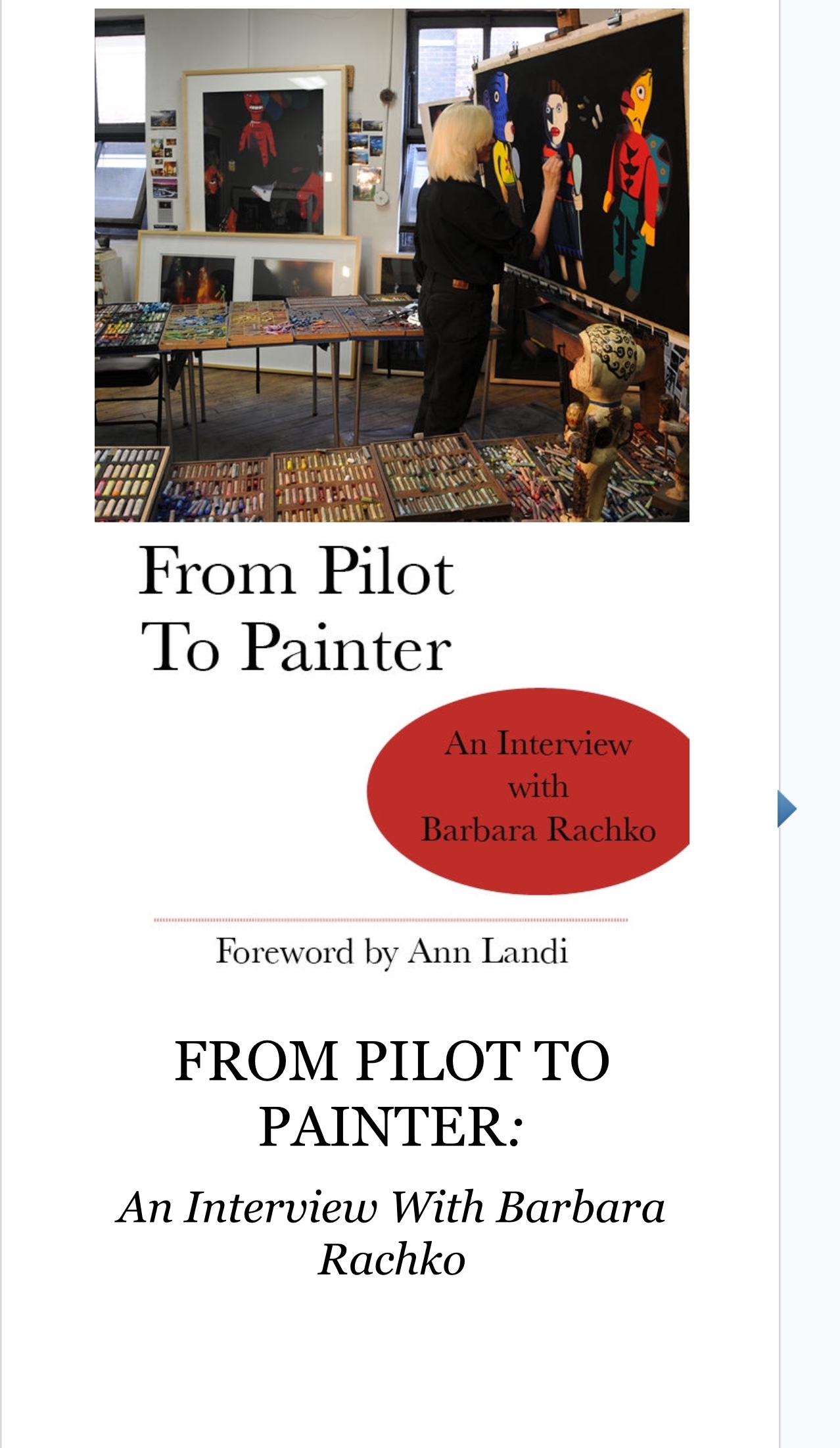
“From Pilot to Painter”
A: I am pleased that my eBook FROM PILOT TO PAINTER is available on Amazon and iTunes. It is based on my blog and is part memoir, including my personal loss on 9/11, insights into my creative practice, and intimate reflections on what it’s like to be an artist living in New York City now. The eBook includes new material not found on the blog, plus 25+ reproductions of my vibrant pastel-on-sandpaper paintings, a Foreword by Ann Landi (who writes for ARTnews and The Wall Street Journal), and more.
“Barbara Rachko’s Colored Dust” (the title of my blog) continues to be a crucial part of my overall art practice. Blogging twice a week forces me to think deeply about my work and to explain it clearly to others. The process has helped me develop a better understanding about why I make art and has encouraged me to become a better writer.
From the beginning in the 1980s I used photographs as reference material and Bryan would shoot 4” x 5” negatives of my elaborate setups with his Toyo-Omega view camera. In those days I rarely picked up a camera except when we were traveling. After Bryan was killed on 9/11, I inherited his extensive camera collection – old Nikons, Leicas, Graphlex cameras, etc. – and I wanted to learn how to use them. In 2002 I enrolled in a series of photography courses (about 10 over 4 years) at the International Center of Photography in New York. I learned how to use all of Bryan’s cameras and how to make my own big color prints in the darkroom. Along the way I discovered that the sense of composition, form, and color I developed over many years as a painter translated well into photography. The camera was just another medium with which to express my ideas. Astonishingly, in 2009 I had my first solo photography exhibition in New York.
It’s wonderful to be both a painter and a photographer. Pastel painting will always be my first love, but photography lets me explore ideas much faster than I ever could as a painter. Paintings take months of work. To me, photographs – from the initial impulse to hanging a framed print on the wall – are instant gratification.
For two years I have been using my iPad Pro to capture thousands of travel photographs. Most recently, I visited Gujarat and Rajasthan in India. I have never been inclined to use a sketchbook so composing photos on my iPad keeps my eye sharp while I’m halfway around the world, far from my studio practice.
Comments are welcome!


 barbararachkoscoloreddust.com