Blog Archives
Pearls from artists* # 659

*an ongoing series of quotations – mostly from artists, to artists – that offers wisdom, inspiration, and advice for the sometimes lonely road we are on.
Your only goal is to be the purest and strongest version of yourself, and to articulate that as fully as possible through your creations. Avoid any enticements that threaten to eclipse the priority of your work, to lure you off in another direction toward a different goal. You are here to spend a lifetime exploring and refining what excites you.
Like Olympic athletes, trailblazing artists do not waste a second looking around at their competition to measure how they are doing. They do not look to the sidelines to measure their applause. They just keep moving forward, in the focused direction of their vision. When you possess a quiet, solid confidence and you are completely unshaken (not even a twitch) when someone looks at your work and says, ‘I don’t really like it,’ you have arrived. If you are not there yet, keep practicing. The opinions of others are simply the ever-shifting clouds, moving across your infinite azure sky.
Kate Kretz in Art From Your Core: A Holistic Guide to Visual Voice
Comments are welcome!
Pearls from artists* # 635

Dinard, Brittany, France
*an ongoing series of quotations – mostly from artists, to artists – that offers wisdom, inspiration, and advice for the sometimes lonely road we are on.
The body of writing takes a thousand different forms,
and there is no right way to measure.
Changing, changing at the flick of a hand, its various
forms are difficult to capture.
Words and phrases compete with one another, but the
mind is still master.
Caught between the unborn and the living, the writer
struggles to maintain both depth and surface.
He may depart from the square, he may overstep the
circle, searching for the one true form of his reality.
He would fill the eyes of his readers with splendor, he
would sharpen the mind’s values.
The one whose language is muddled cannot do it;
only when mind is clear can language be noble.
Lu Chi quoted in Free Play: Improvisation in Art and Life by Stephen Nachmanovitch
Comments are welcome!
Pearls from artists* # 611
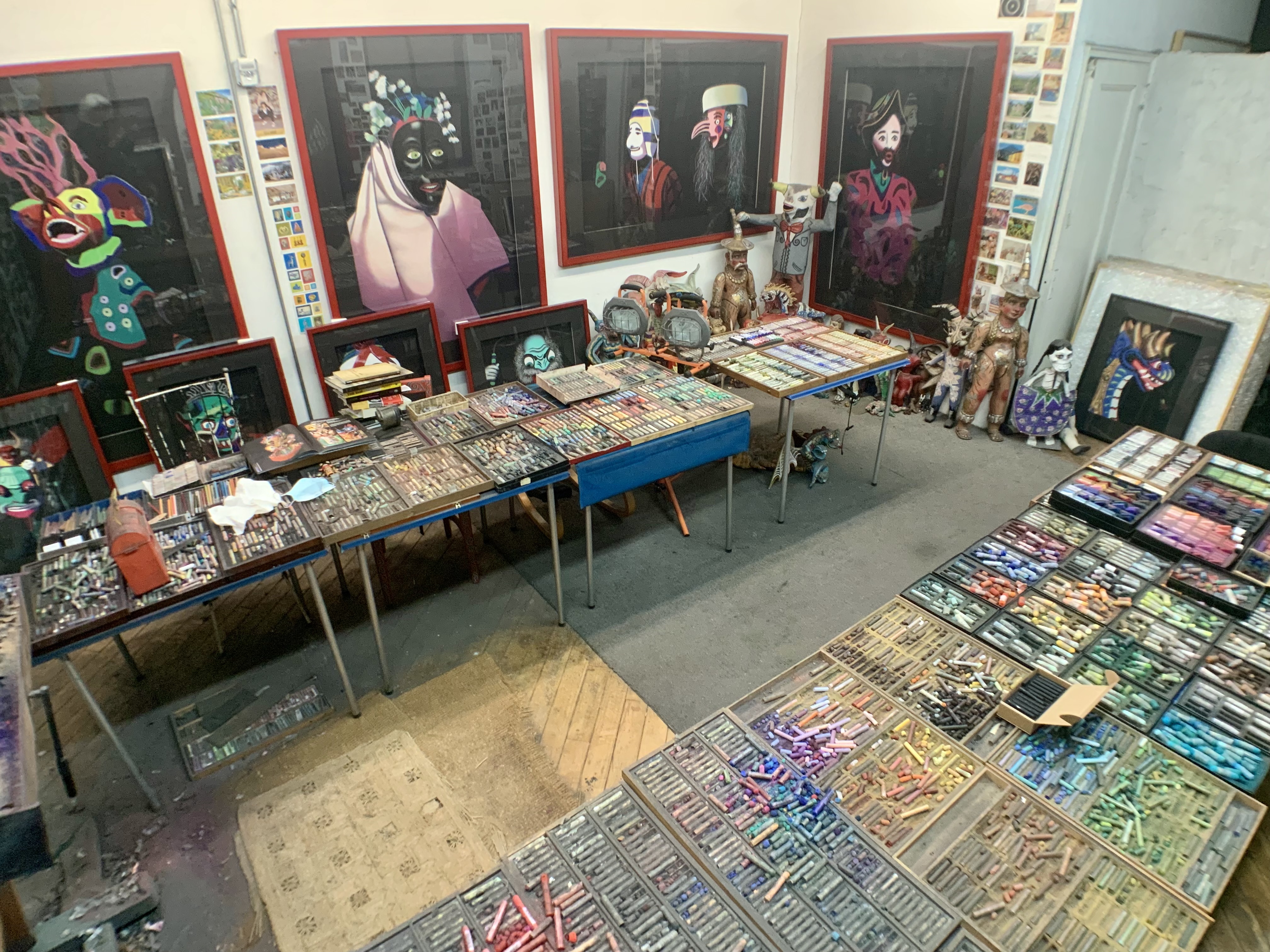
Barbara’s Studio
*an ongoing series of quotations – mostly from artists, to artists – that offers wisdom, inspiration, and advice for the sometimes lonely road we are on.
This common participation in the Trinity of Line, Form, and Color has founded a promiscuous fellowship which, while promoting the respect for skill, promotes to a far greater degree the misunderstanding of art. For skill in itself is but a sleight of hand. In a work of art one does not measure its extent but counts himself happiest when he is unaware of its existence in the contemplation of the result. Among those who decorate our banks and hotels you will find many who can imitate the manner of any master, living or dead, far better than the master could imitate himself, but they have no more knowledge of his soul than they have knowledge of their own. We will know how little skill avails, how ineffective are its artifices in filling the lack of true artistic motivation. His “less is more,” is Robert Browning’s famous evaluation of this problem in comparing the imperfections of Raphael’s art to the impecability of Del Sarto’s, “I should rather say that it will be more difficult to improve the mind of the master who makes such mistakes than to repair the work he has spoilt,” Leonardo wrote. Neither Giotto nor Goya exhibited half the skill of Coreggio or Sargent, either in the complexity of their undertaking or the apparent virtuosity of execution. The artist must have the particular skill to achieve his particular ends. If he has more, we are fortunate not to know it, for the exhibition of excess would only mar his art. You may be sure that the artist whose method is muddled betrays less his technical inadequacy than the incoherence of his own intentions.
Mark Rothko in The Artist’s Reality: Philosophies of Art
Comments are welcome!
Pearls from artists* # 610
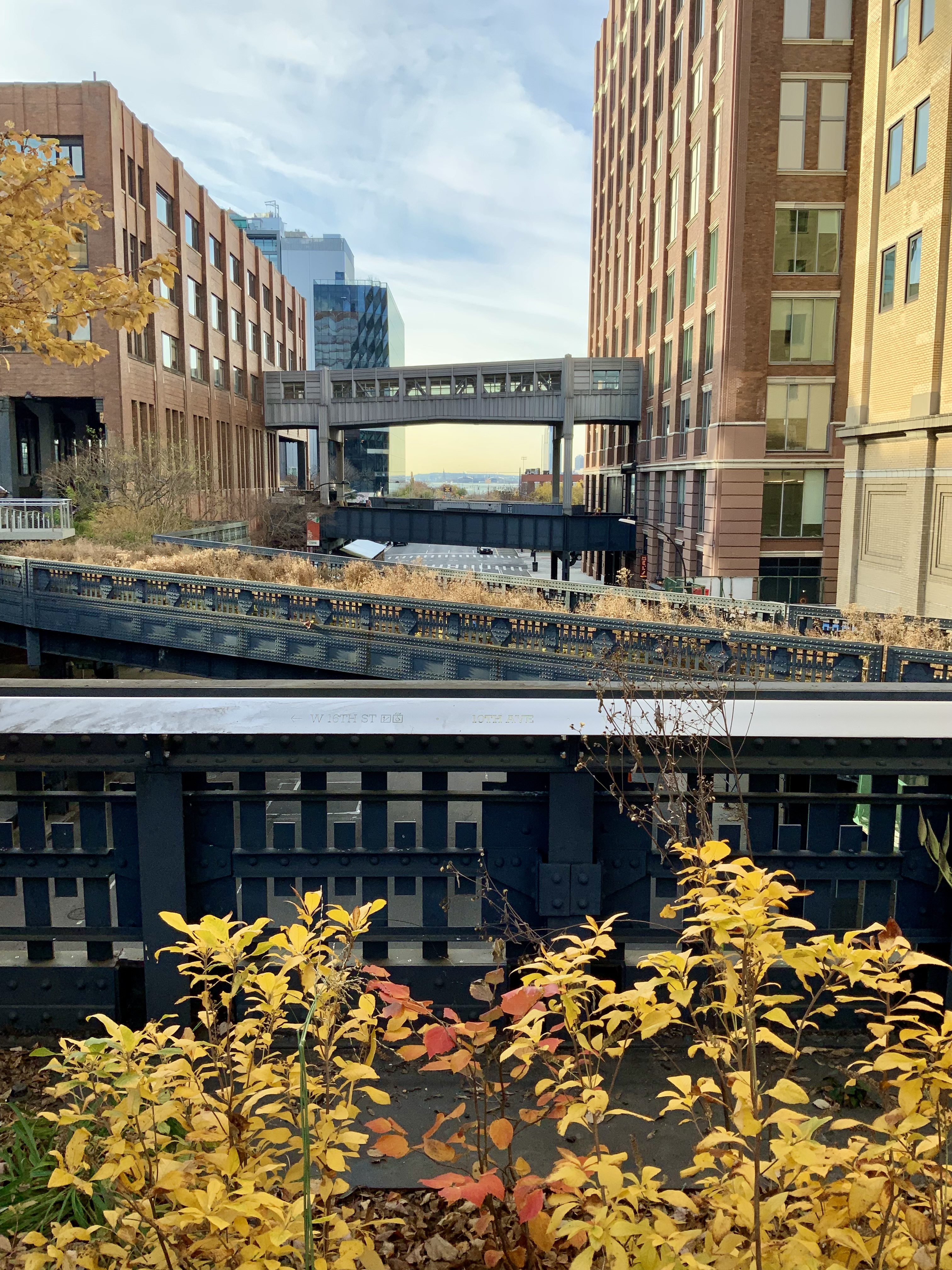
View from the High Line, New York NY
*an ongoing series of quotations – mostly from artists, to artists – that offers wisdom, inspiration, and advice for the sometimes lonely road we are on.
Just as the restless, committed, curious, and perhaps obsessed explorer follows the river from bend to bend, shooting rapids and pulling himself out of the water, so the self-dedicated artist launches himself on an exploratory art journey. He judges which fork in the river he will take, when he will rest and when he will push on, who he will take with him or whether he will travel alone. While he doesn’t possess unlimited freedom as he journeys, bound as he is by the demands of his personality, by his time and place, and by circumstances beyond his control, he does possess unrestricted permission from himself to explore every available avenue.
The contemporary artist must especially direct and trust himself because he lives in a constantly changing art environment. … as Pablo Picasso put it, “Beginning with Van Gogh we are all in a measure, autodidacts.” Painters no longer live within a tradition and so each of us must create an entire language.
Eric Maisel in A Life in the Arts: Practical Guidance and Inspiration for Creative and Performing Artists
Comments are welcome!
Pearls from artists* # 562

“Shadow,” soft pastel on sandpaper, 26” x 20,” in progress
*an ongoing series of quotations – mostly from artists, to artists – that offers wisdom, inspiration, and advice for the sometimes lonely road we are on.
Jung observed that complexes could affect groups of people en masse. He saw that certain moments seemed to be expressions of a collective shadow, a bursting forth of a mass psychosis; the repressed side of a whole group coming alive; a tribal Mr. Hyde. He saw this madness first-hand in Germany in the 1930s and wrote about it. But every era carries some measure of collective shadow.
One could argue that no moment in time has seen more of the reality of human darkness than ours. Having witnessed the Holocaust and faced the threat of nuclear war in the twentieth century, and now facing the environmental impact of fossil fuels and plastics in the twenty-first century, we are undoubtedly aware of more of humanity’s potential for destruction than any of our ancestors ever were. Such a view does not come from a moralizing stance. Our era has made forced witnesses of us all.
The shadow is about where we put the Devil – where do we allow darkness to be housed? Racism and bigotry offer the relief of foisting our group’s shadow onto another whom we view as lesser. Doing so enables us not to look at or feel our shadow, and not see our own worst selves. But this collective shadow of our modern culture is also bigger and wider than group-to-group projections. There are culture-wide or civilization expressions of the collective shadow.
Jung saw the widespread loss of connection to the inner life and to a lived spirituality as one of the primary illnesses of our time. He observed that people were no longer animated by the traditional religions… For Jung, this meant that we’ve lost the old way but not yet found the new, and are sitting in a spiritual vacuum.
Into that vacuum, without our awareness, has slipped our fascination with human technology. Observe people closely today and you’ll notice that we have an almost magical faith in our devices. People see their computers and phones as all-knowing and expect them to function perfectly all the time, and view pharmaceuticals as magic cure-alls. Where we used to put God, we now have put technology. Where spirit was, we have unconsciously placed human genius.
Gary Bobroff in Carl Jung: Knowledge in a Nutshell
Comments are welcome!
Pearls from artists* # 556
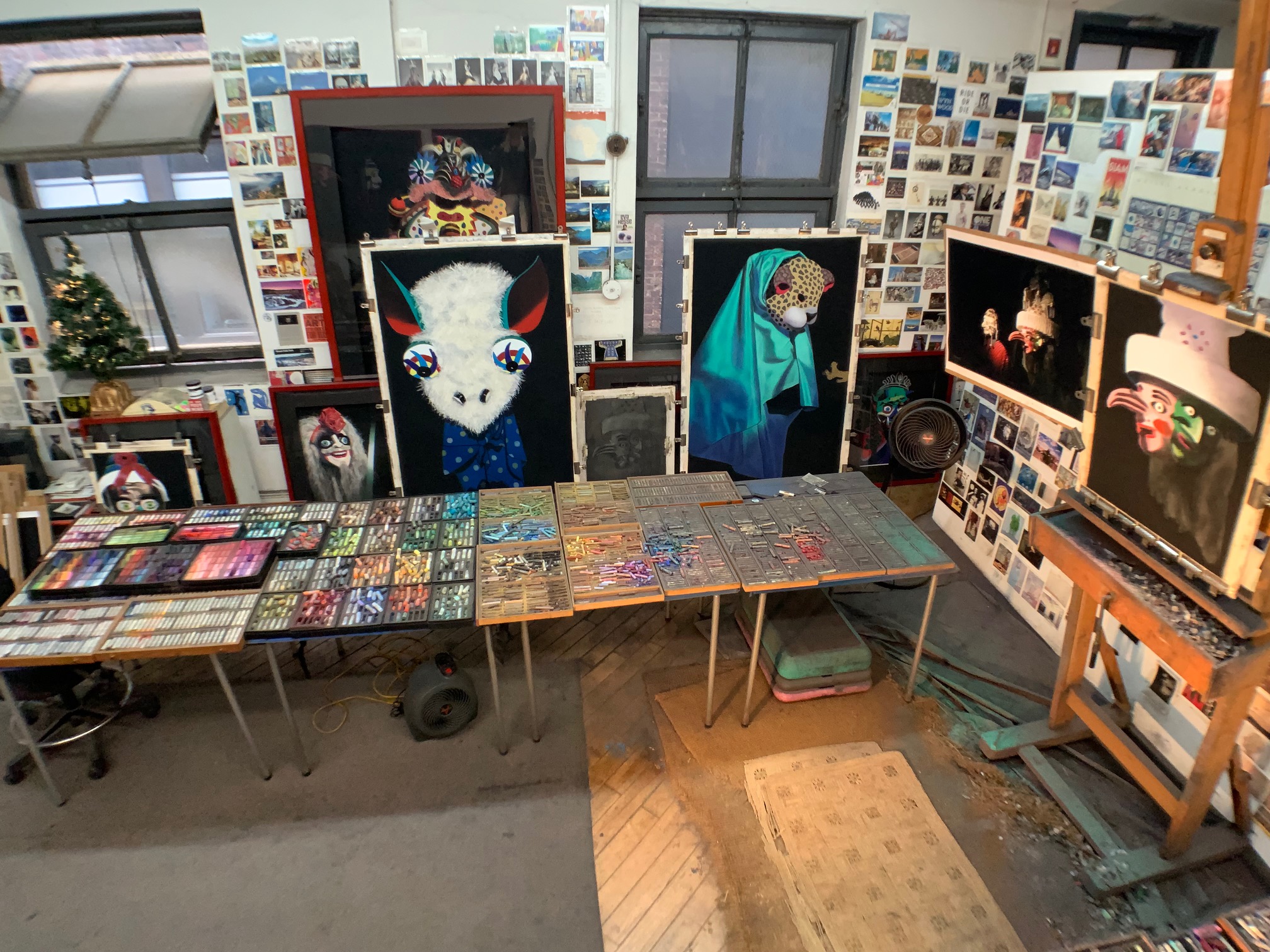
Barbara’s Studio
*an ongoing series of quotations – mostly from artists, to artists – that offers wisdom, inspiration, and advice for the sometimes lonely road we are on.
The painter Paul Klee exclaimed in his diary, “Am I God? I have accumulated so many great things in me!” But we also remember these other words of Klee… “He who strives will never enjoy this life peacefully.” The lucky artist may be the one who, while in human measure a god, has nevertheless found satisfactory ways of escaping the relentless firing of his synapses.
Eric Maisel in A Life in the Arts: Practical Guidance and Inspiration for Creative and Performing Artists
Comments are welcome!
Q: How do you determine what size to make your pastel paintings? (Question from Prince North via Facebook)

A: For three decades I have been making pastel paintings in two sizes: 26” x 20” and 58” x 38.” These sizes are dictated by practical considerations.
The smaller ones are because 28” x 22” sheets of acid-free sandpaper are what’s available. (I mask off an inch all around for mats so the paintings are 20″ x 26″). For large paintings I buy rolls of acid-free sandpaper that measure 54 inches wide by 30 feet. I cut this down to 40″ x 60″ for paintings and mask off an inch all around on these, too.
And why specifically make them 58” x 38”? This is the absolute largest size I can make and I prefer making big paintings!
Again, practical factors come into play: the size of my truck, the cost and size of mat board, and the weight of the frames.
My pastel paintings need to lie flat when they are moved. Framed paintings are 70” x 50,” the largest size that can fit flat in the back of my Ford F-150. 58” x 38” is the largest size that will fit in a 8 feet by 4 feet sheet of mat board. (60 inch wide mat board is available, but the cost goes up considerably). Lastly, I’ve never weighed them but my large framed paintings are already rather heavy. It takes two people to carry them.
Comments are welcome!
Pearls from artists* # 504

* an ongoing series of quotations – mostly from artists, to artists – that offers wisdom, inspiration, and advice for the sometimes lonely road we are on.
… if a project doesn’t work out, you can always think of it as having been a worthwhile and constructive experiment. You can resist the seductions of grandiosity, blame, and shame. You can support other people in their creative efforts, acknowledge the truth that there’s plenty of room for everyone. You can measure your worth by your dedication to your path, not by your successes or failure. You can battle your demons (through therapy, recovery, prayer, or humility) instead of battling your gifts – in part by realizing that your demons were never the ones doing the work, anyhow. You can believe that you are neither a slave to inspiration nor its master, but something far more interesting – its partner – and that the two of you are working together toward something intriguing and worthwhile. You can live a long life, moving and doing really cool things the entire time. You might earn a living with your pursuits or you might not, but you can recognize that this is not really the point. And at the end of your days, you can thank creativity for having blessed you with a charmed, interesting, passionate existence.
Elizabeth Gilbert in Big Magic: Creative Living Beyond Fear
Comments are welcome!
Pearls from artists* # 436
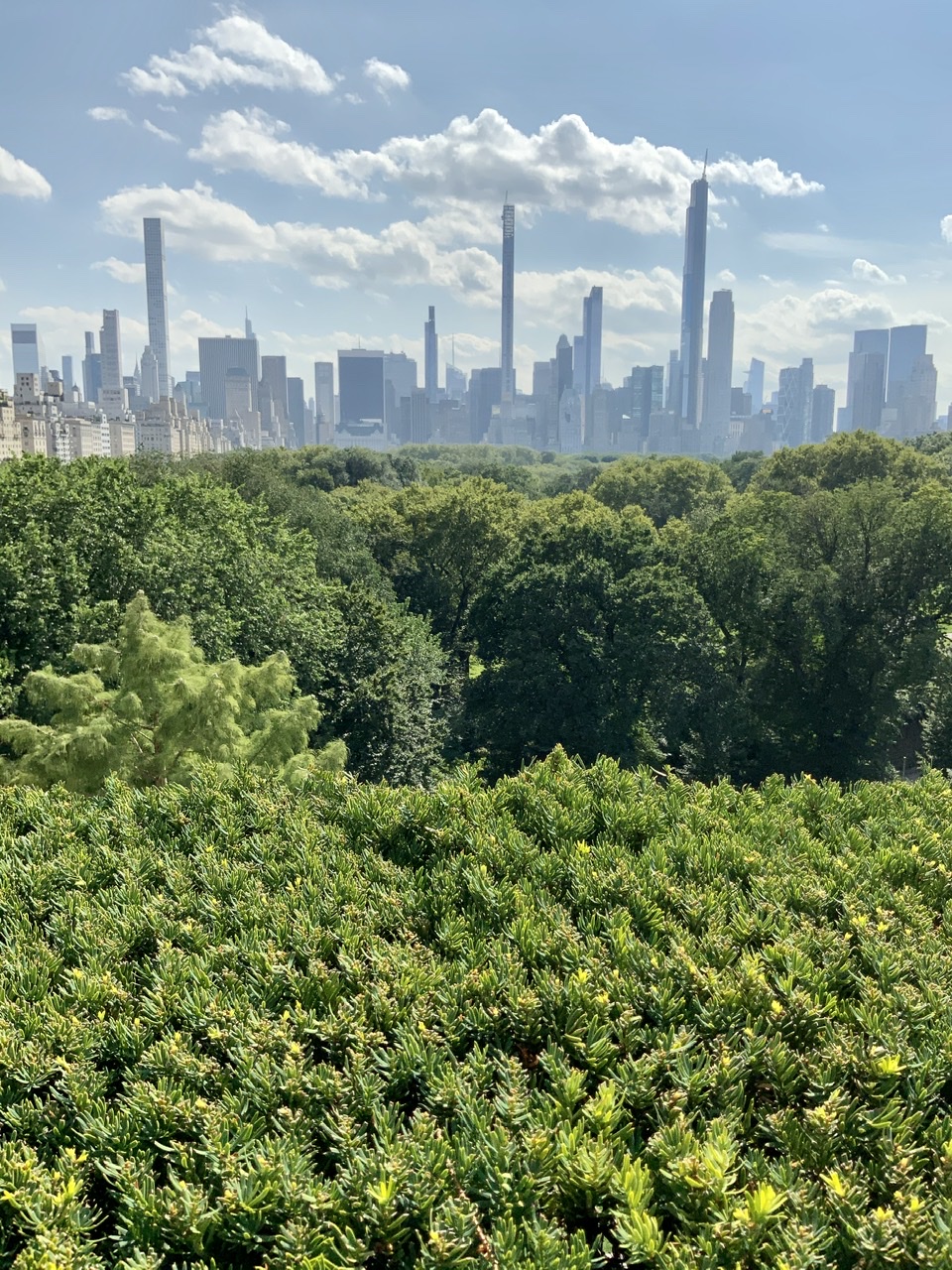
View from the roof of the Metropolitan Museum of Art, New York
*an ongoing series of quotations – mostly from artists, to artists – that offers wisdom, inspiration, and advice for the sometimes lonely road we are on.
Cassirer’s partial definition of art as symbolic language has dominated art studios in our [20th] century. A new history of culture anchored upon the work of art as a symbolic expression thus came into being. By these means art has been made to connect with the rest of history.
But the price has been high, for while studies of meaning received all our attention, another definition of art, as a system of formal relationships, thereby suffered neglect. This other definition matters more than meaning. In the same sense speech matters more than writing, because speech preceded writing, and because writing is but a special case of speech.
The other definition of art as form remains unfashionable, although every thinking person will accept it as a truism that no meaning can be conveyed without form. Every meaning requires a support, or a vehicle, or a holder. These are the bearers of meaning, and without them no meaning would cross from me to you, or from you to me, or indeed from any part of nature to any other part.
… The structural forms can be sensed independent of meaning. We know from linguistics in particular that the structural elements undergo more or less regular evolutions in time without relation to meaning, as when certain phonetic shifts in the history of cognate languages can be explained only by a hypothesis of regular change. Thus phoneme a occurring in an early stage of language, becomes phoneme b at a later stage, independently of meaning, and only under the rules governing the phonetic structure of the language. The regularity of these changes is such that the phonetic changes can be used to measure durations between recorded but undated examples of speech.
Similar regularities probably govern the formal infrastructure of every art. Whenever symbolic clusters appear, however, we see interferences that may disrupt the regular evolution of the formal system. An interference from visual images is present in almost all art. Even architecture, which is commonly thought to lack figural intention, is guided from one utterance to the next by the images of the admired buildings of the past, both far and near in time.
George Kubler in The Shape of Time: Remarks on the History of Things
Comments are welcome!
Q: Would you talk about how the Judas figures you depict in your pastel paintings function in Mexico?
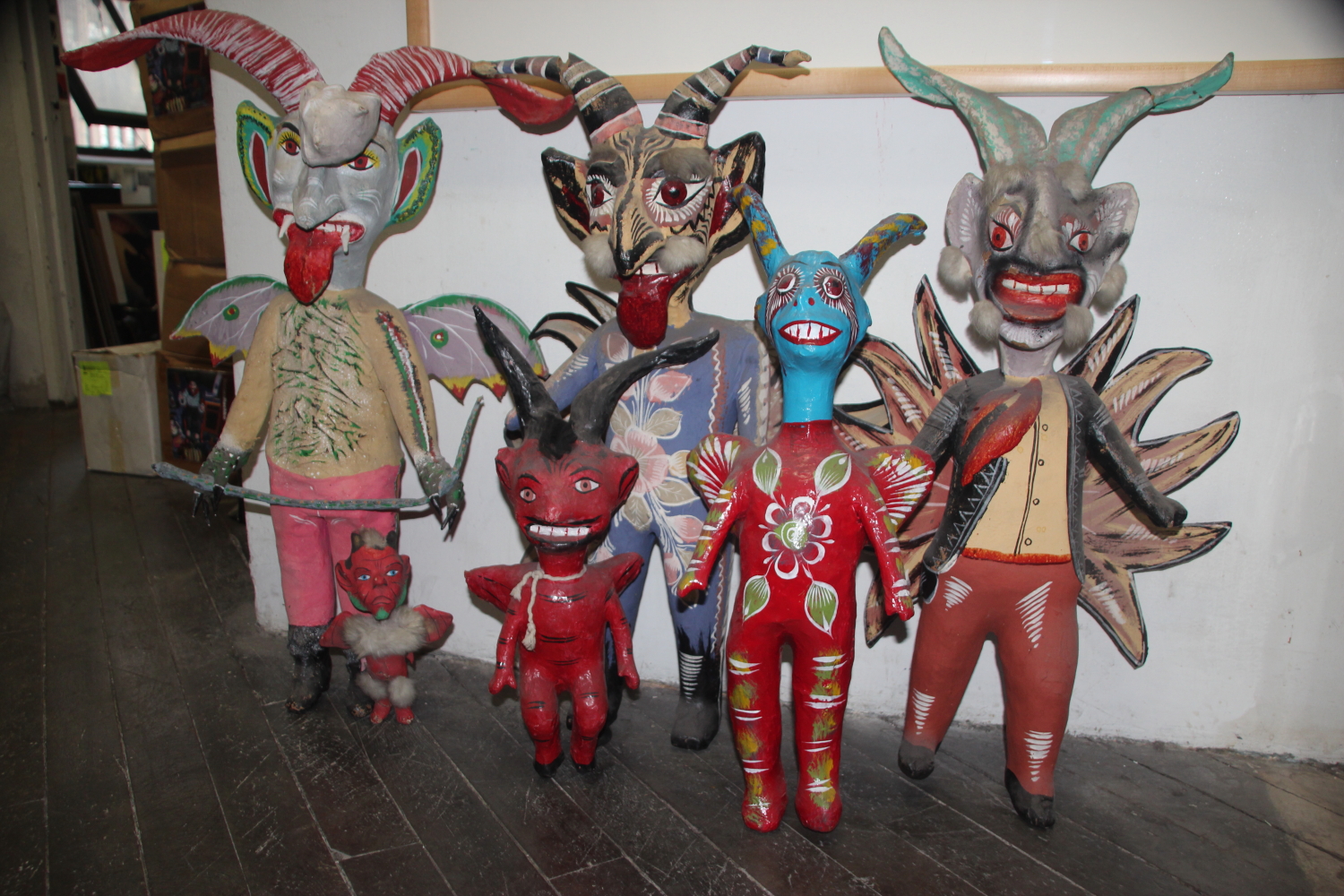
Some Judases
A: Here’s a good explanation from a website called “Mexican Folk Art Guide”:
“La quema de Judas or the Judas burning in Mexico is a celebration held on Sabado de Gloria (Holy Saturday). Papier mache figures symbolizing Judas Iscariot stuffed with fireworks are exploded in local plazas in front of cheerful spectators.
The Judases exploded in public spaces can measure up to 5 meters, while 30 cm ones can be found with a firework in their back to explode at home.
In Mexico la quema de Judas dates from the beginning of the Spanish colony when the Judas effigies were made with hay and rags and burned. Later as paper became available and the fireworks techniques arrived, thanks to the Spanish commerce route from the Philippines, the Judases were made out of cardboard, stuffed with fireworks, and exploded.
After the Independence War the celebration lost its religious character and became a secular activity. The Judas effigies were stuffed with candies, bread, and cigarettes to attract the crowds into the business [establishment] that sponsored the Judas.
Judas was then depicted as a devil and identified with a corrupt official, or any character that would harm people. In 1849 a new law stipulated that it was forbidden to relate a Judas effigy with any person by putting a name on it or dressing it in a certain way to be identified with a particular person.”
This is why whenever I bring home a Judas figure from Mexico, I feel like I have rescued it from a fire-y death!
Comments are welcome!


 barbararachkoscoloreddust.com