Blog Archives
Q: The first pastel painting you see every morning when you arrive at your studio is “Myth Meets Dream.” It must have special meaning. Would you elaborate? (Question suggested by Marlissa Gardner via Facebook)

A: “Myth Meets Dream,” an early pastel painting from the “Domestic Threats” series, is one I have never wanted to sell. It marks the first time I included Mexican folk art figures in my work. In 1992 as a Christmas present, my future sister-in-law sent the two Oaxacan painted wooden figures you see depicted above – the blue winged creature and the red, white, and black figure behind it. The other three figures in this painting are hand-puppets.
Previously, I had been creating elaborate staged photographs in my Alexandria house using stuffed animals and hand-puppets. (The latter were made by a company called “Folk Tails”). I used the photos as reference material for pastel paintings. In other words, rather than work exclusively from life, I mostly looked at these photos while I made the painting. Although I have simplified my process since those early days, I still create pastel paintings using reference photographs.
In “Myth Meets Dream” you can see both puppets and my then new Oaxacan folk art figures. This pastel painting marks an important transition in subject matter and was the start of decades-worth of foreign travel, study, adventure, hard work, and yes, fun. It’s true that “Myth Meets Dream” hangs in my studio and is the first thing I see every morning. It brings back so many precious memories.
Every painting has a story!
If you’re interested to learn more, please see https://barbararachko.art/en/art-market
Comments are welcome!
Q: Would you talk about how the Judas figures you depict in your pastel paintings function in Mexico?
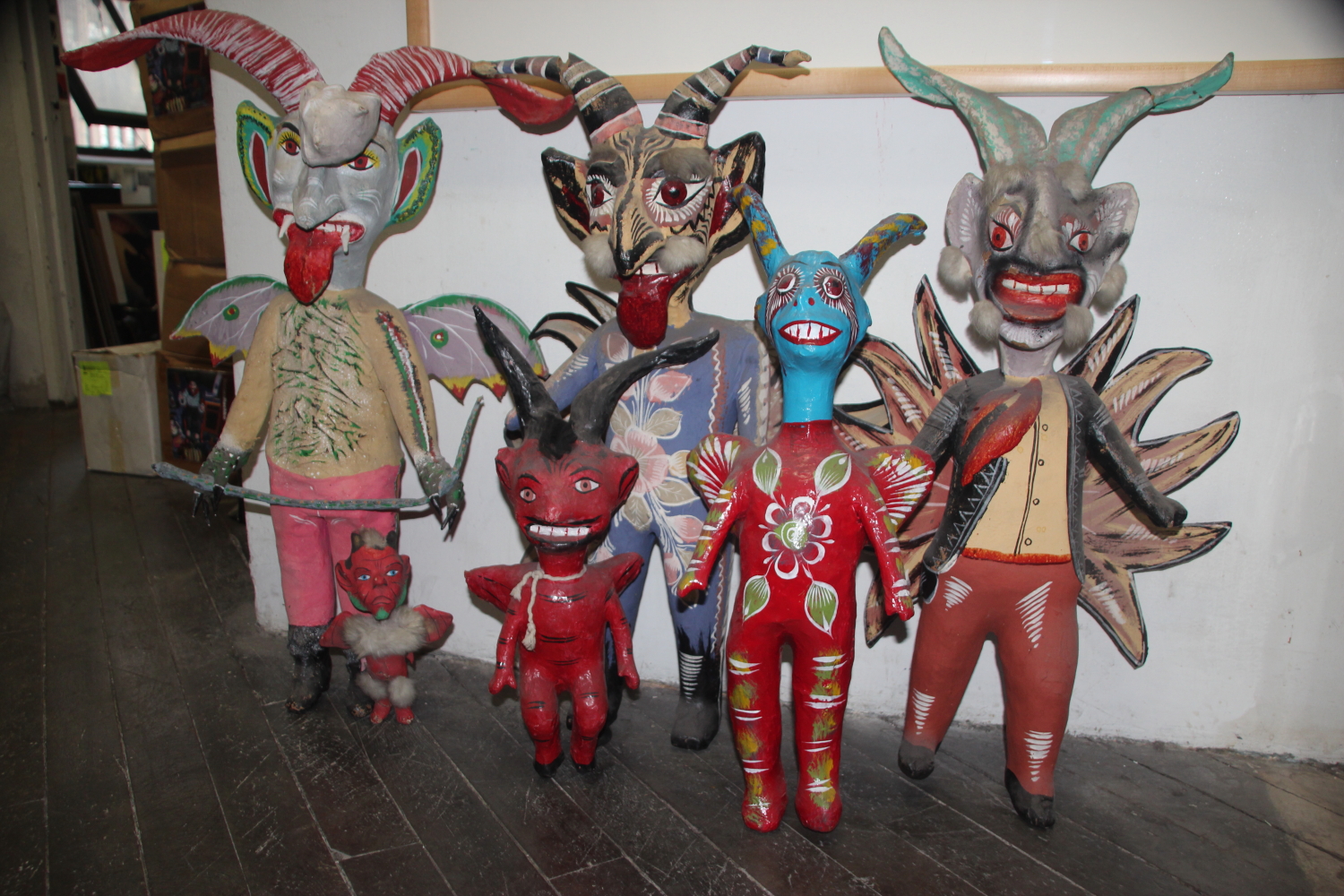
Some Judases
A: Here’s a good explanation from a website called “Mexican Folk Art Guide”:
“La quema de Judas or the Judas burning in Mexico is a celebration held on Sabado de Gloria (Holy Saturday). Papier mache figures symbolizing Judas Iscariot stuffed with fireworks are exploded in local plazas in front of cheerful spectators.
The Judases exploded in public spaces can measure up to 5 meters, while 30 cm ones can be found with a firework in their back to explode at home.
In Mexico la quema de Judas dates from the beginning of the Spanish colony when the Judas effigies were made with hay and rags and burned. Later as paper became available and the fireworks techniques arrived, thanks to the Spanish commerce route from the Philippines, the Judases were made out of cardboard, stuffed with fireworks, and exploded.
After the Independence War the celebration lost its religious character and became a secular activity. The Judas effigies were stuffed with candies, bread, and cigarettes to attract the crowds into the business [establishment] that sponsored the Judas.
Judas was then depicted as a devil and identified with a corrupt official, or any character that would harm people. In 1849 a new law stipulated that it was forbidden to relate a Judas effigy with any person by putting a name on it or dressing it in a certain way to be identified with a particular person.”
This is why whenever I bring home a Judas figure from Mexico, I feel like I have rescued it from a fire-y death!
Comments are welcome!



Pearls from artists* # 706
Jun 10
Posted by barbararachkoscoloreddust
Carnival mask, MUSEF La Paz, Bolivia
*an ongoing series of quotations – mostly from artists, to artists – that offers wisdom, inspiration, and advice for the sometimes lonely road we are on.
Several observers have commented that Saint Michael seems “pallid and emasculated” compared to the fearsome devils that oppose him. During the dancing that filled the parade ground immediately before and after the play’s performance, Michael was visually outshone and vastly outnumbered. While a few archangels danced up and down in pink and white, hundreds of devils cavorted in a wild array of colors splashed liberally across their high boots, skintight trousers, beaded capes and tunics, long wigs, and monstrous masks. Their masks are among the most complex headpieces in the festive world: “bulging, billiard-ball eyes studded with bright artificial stones and huge grinning silver teeth, hideously pointed, leer grotesquely out of an exuberant triangle of horns and ears and tusks, painted in a wild cacophony of colors, and crowned by a three-headed viper or other misshapen reptile.” Some masks are crowned with whole stuffed condors. No two masks are alike. Dancing alongside the devils, a number of China Supays provocatively swing their hips and twirled their skirts. The odds were stacked against the virtuous archangel. The audience’s eyes were on the devil’s masks and the China Supay’s thighs. Winning the aesthetic war in performance is a common folk means of challenging an officially scripted defeat.
Max Harris in Carnival and Other Christian Festivals: Folk Theology and Folk Performance
Comments are welcome!
Share this:
Posted in 2026, Bolivia, Inspiration, Pearls from Artists, Quotes
Comments Off on Pearls from artists* # 706
Tags: aesthetic, against, alongside, archangel, artificial, audience, “Carnival and Other Christian Festivals: Folk Theology and Folk Performance”, beaded, billiard-ball, Bolivia, bulging, cacophony, Carnival mask, cavorted, challenging, China Supay, colors, commented, common, compared, complex, condors, crowned, danced, dancing, defeat, devils, emasculated, exuberant, fearsome, festive, filled, grinning, grotesquely, headpieces, hideously, hundreds, immediately, liberally, Max Harris, misshapen, monstrous, MUSEF La Paz, number, observers, officially, oppose, other, outnumbered, outshone, painted, pallid, parade ground, performance, pointed, provocatively, reptile, Saint Michael, scripted, several, silver, skintight, skirts, splashed, stacked, stones, studded, stuffed, thighs, three-headed, triangle, trousers, tunics, twirled, vastly, virtuous, visually, winning