Blog Archives
Pearls from artists* # 664

*an ongoing series of quotations – mostly from artists, to artists – that offers wisdom, inspiration, and advice for the sometimes lonely road we are on.
Throughout history, geniuses have attributed their breakthroughs to the time they spent alone, deep in thought. Frank Kafka assures us,
‘You need not leave your room. Remain sitting at your table and listen. You need not even listen, simply wait. You need not even wait, just learn to become quiet, and still, and solitary. The world will freely offer itself to you to be unmasked. It has no choice; it will roll in ecstasy at your feet.’
Artists have a special relationship with the passing hours. Our work is tangible evidence of how we mark and give value to time. We have a finite, unknown number of hours on Earth, so we will only leave behind so many pieces. Our artistic legacy is literally tied to our ability to steal time and maintain silence.
And yet, we exist in a time and place with a tremendous aversion to peace. We must fight both ourselves and others to acquire it. No one asked us if this is the kind of environment we want to inhabit. Corporations inundate every square inch of space with uninvited visual and auditory interference, designed to light up the addiction pleasure centers in our brains. Our ancestors would have found this environment assaulting and maddening. It is certainly causing damage to our mental health, happiness, and creativity. But, it is so ubiquitous that there is pressure to simply accept the anxiety-producing ‘new normal’: we have collectively surrendered our brain space to the colonization.
Kate Kretz in Art From Your Core: A Holistic Guide to Visual Voice
Comments are welcome!
Q: When did you begin drawing and painting? (Question from “Cultured Focus Magazine”)

A: This is a long story because my path to becoming a professional artist has been unusually circuitous.
I grew up in a blue collar family in suburban New Jersey. My parents were both first-generation Americans and no one in my family had gone to college. I was a smart kid, who showed some artistic talent in kindergarten and earlier. At the age of 6, my sister, my cousin, and I enrolled in Saturday morning painting classes at the studio of a local artist. I continued the classes for about 8 years and became a fairly adept oil painter.
At the age of 15 my father decided that art was not a serious pursuit – he called it a hobby, not a profession – and abruptly stopped paying for my Saturday morning lessons. Unfortunately, there were no artists or suitable role models in my family. So with neither financial nor moral support to pursue art, I turned my attention to very different interests.
Cut to ten years later. When I was 25, I earned my private pilot’s license and spent the next two years amassing other flying licenses and ratings, culminating in a Boeing-727 flight engineer’s certificate.
At 29, I joined the Navy. By then I was an accomplished civilian pilot with thousands of flight hours so I expected to fly jets. However, in the early 1980s women were not allowed in combat. There were very few women Navy pilots and those few were restricted to training male pilots. There were no women pilots landing on aircraft carriers.
In the mid-1980s I was in my early 30s, a lieutenant on active duty in the Navy, working a soul-crushing job as a computer analyst on the midnight shift in a Pentagon basement. It was literally and figuratively the lowest point of my life. I was completely bored and miserable.
Remembering the joyful Saturdays of my youth when I had taken art classes with a local New Jersey painter, I enrolled in a drawing class at the Art League School in Alexandria, Virginia. Initially I wasn’t very good, but it was wonderful to be around other women and a world away from the mentality of the Pentagon. I was having fun again! I enrolled in more classes and became a very motivated full-time art student who worked nights at the Pentagon. As I studied and improved my skills, I quickly discovered my preferred medium – soft pastel on sandpaper.
Although I knew I had found my calling, for more than a year I agonized over whether or not to leave the financial security of a Navy paycheck. Finally I did make up my mind and resigned my commission, effective on September 30, 1989. With Bryan’s (my then boyfriend’s) support, I left the Navy to devote my time to making art.
I’m probably one of the few people who can name THE day I became a professional artist! That day was October 1, 1989. Fortunately, I have never needed another job. I remained in the Navy Reserve for the next 14 years, working primarily at the Pentagon for two days each month and two weeks each year. I commuted by train to Washington, DC after I moved to Manhattan in 1997. Finally on November 1, 2003, I officially retired as a Navy Commander.
Life as a self-employed professional artist is endlessly varied, fulfilling, and interesting. I have never regretted my decision to pursue art full-time.
Comments are welcome!
Pearls from artists* # 609
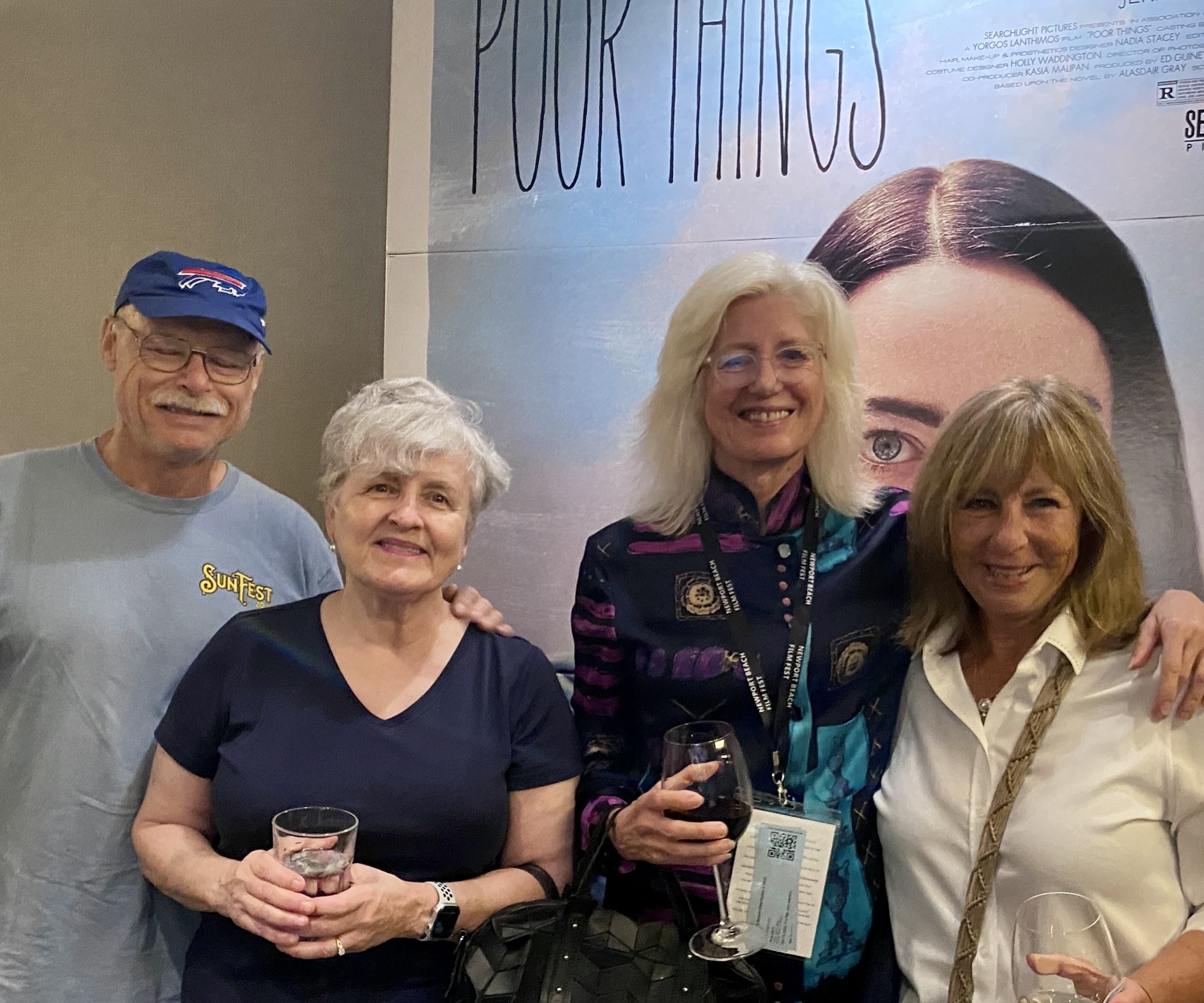
At the World Premier of “Barbara Rachko: True Grit” during the Newport Beach Film Festival
*an ongoing series of quotations – mostly from artists, to artists – that offers wisdom, inspiration, and advice for the sometimes lonely road we are on.
Whether we are creating high art or a meal, we improvise when we move with the flow of time and with our own evolving consciousness, rather than with a preordained script or recipe. In composed or scripted art forms, there are two kinds of time: the moment of inspiration in which a direct intuition of beauty or truth comes to the artist; then the often laborious struggle to hold onto it long enough to get it down on paper or canvas, film or stone. A novelist may have a moment (literally a flash) of insight into which the birth, meaning, and purpose of a new book reveal itself; but it may take years to write it. During this time he must not only keep the thought fresh and clear, he must also eat, live, make money, suffer, enjoy, be a friend, and everything else human beings do. In composed music or theater, moreover, there is yet a third kind of time: besides the moment (or moments) of inspiration and time it takes to write the score, there is the time of the actual performance. Often the music is not even performed until after the composer’s death.
Stephen Nachmanovitch in Free Play: Improvisation in Life and Art
Comments are welcome!
Q: How do you think about risk? What role has taking risks played in your life/career? (Question from Emma Jacobs, VoyageMIA.com)

A: My journey to becoming a visual artist was circuitous, to say the least. Risk-taking gave me the life and career I enjoy now.
The biggest – and scariest – risk I’ve ever taken was deciding to leave my active duty Naval career to pursue art full-time. The second most significant risk was moving to New York City in 1997. I have never regretted doing either one.
When I was 25, and a civilian, I earned my private pilot’s license and spent the next two years amassing other flying licenses and ratings, culminating in a Boeing-727 flight engineer’s certificate. Two years later I joined the Navy.
As an accomplished civilian pilot with thousands of flight hours, I had expected to fly jets in the Navy. However, women were barred from combat in those days (the 1980s) so there were very few women Navy pilots. There were no female pilots on aircraft carriers and no female Blue Angels. Women were restricted to training male pilots for combat jobs and priority was given to Naval Academy graduates. My BA was from a different university.
In the mid-1980s I was in my early 30s and a Lieutenant on active duty in the Navy. I worked a soul-crushing job as a computer analyst on the midnight shift in a Pentagon sub-basement. It was literally and figuratively the lowest point of my life. I hated my job! Not only was it boring, I was not using my hard-won flying skills. In short I was miserable – miserable and trapped because a Naval officer cannot just resign with two weeks notice.
Remembering the joyful Saturdays of my youth when I had taken art classes with a local New Jersey painter, I enrolled in a drawing class at the Art League School in Alexandria, Virginia. Initially I wasn’t very good, but it was wonderful to be around other women and a world away from the “warrior mentality” of my mostly male Pentagon co-workers. Plus, I was having fun!
Soon I enrolled in more classes and became a very motivated full-time art student who worked nights at the Pentagon. As I studied and improved my skills, I discovered my preferred medium – soft pastel on sandpaper.
Although I was certain I had found my life’s calling as a fine artist, I had grown used to a regular paycheck and the many benefits of being a Navy Lieutenant. For more than a year I agonized over whether or not to leave the Navy and lose my financial security. I’d be taking a huge risk: could I ever support myself as an artist? Was I making the dumbest mistake of my life?
Eventually, I decided I HAD TO take a leap. I simply adored making art – it challenged me to use all of my skills and talents – while I was unhappy, bored, and unfulfilled working at the Pentagon.
But once my mind was finally made up, I still could not leave. Due to geopolitical circumstances, there was a significant delay. The Navy was experiencing a manpower shortage and Congress had enacted a stop-loss order, which prevented officers from resigning for one year. I submitted my resignation effective exactly one year later: on September 30, 1989. Being stuck in a job I no longer wanted nor had the slightest interest in, was truly the longest year of my life!
Unlike most people, I can pinpoint exactly when I became an artist. I designate October 1, 1989 as the day I became a professional artist! I have never regretted my decision and I never again needed, nor had, a day job.
However, I must mention that I remained as a part-time Naval Reservist for the next 14 years, working primarily at the Pentagon for two days every month and two weeks each year. The rest of the time was my own to pursue my art career. After I moved to Manhattan in 1997, I commuted by train to Washington, DC to work for the Navy.
Finally on November 1, 2003, I officially retired as a Navy Commander. Now, I daresay, I am the rare fine artist who can point to a Navy pension as a source of income.
I love my life as an accomplished New York fine artist! With the help of two social media assistants, I work hard to make and promote the art I create. My pastel paintings and my pastel skills continue to evolve and grow, gaining wider recognition and a larger audience along the way.
In addition to making art, I have been a blogger since 2012. The audience for my blog, https://barbararachkoscoloreddust.com/ increases by 1,000 – 2,000 new subscribers each month. Today I have more than 72,000 readers!
Comments are welcome!
Pearls from artists* # 328

Barbara in her studio, Photo: Izzy Nova
*an ongoing series of quotations – mostly from artists, to artists – that offers wisdom, inspiration, and advice for the sometimes lonely road we are on.
An artist’s words are always to be taken cautiously… The artist who discusses the so-called meaning of his work is usually describing a literary side-issue. The core of his original impulse is to be found, if at all, in the work itself. Just the same, the artist must say what he feels…
I want to explain why I did the piece, I don’t see why artists should say anything because the work is supposed to speak for itself. So whatever the artist says about it is like an apology, it is not necessary.
I never talk literally; you have to use analogy and interpretation and leaps of all kinds…
I am suspicious of words. They do not interest me, they do not satisfy me. I suffer from the ways in which words wear themselves out. I distrust the Lacans and Bossuets because they gargle with their own words. I am a very concrete woman. The forms are everything…
With words you can say anything. You can lie as long as the day, but you cannot lie in the recreation of experience…
Louise Bourgeois: Destruction of the Father, Reconstruction of the Father: Writings and interview 1923-1997, edited and with texts by Marie-Laure Bernadac and Hans-Ulrich Obrist
Comments are welcome!
Q: What more would you wish to bring to your work?

Tile worker in South India
A: I tend to follow wherever the work leads, rather than directing it. I have never been able to predict where it will lead or what more might be added.
Travel is essential for inspiration. Besides many Mexican sojourns, I have been to Bali, Sri Lanka, South India, Guatemala, Honduras, Brazil, Peru, Argentina, Paraguay, and other places. A second trip to India is upcoming, to Gujarat and Rajistan this time.
Last year I had the opportunity to go to Bolivia. In La Paz I visited the Museum of Ethnography and Folklore, where a stunning mask exhibition was taking place. As soon as I saw it, I knew this would be the inspiration for my next series, “Bolivianos.” So far I have completed six “Bolivianos” pastel paintings with two more in progress now. This work is getting a lot of press and several critics have declared it to be my strongest series yet.
Comments are welcome!
Pearls from artists* # 156
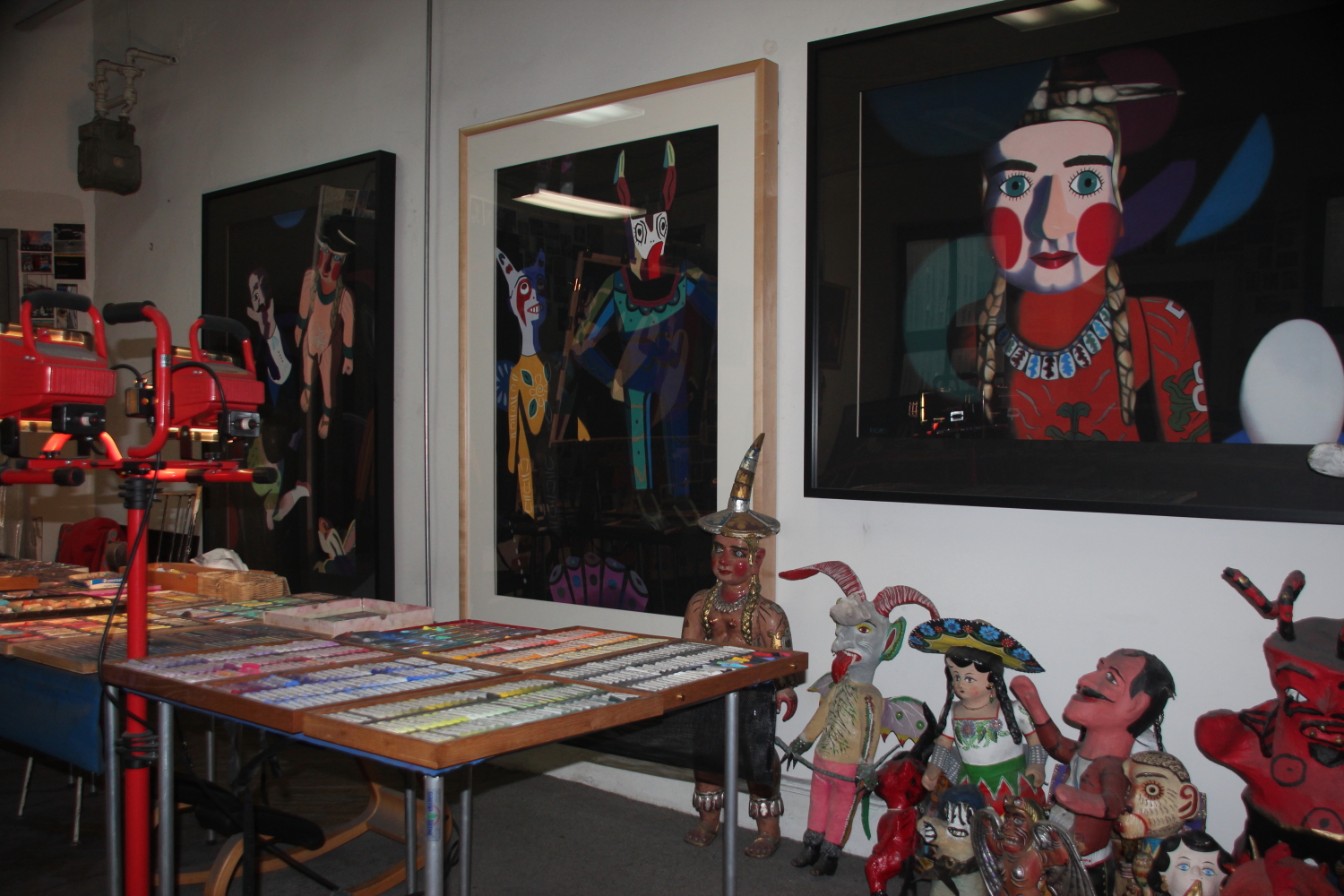
Barbara’s studio
Our vision is what makes us unique and special. Literally, vision means an artist’s unique way of seeing the world, the special and specific choices the artist makes when observing the world around him. It is also what the artist imagines and sees with his unique mind’s eye and brings out by way of his art. Vision is like a lighthouse, it guides the artist to a specific area of nature or life or to a subject that is personal to the artist, one that others might have overlooked. Vision also includes that which the artist’s conscience tells him the world ought to be – or what the world is lacking. Vision is that unique and special contribution we bring and add to life; it is that which no one can provide but us. Passion, inspiration, talent and skill all have to come together so that our vision can be achieved.
Samuel Adoquei in Origin of Inspiration: Seven Short Essays for Creative People
Comments are welcome!
Q: How do you know when a series has ended?

“A Promise, Meant to be Broken,” soft pastel on sandpaper, 58″ x 38″
A: I suppose it’s when there is nothing left to say within a particular body of work. The urgency to add something I haven’t tried vanishes. Usually I can’t even think of anything I haven’t tried.
I knew with certainty that the “Domestic Threats” series was finished while “A Promise Meant to be Broken” was still on my easel. It’s no accident that I included a self-portrait. This painting was my way of saying good-bye to an important body of work – literally turning my back on it – and summing up where the work had taken me.
For artists each series is a creative journey with a beginning, a middle, and an end. At a certain point it’s over. Then you build on what you’ve accomplished and move on to create something new. The connection between new work and old may not always be obvious, but one thing is certain: all the previous work laid the groundwork for what you make today.
Comments are welcome!
Q: Another interesting series of yours that has impressed me is your recent “Black Paintings.” The pieces in this series are darker than the ones in “Domestic Threats.” You create an effective mix between the dark background and the few bright tones, which establish such a synergy rather than a contrast, and all the dark creates a prelude to light. It seems to reveal such a struggle, a deep tension, and intense emotions. Any comments on your choice of palette and how it has changed over time?

West 29th Street studio
A: That is a great question!
You are correct that my palette has darkened. It’s partly from having lived in New York for so long. This is a generally dark city. We famously dress in black and the city in winter is mainly greys and browns.
Also, the “Black Paintings” are definitely post-9/11 work. My husband, Bryan, was tragically killed onboard the plane that crashed into the Pentagon. Losing Bryan was the biggest shock I ever have had to endure, made even harder because it came just 87 days after we had married. We had been together for 14 ½ years and in September 2001 were happier than we had ever been. He was killed so horribly and so senselessly. Post 9/11 was an extremely difficult, dark, and lonely time.
In the summer of 2002 I resumed making art, continuing to make “Domestic Threats” paintings. That series ran its course and ended in 2007. Around then I was feeling happier and had come to better terms with losing Bryan (it’s something I will never get over but dealing with loss does get easier with time). When I created the first “Black Paintings” I consciously viewed the background as literally, the very dark place that I was emerging from, exactly like the figures emerging in these paintings. The figures themselves are wildly colorful and full of life, so to speak, but that black background is always there.
Comments are welcome!


 barbararachkoscoloreddust.com
Pearls from artists # 429
Nov 18
Posted by barbararachkoscoloreddust
*an ongoing series of quotations – mostly from artists, to artists – that offers wisdom, inspiration, and advice for the sometimes lonely road we are on.
Vincent [van Gogh] found himself in perfect harmony with[Emile] Zola’s world view. Neither of them sugarcoated or idealized the harsh reality of the everyday life that surrounded them, or the subjects it offered up. The same reality was at the heart of both of their work. In July 1883, Vincent read Zola’s essay on art, ‘Le Moment artistique,’ contained in one of his critical works on literary and artistic life, Mes haines (My Hatreds), in which Zola reflected on a crucial aspect of artistic creativity, going beyond the word ‘realistic;’ ‘the word “realist” means nothing to me, and I declare reality subordinate to temperament.’ Therefore, according to Zola, a ‘work of art is a corner of creation seen through a temperament.’ Vincent did not comment on this passage directly, but in his lines we see that in Zola’s words he found confirmation of his own beliefs. To Theo, in 1885, he wrote of his attempts to capture the effects of light in The Potato Eaters: “Not always literally exactly – rather never exactly – for one sees nature through one’s temperament.” The two contrasting souls that live side by side in the author of Les Rougon Macquart, one methodical, the other creative, reflected Vincent’s own creative approach.
Mariella Guzzoni in Vincent’s Books: Van Gogh and the Writers Who Inspired Him
Comments are welcome!
Share this:
Posted in 2020, An Artist's Life, Creative Process, Inspiration, Pearls from Artists, Quotes
Comments Off on Pearls from artists # 429
Tags: "Le Moment artistique", "Les Rougon Macquart", "Mes haines", "The Potato Eaters", accepted, according, ality, approach, artist, artistic, aspect, attempts, author, beliefs, beyond, capture, comment, confirmation, contained, contrasting, corner, creation, creative, creativity, critical, crucial, directly, effects, Emile Zola, everyday, exactly, harmony, himself, idealized, individual, literally, literary, Mariella Guzzoni, methodical, nature, neither, nothing, offered, passage, perfect, rather, realist, reality, reemperament, subjects, subordinate, sugarcoated, surrounded, transposition, Vincent Van Gogh, Vincent's Books: Van Gogh and the Writers Who Inspired Him, world view