Blog Archives
Pearls from artists* # 715

*an ongoing series of quotations – mostly from artists, to artists – that offers wisdom, inspiration, and advice for the sometimes lonely road we are on
Whenever we must solve a big problem, such as the art/money challenge, it is worthwhile to look inward, to see where we may be complicit in perpetuating the problem. While artists are not always valued in our society, we also get what we settle for. Although we must eat and pay rent or mortgages like everyone else, non-artists often try to persuade us that we do not deserve to earn a living wage, because we enjoy our job. In the United States, we are often asked to work for free in a way that other professionals are not.
Consider trying to get an accountant to work ‘for the exposure.’ In many cases, artists go to college, even graduate school, to learn our profession. Many of us are still paying off student loans. We put in thousands of hours to develop our skills. We may win awards or grants that distinguish us from other artists. It is up to us to put a stop to the devaluation of our profession. Artists who agree to work for free, or for a pittance, are essentially strikebreakers on a picket line. As a group, we should be fighting in solidarity to raise standards of living and respect for our collective profession by refusing to work for less. When we agree to bad conditions, we devalue ourselves, and enable a dysfunctional system that perpetuates the exploitation of artists.
Kate Kretz in Art From Your Core: A Holistic Guide to Visual Voice
Comments are welcome!
Pearls from artists* # 714
*an ongoing series of quotations – mostly from artists, to artists – that offers wisdom, inspiration, and advice for the sometimes lonely road we are on
A moment comes when we realize that we have fallen in love with our instrument, our sculptor’s tools, our dance floor, our computer. We are in love with music, art, literature, cooking, physics. We feel love of beauty, love of the craft well done, love of the material, of the instruments. We feel the sensuality of playing, and of listening, reading, seeing, learning. The desire to learn and to play, if we have it at all, the motive power of creation, is part of our innate makeup, that craving to reach beyond ourselves.
Stephen Nachmanovitch in Free Play: Improvisation in Life and Art
Comments are welcome!
Pearls from artists* # 713

Dropping off “Magisterial” at the framer
*an ongoing series of quotations – mostly from artists, to artists – that offers wisdom, inspiration, and advice for the sometimes lonely road we are on
One of the great traps at times of blockage is that we may accuse ourselves of a deficit of concentration and focus, a deficit of discipline. We then take a paternal or militaristic attitude toward ourselves. We will force ourselves to work, we will go on a schedule, we will take vows. The most dangerous trap is to get into a contest of strength between “will power” and “won’t power.” Discipline is crucial, but we do not attain it by stiffening up. We attain it by sitting still and penetrating the emptiness within, making of that emptiness a friend rather than an adversary or bogeyman.
When you are stuck, meditate, free associate, do automatic writing, talk to yourself and answer yourself. Play with the blocks. Stay in the temenos of the workplace. Relax, surrender to the bafflement; don’t leave the temenos, and the solution will come. Persevere gently. Use intelleto, the visionary faculty. Stay close to the zero mark; indulge neither in great highs or great lows.
The depths are obscured in us when we try to force feelings; we clarify them by giving them adequate time and space and letting them come. What we experienced yesterday as the pride of creativity or the self-deprecating feeling of incapacity we see today as the signal to surrender.
Like the rules of the universe, the whole matter of personal creativity is baffling and paradoxical. To try to control yourself, to try to create, to try to break free of the knots you yourself have tied is to set yourself up at a distance from that which you already are. It is like looking around this way and that for your own head.
Stephen Nachmanovitch in Free Play: Improvisation in Life and Art
Comments are welcome!
Pearls from artists* # 703
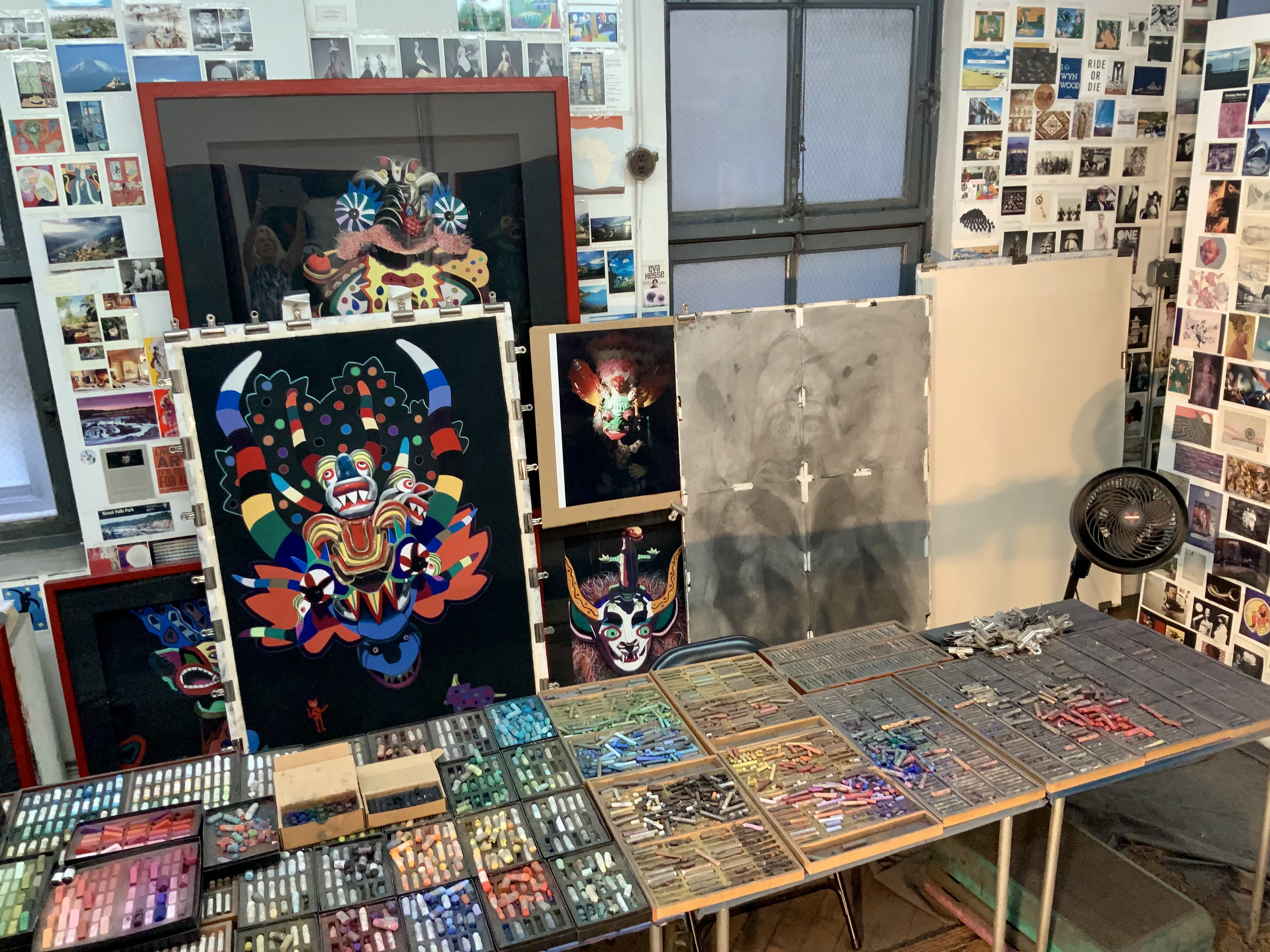
Barbara’s Studio
*an ongoing series of quotations – mostly from artists, to artists – that offers wisdom, inspiration, and advice for the sometimes lonely road we are on.
Artmaking embodies freedom, in a way that few vocations do. But, while we have no supervisors in our studios, we are not quite as free as we imagine. We all carry sone cumulative art baggage. All the people and ideas that have influenced us over the years have shaped the art we make today. Sone guidance served us well, seamlessly dovetailing into our own divine direction. Yet others may hold us back, constraining the distinct development of our creative articulation.
The work we do is affected by logistical limitations, such as time, space, and money. But we also possess biases, assumptions, rules, values, methodologies, goal structures, and conceptual frameworks we have assimilated into our practice along the way. We may delude ourselves into thinking we have actively chosen these limiting parameters, instead of recognizing that we may have absorbed them purely by default. Authority figures, over the course of our entire lives, have provided positive or negative reinforcement, not only through overt criticism or praise, but also through omission. These pressures are frequently tacit, wordlessly shaping the direction of our practice when a piece was changed or ignored by the powers that be.
Kate Kretz in Art From Your Core: A Holistic Guide to Visual Voice
Comments are welcome!
Pearls from artists* # 684

*an ongoing series of quotations – mostly from artists, to artists – that offers wisdom, inspiration, and advice for the sometimes lonely road we are on.
I often think that we should invent another word altogether for what real artists are doing… outside of, and despite, the market, so we could divorce ourselves from what ‘Art’ has devolved into. I aspire to create a new and visionary paradigm far away from the old one. I wish all the art magazines and blogs would declare that there is no longer any money to be made or any fame to be had, so all the people who were in for the wrong reasons would simply go away.
I want artists everywhere to figure out how to tap into their own deep well, the unpredictable source inside that can keep their work fresh and alive. I hope they build confidence to consistently preserve their integrity and independence. I long for them to trust their own intuition, to keep them on their true path as their work evolves. Finally, I yearn for them to reject anything that gets in the way of actualizing their deepest voice, so they might step into that expansive space that the universe has intended for them since the day they appeared on this earth.
Kate Kretz in Art From Your Core: A Holistic Guide to Visual Voice
Comments are welcome!
Pearls from artists* # 665

*an ongoing series of quotations – mostly from artists, to artists – that offers wisdom, inspiration, and advice for the sometimes lonely road we are on.
We are wordlessly persuaded and taught outright to hide so much of what we have unearthed in our lives. But artists throughout the centuries have described the power of using anguish as a catalyst to fuel their creativity. In Greek epic poetry, ‘Kleos’ refers to immortal renown. Unlike present-day fame, this term referred exclusively to heroes who had surmounted a great obstacle or persevered through tremendous difficulties. There is a certain authority that comes from those who have endured hardship. They have earned the depth of their work.
Darkness contains a great deal of energy. We can use it for destruction or creativity. Only those who tolerate it are able to illuminate the shadowy corners, revealing the nefariousness that hopes to stay hidden. We cannot change our past, or any hell that we have been through. But art provides the means to exorcise the pain that has taken up residence in our body and fashion it into a form outside ourselves, in an infinitely affirmative gesture. The darkness we have passed through was not endured in vain if we mold it into a vision that lights the way out… for us, and for all the other souls who undoubtedly need it.
Kate Kretz in Art From Your Core: A Holistic Guide to Visual Voice
Comments are welcome!
Pearls from artists* # 664

*an ongoing series of quotations – mostly from artists, to artists – that offers wisdom, inspiration, and advice for the sometimes lonely road we are on.
Throughout history, geniuses have attributed their breakthroughs to the time they spent alone, deep in thought. Frank Kafka assures us,
‘You need not leave your room. Remain sitting at your table and listen. You need not even listen, simply wait. You need not even wait, just learn to become quiet, and still, and solitary. The world will freely offer itself to you to be unmasked. It has no choice; it will roll in ecstasy at your feet.’
Artists have a special relationship with the passing hours. Our work is tangible evidence of how we mark and give value to time. We have a finite, unknown number of hours on Earth, so we will only leave behind so many pieces. Our artistic legacy is literally tied to our ability to steal time and maintain silence.
And yet, we exist in a time and place with a tremendous aversion to peace. We must fight both ourselves and others to acquire it. No one asked us if this is the kind of environment we want to inhabit. Corporations inundate every square inch of space with uninvited visual and auditory interference, designed to light up the addiction pleasure centers in our brains. Our ancestors would have found this environment assaulting and maddening. It is certainly causing damage to our mental health, happiness, and creativity. But, it is so ubiquitous that there is pressure to simply accept the anxiety-producing ‘new normal’: we have collectively surrendered our brain space to the colonization.
Kate Kretz in Art From Your Core: A Holistic Guide to Visual Voice
Comments are welcome!
Pearls from artists* # 653

*an ongoing series of quotations – mostly from artists, to artists – that offers wisdom, inspiration, and advice for the sometimes lonely road we are on.
Watching online markers of approval climb into high numbers releases dopamine in our brains, which can become addictive. If we crave ‘likes,’ and consciously or unconsciously make more of what our audience wants, we become supply-and-demand widget makers. We start catering to the lowest common denominator, asking ourselves what kind of widget will get the most likes or shares. Would you allow a committee into your studio to dictate your next work, to tell you what goes and what stays? How is catering to ‘likes’ any different?
… Every time your work grows, you will gain and lose fans. The more followers you have, the more individuals will need to adjust to the shifts that are happening. Some are guaranteed to disapprove of any new direction, regardless of content. Those who cannot tolerate change will be replaced by supporters of a higher caliber who approve and encourage you to grow.
Kate Kretz in Art From Your Core: A Holistic Guide to Visual Voice
Comments are welcome!
Pearls from artists* # 649
*an ongoing series of quotations – mostly from artists, to artists – that offers wisdom, inspiration, and advice for the sometimes lonely road we are on.
Some of us spend our entire creative lives digging at the buried parts of ourselves to solve unknown mysteries that we are not even aware of. Unearthing those aspects is not an easy process, because our true psychic reality does not lie in our daily waking thoughts. It exists in the unconscious, in the form of an unfathomable, nonverbal sensory language, one that is so complex and runs so deep that we can only grasp at it, to attain small, amorphous bits. These bits can take any form, even uncharacteristic, surprising ones. We access, process, and finally transform them into what Saint Augustine called ‘visible signs of invisible realities.’
Kate Kretz in Art From Your Core: A Holistic Guide to Visual Voice”
Comments are welcome!
Pearls from artists* # 627

In Hanga Roa, Rapa Nui (Easter Island), one of the most remote places on Earth!
*an ongoing series of quotations – mostly from artists, to artists – that offers wisdom, inspiration, and advice for the sometimes lonely road we are on.
We cannot afford to walk sightless among miracles. Nor can we protect ourselves from suffering. We do work that thrusts us into the pulsing heart of this world, whether or not we’re on the mood, whether or not it’s difficult or painful or we’d prefer to divert our eyes. When I think of the wisest people I know, they share one defining trait: curiosity. They turn away from the minutiae of their lives – and focus on the world around them. They are motivated by a desire to explore the unfamiliar. They are drawn toward what they don’t understand. They enjoy surprise. Some of these people are seventy, eighty, close to ninety years old, but they remind me of my son and his friend on the day I sprung them from camp. Courting astonishment. Seeking breathless wonder.
Dani Shapiro in Still Writing: The Perils and Pleasures of a Creative Life
Comments are welcome!



