Blog Archives
Pearls from artists* # 703
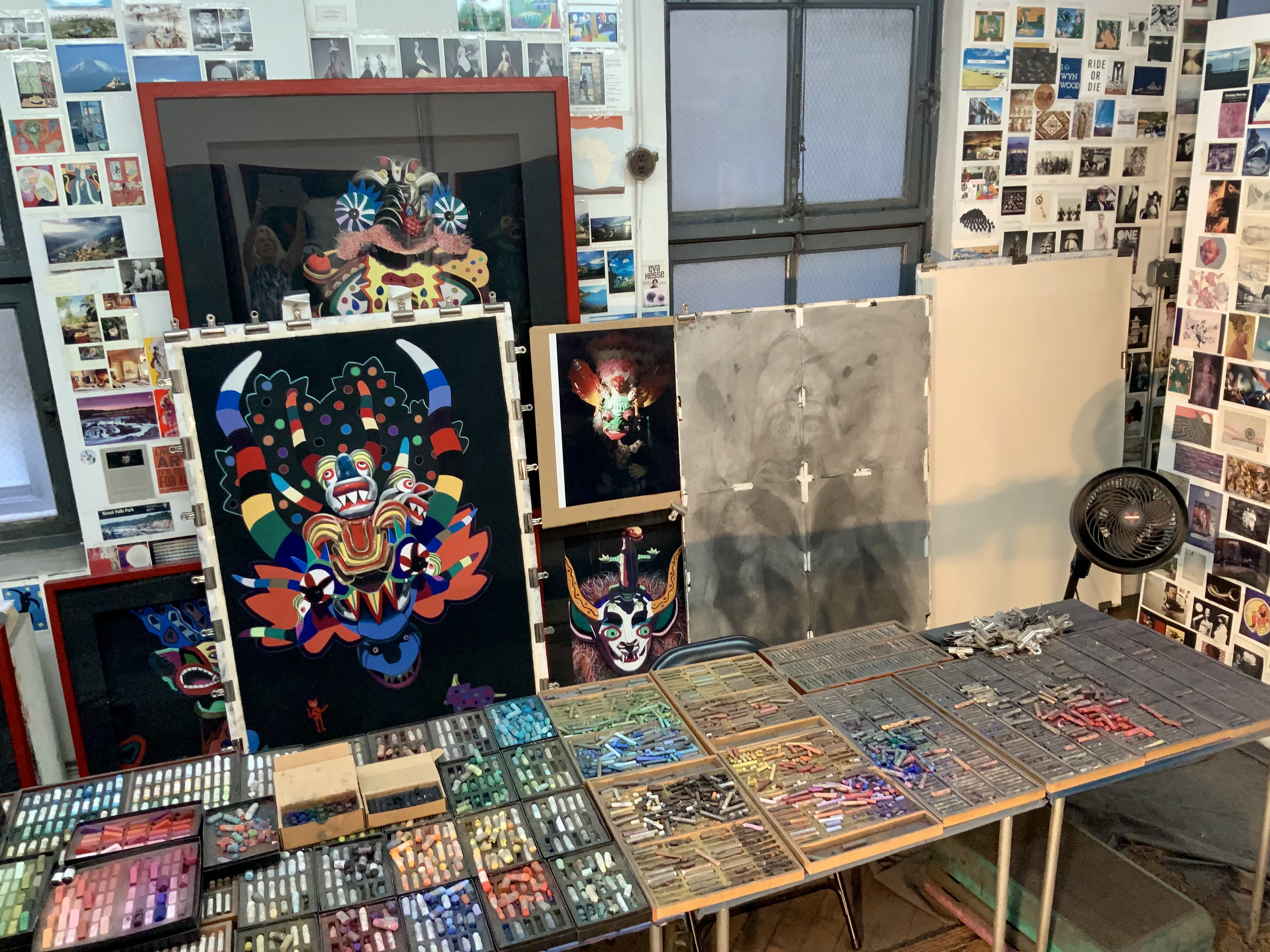
Barbara’s Studio
*an ongoing series of quotations – mostly from artists, to artists – that offers wisdom, inspiration, and advice for the sometimes lonely road we are on.
Artmaking embodies freedom, in a way that few vocations do. But, while we have no supervisors in our studios, we are not quite as free as we imagine. We all carry sone cumulative art baggage. All the people and ideas that have influenced us over the years have shaped the art we make today. Sone guidance served us well, seamlessly dovetailing into our own divine direction. Yet others may hold us back, constraining the distinct development of our creative articulation.
The work we do is affected by logistical limitations, such as time, space, and money. But we also possess biases, assumptions, rules, values, methodologies, goal structures, and conceptual frameworks we have assimilated into our practice along the way. We may delude ourselves into thinking we have actively chosen these limiting parameters, instead of recognizing that we may have absorbed them purely by default. Authority figures, over the course of our entire lives, have provided positive or negative reinforcement, not only through overt criticism or praise, but also through omission. These pressures are frequently tacit, wordlessly shaping the direction of our practice when a piece was changed or ignored by the powers that be.
Kate Kretz in Art From Your Core: A Holistic Guide to Visual Voice
Comments are welcome!
Q: You take 3-4 months to complete one artwork. How do you plan a series such as Bolivianos over a year’s timeline and over the years? (Question from Vedica Art Studios and Gallery)

A: Bolivianos is my third series, and like the previous two, it naturally evolves from one painting to the next. There wasn’t a long-term plan involved, and I doubt such detailed planning would even be practical. Many artists likely work this way—finishing one project and then beginning another. As with Bolivianos, I typically have ideas for the next two or three paintings, but little concept beyond that.
The main impetus for Bolivianos was to continue work I began in the early 1990s. During a visit to La Paz, I captured a series of stunning photographs, inspiring me to translate them into a major pastel series. Each painting leads to ideas about the next, guiding the entire series’ evolution and shaping my understanding of its meaning. Both the series and my insights deepen as I engage further with the subject matter. The Bolivian Carnival masks I photographed provided the starting point for a long and continuing intellectual journey.
Comments are welcome!
Q: When you left the Navy you worked on commission as a portrait artist. Why don’t you accept commissions now?

Barbara’s studio
A: As I have often said, I left the active duty Navy in 1989, but stayed in the Reserves. The Reserves provided a small part-time income and the only requirement was that I work one weekend a month and two weeks each year. Plus, I could retire after 13 more years and receive a pension. (In 2003 I retired from the Navy Reserve as a Commander). The rest of the time I was free to pursue my studio practice.
For a short time I made a living making commissioned photo-realist portraits in soft pastel on sandpaper. However, after a year I became very restless. I remember thinking, “I did not leave a boring job just to make boring art!” I lost interest in doing commissions because what I wanted to accomplish personally as an artist did not coincide with what portrait clients wanted. I finished my final portrait commission in 1990 and never looked back.
To this day I remain reluctant to accept a commission of any kind. So I am completely free to paint whatever I want, which is the only way to evolve as a serious, deeply committed artist.
Comments are welcome!



