Blog Archives
Q: You once faced a major creative block. How did you break through it? (Question from “Pastel, Passion, and Perseverance: An Interview with Barbara Rachko” in .ART Odyssey: Healing)

A: That was in 2007, after I finished my Domestic Threats series. The last painting in that series hardly interested me. I was wringing my hands, thinking, “I’m a full-time artist not making art —what do I do NOW?” It was frightening. At the time, I was also taking a jazz history class at Lincoln Center. One day the instructor spoke about Miles Davis.
He explained how Davis moved away from bebop —where musicians packed in as many notes as possible to show off—to cool jazz, where every note carried weight.
And something clicked. I realized I’d been working like bebop: showing off meticulous detail, every stitch of fabric, every grain in a wooden floor.
That revelation was my way forward. I stripped everything back. No more domestic backdrops. Just the figures, placed against solid black. Only what mattered. That was the beginning of my Black Paintings.
The block that had haunted me for months lifted in an instant, because I’d found a new way to speak. I realized the black background represented the dark place I had emerged from; the vibrant figures symbolized resilience and life.
It was like a lightbulb going off.
Comments are welcome!
Pearls from artists* # 593
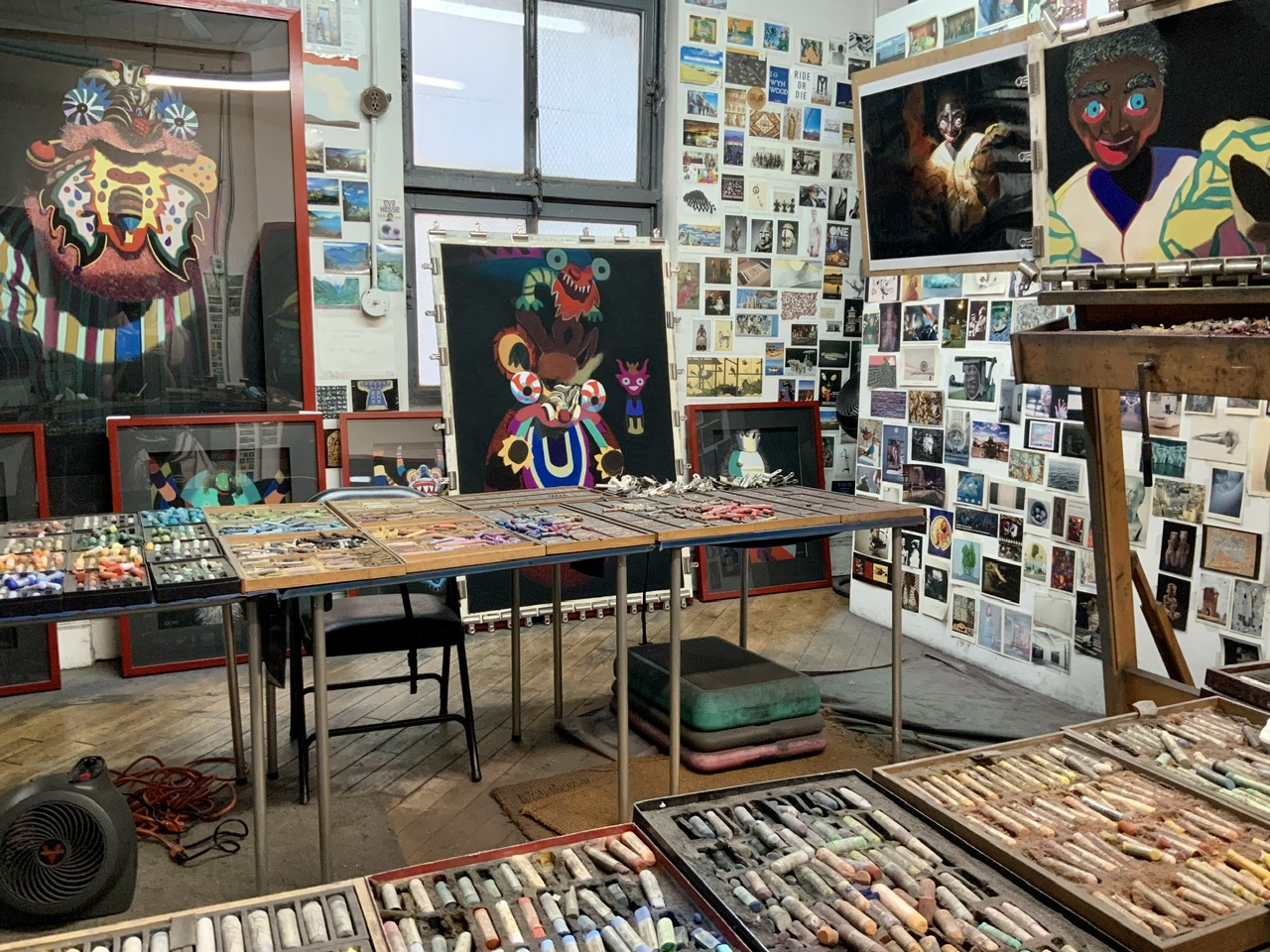
Barbara’s Studio with work in progress
*an ongoing series of quotations – mostly from artists, to artists – that offers wisdom, inspiration, and advice for the sometimes lonely road we are on.
Falling in love with beauty or with someone else’s artwork that touches us is easy. We can experience the rapture of it and go home. But falling in love with our instrument or with our work is more like falling in love with a person, in that we experience the rapture and delight of the discovery, but then we are saddled with the effort of fulfillment, with love’s labors and the hard lessons in which illusions are stripped away, in which we confront difficult pieces of self-knowledge, in which we have to stretch our physical, emotional, intellectual stamina to its limits, in which our patience and our ability to persevere and transcend ourselves are tested.
Stephen Nachmanovitch in Free Play: Improvisation in Life and Art
Comments are welcome!
Pearls from artists* # 466
*an ongoing series of quotations – mostly from artists, to artists – that offers wisdom, inspiration, and advice for the sometimes lonely road we are on.
Within the initial artistic response to something is a core idea or feeling and most of our work comes from stripping away everything that is extraneous to it. To translate that vision means “to get across” the idea or feeling. How cleanly can that idea be isolated and honed, how much can be stripped away? Everything superfluous and tangential needs to be eliminated. Otherwise the idea may get buried and our intention deflected. And the viewer’s will also. The problem is seldom that an idea is too simple. Power comes from something deeply felt and simply stated. “Nothing astonishes men so much as common sense and plain dealing. All great actions have been simple, and all great pictures are.” (Quote from Ken Weber, The Eye of the Spirit, Shambala, 1998, p. 136).
Ian Roberts in Creative Authenticity: 16 Principles to Clarify and Deepen Your Artistic Vision
Comments are welcome!



