Blog Archives
Q: You read books on Friedrich Nietzsche and other philosophers. How has philosophy and your personal experience shaped the latest series, Bolivianos? (Question from Vedica Art Studios and Gallery)

A: It’s difficult to pinpoint how philosophy specifically shaped my work because my curiosity spans so many subjects. Some critics have described me as a Renaissance woman, remarking on my wide-ranging and voracious reading. It’s true—I’m genuinely interested in practically everything!
In pursuit of making art, I have undertaken in-depth studies of numerous intriguing fields: drawing, color, composition, gross anatomy, art and art history, the art business, film history, photography, psychology, mythology, literature, philosophy, religion, music, jazz history, and archaeology—particularly ancient Mesoamerica (Olmec, Zapotec, Mixtec, Aztec, and Maya) and South America (the Inca and their ancestors).
Since the early 1990s, my inspiration and subject matter have come primarily from international travel to remote parts of the globe, especially Mexico, Central America, and South America. Travel is by far the best education! By visiting distant destinations, I have developed a deep reverence for people and cultures around the world. People everywhere are connected by our shared humanity.
These travels, supplemented by extensive research at home, are essential parts of my creative process. Research can be solitary and demanding, but I truly enjoy it. I want to know as much as possible, and this curiosity generates ideas for new work, propelling me into unexplored creative realms.
Foreign travel always expands our ways of thinking. This rich mixture of creative influences continually evolves and finds its way into my pastel paintings. Working, learning, evolving, and growing—I am perpetually curious and can hardly imagine a better way to spend my time on Earth!
Comments are welcome!
Pearls from artists* # 664

*an ongoing series of quotations – mostly from artists, to artists – that offers wisdom, inspiration, and advice for the sometimes lonely road we are on.
Throughout history, geniuses have attributed their breakthroughs to the time they spent alone, deep in thought. Frank Kafka assures us,
‘You need not leave your room. Remain sitting at your table and listen. You need not even listen, simply wait. You need not even wait, just learn to become quiet, and still, and solitary. The world will freely offer itself to you to be unmasked. It has no choice; it will roll in ecstasy at your feet.’
Artists have a special relationship with the passing hours. Our work is tangible evidence of how we mark and give value to time. We have a finite, unknown number of hours on Earth, so we will only leave behind so many pieces. Our artistic legacy is literally tied to our ability to steal time and maintain silence.
And yet, we exist in a time and place with a tremendous aversion to peace. We must fight both ourselves and others to acquire it. No one asked us if this is the kind of environment we want to inhabit. Corporations inundate every square inch of space with uninvited visual and auditory interference, designed to light up the addiction pleasure centers in our brains. Our ancestors would have found this environment assaulting and maddening. It is certainly causing damage to our mental health, happiness, and creativity. But, it is so ubiquitous that there is pressure to simply accept the anxiety-producing ‘new normal’: we have collectively surrendered our brain space to the colonization.
Kate Kretz in Art From Your Core: A Holistic Guide to Visual Voice
Comments are welcome!
Pearls from artists* # 628

*an ongoing series of quotations – mostly from artists, to artists – that offers wisdom, inspiration, and advice for the sometimes lonely road we are on.
Down the rabbit hole of my research, I’d stumbled into an odd conundrum: Even though art experts can’t agree on what art is, a large number of them are convinced that making and experiencing art is an innate human impulse. It’s not a learned pastime we dreamt up once we got bored of staring at blank walls or figured out how to live past age twenty, but a biological predisposition that has helped our species survive. (One we may share with songbirds, parrots, whales, and other animals that have their own “aesthetic culture,” writes evolutionary biologist Richard O. Prom.) One survival-of-the-most-artistic hypothesis contends that art is our version of peacock feathers: An extravagant, frivolous display by which Paleolithic humans showed potential mates that they were fit enough to hunt and gather and have time left-over to paint warty pigs. Another theory is that our art-inclined ancestors survived, thrived, and reproduced because making art offered a dress rehearsal for grappling with hostile conditions. (Nine-thousand-year-old Libyan rock paintings of spear-wielding figures sprinting after horned beasts come to mind.) The scholar Ellen Dissanayake, who’s dabbled in anthropology, archaeology, psychology, and art history, argues that art is a social glue that binds communities together and thus increases its members’ odds of survival. Also, she thinks the concept of “fine art” is a travesty that’s made us forget that “engaging with the arts is as universal, normal, and obvious in human behavior as sex or parenting.”
Bianca Bosker in Get the Picture: A Mind-Bending Journey Among the Inspired Artists and Obsessive Art Fiends Who Taught Me How to See
Comments are welcome!
Pearls from artists* # 562

“Shadow,” soft pastel on sandpaper, 26” x 20,” in progress
*an ongoing series of quotations – mostly from artists, to artists – that offers wisdom, inspiration, and advice for the sometimes lonely road we are on.
Jung observed that complexes could affect groups of people en masse. He saw that certain moments seemed to be expressions of a collective shadow, a bursting forth of a mass psychosis; the repressed side of a whole group coming alive; a tribal Mr. Hyde. He saw this madness first-hand in Germany in the 1930s and wrote about it. But every era carries some measure of collective shadow.
One could argue that no moment in time has seen more of the reality of human darkness than ours. Having witnessed the Holocaust and faced the threat of nuclear war in the twentieth century, and now facing the environmental impact of fossil fuels and plastics in the twenty-first century, we are undoubtedly aware of more of humanity’s potential for destruction than any of our ancestors ever were. Such a view does not come from a moralizing stance. Our era has made forced witnesses of us all.
The shadow is about where we put the Devil – where do we allow darkness to be housed? Racism and bigotry offer the relief of foisting our group’s shadow onto another whom we view as lesser. Doing so enables us not to look at or feel our shadow, and not see our own worst selves. But this collective shadow of our modern culture is also bigger and wider than group-to-group projections. There are culture-wide or civilization expressions of the collective shadow.
Jung saw the widespread loss of connection to the inner life and to a lived spirituality as one of the primary illnesses of our time. He observed that people were no longer animated by the traditional religions… For Jung, this meant that we’ve lost the old way but not yet found the new, and are sitting in a spiritual vacuum.
Into that vacuum, without our awareness, has slipped our fascination with human technology. Observe people closely today and you’ll notice that we have an almost magical faith in our devices. People see their computers and phones as all-knowing and expect them to function perfectly all the time, and view pharmaceuticals as magic cure-alls. Where we used to put God, we now have put technology. Where spirit was, we have unconsciously placed human genius.
Gary Bobroff in Carl Jung: Knowledge in a Nutshell
Comments are welcome!
Q: How does art help you explore and understand other cultures? (Question from Arte Realizzata)
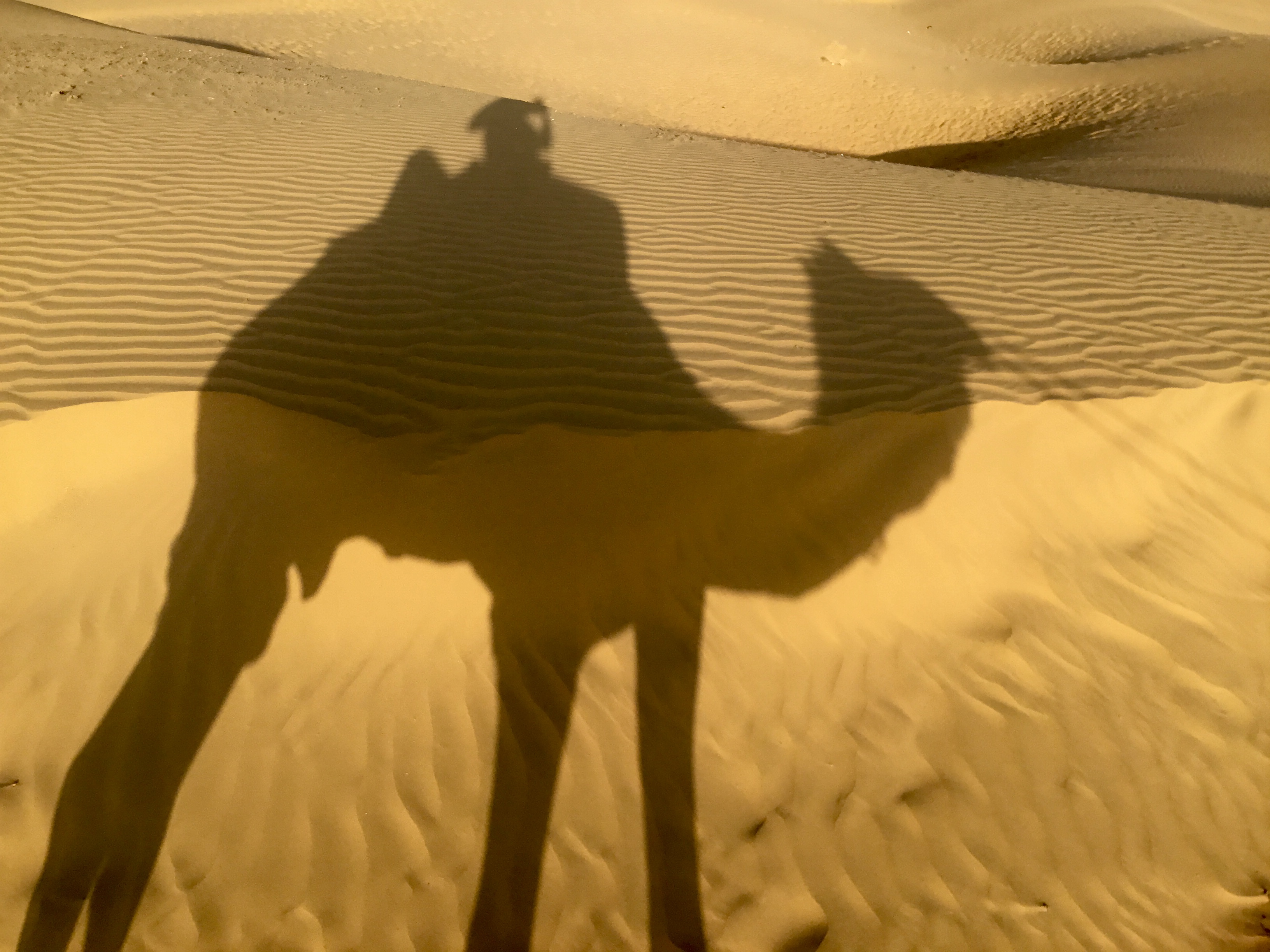
A: Art helps me explore and understand other cultures by revealing our shared humanity across space and time. For me art and travel are intertwined; there is no better education! My art-making has led me to visit fascinating places in search of source material, ideas, and inspiration: to Mexico, Guatemala, Brazil, Argentina, Uruguay, France, England, Italy, Bali, Java, Sri Lanka, and India. I have seen firsthand that people all over the world are the same.
Art has led me to undertake in-depth studies of intriguing subjects: drawing, color, composition, art, art history, the art business, film, film history, photography, mythology, literature, music, jazz, jazz history, and archaeology, particularly that of ancient Mesoamerica (Olmec, Zapotec, Mixtec, Aztec, and Maya), and South America (the Inca and their ancestors).
This rich mixture of creative influences continually grows. For anyone wanting to spend their time on earth studying, learning, and meeting new challenges, there is hardly anything more fascinating than to be a well-travelled, perpetually curious artist!
Comments are welcome!
Pearls from artists* # 400

In the studio with friends
* an ongoing series of quotations – mostly from artists, to artists – that offers wisdom, inspiration, and advice for the sometimes lonely road we are on.
A student in the audience raised her hand and asked me:
“Why should I live?”
… In the very act of asking that question, you are seeking reasons for your convictions, and so you are committed to reason as the means to discover and justify what is important to you. And there are so many reasons to live!
As a sentient being, you have the potential to flourish. You can refine your faculty of reason itself by learning and debating. You can seek explanations of the natural world through science, and insight into the human condition through the arts and humanities. You can make the most of your capacity for pleasure and satisfaction, which allowed your ancestors to thrive and thereby allowed you to exist. You can appreciate the beauty and the richness of the natural and cultural world. As the heir to billions of years of life perpetuating itself, you can perpetuate life in turn. You have been endowed with a sense of sympathy – the ability to like , love, respect, help, and show kindness – and you can enjoy the gift of mutual benevolence with friends, family, and colleagues.
And because reason tells you that none of this is particular to you, you have the responsibility to provide to others what you expect for yourself. You can foster the welfare of other sentient beings by enhancing life, health, knowledge, freedom, abundance, safety, beauty, and peace. History shows that when we sympathize with others and apply our ingenuity to improving the human condition, we can make progress in doing so, and you can help to continue that progress.
Stephen Pinker in Enlightenment Now: The Case for Reason, Science, Humanism, and Progress
Comments are welcome!
Q: When did your love of indigenous artifacts begin? Where have you traveled to collect these focal points of your works and what have those experiences taught you?
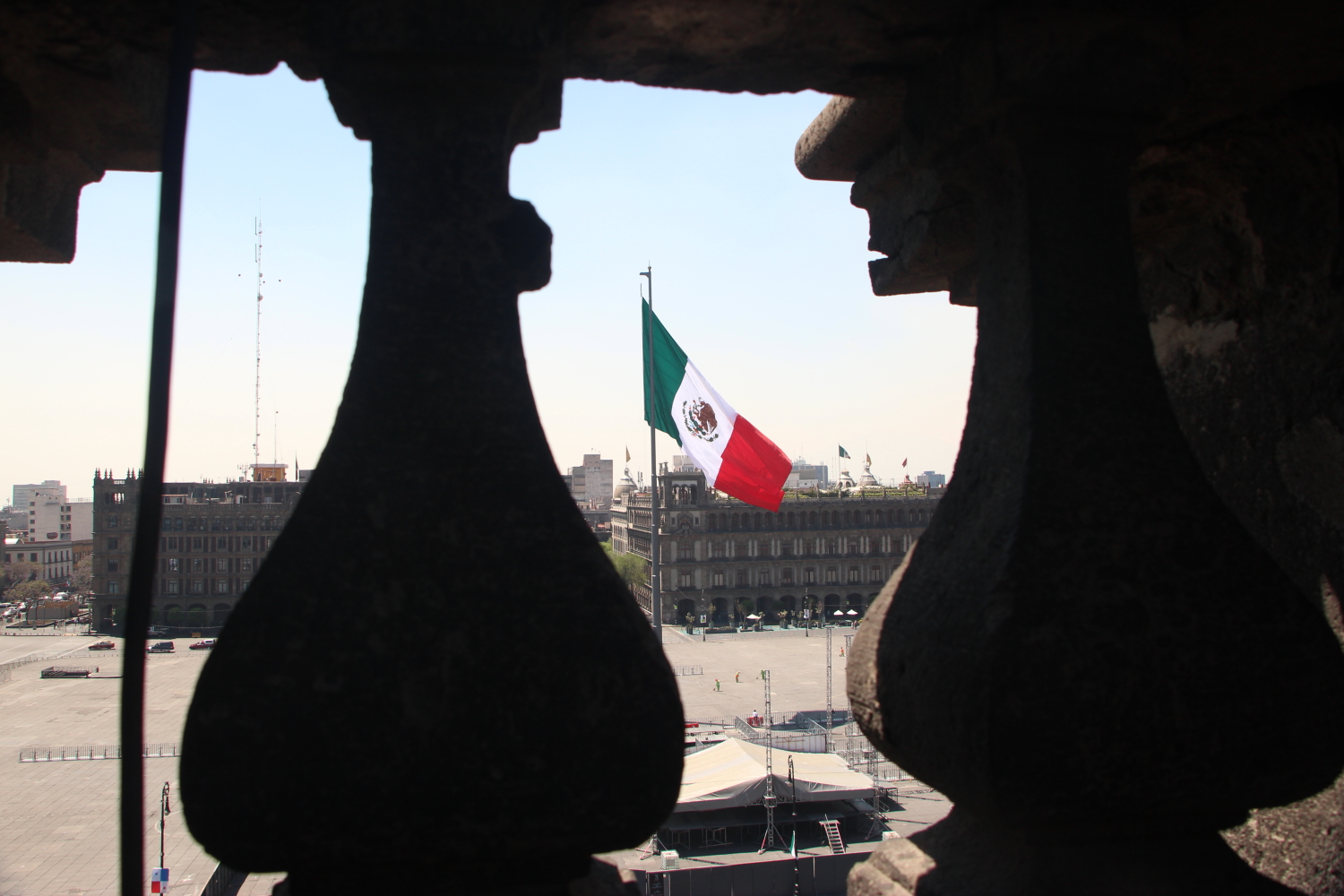
Mexico City
A: As a Christmas present in 1991 my future sister-in-law sent me two brightly painted wooden animal figures from Oaxaca, Mexico. One was a blue polka-dotted winged horse. The other was a red, white, and black bear-like figure.
I was enthralled with this gift and the timing was fortuitous because I had been searching for new subject matter to paint. I started asking artist-friends about Oaxaca and learned that it was an important art hub. Two well-known Mexican painters, Rufino Tamayo and Francisco Toledo, had gotten their start there, as had master photographer Manuel Alvarez Bravo. There was a “Oaxacan School of Painting” (‘school’ meaning a style) and Alvarez Bravo had established a photography school there (the building/institution kind). I began reading everything I could find. At the time I had only been to Mexico very briefly, in 1975.
The following autumn, Bryan and I planned a two-week trip to visit Mexico. We timed it to see Day of the Dead celebrations in Oaxaca. (During my research I had become fascinated with this festival). We spent one week in Oaxaca followed by one week in Mexico City. My interest in collecting Mexican folk art was off and running!
Along with busloads of other tourists, we visited several cemeteries in small Oaxacan towns for the “Day of the Dead.” The indigenous people tending their ancestors’ graves were so dignified and so gracious, even with so many mostly-American tourists tromping around on a sacred night, that I couldn’t help being taken with these beautiful people and their beliefs.
From Oaxaca we traveled to Mexico City, where again I was entranced, but this time by the rich and ancient history. We visited the National Museum of Anthropology, where I was introduced to the fascinating story of ancient Mesoamerican civilizations; the ancient city of Teotihuacan, which the Aztecs discovered as an abandoned city and then occupied as their own; and the Templo Mayor, the historic center of the Aztec empire, infamous as a place of human sacrifice. I was astounded! Why had I never learned in school about Mexico, this highly developed cradle of Western civilization in our own hemisphere, when so much time had been devoted to the cultures of Egypt, Greece, and elsewhere? When I returned home to Virginia I began reading everything I could find about ancient Mexican civilizations, including the Olmec, Zapotec, Mixtec, Aztec, and Maya. The first trip to Mexico opened up a whole new world and was to profoundly influence my future work. I would return there many more times, most recently to study Olmec art and archeology. In subsequent years I have traveled to Guatemala, Peru, Bolivia and other countries in search of inspiration and subject matter to depict in my work.
Comments are welcome!
Q: Would you speak about your first trip to Mexico?
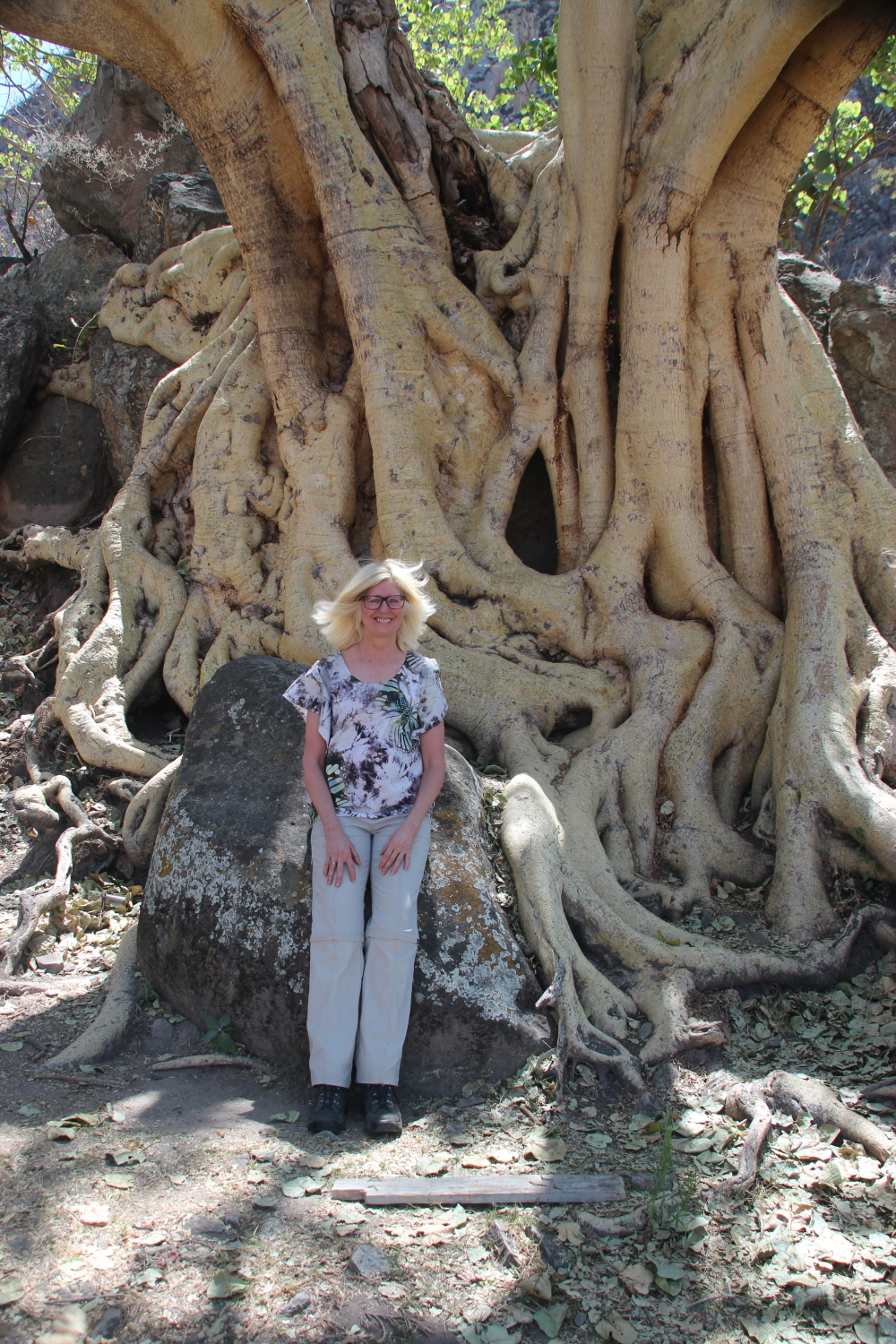
With an amate tree at Chalcatzingo
A: In the early 90’s my late husband, Bryan, and I made our first trip to Oaxaca and to Mexico City. At the time I had become fascinated with the Mexican “Day of the Dead” celebrations so our trip was timed to see them firsthand. Along with busloads of other tourists, we visited several cemeteries in small Oaxacan towns. The indigenous people tending their ancestor’s graves were so dignified and so gracious, even with so many mostly-American tourists tromping around on a sacred night, that I couldn’t help being taken with these beautiful people and their beliefs. From Oaxaca we traveled to Mexico City, where again I was entranced, but this time by the rich and ancient history. On that first trip to Mexico we visited the National Museum of Anthropology, where I was introduced to the fascinating story of ancient Mesoamerican civilizations (it is still one of my favorite museums in the world); the ancient city of Teotihuacan, which the Aztecs discovered as an abandoned city and then occupied as their own; and the Templo Mayor, the historic center of the Aztec empire, infamous as a place of human sacrifice. I was astounded! Why had I never learned in school about Mexico, this highly developed cradle of Western civilization in our own hemisphere, when so much time had been devoted to the cultures of Egypt, Greece, and elsewhere? When I returned home to Virginia I began reading everything I could find about ancient Mexican civilizations, including the Olmec, Zapotec, Mixtec, Aztec, and Maya. This first trip to Mexico opened up a whole new world and was to profoundly influence my future work. I would return there many more times, most recently this past March to study Olmec art and culture.
Comments are welcome!
Q: What have you learned about the people of Mexico through your travels, reading, and research?
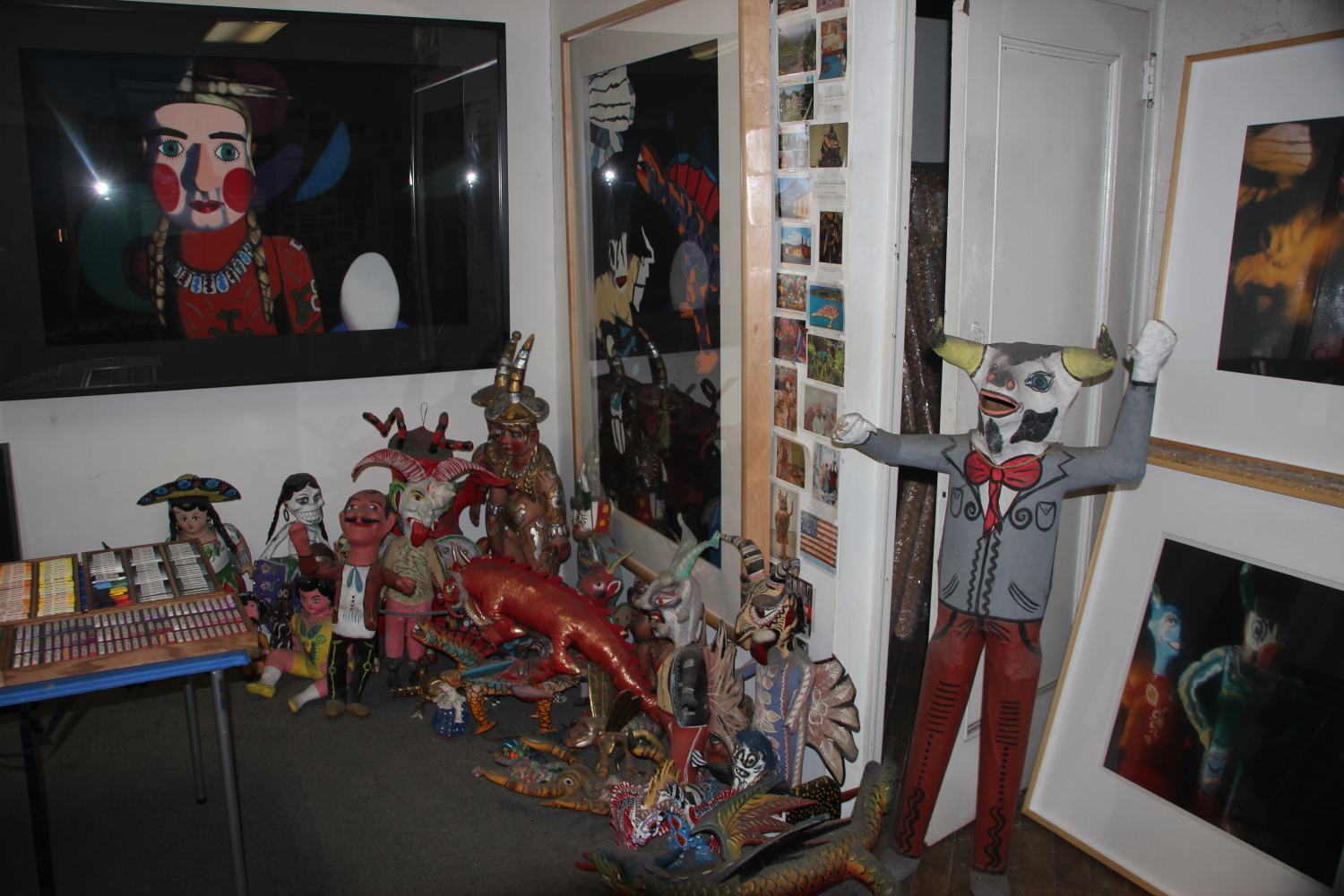
A corner of the studio
A: It didn’t take long to become smitten with these beautiful people. It happened on my first trip there in 1992 when Bryan and I, along with busloads of other tourists, were visiting the Oaxacan cemeteries on The Day of the Dead. The Oaxaquenos tending their ancestor’s graves were so dignified and so gracious, even with so many mostly-American tourists tromping around on a sacred night, that I couldn’t help being taken with them and with their beliefs. My studies since that time have given me a deeper appreciation for the art, architecture, history, mythology, etc. that comprise the extremely rich and complex story of Mexico as a cradle of civilization in the West. It is a wonderfully heady mix and hopefully some of it comes through in my work as a painter and a photographer.
By the way I often wonder why the narrative of Mexico’s fascinating history was not taught in American public schools, at least not where I went to public school in suburban New Jersey. Mexico is our neighbor, for goodness sake, but when I speak to many Americans about Mexico they have never learned anything about the place! It’s shocking, but many people think only “Spring Break” and/or “Drug Wars,” when they hear the word “Mexico.” As a kid I remember learning about Egypt, Mesopotamia, Greece, and other early civilizations in the Middle East, Europe, and Asia, but very little about Mexico. We learned about the Maya, when it was still believed that they were a peaceful people who devoted their lives to scientific and religious pursuits, but that story was debunked years ago. And I am fairly sure that not many Americans even know that Maya still exist in the world … in Mexico and in Guatemala. There are a few remote places that were not completely destroyed by Spanish Conquistadores in the 16th century and later. I’ve been to Mayan villages in Guatemala and seen shamans performing ancient rituals. For an artist from a place as rooted in the present moment as New York, it’s an astounding thing to witness!
Comments are welcome!


 barbararachkoscoloreddust.com