Blog Archives
Pearls from artists* # 525

* an ongoing series of quotations – mostly from artists, to artists – that offers wisdom, inspiration, and advice for the sometimes lonely road we are on.
… this reflects the inner necessity of the arts, the creative spirit’s determination to make something that can stand on its own, precisely because it’s rooted in rules, systems, and processes that are immune to the vagaries of politics, society, and day-to-day life. It’s the discipline of art that frees the artist to go public with the most private thoughts and feelings. No matter how the world encroaches on the artist, the artist in the act of creation must stand firm in the knowledge that art has its own laws and logic. These are the fundamentals of the creative vocation.
Jed Perl in Authority and Freedom: A Defense of the Arts
Comments are welcome!
Q: What is your process? (Question from artamour)
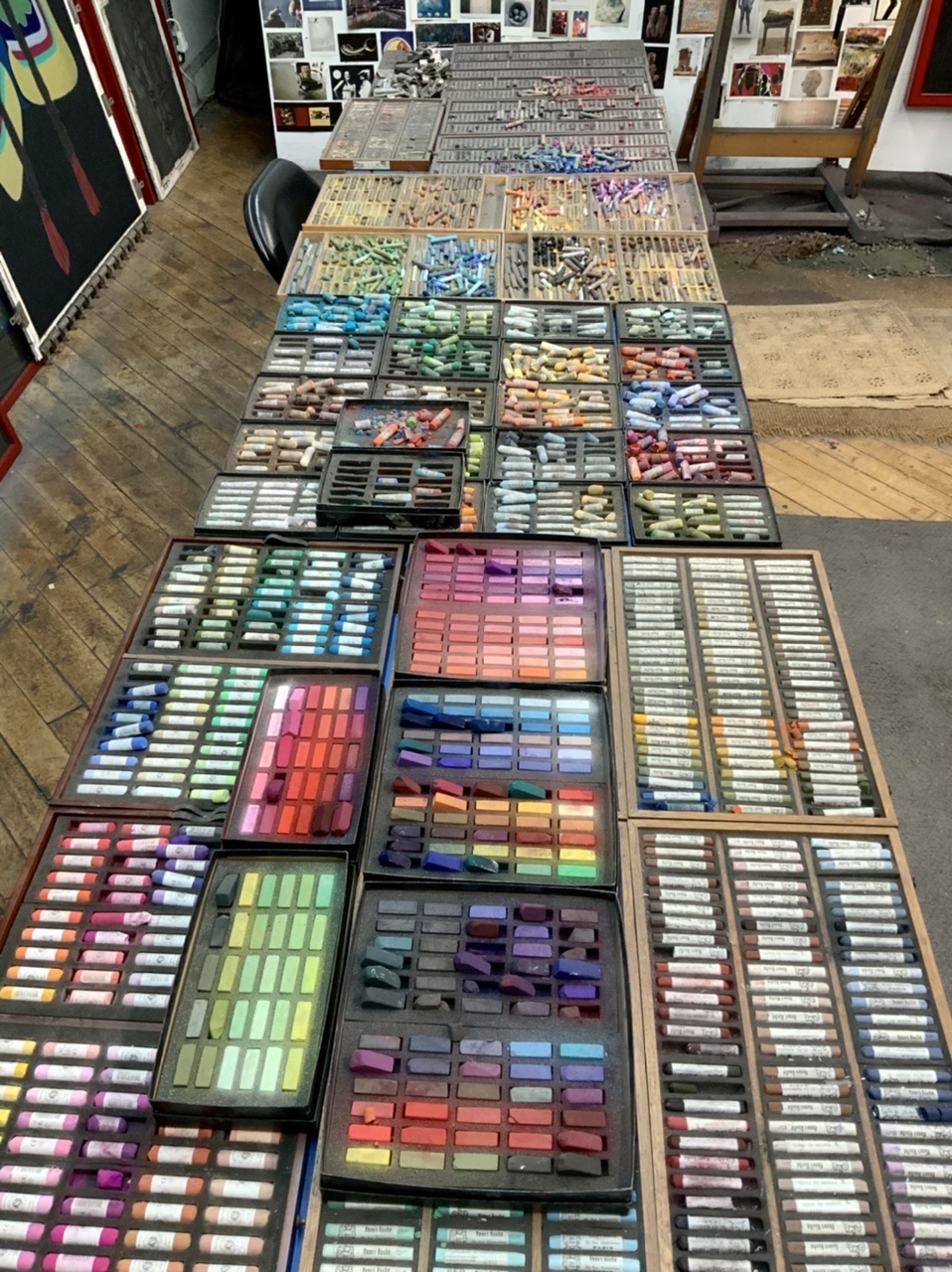
A: For thirty-six years I have worked exclusively in soft pastel on sandpaper. Pastel, which is pigment and a binder to hold it together, is as close to unadulterated color as an artist can get. It allows for very saturated color, especially employing the self-invented techniques I have developed and mastered. I believe my “science of color” is unique, completely unlike how any other artist works. I spend three to four months on each painting, applying pastel and blending the layers together to mix new colors on the paper.
The acid-free sandpaper support allows the buildup of 25 to 30 layers of pastel as I slowly and meticulously work for hundreds of hours to complete a painting. The paper is extremely forgiving. I can change my mind, correct, refine, etc. as much as I want until a painting is the best I can create at that moment in time.
My techniques for using soft pastel achieve rich velvety textures and exceptionally vibrant color. Blending with my fingers, I painstakingly apply dozens of layers of pastel onto the sandpaper. In addition to the thousands of pastels that I have to choose from, I make new colors directly on the paper. Regardless of size, each pastel painting takes three to four months and hundreds of hours to complete.
I have been devoted to soft pastel from the beginning. In my blog and in numerous interviews online and elsewhere, I continue to expound on its merits. For me no other fine art medium comes close.
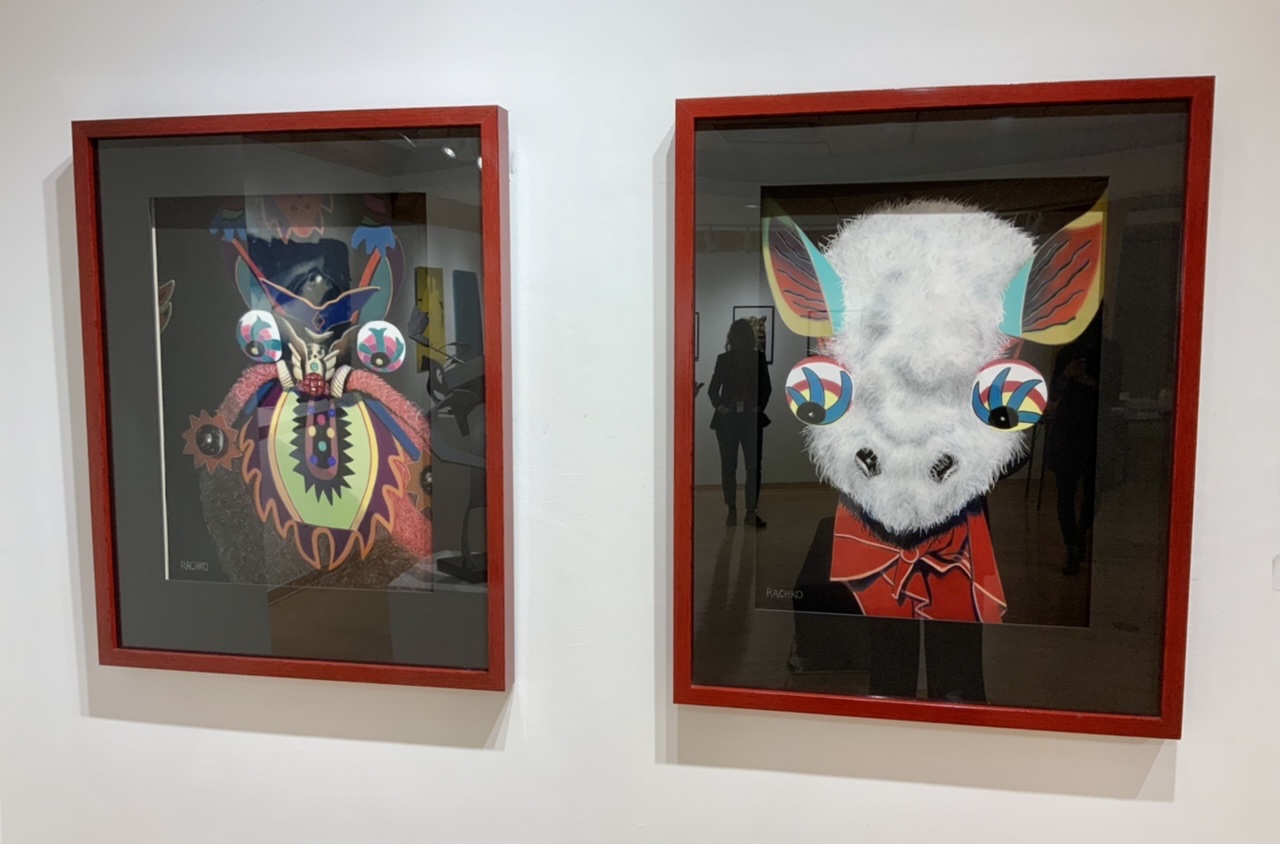
My subject matter is unique. I am drawn to Mexican, Guatemalan, and Bolivian cultural objects—masks, carved wooden animals, papier mâché figures, and toys. On trips to these countries and elsewhere I frequent local mask shops, markets, and bazaars searching for the figures that will populate my pastel paintings. How, why, when, and where these objects come into my life is an important part of the creative process. Each pastel painting is a highly personal blend of reality, fantasy, and autobiography.
Comments are welcome!
Pearls from artists* # 513
*an ongoing series of quotations – mostly from artists, to artists – that offers wisdom, inspiration, and advice for the sometimes lonely road we are on.
… you will never be able to create anything interesting out of your life if you don’t believe that you’re entitled to at least try. Creative entitlement doesn’t mean behaving like a princess or acting as though the world owes you anything whatsoever. No, creative entitlement simply means believing that you are allowed to be here, and that – merely by being here – you are allowed to have a voice and a vision of your own.
The poet David Whyte calls this sense of creative entitlement “the arrogance of belonging,” and claims that it is an absolutely vital privilege to cultivate if you wish to interact more vividly with life. Without this arrogance of belonging, you will never be able to take any creative risks whatsoever. Without it, you will never push yourself out of the suffocating insulation of personal safety into the frontiers of the beautiful and the unexpected.
The arrogance of belonging is not about egotism or self-absorption. In a strange way, it’s the opposite; it is a divine force that will actually take you out of yourself and allow you to engage more fully with life. Because often what keeps you from creative living is your self-absorption (your self-doubt, your self-disgust, your self-judgment, your crushing sense of self-protection). The arrogance of belonging pulls you out of the darkest depths of self-hatred – not by saying “I am the greatest!” but merely saying “I am here!”
Elizabet Gilbert in Big Magic: Creative Living Beyond Fear
Comments are welcome!
Pearls from artists* # 506

*an ongoing series of quotations – mostly from artists, to artists – that offers wisdom, inspiration, and advice for the sometimes lonely road we are on.
Inspiration is allowed to do whatever it wants to, in fact, and it is never obliged to justify its motives to any of us. (As far as I’m concerned, we’re lucky that inspiration talks to us at all; it’s too much to ask that it also explain itself).
In the end, it’s all about violets trying to come to light.
Don’t fret about the irrationality and unpredictability of all this strangeness. Give in to it. Such is the bizarre, unearthly contract of creative living. There is no theft; there is no ownership; there is no tragedy; there is no problem. There is no time or space where inspiration comes from – and also no competition, no ego, no limitations. There is only the stubbornness of the idea itself, refusing to stop searching until it has found an equally stubborn collaborator. (Or multiple collaborators, as the case may be).
Work with that stubbornness.
Work with it as openly and trustingly and diligently as you can.
Work with all your heart, because – I promise – if you show up for your work day after day after day after day, you just might get lucky enough some random morning to burst right into bloom.
Elizabeth Gilbert in Big Magic: Creative Living Beyond Fear
Comments are welcome!
Pearls from artists* # 504

* an ongoing series of quotations – mostly from artists, to artists – that offers wisdom, inspiration, and advice for the sometimes lonely road we are on.
… if a project doesn’t work out, you can always think of it as having been a worthwhile and constructive experiment. You can resist the seductions of grandiosity, blame, and shame. You can support other people in their creative efforts, acknowledge the truth that there’s plenty of room for everyone. You can measure your worth by your dedication to your path, not by your successes or failure. You can battle your demons (through therapy, recovery, prayer, or humility) instead of battling your gifts – in part by realizing that your demons were never the ones doing the work, anyhow. You can believe that you are neither a slave to inspiration nor its master, but something far more interesting – its partner – and that the two of you are working together toward something intriguing and worthwhile. You can live a long life, moving and doing really cool things the entire time. You might earn a living with your pursuits or you might not, but you can recognize that this is not really the point. And at the end of your days, you can thank creativity for having blessed you with a charmed, interesting, passionate existence.
Elizabeth Gilbert in Big Magic: Creative Living Beyond Fear
Comments are welcome!
Pearls from artists* # 501

* an ongoing series of quotations – mostly from artists, to artists – that offers wisdom, inspiration, and advice for the sometimes lonely road we are on.
When I talk about “creative living” here, please understand that I am not necessarily talking about pursuing a life that is professionally or exclusively devoted to the arts. I’m not saying that you must become a poet who lives on a mountaintop in Greece, or that you must perform at Carnegie Hall, or that you must win the Palme d’Or at the Cannes Film Festival. (Though if you want to attempt any of these feats, have at it. I love to watch people swing for the bleachers.) No, when I refer to “creative living,” I am speaking more broadly. I’m talking about living a life that is driven more strongly by curiosity than by fear.
... A creative life is an amplified life. It’s a bigger life, a happier life, an expanded life, and a hell of a lot more interesting life. Living in this manner – continually and stubbornly bringing forth the jewels that are hidden within you – is a fine art, in and of itself.
Elizabeth Gilbert in Big Magic: Creative Living Beyond Fear
Comments are welcome!

Q: How does art help you explore and understand other cultures? (Question from Arte Realizzata)
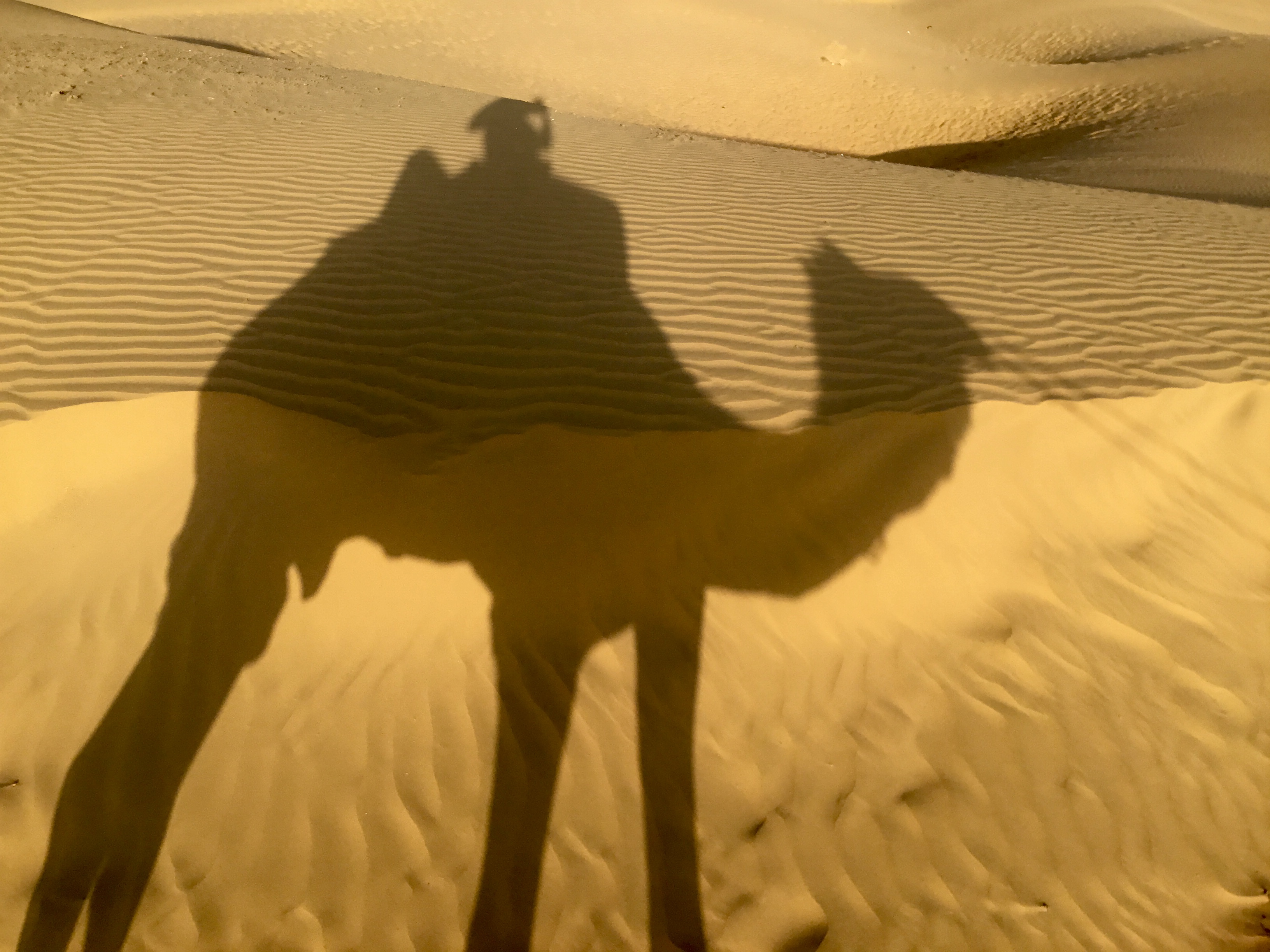
A: Art helps me explore and understand other cultures by revealing our shared humanity across space and time. For me art and travel are intertwined; there is no better education! My art-making has led me to visit fascinating places in search of source material, ideas, and inspiration: to Mexico, Guatemala, Brazil, Argentina, Uruguay, France, England, Italy, Bali, Java, Sri Lanka, and India. I have seen firsthand that people all over the world are the same.
Art has led me to undertake in-depth studies of intriguing subjects: drawing, color, composition, art, art history, the art business, film, film history, photography, mythology, literature, music, jazz, jazz history, and archaeology, particularly that of ancient Mesoamerica (Olmec, Zapotec, Mixtec, Aztec, and Maya), and South America (the Inca and their ancestors).
This rich mixture of creative influences continually grows. For anyone wanting to spend their time on earth studying, learning, and meeting new challenges, there is hardly anything more fascinating than to be a well-travelled, perpetually curious artist!
Comments are welcome!
Pearls from artists* # 478

*an ongoing series of quotations – mostly from artists, to artists – that offers wisdom, inspiration, and advice for the sometimes lonely road we are on.
Artists, because of the demands of their personality, their sense of personal mission, and their need to create or perform, are driven people. Mixed with the love of work can be a terrible pressure to work. For many artists, and especially for the most productive ones, the line between love and obsession and between love and compulsion blurs or disappears entirely. Are such artists free or are they slaves to their work?
In The Artist and Society the psychiatrist Lawrence Hatterer said of such an artist:
His most recognizable trait is his recurring daily preoccupation with translating artistic activity into accomplishment. The consuming intensity of this artistic pursuit brooks no interference or obstacles. His absorption with the creative act is such that he experiences continually what the average artist feels only infrequently when he reaches unusual levels of creative energy with accompanying output. He appears to be incapable of willful nonproductivity.
This is Picasso working for 72 hours straight. This is van Gogh turning out 200 finished paintings during his 444 days in Arles. The artist who is “incapable of willful nonproductivity” is a workaholic for whom little in life, apart from his artistic productivity and accomplishment, may have any meaning.
Eric Maisel in A Life in the Arts: Practical Guidance and Inspiration for Creative and Performing Artists
Comments are welcome!
Q: How did your ebook “From Pilot to Painter” come to be? (Question from “Arte Realizzata”)
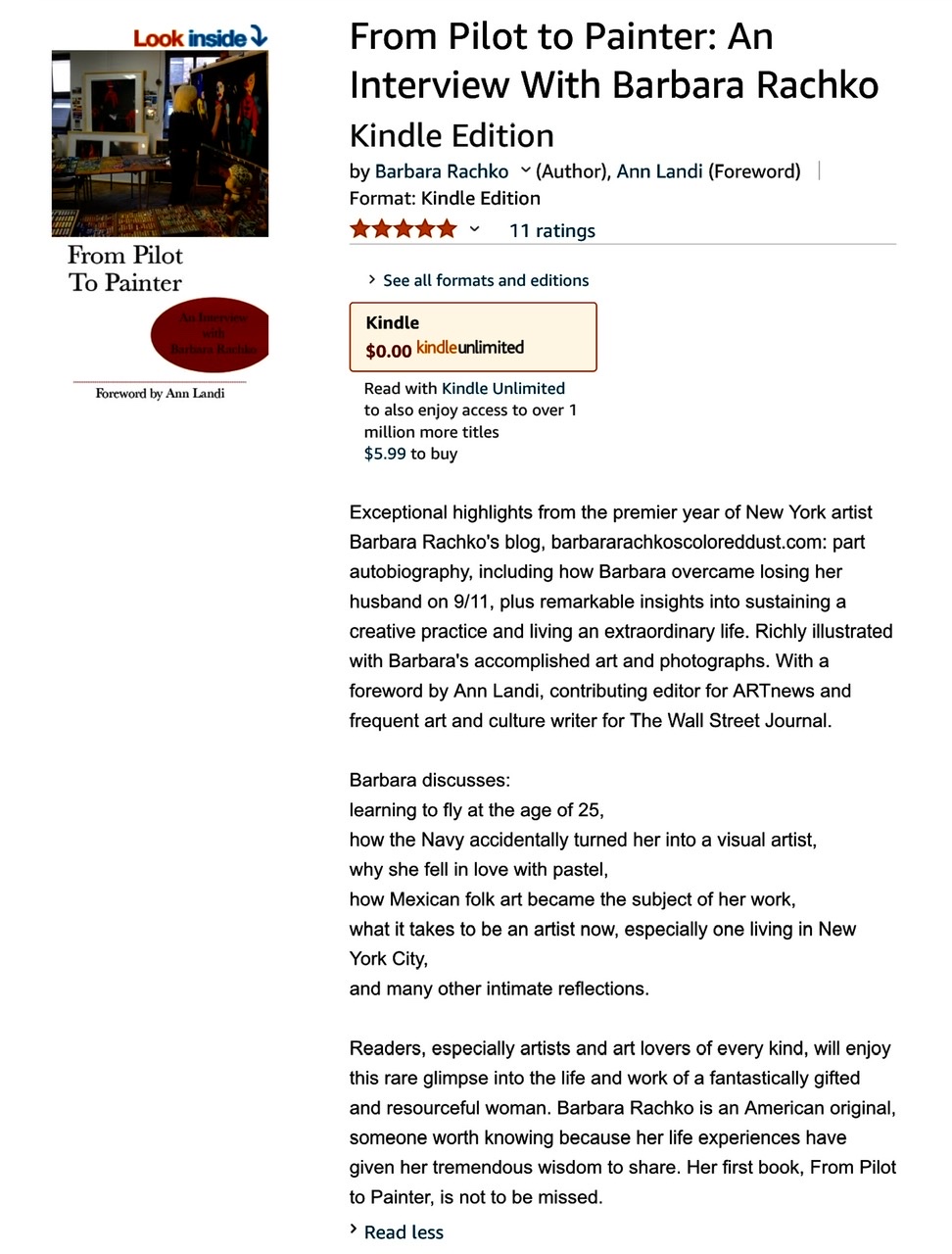
A: It was my longtime assistant, Barbra Drizin’s, idea and more than I’d care to admit, I was resistant. I said, “I am much too busy to write an ebook!” Barbra went on to explain that we could start with material I had already written for my blog, expand on it, add reproductions of my pastel paintings, etc. With her persuasion, I agreed! Barbra made the initial selections and together we added and revised text, organized the material, and worked out countless details. I asked my friend, Ann Landi, to write a foreword and Barbra found an editor to put everything into Amazon’s ebook format.
Now I am extremely pleased that my ebook FROM PILOT TO PAINTER is available not only on Amazon, but also on iTunes. It is based on my blog and is part memoir, including the loss of my husband on 9/11, insights into my creative practice, and intimate reflections on what it’s like to be an artist living in New York City. The ebook includes material not found on the blog, plus 25+ reproductions of my vibrant pastel-on-sandpaper paintings, a Foreword by Ann Landi, the founder of Vasari21.com and longtime critic for ARTnews, and more.
Comments are welcome!



