Barbara Rachko, born in 1953 in Paterson, New Jersey, is a contemporary painter based in New York City, renowned for her large pastel-on-sandpaper paintings inspired by Bolivian Carnival masks. With nearly 40 years dedicated to revolutionizing pastel as a fine art medium, Rachko’s influential blog, Barbara Rachko’s Colored Dust, has garnered over 229,000 subscribers. She is the subject of the acclaimed documentary “Barbara Rachko: True Grit,” available on YouTube, and her ebook “From Pilot to Painter” captures her inspiring journey from a former pilot to an accomplished artist.
Rachko’s work explores the vibrant cultural heritage of Bolivian Carnival masks, and Mexican and Guatemalan folk art. Her meticulous attention to detail is showcased in notable series such as Bolivianos, Black Paintings, and Domestic Threats. In 2023, she was featured in a documentary that premiered at the Newport Beach Film Festival, earning the Audience Award and Best in Category Award, further cementing her impact on contemporary art.
Her solo exhibitions include the Joy Pratt Markham Gallery at Walton Arts Center (AR), Louise Jones Brown Gallery at Duke University (NC), Olin Gallery (VA), and La MaMa La Galleria (NY). She trained in photography at the International Center of Photography in New York and studied drawing and pastel techniques at the Art League School in Alexandria, VA. Her works are held in private collections worldwide and have been showcased at prestigious art fairs, including Art Basel Miami, Moon Art Fair in Hamburg, and Art Busan in Korea, affirming her global influence in pastel painting.
A: This is a long story because my path to becoming a professional artist has been unusually circuitous.
I grew up in a blue collar family in suburban New Jersey. My parents were both first-generation Americans and no one in my family had gone to college. I was a smart kid, who showed some artistic talent in kindergarten and earlier. At the age of 6, my sister, my cousin, and I enrolled in Saturday morning painting classes at the studio of a local artist. I continued the classes for about 8 years and became a fairly adept oil painter.
At the age of 15 my father decided that art was not a serious pursuit – he called it a hobby, not a profession – and abruptly stopped paying for my Saturday morning lessons. Unfortunately, there were no artists or suitable role models in my family. So with neither financial nor moral support to pursue art, I turned my attention to very different interests.
Cut to ten years later. When I was 25, I earned my private pilot’s license and spent the next two years amassing other flying licenses and ratings, culminating in a Boeing-727 flight engineer’s certificate.
At 29, I joined the Navy. By then I was an accomplished civilian pilot with thousands of flight hours so I expected to fly jets. However, in the early 1980s women were not allowed in combat. There were very few women Navy pilots and those few were restricted to training male pilots. There were no women pilots landing on aircraft carriers.
In the mid-1980s I was in my early 30s, a lieutenant on active duty in the Navy, working a soul-crushing job as a computer analyst on the midnight shift in a Pentagon basement. It was literally and figuratively the lowest point of my life. I was completely bored and miserable.
Remembering the joyful Saturdays of my youth when I had taken art classes with a local New Jersey painter, I enrolled in a drawing class at the Art League School in Alexandria, Virginia. Initially I wasn’t very good, but it was wonderful to be around other women and a world away from the mentality of the Pentagon. I was having fun again! I enrolled in more classes and became a very motivated full-time art student who worked nights at the Pentagon. As I studied and improved my skills, I quickly discovered my preferred medium – soft pastel on sandpaper.
Although I knew I had found my calling, for more than a year I agonized over whether or not to leave the financial security of a Navy paycheck. Finally I did make up my mind and resigned my commission, effective on September 30, 1989. With Bryan’s (my then boyfriend’s) support, I left the Navy to devote my time to making art.
I’m probably one of the few people who can name THE day I became a professional artist! That day was October 1, 1989. Fortunately, I have never needed another job. I remained in the Navy Reserve for the next 14 years, working primarily at the Pentagon for two days each month and two weeks each year. I commuted by train to Washington, DC after I moved to Manhattan in 1997. Finally on November 1, 2003, I officially retired as a Navy Commander.
Life as a self-employed professional artist is endlessly varied, fulfilling, and interesting.I have never regretted my decision to pursue art full-time.
*an ongoing series of quotations – mostly from artists, to artists – that offers wisdom, inspiration, and advice for the sometimes lonely road we are on.
The creation of something new is not accomplished by the intellect but by the play instinct acting from inner necessity. The creative mind plays with the object it loves.
Carl Jung quoted by Stephen Nachmanovitch in Free Play: Improvisation in Life and Art
*an ongoing series of quotations – mostly from artists, to artists – that offers wisdom, inspiration, and advice for the sometimes lonely road we are on.
I learned about the Japanese word irimi while studying Aikido, a Japanese martial art. Simply translated, irimi means ,’to enter’ but it can also be translated ‘choose death.’ When attacked you always have two options:to enter, irimi, or to go around, ura. Both when accomplishedin the right manner, are creative. To enter or to ‘choose death’ means to enter fully with the acceptance, if necessary, of death. The only way to win is to risk everything and be fully willing to die. If this is an extreme notion to Occidental sensibilities, it does make sense in creative practice. To achieve the violence of decisiveness, one has to ‘choose death’ in the moment by acting fully and intuitively without pausing for reflection about whether it is the right decision or if it is going to provide the winning solution.
It is also valuable to know when to use ura, or going around. There is a time for ura, going around, and there is a time for irimi, entering. And these times can never be known in advance. You must sense the situation and act immediately. In the heat of creation, there is no time for reflection; there is only connection to what is happening. The analysis, the reflection and the criticism belong before and after, never during, the creative act.
Anne Bogart in “A Director Prepares: Seven Essays on Art and Theater”
A: My journey to becoming a visual artist was circuitous, to say the least. Risk-taking gave me the life and career I enjoy now.
The biggest – and scariest – risk I’ve ever taken was deciding to leave my active duty Naval career to pursue art full-time. The second most significant risk was moving to New York City in 1997. I have never regretted doing either one.
When I was 25, and a civilian, I earned my private pilot’s license and spent the next two years amassing other flying licenses and ratings, culminating in a Boeing-727 flight engineer’s certificate. Two years later I joined the Navy.
As an accomplished civilian pilot with thousands of flight hours, I had expected to fly jets in the Navy. However, women were barred from combat in those days (the 1980s) so there were very few women Navy pilots. There were no female pilots on aircraft carriers and no female Blue Angels. Women were restricted to training male pilots for combat jobs and priority was given to Naval Academy graduates. My BA was from a different university.
In the mid-1980s I was in my early 30s and a Lieutenant on active duty in the Navy. I worked a soul-crushing job as a computer analyst on the midnight shift in a Pentagon sub-basement. It was literally and figuratively the lowest point of my life. I hated my job! Not only was it boring, I was not using my hard-won flying skills. In short I was miserable – miserable and trapped because a Naval officer cannot just resign with two weeks notice.
Remembering the joyful Saturdays of my youth when I had taken art classes with a local New Jersey painter, I enrolled in a drawing class at the Art League School in Alexandria, Virginia. Initially I wasn’t very good, but it was wonderful to be around other women and a world away from the “warrior mentality” of my mostly male Pentagon co-workers. Plus, I was having fun!
Soon I enrolled in more classes and became a very motivated full-time art student who worked nights at the Pentagon. As I studied and improved my skills, I discovered my preferred medium – soft pastel on sandpaper.
Although I was certain I had found my life’s calling as a fine artist, I had grown used to a regular paycheck and the many benefits of being a Navy Lieutenant. For more than a year I agonized over whether or not to leave the Navy and lose my financial security. I’d be taking a huge risk: could I ever support myself as an artist? Was I making the dumbest mistake of my life?
Eventually, I decided I HAD TO take a leap. I simply adored making art – it challenged me to use all of my skills and talents – while I was unhappy, bored, and unfulfilled working at the Pentagon.
But once my mind was finally made up, I still could not leave. Due to geopolitical circumstances, there was a significant delay. The Navy was experiencing a manpower shortage and Congress had enacted a stop-loss order, which prevented officers from resigning for one year. I submitted my resignation effective exactly one year later: on September 30, 1989. Being stuck in a job I no longer wanted nor had the slightest interest in, was truly the longest year of my life!
Unlike most people, I can pinpoint exactly when I became an artist. I designate October 1, 1989 as the day I became a professional artist! I have never regretted my decision and I never again needed, nor had, a day job.
However, I must mention that I remained as a part-time Naval Reservist for the next 14 years, working primarily at the Pentagon for two days every month and two weeks each year. The rest of the time was my own to pursue my art career. After I moved to Manhattan in 1997, I commuted by train to Washington, DC to work for the Navy.
Finally on November 1, 2003, I officially retired as a Navy Commander. Now, I daresay, I am the rare fine artist who can point to a Navy pension as a source of income.
I love my life as an accomplished New York fine artist! With the help of two social media assistants, I work hard to make and promote the art I create. My pastel paintings and my pastel skills continue to evolve and grow, gaining wider recognition and a larger audience along the way.
In addition to making art, I have been a blogger since 2012. The audience for my blog, https://barbararachkoscoloreddust.com/ increases by 1,000 – 2,000 new subscribers each month. Today I have more than 72,000 readers!
* an ongoing series of quotations – mostly from artists, to artists – that offers wisdom, inspiration, and advice for the sometimes lonely road we are on.
In its spectacle and ritual the Carnival procession in Oururo bears an intriguing resemblance to the description given by Inca Garcilaso de la Vega of the great Inca festival of Inti Raymi, dedicated to the Sun. Even if Oururo’s festival did not develop directly from that of the Inca, the 16th-century text offers a perspective from the Andean tradition:
“The curacas (high dignitaries) came to their ceremony in their finest array, with garments and head-dresses richly ornamented with gold and silver.
Others, who claimed to descend from a lion, appeared, like Hercules himself, wearing the skin of this animal, including its head.
Others, still, came dressed as one imagines angels with the great wings of the bird called condor, which they considered to be their original ancestor. This bird is black and white in color, so large that the span of its wing can attain 14 or 15 feet, and so strong that many a Spaniard met death in contest with it.
Others wore masks that gave them the most horrible faces imaginable, and these were he Yuncas (people from the tropics), who came to the feast with the heads and gestures of madmen or idiots. To complete the picture, they carried appropriate instruments such as out-of-tune flutes and drums, with which they accompanied the antics.
Other curacas in the region came as well decorated or made up to symbolize their armorial bearings. Each nation presented its weapons: bows and arrows, lances, darts, slings, maces and hatchets, both short and long, depending upon whether they used them with one hand or two.
They also carried paintings, representing feats they had accomplished in the service of the Sun and of the Inca, and a whole retinue of musicians played on the timpani and trumpets they had brought with them. In other words, it may be said that each nation came to the feast with everything that could serve to enhance its renown and distinction, and if possible, its precedence over the others.”
El Carnaval de Oruro by Manuel Vargas in Mascaras de los Andes Bolivianos, Editorial Quipus and Banco Mercantil
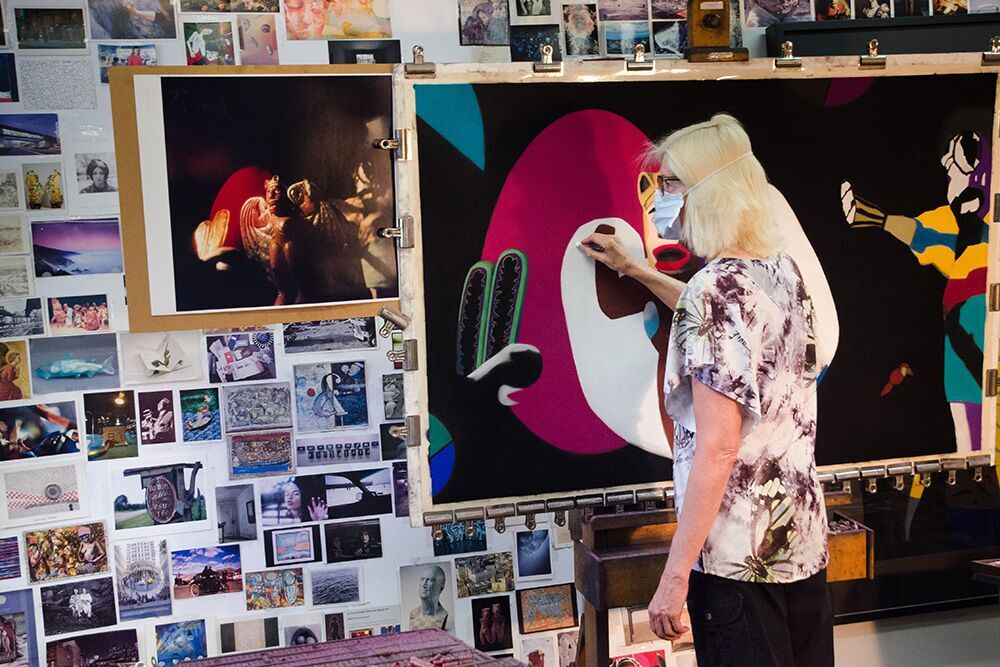
Barbara at work on “Schemer,” Soft Pastel on Sandpaper, 26” x 20”
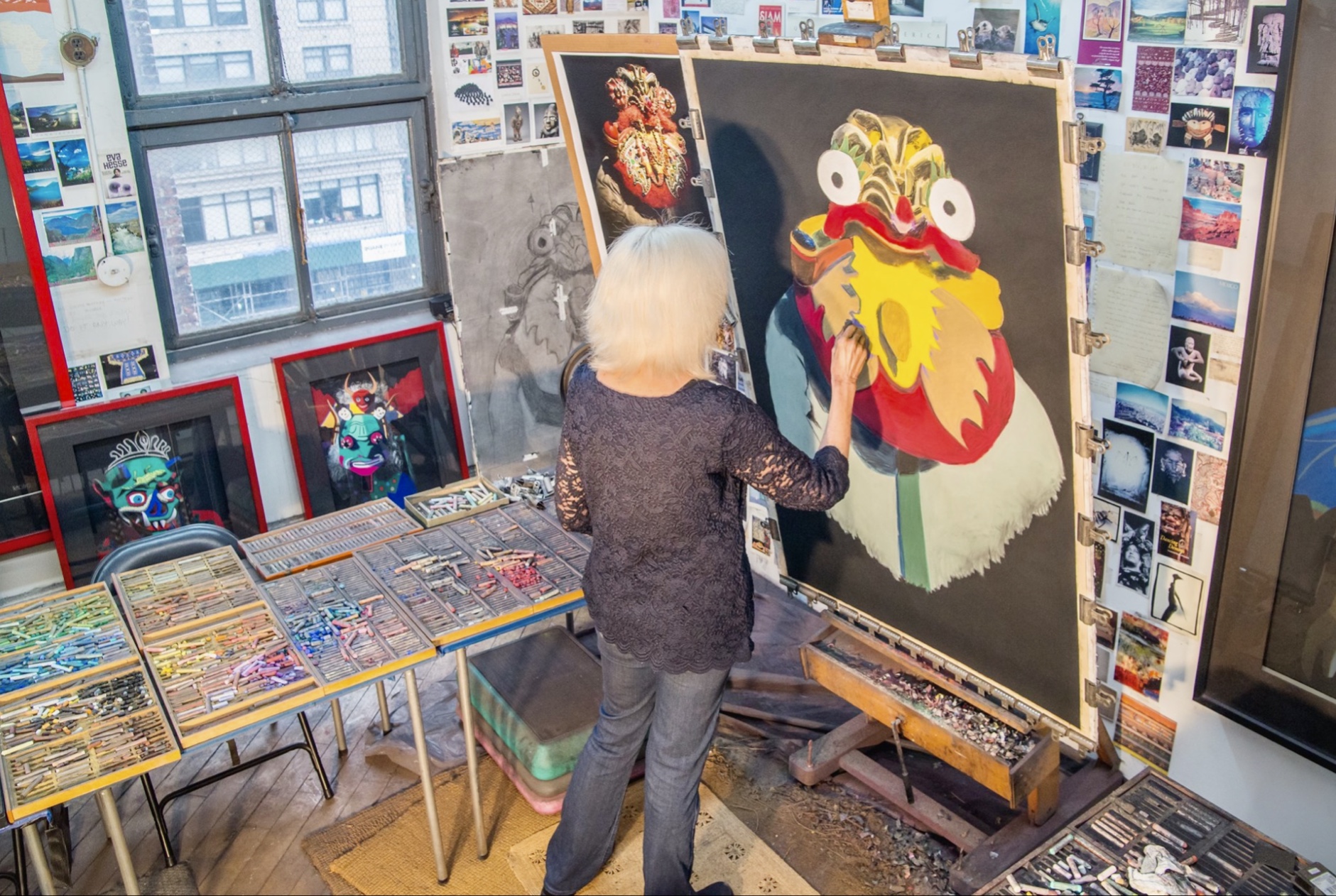
A: I’ll describe a typical day at the studio. When I first arrive in the morning, I read for 30 minutes. Reading focuses and quiets my mind and gets me ready to begin the day’s work. While I read, I look at the pastel painting that’s on my easel to see where to begin. Then I close the book, turn on some music, plug in the Halogen lamps I use while working, apply a barrier cream to my hands, put on a surgical mask (to avoid breathing pastel dust), pick up a pastel, and start.
I never sit while working. I enjoy the physicality of art-making and prefer to stand at my easel so I can back up to see how the pastel painting looks from a distance. I like being on my feet all day and getting some exercise. I work for a couple of hours, break for lunch, and then work the rest of the afternoon.
I believe artists need to be disciplined. I work five days a week, taking Wednesdays and Sundays off, and spend seven hours or more per day in the studio. Daylight is essential so I work more hours in summer, fewer in winter. I like to think of art-making as independent of time tables, but I tend to work in roughly two-hour blocks before taking a break. I typically work until 5:00 or so.
Studio hours are sacrosanct and exclusively for creative work. I do not have WiFi at my studio and prefer to keep my computer and mobile devices elsewhere (they devour time). Art business activities – answering email, keeping up with social media, sending jpegs, writing blog posts, doing interviews, etc. – are accomplished at home in the mornings, in the evenings, and on days off from the studio.
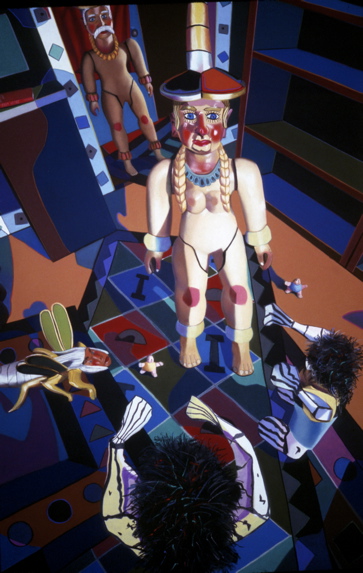
“Answering the Call,” 58″ x 38,” soft pastel on sandpaper, 2000
A: In my younger days boredom was a strong motivator. I left the active duty Navy out of boredom. I couldn’t bear not being intellectually challenged (most of my jobs consisted of paper-pushing), not using my flying skills, and not developing my artistic talent. In what must be a first, by spending a lot of time and money training me for jobs I hated, the Navy turned me into a hard-working, devoted, and disciplined artist! Once I left the Navy there was no plan B. It was “full speed ahead” to become an accomplished artist.
A: No, I never sit while working. I enjoy the physicality of art-making and prefer to stand at my easel so I can back up to see how a painting looks from a distance. I like being on my feet all day and getting some exercise.
In order to accomplish anything, artists need to be disciplined. I work five days a week, taking Wednesdays and Sundays off, and spend seven hours or more in the studio. Daylight is necessary so I work more hours in summer, fewer in winter. I deliberately don’t have a clock on the wall – art-making is independent of timetables – but I tend to work in roughly two-hour blocks before taking a break.
Studio hours are sacrosanct and exclusively for creative work. I keep my computer and mobile devices out of the studio. Art business activities – answering email, keeping up with social media, sending jpegs, writing blog posts, doing interviews, etc. – are mostly accomplished at home in the evenings and on days off.
A: Two essentials immediately come to mind. I believe imagination and curiosity are very important qualities, not only for artists, but for anyone who hopes to look back on a well-lived life. As Lauren Bacall famously said, “Imagination is the highest kite one can fly.”
It is curiosity that keeps people laser-focused on a lifetime journey of learning. I’d venture to say that curiosity is the not-so-secret quality of accomplished people in every profession. We humans can never know enough!







 barbararachkoscoloreddust.com