Blog Archives
Pearls from artists* # 629

Barbara’s Studio
*an ongoing series of quotations – mostly from artists, to artists – that offers wisdom, inspiration, and advice for the sometimes lonely road we are on.
I kept coming back to [Ellen] Dissanayake. She’s for banning the word art altogether on the grounds it’s uselessly vague, and argues we shouldn’t treat art as a thing but as a behavior. Art, she claims, occurs anytime we take ordinary things and transform them into extraordinary experiences through a process she calls “making special.” Making special happens when words turn into poetry, flesh gets painted for a shaman’s ceremony, a B-flat meets a middle G to form the tune in a Peking opera. I liked her definition, which seemed less arbitrary than others I’d read and didn’t turn up its nose at blockbuster movies or Super Bowl halftime shows – which Dissanayake calls “the arts of our time.” As she sees it, art results from several key “operations” … Artists repeat… formalize… exaggerate… elaborate… and manipulate expectation… Break dancing, leading a tea ceremony, designing Grand Theft Auto – to Dissanayake, it’s art, art, and more art.
Bianca Bosker in Get the Picture: A Mind-Bending Journey Among the Inspired Artists and Obsessive Art Fiends Who Taught Me How to See
Comments are welcome!
Pearls from artists* # 622

In the studio
*an ongoing series of quotations – mostly from artists, to artists – that offers wisdom, inspiration, and advice for the sometimes lonely road we are on.
Divining meaning from a painting is not so simple that it can be codified in a book, and [Mark] Rothko certainly would not have wanted such a guide to his work. So much of understanding his work is personal, and so much of it is made up of the process of getting inside the work. It is like the “plastic journey” he describes in his “Plasticity” chapter – you must undertake a sensuous adventure within the world of the painting in order to know it at all. He cannot tell you what his paintings, or anyone else’s, is about. You have to experience them. Ultimately, if he could have expressed the truth – the essence of these works – he probably would not have bothered to paint them. As his works exemplify, writing and painting involve different kinds of knowing.
Christopher Rothko in The Artist’s Reality: Philosophies of Art by Mark Rothko
Comments are welcome!
Pearls from artists* # 613
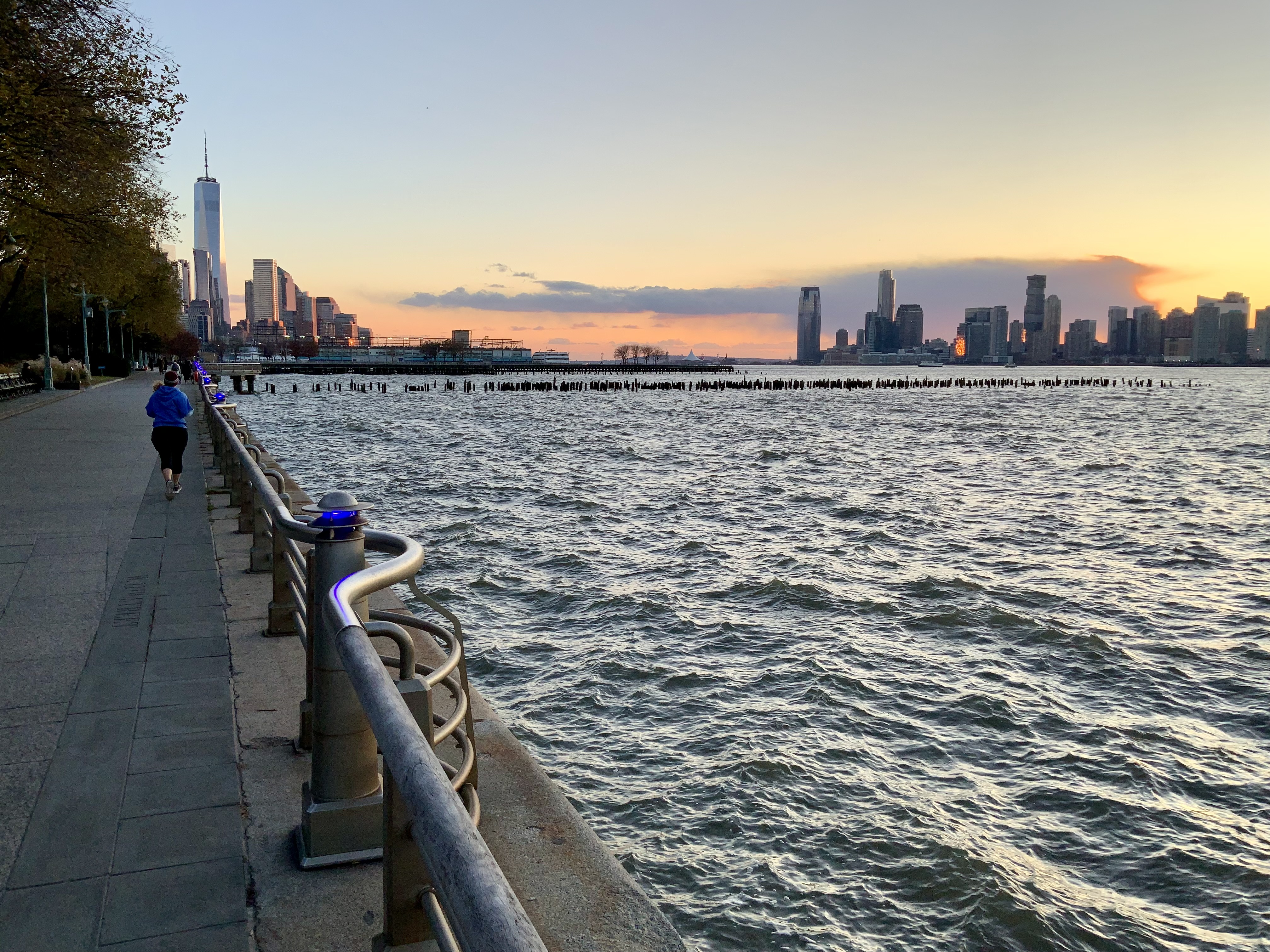
New York NY
*an ongoing series of quotations – mostly from artists, to artists – that offers wisdom, inspiration, and advice for the sometimes lonely road we are on.
A painting is a statement of the artist’s notions of reality in terms of plastic speech. In that sense the painter must be likened to the philosopher rather than to the scientist. For science is a statement of the laws that govern a specific phenomenon or category of matter or energy within the specified units and conditions of its operation. Philosophy, however, must combine all these specialized truths within a single system. It is because of this broad scope that Aristotle gives preeminence to the philosopher in the introduction to his Metaphysics, for he tells us that every man except the philosopher is an authority within his specific field, whereas the philosopher must have the acute knowledge that each man has in his own field plus the ability to relate all these fields to the operations of universality and eternity.
Therefore art, like philosophy, is of its own age; for the partial truths of each age differ from those of other ages, and the artist, like the philosopher, must constantly adjust eternity, as it were, to all the specifications of the moment. Art, too, creates at different times the notions of reality that the artist, as a man of the age, must inherit and develop and consider real along with the other intellectually conscious men of his time. His language, which is his plastic means, will also adjust itself to the possibility of making these notions manifest in their most coherent possibilities. The reality of the artist, therefore, reflects the understanding of his times, even as his creations shape those understandings. We posit this without wishing to attempt to untangle here the series of causes and effects, a process which would probably obscure more than it certified.
Mark Rothko in The Artist’s Reality: Philosophies of Art
Comments are welcome!
Q: How do you persist despite the haters, nay-sayers, etc.? (Question from Bold Journey Publishing)

Barbara’s Studio
A: There are so many obstacles to art-making and countless reasons to just give up. When you really think about it, it’s amazing that great art gets made at all. So why do we do it? For artists I believe it’s all about making our time on earth matter, about devotion to our innate gifts, and a deep love of our hard-fought creative process.
I have been a full-time professional artist for 37 years. How and why do successful artists persist? It helps a lot to be stubborn! We just keep digging in that much deeper. Making art is a most noble and sacred calling – you know this if you are one of the called – and that’s what separates those of us who are in it for the long haul from the wimps, fakers, and hangers-on. I say to my fellow artists who continue to work despite the endless challenges, we artists who continue to struggle every day for recognition of our gifts are true heroes!
These words below by Mary Gabriel in Ninth Street Women, published in 2017, ring true for artists. It’s good, even for me, to occasionally reread them and be reminded.
The obstacles faced by women who hoped to leave a mark on humankind have, through the millennium, varied in height but not in stubborn persistence. And yet, a great many women have stubbornly ignored them. The desire to put words on a page or marks on a canvas was greater than the accrued social forces that told them they had no right to do so, that they were excluded by their gender from that priestly class called artist. The reason, according to Western tradition, was as old as creation itself: For many, God was the original artist and society had assigned its creator a gender – He. The woman who dared to declare herself an artist in defiance of centuries of such unwavering belief required monstrous strength, to fight not for equal recognition and reward but for something at once more basic and vital: her very life. Her art was her life. Without it, she was nothing. Having no faith that society would broaden its views on artists by dethroning men and accommodating women, in 1928 [Virginia] Woolf offered her fellow writers and painters a formula for survival that allowed them to create, if not with acceptance, then at least unimpeded. A woman artist, she said, needed but two possessions: “money and a room of her own.”
Furthermore, I think I persist because I do not believe in “big breaks.” Big breaks may sometimes happen, but in my experience an artist’s life is made up of single-minded dedication, persistence, hard work, and lots of small breaks. I recently finished reading “Failing Up: How to Take Risks, Aim Higher, and Never stop Learning” by Leslie Odom, Jr. I like what he has to say to artists here:
The biggest break is the one you give yourself by choosing to believe in your wisdom, in what you love, and in the gifts you have to offer the waiting world.
Comments are welcome!
Pearls from artists* # 575

Barbara’s Studio
*an ongoing series of quotations – mostly from artists, to artists – that offers wisdom, inspiration, and advice for the sometimes lonely road we are on.
Creativity is a harmony of opposite tensions… As we ride through the flux of our own creative processes, we hold onto both poles. If we let go of play, our work becomes ponderous and stiff. If we let go of the sacred, our work loses its connection to the ground on which we live.
Knowledge of the creative process cannot substitute for creativity, but it can save us from giving up on creativity when the challenges seem too intimidating and free play seems blocked. If we know that our inevitable setbacks and frustrations are phases of the natural cycle of creative processes, if we know that our obstacles can become our ornaments, we can persevere and bring our desires to fruition. Such perseverance can be a real test, but there are ways through, there are guideposts. And the struggle, which is guaranteed to take a lifetime, is worth it. It is a struggle that generates incredible pleasure and joy. Every attempt we make is imperfect; yet each one of these imperfect attempts is an occasion for a delight unlike anything else on earth.
The creative path is a spiritual path. The adventure is about us, about the deep self, the composer in all of us, about originality, meaning not that which is all new, but that which is fully and originally ourselves.
Stephen Nachmanovitch in Free Play: Improvisation in Life and Art
Comments are welcome!
Q: The first pastel painting you see every morning when you arrive at your studio is “Myth Meets Dream.” It must have special meaning. Would you elaborate? (Question suggested by Marlissa Gardner via Facebook)

A: “Myth Meets Dream,” an early pastel painting from the “Domestic Threats” series, is one I have never wanted to sell. It marks the first time I included Mexican folk art figures in my work. In 1992 as a Christmas present, my future sister-in-law sent the two Oaxacan painted wooden figures you see depicted above – the blue winged creature and the red, white, and black figure behind it. The other three figures in this painting are hand-puppets.
Previously, I had been creating elaborate staged photographs in my Alexandria house using stuffed animals and hand-puppets. (The latter were made by a company called “Folk Tails”). I used the photos as reference material for pastel paintings. In other words, rather than work exclusively from life, I mostly looked at these photos while I made the painting. Although I have simplified my process since those early days, I still create pastel paintings using reference photographs.
In “Myth Meets Dream” you can see both puppets and my then new Oaxacan folk art figures. This pastel painting marks an important transition in subject matter and was the start of decades-worth of foreign travel, study, adventure, hard work, and yes, fun. It’s true that “Myth Meets Dream” hangs in my studio and is the first thing I see every morning. It brings back so many precious memories.
Every painting has a story!
If you’re interested to learn more, please see https://barbararachko.art/en/art-market
Comments are welcome!
Pearls from artists* # 563

*an ongoing series of quotations – mostly from artists, to artists – that offers wisdom, inspiration, and advice for the sometimes lonely road we are on.
[John] Graham defined art as a “process of abstracting” thought and emotion by the use of paint or metal or stone. Because art was therefore intrinsically abstract, the duty of the artist would be to push abstraction “fearlessly to its logical end instead of evading it under the disguises of charm or being ‘true to nature.’” The artist created for society, he said, but if that society didn’t like what he or she had produced, the artist”does not trade his ideals for success. Martyrs and saints love luxury and success just as much as ordinary people, only they love something else even more.” Graham said, if the artist is a true genius, he can expect to be misunderstood and alone. “The beauty of genius is frightful to behold, few can envisage it. Others find subterfuge in scepticism.” The abstract artist, he said, would be repeatedly challenged by such skeptics asking, “‘What does it mean?’… Is it a sky, a house, a horse?’” To which they should respond with confidence and honesty, “‘No, it is a painting.’”
Mary Gabriel in Ninth Street Women
Comments are welcome!
Pearls from artists* #561

*an ongoing series of quotations – mostly from artists, to artists – that offers wisdom, inspiration, and advice for the sometimes lonely road we are on.
The most powerful symbols draw profound reactions from us. The symbolic images in great art attract and fascinate us; they stir our souls and move us beyond what can be easily expressed; ‘their pregnant language cries out to us that they mean more than they say.’
The unconscious produces symbols as part of a natural process within us. These images emerge out of the context of our lived experience… Jung saw the meaning-making process as one that not only requires attendance to the real context of our lives and history, but also involves profound inner listening. It asks us to use our rational capacities, but also our feeling and imaginal ones.
Symbolic images redirect our psychic energy, bringing together conscious and unconscious material and producing the lessening of conflict. In this way, they activate a transcendent function within the psyche. We experience this as the discovery of personal meaning and healing. This transformation is not the result of formulaic operations, but rather is a dynamic process that requires our authentic and vulnerable participation. The process challenges the whole of who we are and requires deep moral effort. That the unconscious would produce moving, powerful compensatory symbols inside us at all points to a fact that our culture may not have fully grasped – that there is a force working within us which is always driving us towards healing growth and greater consciousness… Despite our suffering, the psyche is always ultimately seeking both a healthy homeostatic balance and our ever-unfolding growth and unique development.
Gary Bobroff in Carl Jung: Knowledge in a Nutshell
Comments are welcome!
Q: How has the use of photography in your work changed over the decades?
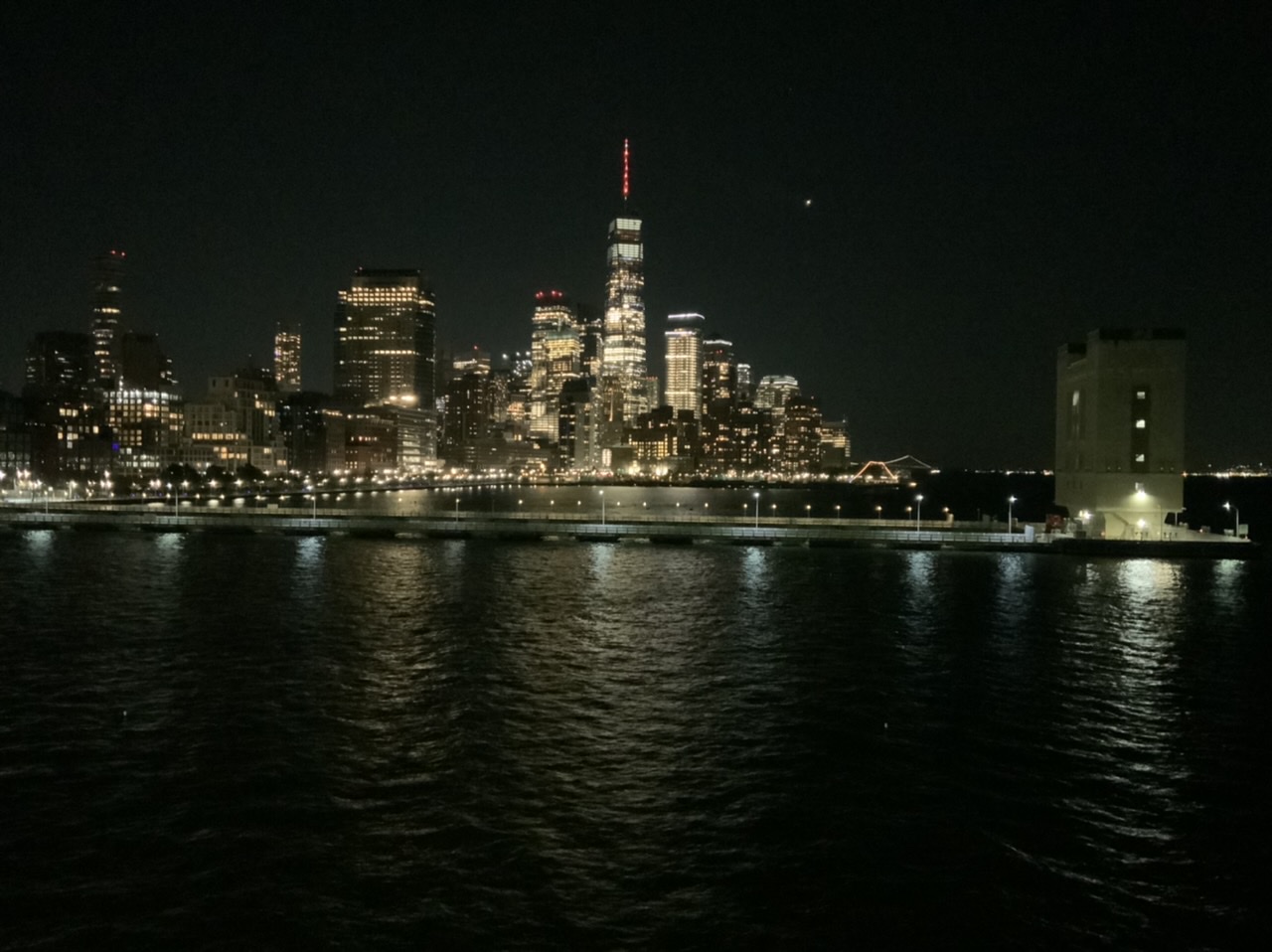
New York, NY
A: From the beginning in the mid-1980s I used photographs as reference material. My late husband, Bryan, would shoot 4” x 5” negatives of my elaborate setups using his Toyo-Omega view camera. In this respect Bryan was an integral part of my creative process as I developed the “Domestic Threats” pastel paintings. At that time I rarely picked up a camera, except to capture memories of our travels.
After Bryan was killed on 9/11, I inherited his extensive camera collection – old Nikons, Leicas, Graphlex cameras, and more. I wanted and needed to learn how to use them. Starting in 2002 I enrolled in a series of photography courses (about 10 over 4 years) at the International Center of Photography in New York. I learned how to use all of Bryan’s cameras and how to make my own big chromogenic prints in the darkroom.
Along the way I discovered that the sense of composition and color I had developed over many years as a painter translated well into photography. The camera was just another medium with which to express my ideas. Surprisingly, in 2009 I had my first solo photography exhibition at a gallery in New York. Bryan would have been so proud!
For several years now my camera of choice has been a 12.9” iPad Pro. It’s main advantage is that the large screen let’s me see every detail as I compose my photographs. I think of it as a portable, lightweight, and easy-to-use 8 x 10 view camera. My iPad is always with me when I travel and as I walk around exploring New York City.
It is a wonderful thing to be both a painter and a photographer! While pastel painting will always be my first love, photography has distinct advantages over my studio practice. Pastel paintings are labor-intensive, requiring months of painstaking work. Photography’s main advantage is speed. Photographs – from the initial impulse to hanging a print on a wall – can be made in minutes. Photography is instant gratification, allowing me to explore ideas much easier and faster than I ever could as a painter. Perhaps most importantly, composing photographs keeps my eye sharp whenever I am away from the studio. I credit photography as an important factor in the overall evolution of my work.
Comments are welcome!
Q: It must be tricky moving pastel paintings from your New York studio to your framer in Virginia. Can you explain what’s involved? (Question from Ni Zhu via Instagram)
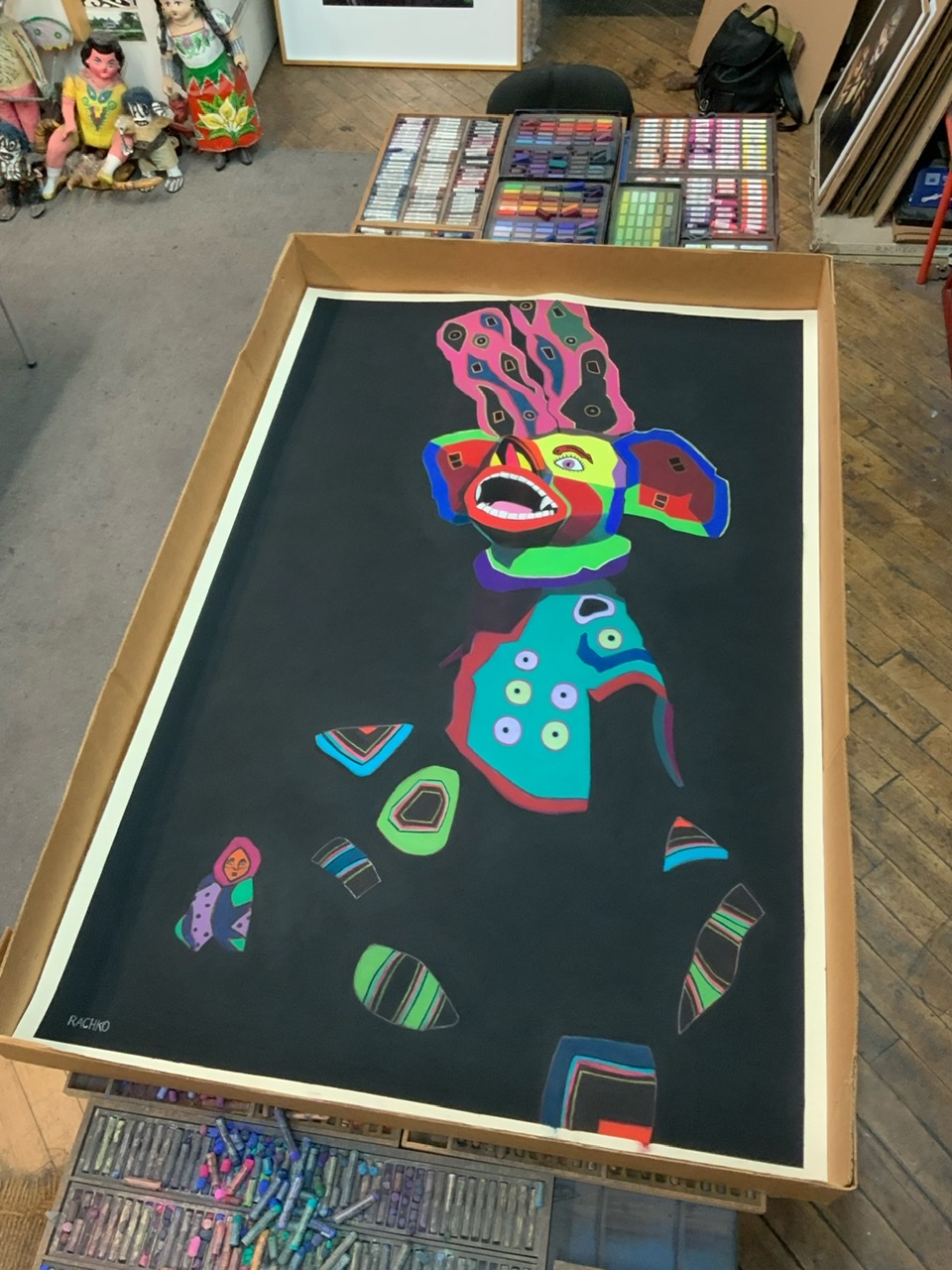
“Impresario” partially boxed for transport to Virginia
A: Well, I have been working with the same framer for three decades so I am used to the process.
Once my photographer photographs a finished, unframed piece, I carefully remove it from the 60” x 40” piece of foam core to which it has been attached (with bulldog clips) during the months I worked on it. I carefully slide the painting into a large covered box for transport. Sometimes I photograph it in the box before I put the cover on (see above).
My studio is in a busy part of Manhattan where only commercial vehicles are allowed to park, except on Sundays. Early on a Sunday morning, I pick up my 1993 Ford F-150 truck from Pier 40 (a parking garage on the Hudson River at the end of Houston Street) and drive to my building’s freight elevator. I try to park relatively close by. On Sundays the gate to the freight elevator is closed and locked so I enter the building around the corner via the main entrance. I unlock my studio, retrieve the boxed painting, bring it to the freight elevator, and buzz for the operator. He answers and I bring the painting down to my truck. Then I load it into the back of my truck for transport to my apartment.
I drive downtown to the West Village, where I live, and double park my truck. (It’s generally impossible to park on my block). I hurry to unload the painting, bring it into my building, and up to my apartment, all the while hoping I do not get a parking ticket. The painting will be stored in my apartment, away from extreme cold or heat, until I’m ready to drive to Virginia. On the day I go to Virginia, I load it back into my truck. Then I make the roughly 5-hour drive south.
Who ever said being an artist is easy was lying!
Comments are welcome!



