Blog Archives
Q: You read books on Friedrich Nietzsche and other philosophers. How has philosophy and your personal experience shaped the latest series, Bolivianos? (Question from Vedica Art Studios and Gallery)

A: It’s difficult to pinpoint how philosophy specifically shaped my work because my curiosity spans so many subjects. Some critics have described me as a Renaissance woman, remarking on my wide-ranging and voracious reading. It’s true—I’m genuinely interested in practically everything!
In pursuit of making art, I have undertaken in-depth studies of numerous intriguing fields: drawing, color, composition, gross anatomy, art and art history, the art business, film history, photography, psychology, mythology, literature, philosophy, religion, music, jazz history, and archaeology—particularly ancient Mesoamerica (Olmec, Zapotec, Mixtec, Aztec, and Maya) and South America (the Inca and their ancestors).
Since the early 1990s, my inspiration and subject matter have come primarily from international travel to remote parts of the globe, especially Mexico, Central America, and South America. Travel is by far the best education! By visiting distant destinations, I have developed a deep reverence for people and cultures around the world. People everywhere are connected by our shared humanity.
These travels, supplemented by extensive research at home, are essential parts of my creative process. Research can be solitary and demanding, but I truly enjoy it. I want to know as much as possible, and this curiosity generates ideas for new work, propelling me into unexplored creative realms.
Foreign travel always expands our ways of thinking. This rich mixture of creative influences continually evolves and finds its way into my pastel paintings. Working, learning, evolving, and growing—I am perpetually curious and can hardly imagine a better way to spend my time on Earth!
Comments are welcome!
Pearls from artists* # 642

New York City
*an ongoing series of quotations – mostly from artists, to artists – that offers wisdom, inspiration, and advice for the sometimes lonely road we are on.
Radical changes in our culture threaten to undermine the potency of art and artists alike. Disparate forces conspire to lower the bar for how we expect art to function. As decades go by, we are educating and evolving to value left-brain strengths over holistic right-brain thought, with disastrous consequences for humanity… Deep contemplation has been hijacked by addictive technology. Rising authoritarianism strives to squash dissenting and diverse voices, as well as historical truths and critical thinking skills. Social media approval affects the art that is produced, shared, and validated. Easily digested work is promoted, while the most compelling work (the kind that could transform the trajectory of art, or affect real social change) is left behind. Critics are coining terms like ‘Zombie Formalism’ … and ‘Zombie Figuration’ … in response to the sterility and stultifying sameness of much contemporary work. It’s as if artists were absorbing online algorithms into their bloodstreams. This empty, safe sensibility riffs and rehashes a vacuous culture, generating a perpetual cycle of well-branded insignificance.
Kate Kretz in Art From Your Core: A Holistic Guide to Visual Voice
Comments are welcome!
Pearls from artists* # 639

Barbara’s Studio
*an ongoing series of quotations – mostly from artists, to artists – that offers wisdom, inspiration, and advice for the sometimes lonely road we are on.
… my deep and lifelong conviction [is] that the results of my work don’t have much to do with me. I can only be in charge of producing the work itself. That’s a hard enough job. I refuse to take on additional jobs, such as trying to police what anybody thinks about my work once it leaves my desk.
Also, I realized it would be unreasonable and immature of me to expect that I should be allowed to have a voice of expression, but other people should not. If I am allowed to speak my inner truth, then my critics are allowed to speak their inner truths, as well. Fair’s fair. If you dare to create something and put it out there, after all, then it may accidentally stir up a response. That’s the natural order of life: the eternal inhale and exhale of action and reaction. But you are definitely not in charge of the reaction – even when the reaction is bizarre.
Elizabeth Gilbert in Big Magic: Creative Living Beyond Fear
Comments are welcome!
Pearls from artists* # 615

*an ongoing series of quotations – mostly from artists, to artists – that offers wisdom, inspiration, and advice for the sometimes lonely road we are on.
There are many artists and critics, including, but not only, Feminists, who have suggested that since “male” esthetic values predominated for centuries, it is impossible, and will be for a long time, to know what “women’s art” might be. I propose that the answer is at hand. The female voice was not lost, only not listened to.
Eleanor Munro in Originals: American Women Artists
Comments are welcome!
Pearls from artists* # 612
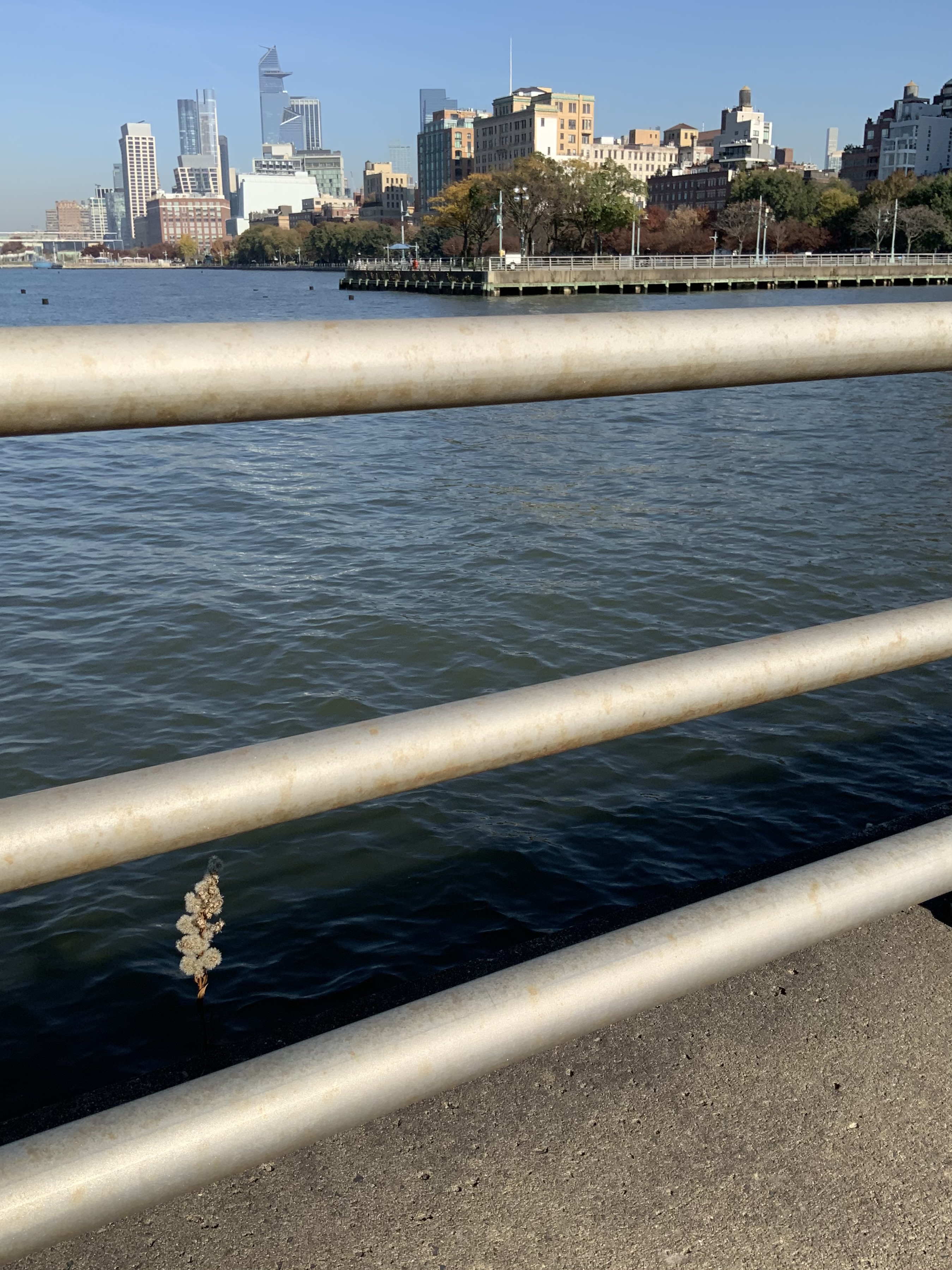
New York, NY
*an ongoing series of quotations – mostly from artists, to artists – that offers wisdom, inspiration, and advice for the sometimes lonely road we are on.
It is the poet and philosopher who provide the community of objectives in which the artist participates. Their chief preoccupation, like the artist, is the expression in concrete form of their notions of reality. Like him, they deal with verities of time and space, life and death, and the heights of exaltation as well as the depths of despair. The preoccupation with these external problems creates a common ground which transcends the disparity of the means used to achieve them. And it is in the language of the philosopher and poet or, for that matter, of other arts which share the same objective that we must speak if we are to establish some verbal equivalent of the significance of art.
Let us not for a moment conceive that the language of one is interchangeable with that of the other: that one can duplicate the sense of a picture by the sense of words or sounds, or that one can translate the truth of words by means of pictorial delineations. Not all odes of Pindar, framed and embroidered, could duplicate the portrayal by Apelles’ brush of the Hero of the Palaestra. The Pandemonium of Milton or Dante’s Inferno can never replace the vision of the Last Judgment by either Michelangelo or Signorelli. No more so than the Pastoral Symphony of Beethoven can be apprehended through the reading of idyllic poems, augmented by descriptions of woodland and fields, of torrents and streams, the study of ornithological sounds, and the laws of harmonics. Neither books on jurisprudence, nor costume plates, can possibly reconstruct Raphael’s School of Athens. And the man who knows a book or a picture through its critics, whatever his experience, has no experience of the art itself. The truth, the reality of each, is confined within its own boundaries and must be perceived in terms of the means generic to itself.
In speaking of art here, there is no thought of recreating the experience of the picture. If we compare one art to another, it is not with the intention of contrasting their actuality, but to speak rather of the motivations and properties such as are admissible to the world of verbal ideas. And if… we are partial to the philosopher – at the expense of those others who share with the artist his common objectives, it is not because we divine in his effort a greater sympathy to the artist, but because philosophy shares with art it’s preoccupation with ideas in the terms of logic.
Mark Rothko in The Artist’s Reality: Philosophies of Art
Comments are welcome!
Pearls from artists* # 475

*an ongoing series of quotations – mostly from artists, to artists – that offers wisdom, inspiration, and advice for the sometimes lonely road we are on.
In order to warm the artist’s heart, it’s necessary to assert that he is doing good work. Random or wrong-headed praise won’t do the trick, but will only exacerbate the artist’s feeling that he is unseen and misunderstood.
Even wrong-headed praise is the exception rather than the rule in the artist’s search for recognition. More often than not your recognition will consist of criticism, not praise. You may be criticized for not attempting work you have no desire to attempt, for pandering to mass taste, for working too exotically or too narrowly… You may be attacked in a mixed review that purports to praise you. In short, you may be criticized for everything and anything under the sun.
Can you escape this criticism as you struggle for recognition? No. The journalist Elbert Hubbard said, “To escape criticism, do nothing, say nothing, be nothing.” … you can’t escape criticism, you can’t tame your critics.
Eric Maisel in A Life in the Arts: Practical Guidance and Inspiration for Creative and performing Artists
Comments are welcome!
Q: What kind of art do you create?
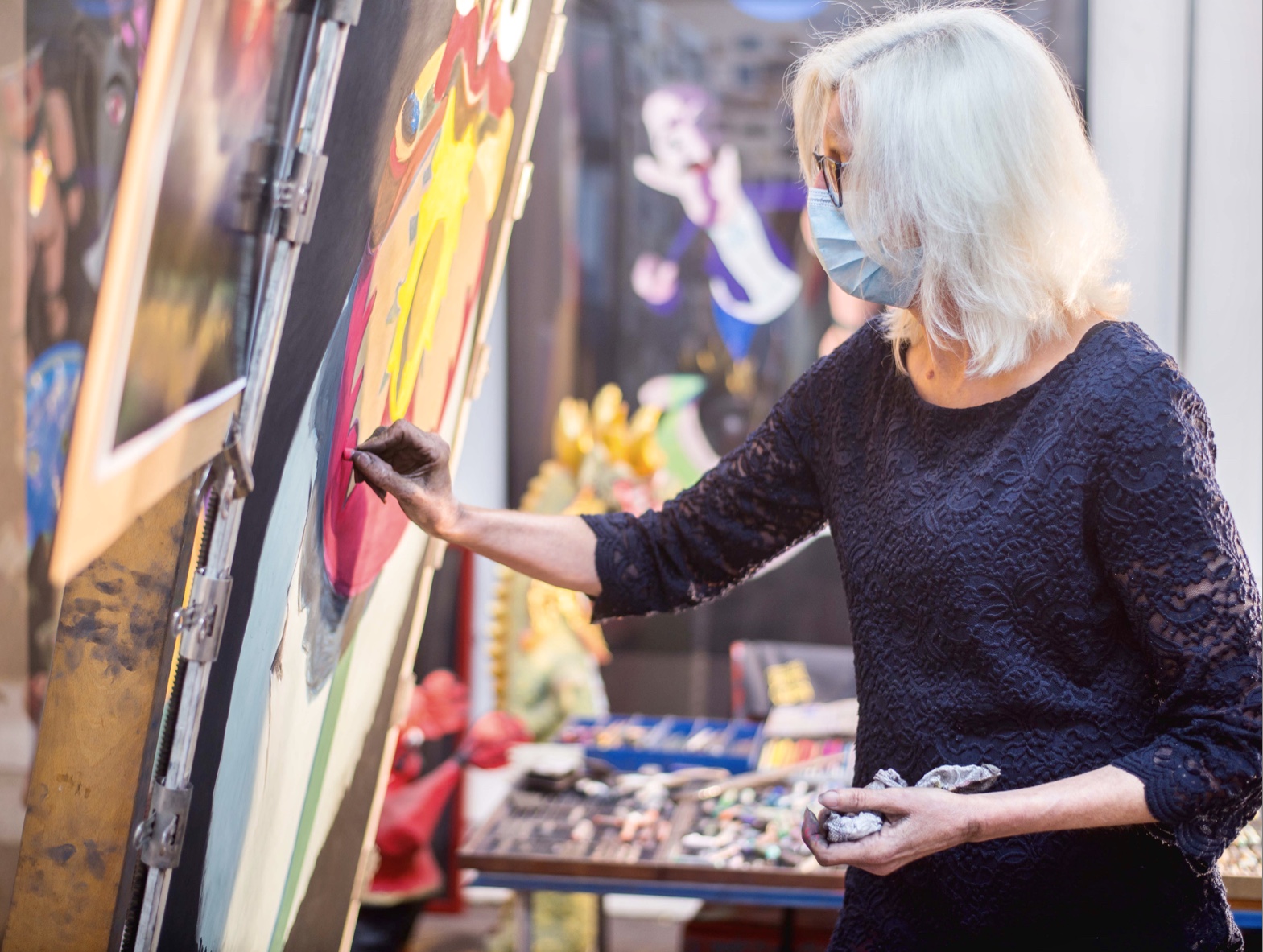
At work
A: I live in the West Village in New York City and have been a working artist for thirty-four years. I create original pastel paintings that use my large collection of Mexican and Guatemalan folk art – masks, carved wooden animals, papier mache figures, and toys – as subject matter. Blending with my fingers, I spend months painstakingly applying dozens of layers of soft pastel onto acid-free sandpaper. My self-invented technique achieves extraordinarily rich, vibrant color and results in paintings that uniquely combine reality, fantasy, and autobiography. Please see https://barbararachko.art/en/
For the last three years I have been working on a series called, “Bolivianos,” based on an exhibition of Carnival masks seen in La Paz. Art critics and others have said that these are my strongest pastel paintings so far. As I write I am working on the fifteenth piece in the series.
Comments are welcome!
Pearls from artists* # 378
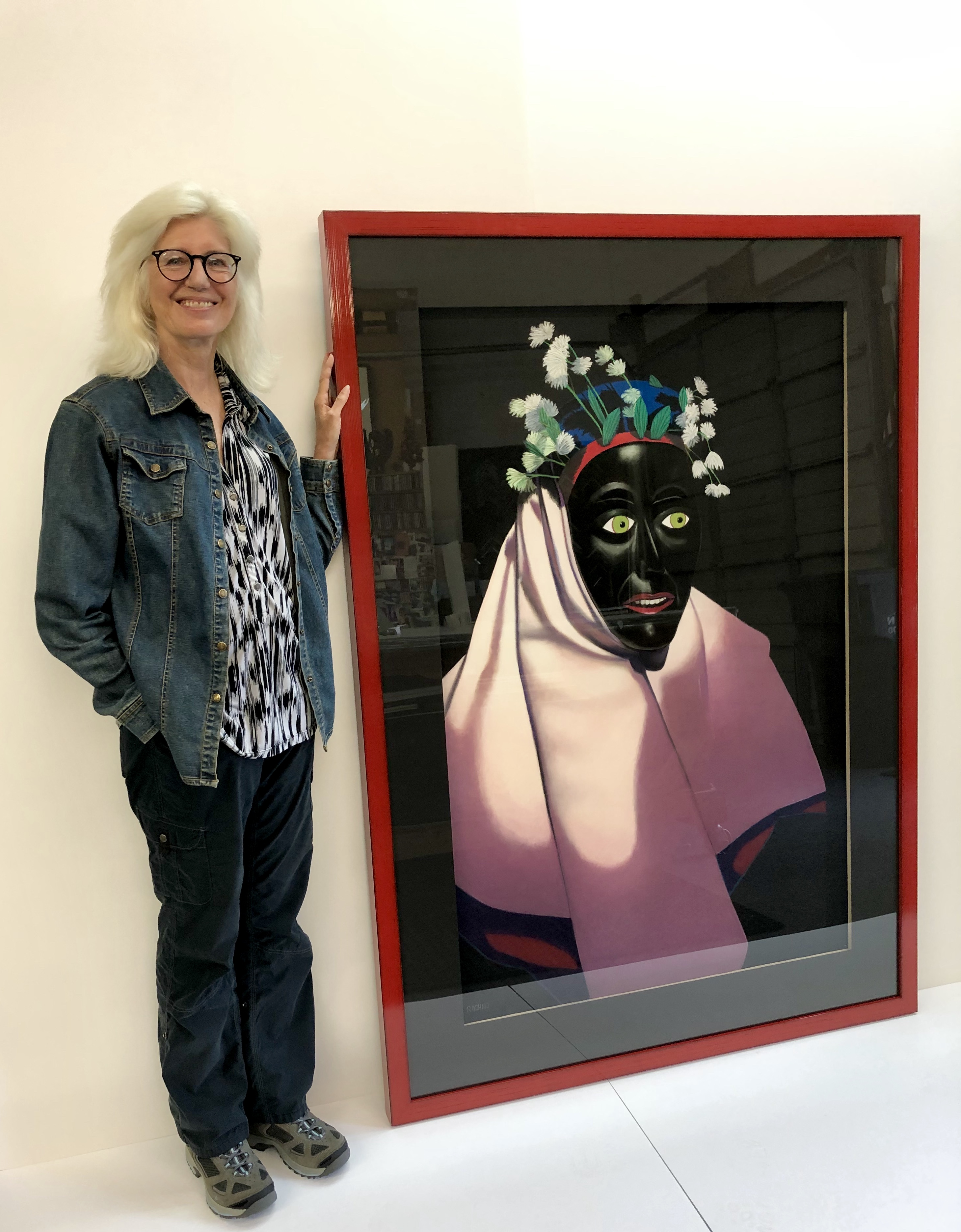
With “Poseur,” Soft Pastel on Sandpaper, 70” x 50,” 2019
* an ongoing series of quotations – mostly from artists, to artists – that offers wisdom, inspiration, and advice for the sometimes lonely road we are on.
[John] Graham told Lee [Krasner] and Jackson [Pollock] they were at the most wonderful part of their artistic journey because they were unknown and therefore free, and that there was only one thing they had to dread: fame.
How many men of great talent on their way to remarkable achievement in the present day are ruthlessly destroyed by critics, dealers, and public while mediocre, insensitive hacks, who by intrigue and industrious commercial effort have gained recognition and success, will go down in history with their inane creations. Success, fame, and greatness coincide very seldom. The great are not recognized during their life-time… Poe, Van Gogh,Rembrandt, Cezanne, Gauguin, Modigliani, Pushkin, Rimbaud, Baudelaire, and others could not make even a miserable living out of their art.
As Graham described it, true art could never be of the world because it was always steps, decades, light-years ahead of it. Artists, therefore, had no need to be part of the world, either. Their only duty was to persevere. Humanity, he said, depended on it.
Mary Gabriel in Ninth Street Women
Comments are welcome!
Q: Would you speak about the meaning of your work and the different materials you use?
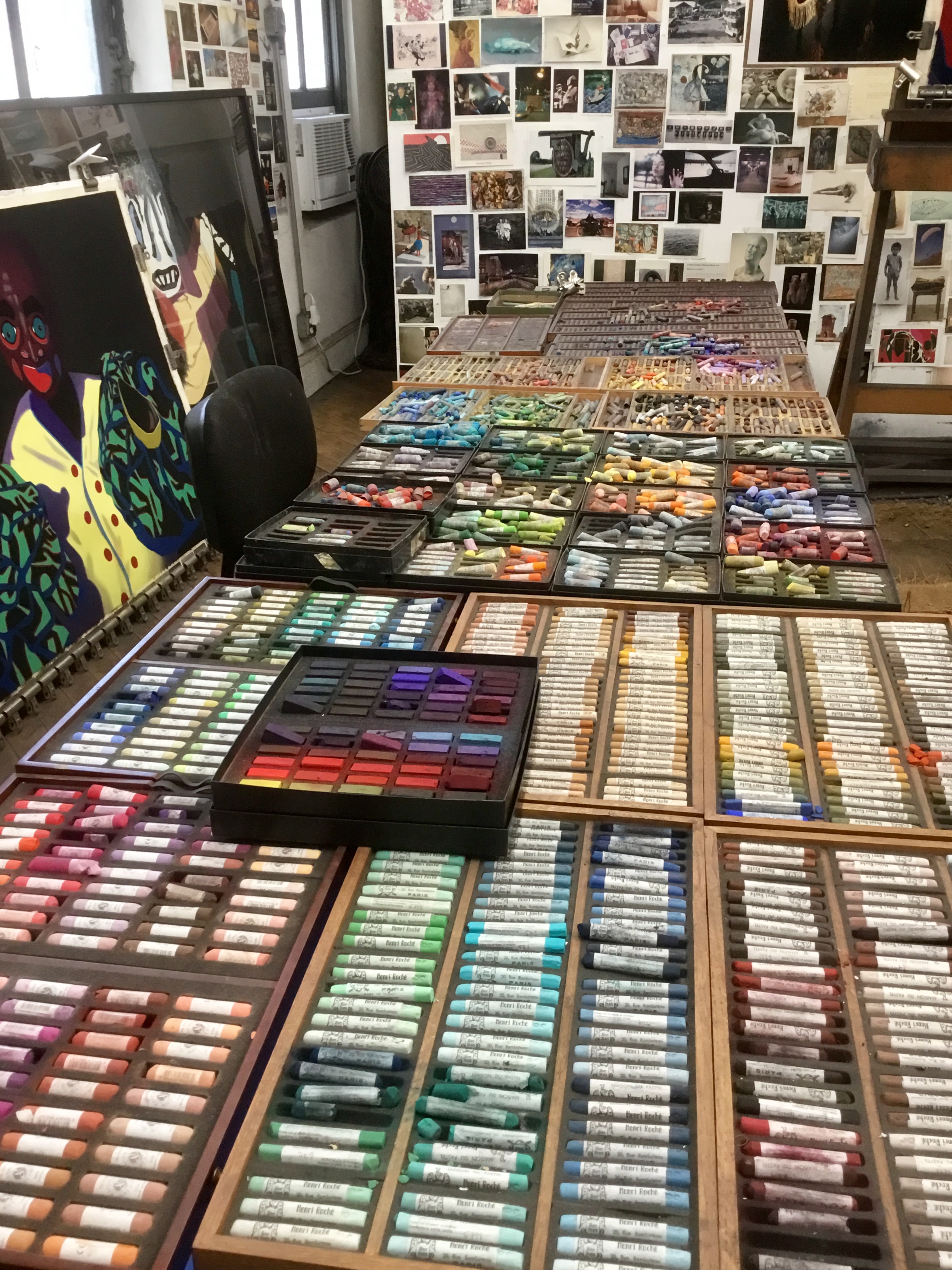
About half of Barbara’s pastels
A: It is as difficult to explain the meaning of my art as it is to interpret the meaning of life! I am invested in and concerned with process: foreign travel, prodigious reading, devotion to craft, months of slow meticulous work in the studio trying to create an exciting work of art that has never been seen before, etc. I love making pastel paintings! Many years ago I challenged myself to push the limits of what soft pastel can achieve. I am still doing so.
I leave it to others – viewers, arts writers, critics, art historians – to study my creative journey and talk about meanings. I believe an artist is inspired to create and viewers ponder the creation. I would not presume to tell anyone how to react to my work.
For many years I have been devoted to promoting soft pastel as a fine art medium. There are excellent reasons it has been around for five hundred years! It is the most permanent of media. There’s no liquid binder to cause oxidizing or cracking over time, as happens with oil paint. Pastel colors are intense because they are close to being pure pigment. Pastel allows direct application (no brushes) with no drying time and no color changes.
I use UArt acid-free sandpaper. This is not sandpaper from a hardware store. It is made for artists who work in pastel and allows me to build up layers of pigment without using a fixative. My process – slowly applying and layering pastels, blending and mixing new colors directly on the paper, making countless adjustments, searching for the best and/or most vivid colors – continually evolves. Each pastel painting takes months to create.
Comments are welcome!
Q: What more would you wish to bring to your work?

Tile worker in South India
A: I tend to follow wherever the work leads, rather than directing it. I have never been able to predict where it will lead or what more might be added.
Travel is essential for inspiration. Besides many Mexican sojourns, I have been to Bali, Sri Lanka, South India, Guatemala, Honduras, Brazil, Peru, Argentina, Paraguay, and other places. A second trip to India is upcoming, to Gujarat and Rajistan this time.
Last year I had the opportunity to go to Bolivia. In La Paz I visited the Museum of Ethnography and Folklore, where a stunning mask exhibition was taking place. As soon as I saw it, I knew this would be the inspiration for my next series, “Bolivianos.” So far I have completed six “Bolivianos” pastel paintings with two more in progress now. This work is getting a lot of press and several critics have declared it to be my strongest series yet.
Comments are welcome!


 barbararachkoscoloreddust.com