Blog Archives
Pearls from artists* # 76
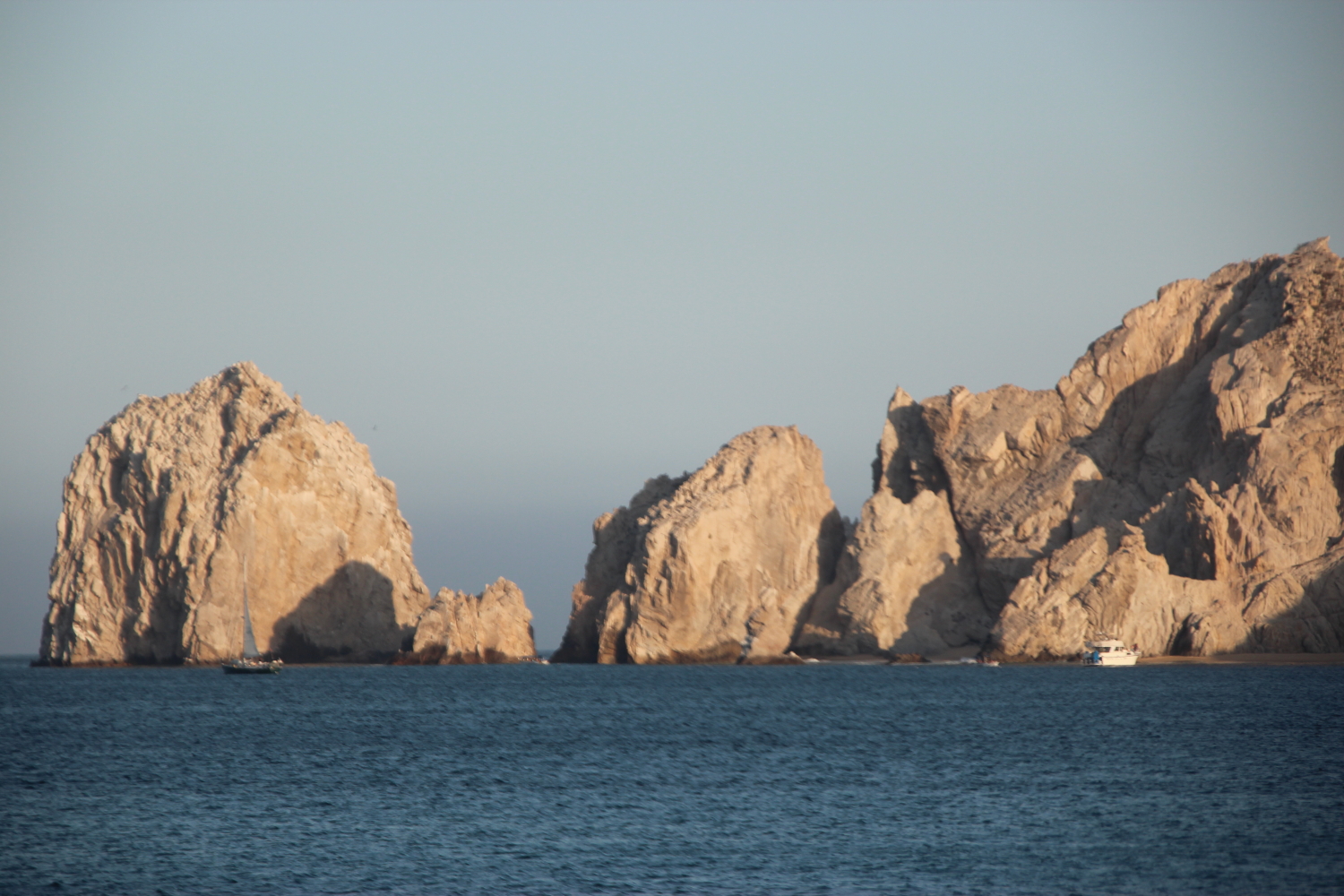
Cabo San Lucas, Mexico
* an ongoing series of quotations – mostly from artists, to artists – that offers wisdom, inspiration, and advice for the sometimes lonely road we are on.
What stops us in our tracks? I am rarely stopped by something or someone I can instantly know. In fact, I have always been attracted to the challenge of getting to know what I cannot instantly categorize or dismiss, whether an actor’s presence, a painting, a piece of music, or a personal relationship. It is the journey towards the object of attraction that interests me. We stand in relation to one another. We long for the relationships that will change our vistas. Attraction is an invitation to an evanescent journey, to a new way of experiencing life or perceiving reality.
An authentic work of art embodies intense energy. It demands response. You can either avoid it, shut it out, or meet it and tussle. It contains attractive and complicated energy fields and a logic all its own. It does not create desire or movement in the receiver, rather it engenders what James Joyce labeled ‘aesthetic arrest.’ You are stopped in your tracks. You cannot easily walk by it and go on with your life. You find yourself in relation to something that you cannot readily dismiss.
Anne Bogart in A Director Prepares: Seven Essays on Art and Theater
Comments are welcome!
Pearls from artists* # 67

Negombo, Sri Lanka
* an ongoing series of quotations – mostly from artists, to artists – that offers wisdom, inspiration, and advice for the sometimes lonely road we are on.
John Robin Baitz: I was just thinking that you still manage to write with some kind of miraculous hope.
Athol Fugard: You’ve got to. Implicit in the act of creation on the part of the artist is: I make it because I want to share it with you. At the end of my process you are waiting for me… Pascal says “Imagine a cell in darkness and the inmates are shackled together. Every morning at dawn, the door opens and the person at the end of the line is taken out and executed and the door is closed. Those left behind read their fate in the opening and closing of the door every day. it is a metaphor of the human condition.” That is Pascal.
Camus comes to that paragraph and says, “There is no question about it – that is an image of the human condition. What do we do during those 24 hours between the opening and closing of the door? Do we cry? Or do we tap the next person in the chain and say ‘What’s your name? I’m Athol Fugard. Who are you?'” And that’s how we create meaning. At the end of the process you are waiting. And that is the act of faith. That is the hope that every artist has.
Quoted by Anne Bogart in “and then you act: making art in an unpredictable world”
Comments are welcome!
Pearls from artists* # 65
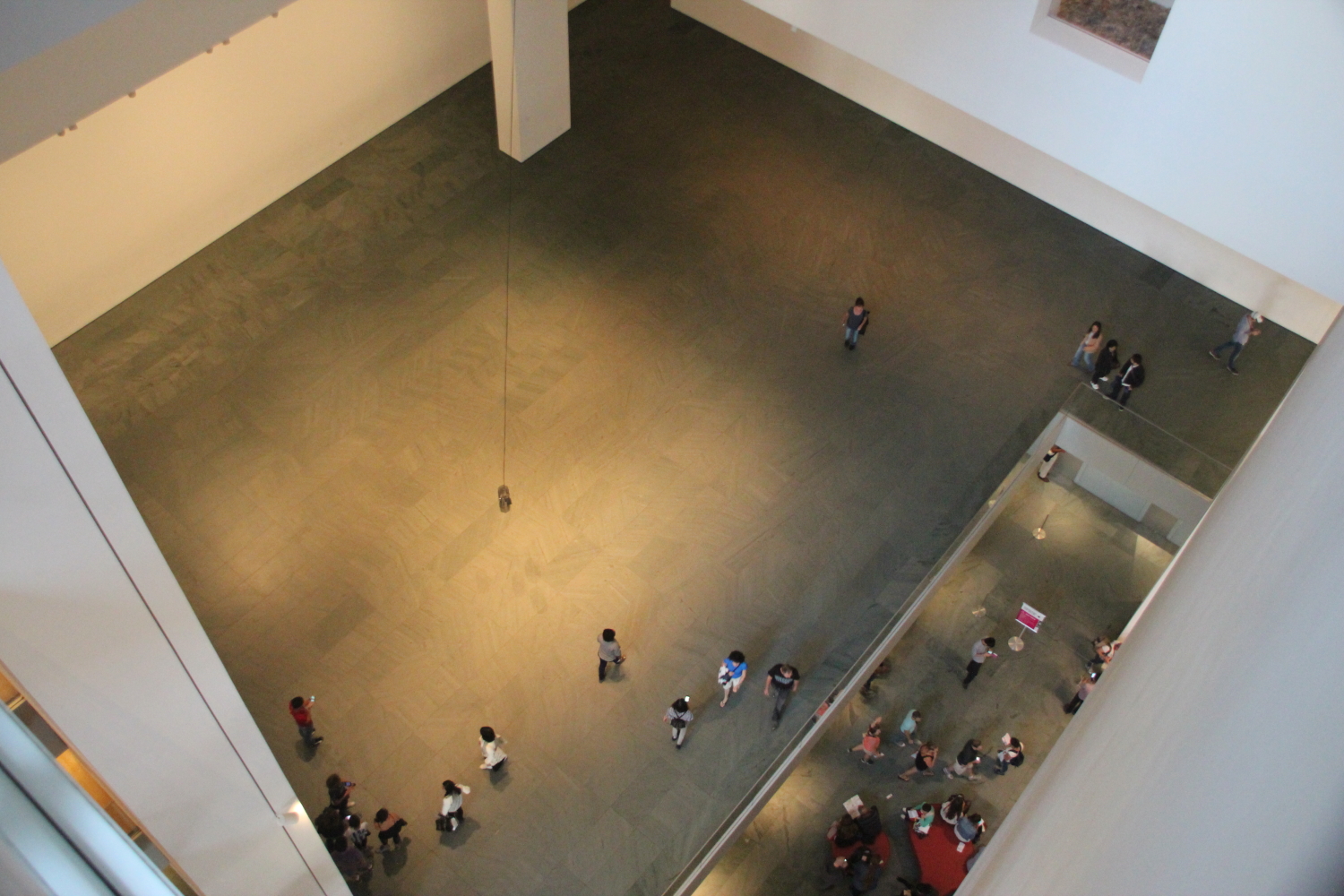
Museum of Modern Art, NYC
* an ongoing series of quotations – mostly from artists, to artists – that offers wisdom, inspiration, and advice for the sometimes lonely road we are on.
To create demands a certain undergoing: surrender to a subconscious process that can yield surprising results. And yet, despite the intuitive nature of the artistic process, it is of utmost importance to be aware of the reason you create. Be conscious about what you are attempting or tempting. Know why you are doing it. Understand what you expect in return.
The intentions that motivate an act are contained within the action itself. You will never escape this. Even though the “why” of any work can be disguised or hidden, it is always present in its essential DNA. The creation ultimately always betrays the intentions of the artist. James Joyce called this invisible motivation behind a work of art “the secret cause.” This cause secretly informs the process and then becomes integral to the outcome. This secret cause determines the distance that you will journey in the process and finally, the quality of what is wrought in the heat of the making.
Anne Bogart in and then, you act: making art in an unpredictable world
Q: Why do you create?
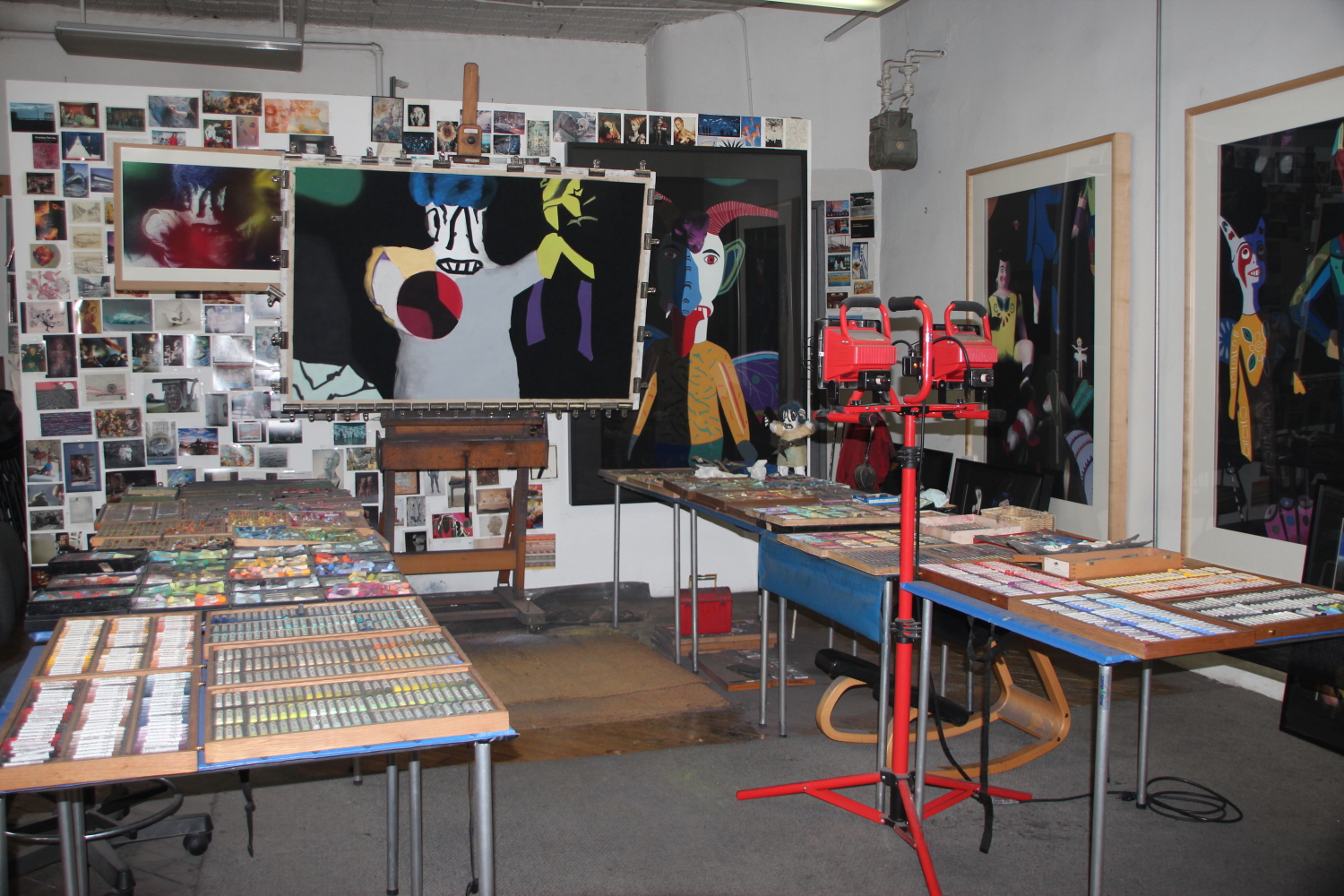
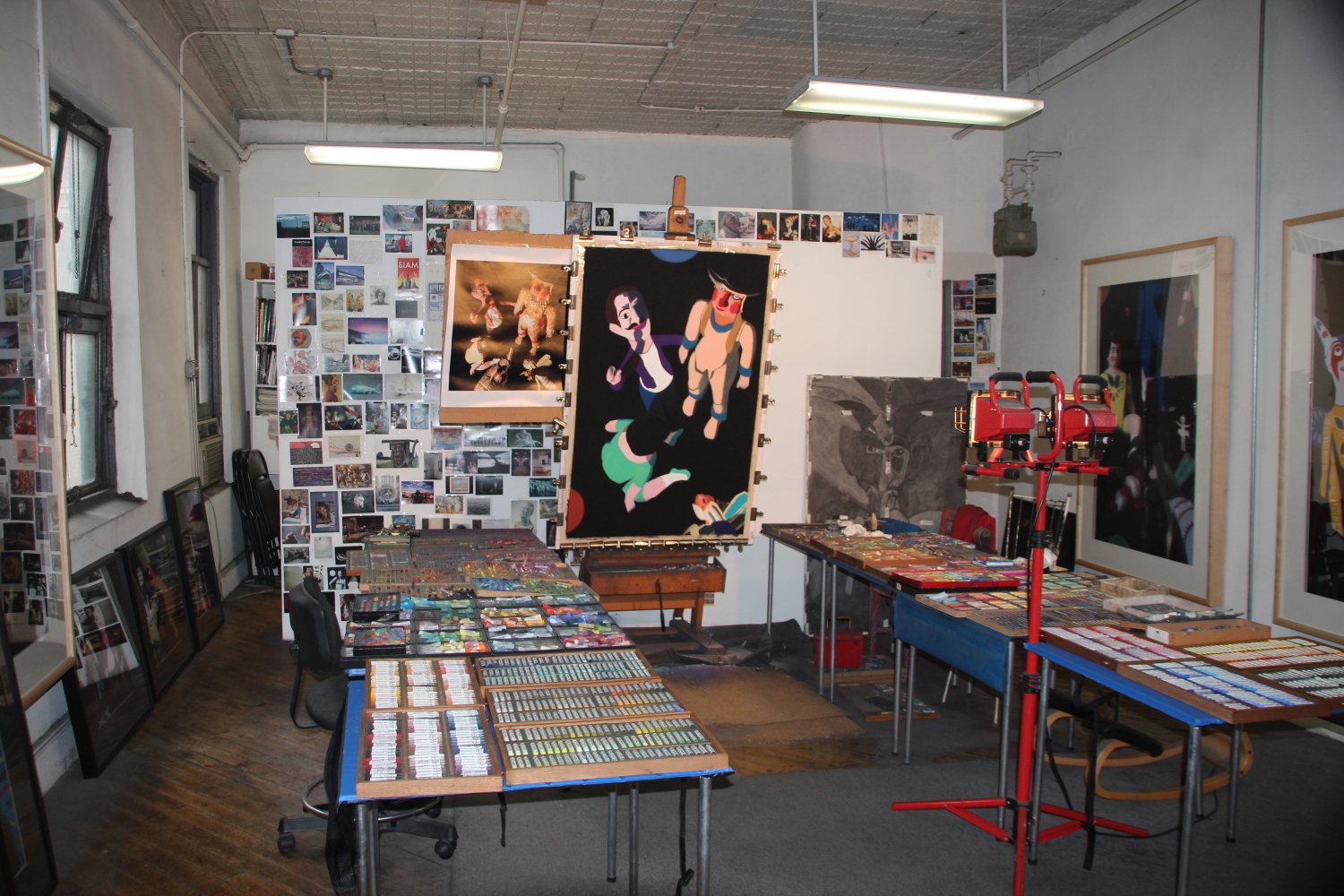
West 29th Street studio
A: There are many answers to that question and my responses vary according to how things are going in the studio. Just now these three are most compelling:
~ to create bold and vibrant pastel paintings and photographs that have never existed before
~ to continue to push my primary medium – soft pastel on sandpaper – as far as I can and to use it in more innovative ways
~ to create opportunities for artistic dialogue with people who understand and value the work to which I am devoting my life
The last has always been the toughest. I sometimes think of myself as Sisyphus because expanding the audience for my art is an ongoing uphill battle. Many artist friends tell me they feel the same way about building their audience. It’s one of the most difficult tasks that we have to do as artists.
Comments are welcome!
Pearls from artists* # 62
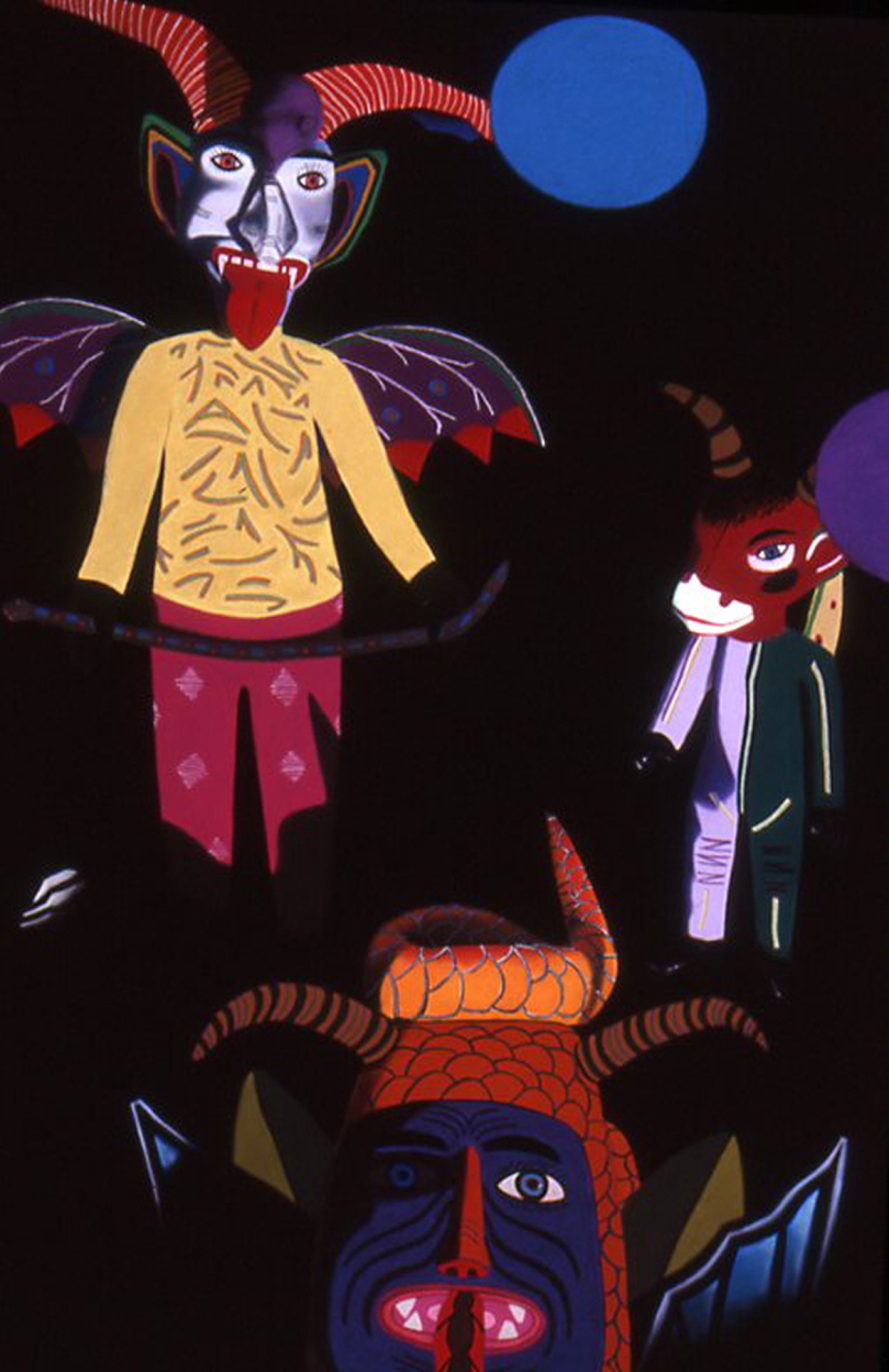
“The Sovereign,” soft pastel on sandpaper, 58″ x 38″
* an ongoing series of quotations – mostly from artists, to artists – that offers wisdom, inspiration, and advice for the sometimes lonely road we are on.
Yes, I’m formalistically obsessed. I see in a picture what I see in nature – everything has its place and is integrated. Like a tree or a human body, the image is put together for a greater whole. If you chop off something, you immediately destroy the organism. Form is crucial to what I do, and I believe that the form, in a way, creates the content. If you don’t have the form, you don’t get the content. If you get the maximum formal relationships in a precise, organic, metaphoric methodology, then you have a better chance of bringing out the content to its full degree. Of course, a picture doesn’t stand alone by its form. You can have forms that relate but offer no meaning. Ultimately, a picture is judged by its meaning, and I think that’s what a lot of people lose sight of.
Interview with Roger Ballen in Lines, Marks, and Drawings: Through the Lens of Roger Ballen, Craig Allen Subler and Christine Mullen Kreamer
Comments are welcome!
Q: Have you ever worked outside?

Reproductions of “Cardinal Rule” (top) and “Blue Ego,” originals are soft pastel on sandpaper, 30″ x 38″
A: As a pastel artist I’ve never worked outside – with so many pastels, it’s just not practical – but early on in the “Domestic Threats” series, I created two outdoor setups. Works in the series derived from elaborate scenes that I arranged and then photographed.
I used to take long walks along the Potomac River in Alexandria, VA, and there was a tree stump that was fascinating. It was mostly twisted roots, knotty branches, dark hidden spaces, etc. (top painting in photo). One morning I took several hand puppets and stuffed animals (my subject matter at the time) and carefully arranged them on the tree. Around me people were busy exercising their dogs. Soon I attracted quite a bit of attention – a tall blonde woman playing with puppets on a tree stump! Dogs came over to sniff. Their owners came over, too, and I was pressed into explaining, again and again, that I was an artist, that I was photographing this scene so I could paint it, etc. The interruptions were very annoying.
The second time I tried an outdoor setup was again along the Potomac River, but this time I selected a secluded strip of beach where I was undisturbed. I had forgotten to consider the light and inadvertently chose a cloudy day. I remember being disappointed that the light was flat and lacking shadows. The painting (bottom in photo) turned out to be one of my least favorites.
I resolved from then on to focus on interiors. Alfred Hitchcock famously used rear projection so that he could work in a studio rather than on location. One reason, he said, was that in a studio he had total control. I know what he meant. When I set up an interior scene and position the lights to make interesting shadows, indeed, I have control over the whole look. No aspect is left to chance. The accidents – improvements! – happen later when I work on the painting.
Comments are welcome!
Q: What is it about soft pastel that you find so intriguing that you use it as your primary fine art medium?

Some of Barbara’s pastels
A: For starters it’s the medium that I fell in love with many years ago. I recently read this article online, “What is Pastel?” by Mike Mahon, and will quote it because it neatly sums up what I love about working with pastel.
Pastel is the most permanent of all media when applied to conservation ground and properly framed. Pastel has no liquid binder that may cause it to oxidize with the passage of time as oftentimes happens with other media.
In this instance, Pastel does not refer to pale colors, as the word is commonly used in cosmetic and fashion terminology. The pure, powdered pigment is ground into a paste with a minimum amount of gum binder, rolled into sticks and dried. The infinite variety of colors in the Pastel palette range from soft and subtle to hard and brilliant.
An artwork is created by stroking the stick of dry pigment across an abrasive ground, embedding the color in the “tooth” of the ground. If the ground is completely covered with Pastel, the work is considered a Pastel painting; whereas, leaving much of the ground exposed produces a Pastel sketch. Techniques vary with individual artists. The Pastel medium is favored by many artists because it allows a spontaneous approach. There is no drying time, therefore, no change in color occurs after drying as it does in other media.
Did you know that a particle of Pastel pigment seen under a microscope looks like a diamond with many facets? It does! Therefore, Pastel paintings reflect light like a prism. No other medium has the same power of color or stability.
Historically, Pastel can be traced back to the 16th century. Its invention is attributed to the German painter, Johann Thiele. A Venetian woman, Rosalba Camera, was the first to make consistent use of Pastel. Chardin did portraits with an open stroke, while La Tour preferred the blended finish. Thereafter, a galaxy of famous artists—Watteau, Copley, Delacroix, Millet, Manet, Renoir, Toulouse Lautrec, Vuillard, Bonnard, Glackens, Whistler, Hassam, William Merritt Chase—used Pastel for a finished work rather than for preliminary sketches.
Pastels from the 16th century exist today, as fresh as the day they were painted. Edgar Degas was the most prolific user of Pastel and its champion. His protégé, Mary Cassat, introduced Pastel to her friends in Philadelphia and Washington, and thus to the United States. In the Spring of 1983, Sotheby Parke Bernet sold at auction, two Degas Pastels for more than $3,000,000 each! Both Pastels were painted about 1880.
Note: Do not confuse Pastel with “colored chalk.” Chalk is a porous, limestone substance impregnated with dyes, whereas, Pastel is pure pigment—the same as is used in other permanent painting media.
Today, Pastel paintings have the stature of oil and watercolor as a major fine art medium. Many of our most renowned, living artists have distinguished themselves in Pastel and have enriched the art world with this beautiful medium.
So knowing all this, I often wonder, why don’t more artists use pastel? Is it because framing is a big issue? Works on paper need to be framed and pastel paintings have unique problems (see my April 27, 2013 blog post). Second only to the cost of maintaining a studio in New York City, frames are my single largest business expense. Sometimes I am grateful that pastel is a very slow medium. I typically finish 4 or 5 paintings in a year, which means I only have to pay for 4 or 5 frames!
Comments are welcome!
Pearls from artists* # 36
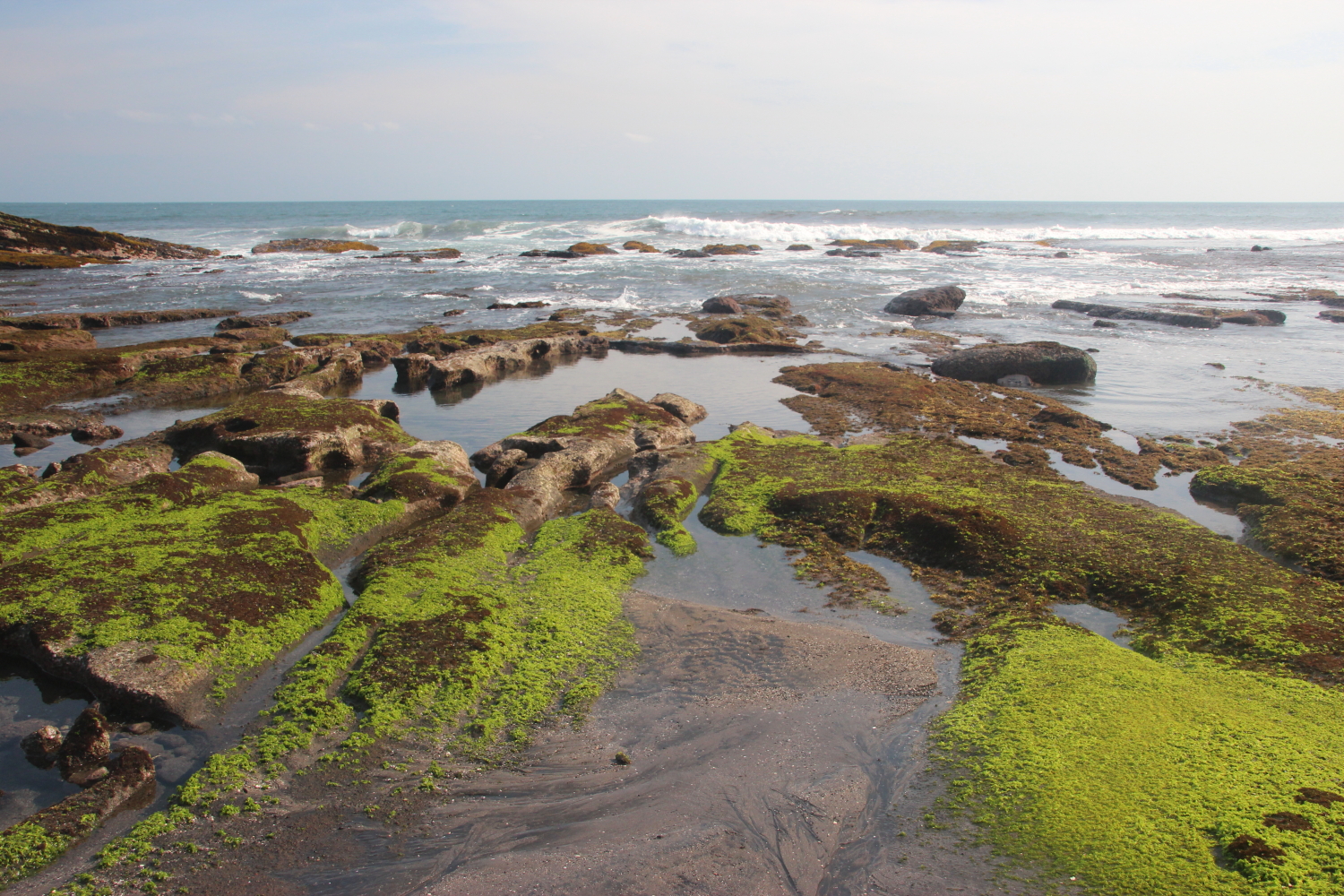
Indian Ocean, Tanah Lot, Bali
* an ongoing series of quotations – mostly from artists, to artists – that offers wisdom, inspiration, and advice for the sometimes lonely road we are on.
… don’t wait for things to change, the hour of man is now and, whether you are working at the bottom of the pile or on top, if you are a creative individual you will go on producing, come hell or high water. And this is the most you can hope to do. One has to go on believing in himself, whether recognized or not, whether heeded or not. The world may seem like hell on wheels – and we are doing our best, are we not, to make it so? – but there is always room, if only in one’s own soul, to create a spot of Paradise, crazy though it may sound.
Henry Miller in Stand Still Like the Hummingbird
Comments are welcome!
Pearls from artists* # 33

Botanical, Bali
* an ongoing series of quotations – mostly from artists, to artists – that offers wisdom, inspiration, and advice for the sometimes lonely road we are on.
I am vitally interested in the man who today has the misfortune of being an artist and a human being. By the same token I am as much interested in the maneuvers of the gangster as I am in those of the financier or the military man. They are all part and parcel of society; some are lauded for their efforts, some reviled, some persecuted and hunted like beasts. In our society the artist is not encouraged, not lauded, not rewarded, unless he makes use of a weapon more powerful than those employed by his adversaries. Such a weapon is not to be found in shops or arsenals: it has to be forged by the artist himself out of his own tissue. When he releases it he also destroys himself. It is the only method he has found to preserve his own kind. From the outset his life is mortgaged. He is a martyr whether he chooses to be or not. He no longer seeks to generate warmth, he seeks for a virus with which society must allow itself to be injected or perish. It does not matter whether he preaches love or hate, freedom or slavery; he must create room to be heard, ears that will hear. He must create, by the sacrifice of his own being, the awareness of a value and a dignity which the word human once connoted. This is not the time to analyze and criticize works of art. This is not the time to see the flowers of genius, differentiate between them, label and categorize. This is the time to accept what is offered and be thankful that something other than mass intolerance, mass suicide, can preoccupy the human intellect.
Henry Miller in Stand Still Like the Hummingbird
Comments are welcome!



