Blog Archives
In celebration of the 13th anniversary of my blog three days from now, I am republishing the very first post from July 15, 2012. Q: What does it take to be an artist, especially one living and working in New York?
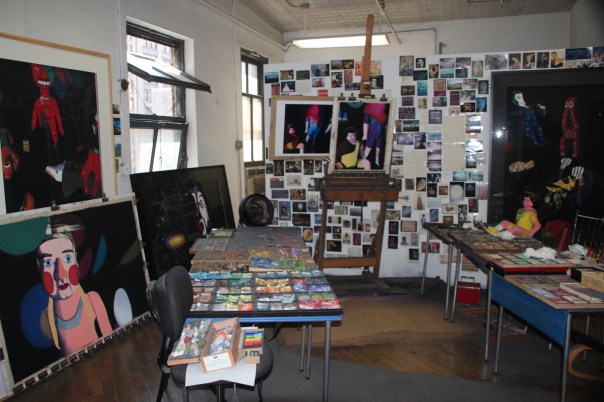
Barbara’s Studio (in 2012) with works in progress.
A: The three Big P’s – Patience, Persistence, and Passion. Without all three you will not have the stamina to work tirelessly for very little external reward. You can expect help from no one.
There are so many obstacles to art-making and countless reasons to just give up. When you really think about it, it’s amazing that great art gets made at all. So why do we do it? Above all it’s about making our time on earth matter, about devotion to our innate gifts and love of our hard-fought creative process.
And, my God, it even gets harder as we get older! So what do we do? We dig in that much deeper. It’s a most noble and sacred calling – you know when you have it – and that’s what separates those of us who are in it for the long haul from the wimps, fakers, and hangers-on. I say to my fellow artists who continue to work despite the endless challenges, we are all true heroes!
These words still ring true and it’s good, even for me, to occasionally be reminded.
Most importantly, THANK YOU to my 222,000+ subscribers for taking this journey with me. When I began this blog in 2012, I had no idea it would prove to be so popular… WOW!
Comments are welcome!
Q: Would you share a bit more about yourself? (Question from “Bold Journey”)

A: I am an American contemporary Master Pastel Artist who divides my time between residences in New York City and Alexandria, VA. I am best known for my pastel-on-sandpaper paintings, my eBook, “From Pilot to Painter,” and my popular blog, “Barbara Rachko’s Colored Dust,” which currently has more than 125,000 subscribers. I am proud to be represented by Apricus Art Collection (US), Art Client Services (US), Galleria Balmain (UK), Emillions (US), Interstellar (IN), and Galleri SoHo (SE). I am a member of the International Association of Visual artists.
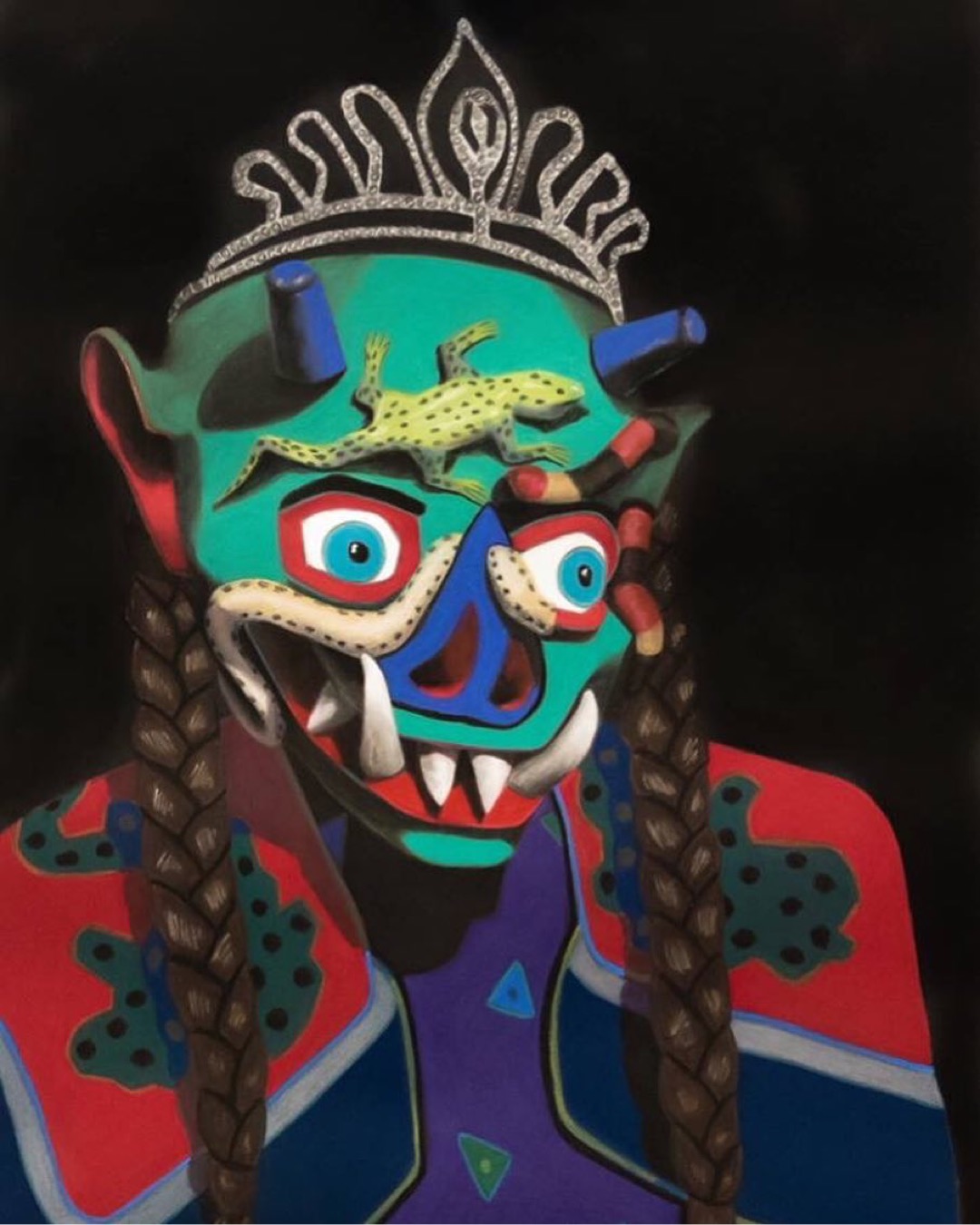
I travel regularly to Mexico, Central America, South America, and Asia. Since 2017 I have been creating “Bolivianos,” a painting series based on an exhibition of Carnival masks I photographed at the Museum of Ethnography and Folklore in La Paz.
My life has been called “extraordinary and inspiring.” I learned to fly when I was 25 and became a Commercial Pilot and Boeing-727 Flight Engineer before joining the Navy. As a Naval Officer I spent many years working at the Pentagon and retired as a Commander. On 9/11 my husband Dr. Bryan Jack was killed onboard the plane that crashed into the Pentagon. Ever since that awful day, I have worked hard to overcome my husband’s tragic loss. Now I enjoy a thriving career as an internationally-known professional artist.
Comments are welcome!
Pearls from artists* # 577

In the Studio
*an ongoing series of quotations – mostly from artists, to artists – that offers wisdom, inspiration, and advice for the sometimes lonely road we are on.
What is the popular conception of the artist? Gather a thousand descriptions and the resulting composite is the portrait of a moron: he is held to be childish, irresponsible, and ignorant or stupid in everyday affairs.
The picture does not necessarily involve censure or unkindness. These definitions are attributed to the artist’s preoccupation with his particular kind of fantasy and to the unworldly nature of the fantastic itself. The bantering tolerance granted to the absentminded professor is extended to the artist. Biographers contrast the artless news of his judgments with the high attainment of his art, and while his naïveté or rascality are gossiped about, they are viewed as signs of Simplicity and Inspiration, which are the Handmaidens of Art. And if the artist is inarticulate and lacking in the usual repositories of fact and information, how fortunate, it is said, that nature has contrived to divert him from all worldly distractions so he may be single-minded in regards to his special office.
Mark Rothko in The Artist’s Reality: Philosophies of Art, edited and with an introduction by Christopher Rothko
Comments are welcome!
Pearls from artists* # 515

*an ongoing series of quotations – mostly from artists, to artists – that offers wisdom, inspiration, and advice for the sometimes lonely road we are on.
“Under [General Francisco] Franco,” he said, “attendance at Catholic holidays was obligatory and much Catalan folklore was banned. People avoided the religious processions and, once they were no longer mandatory, ignored them… Marvesa’s [Spain] festive license of demons and dragons is no longer of darkness. If Franco claimed the mantle of Catholic light, then to party as Catalan devils is a happy celebration of freedom.
Demons and dragons are a customary feature of saints’ days and Corpus-Christi festivals throughout Spain and its former empire. They are also common in Carnivals. Indeed, it is partly because of the presence of demons, dragons, and other masked transgressive figures that Carnival has been so often designated – by defenders and detractors alike – as a pagan or devilish season, a time of unrestrained indulgence before the ascetic penances of Lent.
Julio Caro Baroja, the father of Spanish Carnival studies, scorned the antiquarian notion that the masked figures and seasonal inversions of Carnival were “a mere survival” of ancient pagan rituals. Carnival, he argued, was first nurtured by the dualistic oppositions of Christianity. Where it survives – for when he wrote it had been banned by Franco – it still enacts these old antagonisms. “Carnival,” he concluded, “is the representation of paganism itself face-to-face with Christianity.”
... Peter Burke, one of the more lucid historians of popular culture, has proposed that “there is a sense in which every festival [in early modern Europe] was a miniature Carnival because it was an excuse for disorder and because it drew from the same repertoire of traditional forms.
Max Harris in Carnival and Other Christian Festivals: Folk Theology and Folk Performance
Comments are welcome!
Pearls from artists* # 477
*an ongoing series of quotations – mostly from artists, to artists – that offers wisdom, inspiration, and advice for the sometimes lonely road we are on.
Although he produced thousands of works of art in his pitifully short time on earth, Vincent [van Gogh] – as, following his own example, we shall call him – failed to sell a single painting in his lifetime, despite the fact that his brother Theo was a prominent Paris art dealer who, among other business coups, made a fortune for Claude Monet. Although he suffered through periods of deepest doubt, Vincent knew that one day his work would be recognized for its true worth. All the same, he could not have dreamed that his jarringly revolutionary paintings would one day rise so high in popular regard.
John Banville in His Own Worst Enemy, The New York Review of Books, May 13, 2021
Comments are welcome!
Pearls from artists* # 441
*an ongoing series of quotations – mostly from artists, to artists – that offers wisdom, inspiration, and advice for the sometimes lonely road we are on.
The most perennially popular category of art is the cheerful, pleasant, and pretty kind: meadows in spring, the shade of trees on hot summer days, pastoral landscapes, smiling children. This can be deeply troubling to people of taste and intelligence.
… The worries about prettiness are twofold. First, pretty pictures are alleged to feed sentimentality. Sentimentality is a symptom of insufficient engagement with complexity, by which one really means problems. The pretty picture seems to suggest that in order to make life nice, one merely has to brighten up the apartment with a depiction of some flowers. If we were to ask the picture what is wrong with the world, it might be taken as saying ‘You don’t have enough Japanese water gardens’ – a response that appears to ignore all the more urgent problems that confront humanity (primarily economic, but also moral, political, and sexual). The very innocence and simplicity of the picture seems to mitigate against any attempt to improve life as a whole. Secondly, there is the related fear that prettiness will numb us and leave us insufficiently critical and alert to the injustices surrounding us.
Alain de Botton and John Armstrong in Art as Therapy
Comments are welcome!

Q: Would you speak about the creative process that resulted in your 1994 pastel painting, “Amok”?

A: Behind me in the photo above is one of my circa 1994 50” x 40” c-prints, signed by both Bryan, my late husband, and me. The photo was my reference for a pastel painting titled, “Amok” (right, above).
I staged these photos in our Alexandria house (staged photography was popular then), refined the composition over days or weeks, and lit the scene using two tungsten studio lights. I was careful to accentuate the shadows, doing what I could to light everything as though it were a film noir set. (Film noir is still a favorite movie genre of mine).
In those days I knew nothing about photography so I considered these photos collaborations, since Bryan clicked the shutter. (He typically shot two pieces of film using his old Toyo Omega 4 x 5 view camera with a rented wide angle lens). Bryan was reluctant to take any credit- insisting that the idea, concept, etc. were mine – but I persuaded him to also sign the photos. (How I wish he were still around to fill in forgotten details about our collaboration).People enjoyed and often asked to purchase the reference photos so I sometimes had them enlarged and sold them. The dragon in the foreground is significant because it was my first purchase in Oaxaca during our initial trip to Mexico.
If anyone is interested, please remind me to tell the (long) story about how I got it home on the plane!
Comments are welcome!
Q: Can you give us your current elevator pitch?
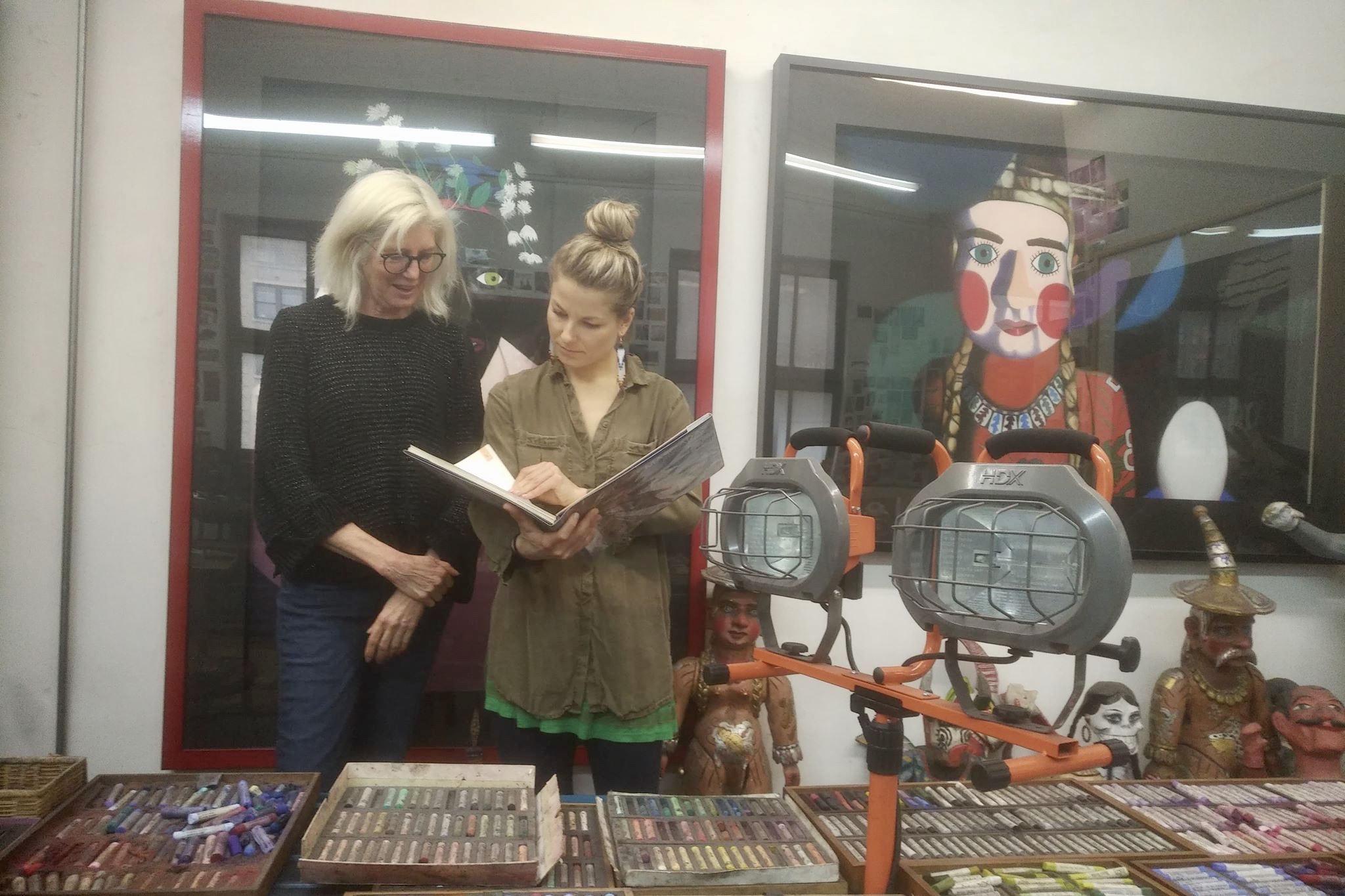
Discussing Bolivian masks with Nika, Photo: David De Hannay
A: Here it is:
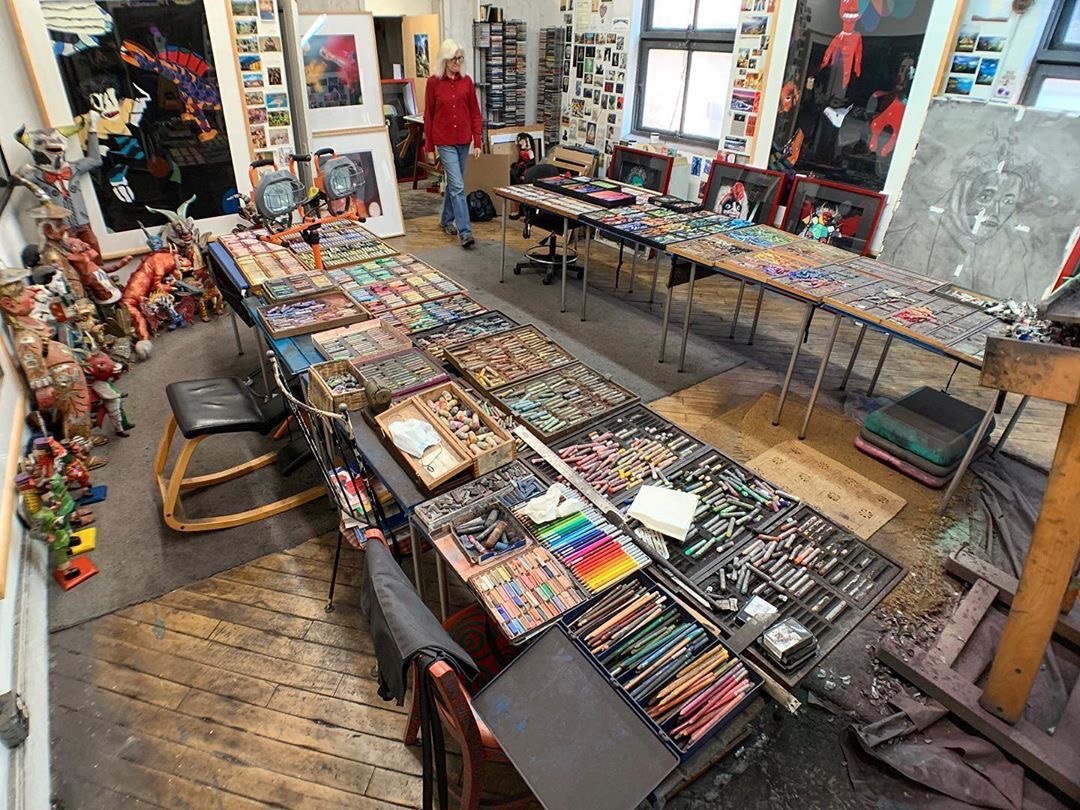
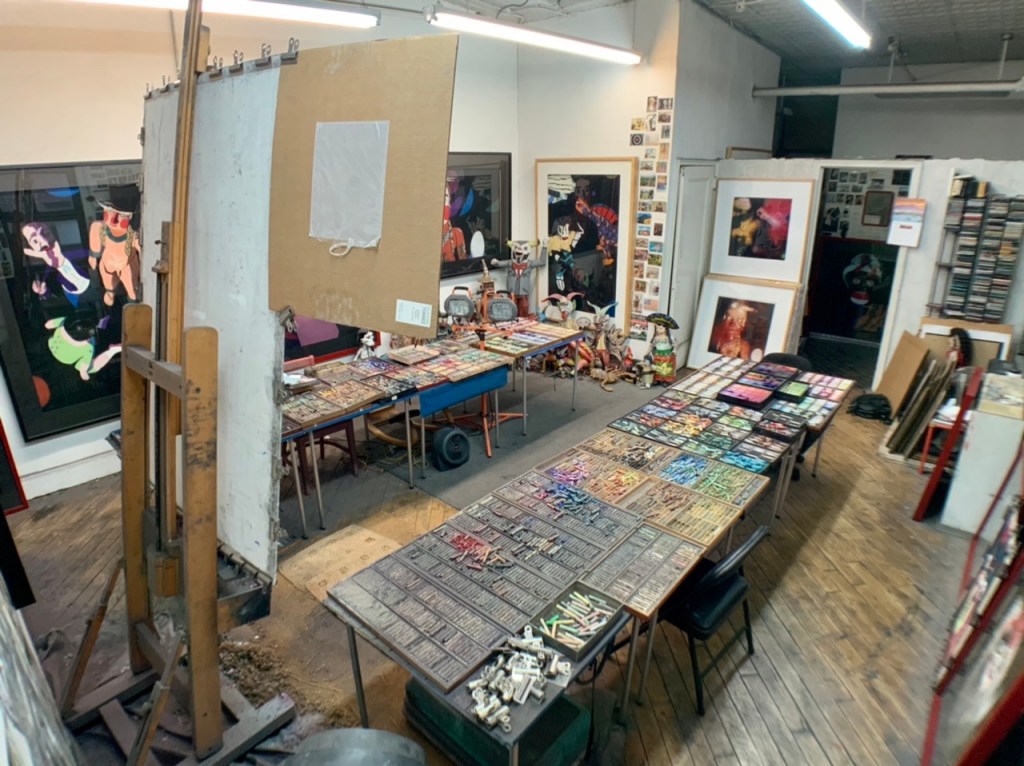
I am a New York visual artist, blogger, and author. For thirty-four years I have been creating original pastel-on-sandpaper paintings that depict my large collection of Mexican and Guatemalan folk art – masks, carved wooden animals, papier mache figures, and toys. “Bolivianos,” my current series, is based on a mask exhibition I saw and photographed in La Paz in 2017 at the National Museum of Folklore and Ethnography.
My technique is self-invented and involves applying dozens of layers of soft pastel onto acid-free sandpaper to create new colors directly on the paper. Each pastel painting takes several months to complete. Typically, I make four or five each year. I achieve extraordinarily rich, vibrant color in pastel paintings that are a unique combination of reality, fantasy, and autobiography.
My background is unusual for an artist. I am a pilot, a retired Navy Commander, and a 9/11 widow. Besides making art, I am a published blogger and author best known for my popular blog, “Barbara Rachko’s Colored Dust” (53,000+ subscribers!) and my eBook, “From Pilot to Painter,” on Amazon and iTunes.
Please see images and more at http://barbararachko.art/en/
Comments are welcome!
Top Instagram Posts for 2019
New Year’s Day is almost here so I decided to depart from the usual. Here are my most popular images posted on Instagram in 2019.

With Jenny Holzer – she’s waiving hello – at Rockefeller Center
Photo: Izzy Nova
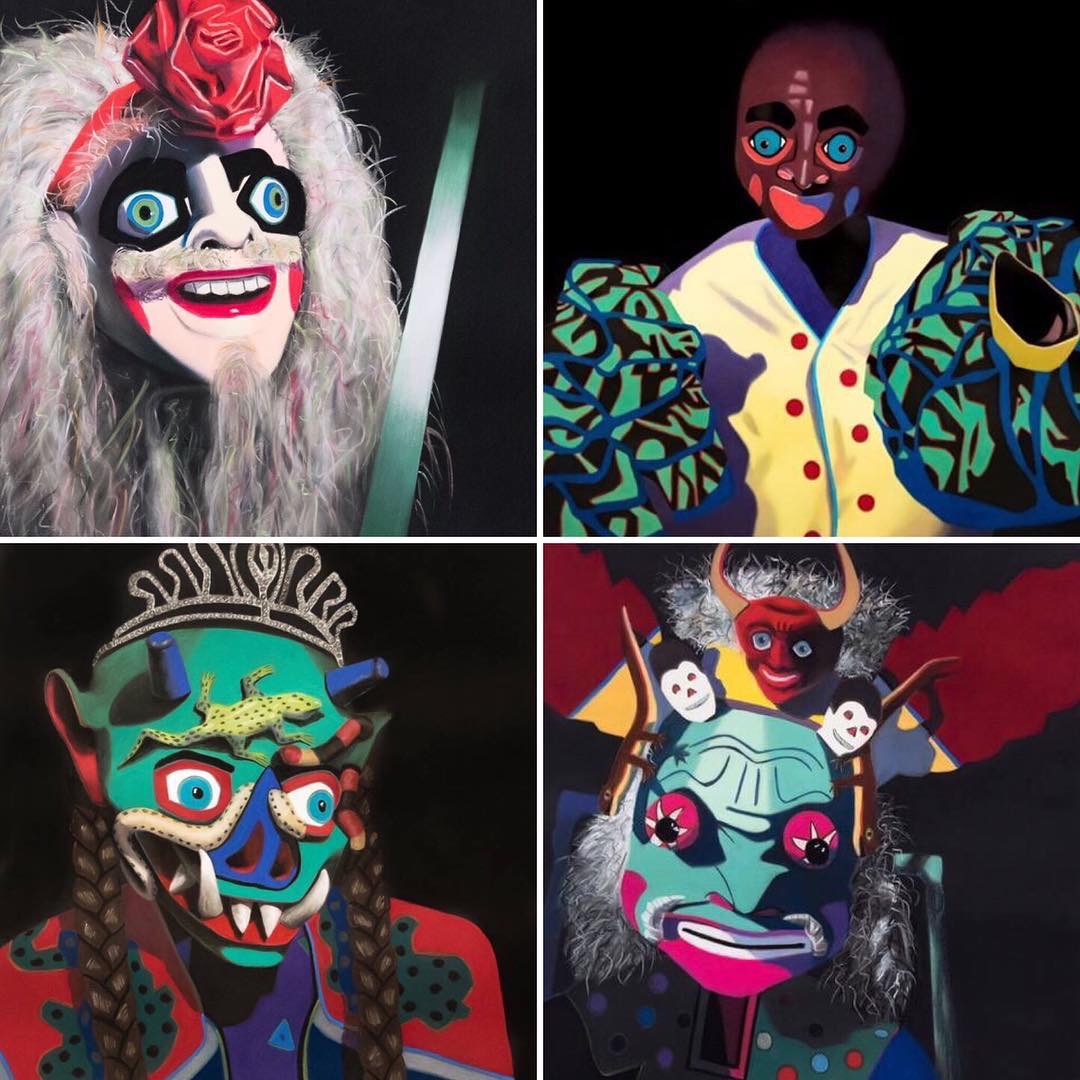
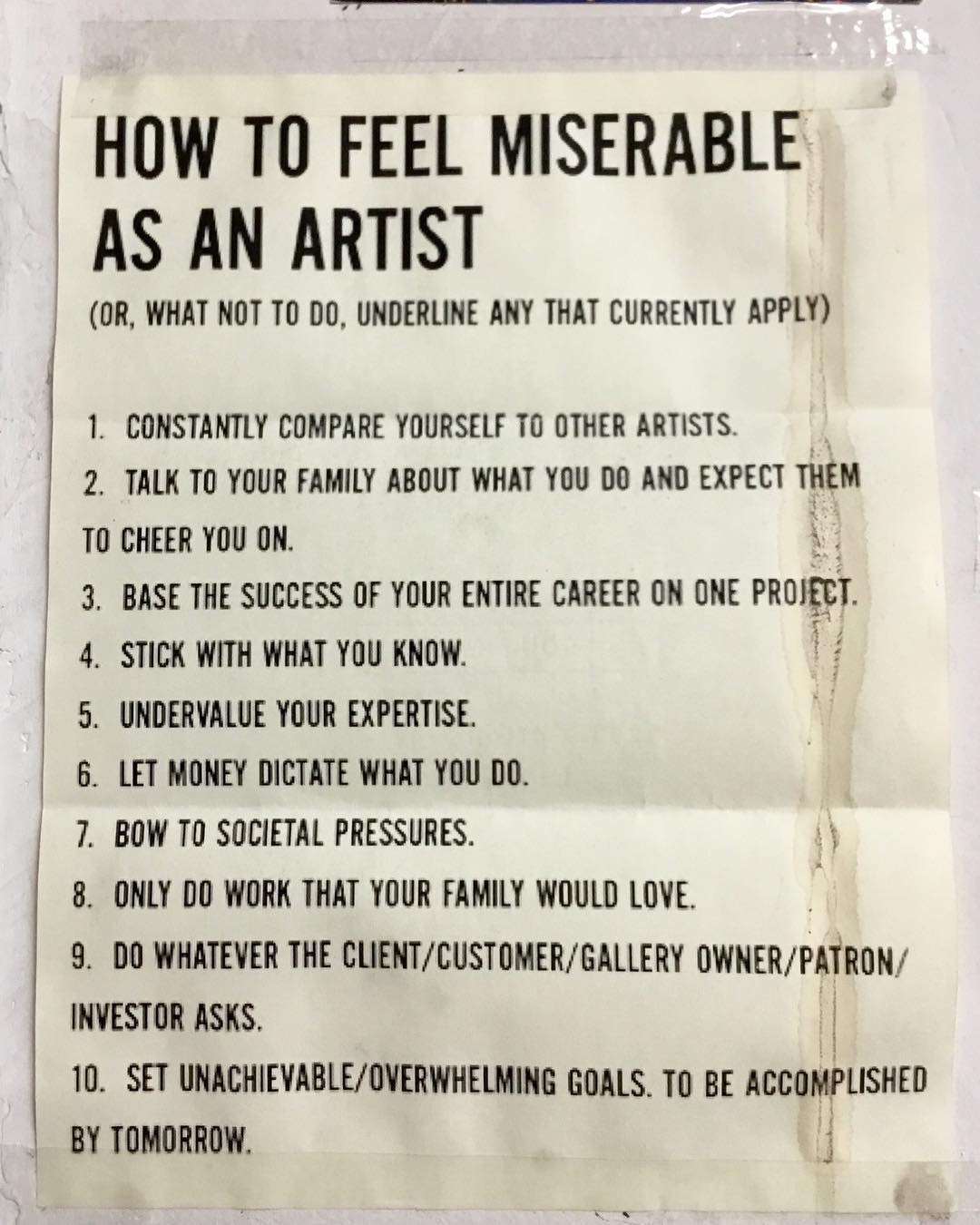
Photo: Izzy Nova
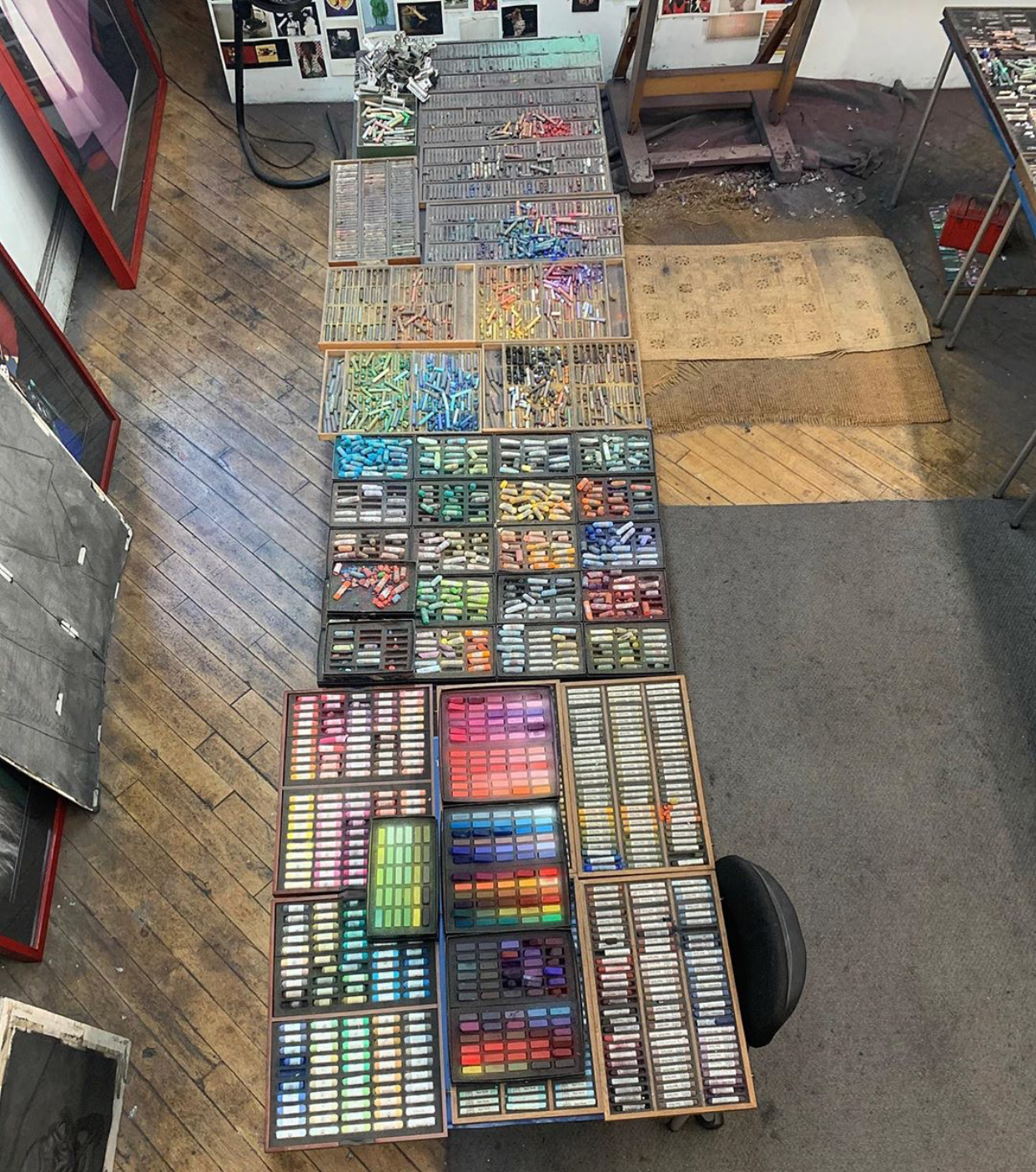
Photo: Izzy Nova
More than 49,000 now!
Please consider following my work at https://Instagram.com/barbararachko_artist.
Comments are welcome!


 barbararachkoscoloreddust.com