Blog Archives
Q: You read books on Friedrich Nietzsche and other philosophers. How has philosophy and your personal experience shaped the latest series, Bolivianos? (Question from Vedica Art Studios and Gallery)
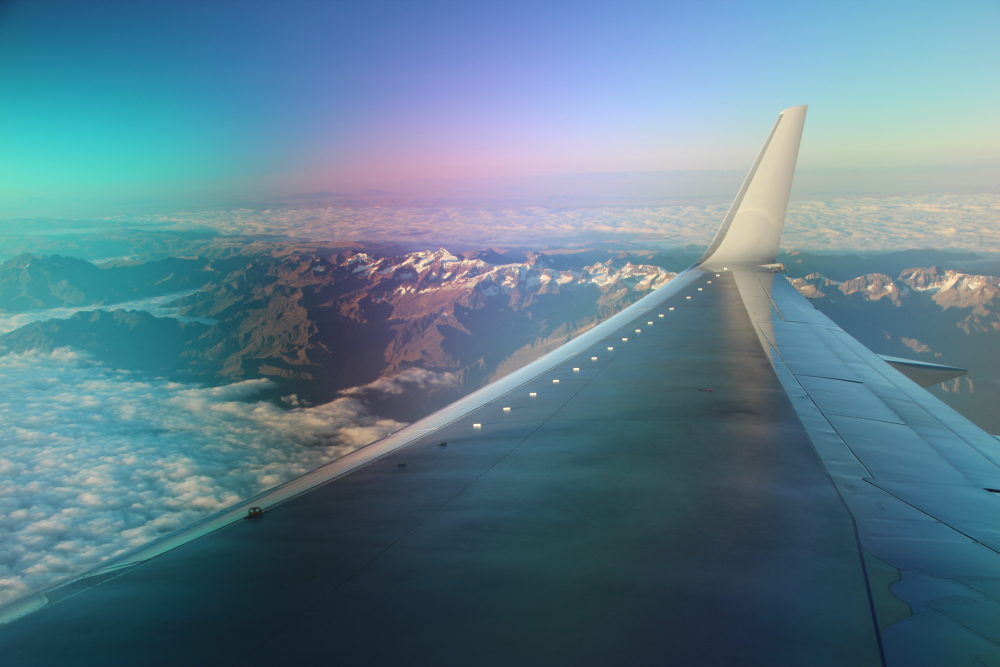
A: It’s difficult to pinpoint how philosophy specifically shaped my work because my curiosity spans so many subjects. Some critics have described me as a Renaissance woman, remarking on my wide-ranging and voracious reading. It’s true—I’m genuinely interested in practically everything!
In pursuit of making art, I have undertaken in-depth studies of numerous intriguing fields: drawing, color, composition, gross anatomy, art and art history, the art business, film history, photography, psychology, mythology, literature, philosophy, religion, music, jazz history, and archaeology—particularly ancient Mesoamerica (Olmec, Zapotec, Mixtec, Aztec, and Maya) and South America (the Inca and their ancestors).
Since the early 1990s, my inspiration and subject matter have come primarily from international travel to remote parts of the globe, especially Mexico, Central America, and South America. Travel is by far the best education! By visiting distant destinations, I have developed a deep reverence for people and cultures around the world. People everywhere are connected by our shared humanity.
These travels, supplemented by extensive research at home, are essential parts of my creative process. Research can be solitary and demanding, but I truly enjoy it. I want to know as much as possible, and this curiosity generates ideas for new work, propelling me into unexplored creative realms.
Foreign travel always expands our ways of thinking. This rich mixture of creative influences continually evolves and finds its way into my pastel paintings. Working, learning, evolving, and growing—I am perpetually curious and can hardly imagine a better way to spend my time on Earth!
Comments are welcome!
Q: What would you be if you were not an artist?

The studio with pastel paintings in progress!
A: I honestly have no idea, but whatever it might be, there is a good chance that I’d be bored! In my younger days boredom was a strong motivator. I left the active duty Navy out of boredom. I couldn’t bear not being intellectually challenged (most of my jobs consisted of paper-pushing), not using my flying skills (at 27 I was a licensed commercial pilot and Boeing 727 flight engineer), and not developing my artistic talent. In what surely must be a first, by spending a lot of time and money training me for jobs I hated, the Navy turned me into a hard-working artist! And once I left the Navy there was no plan B. There was no time to waste. It was “full speed ahead.”
Art is a calling. You do not need to be told this if you are among those who are called. It’s all about “the work,” that all-consuming focus of an artist’s life. If a particular activity doesn’t make you a better artist, you avoid it. You work hard to nourish and protect your gifts. As artists we invent our own tasks, learn whatever we need in order to progress, and complete projects in our own time. It is life lived at its freest.
My art-making has led me to fascinating places: Mexico, Guatemala, Brazil, Chile, Easter island, Argentina, Uruguay, France, England, Italy, Bali, Java, India, Bhutan, and more; and to in-depth studies of intriguing subjects: drawing, color, composition, art and art history, the art business, film and film history, photography, mythology, literature, music, jazz history, and archaeology, particularly that of ancient Mesoamerica (the Olmec, Zapotec, Mixtec, Aztec, Maya, etc.). And this rich mixture continually grows! For anyone wanting to spend their time on earth learning and meeting new challenges, there is no better life than that of an artist.
I SO agree with this exchange that I read years ago between between Trisha Brown and Mikhail Baryshnikov in the New York Times. I wrote it on a piece of paper and taped it to my studio wall:
Trisha: How do you think we keep going? Are we obsessed?
Mikhail: We do it because there’s nothing better. I’m serious. Because there is nothing more exciting than that. Life is so boring, that’s why we are driven to the mystery of creation.
Comments are welcome.
Q: What makes you just want to run back to the studio and start something new?

Beginnings
A: For nearly four decades, I have always worked in series, which means that one pastel painting leads quite naturally into the next. Considerable thought and planning go into each one before I ever begin, so it would be uncharacteristic for me to just start something new out of nowhere.
That said, my favorite part of the months-long creative process is when I am starting a brand new pastel painting. I get excited each time I begin a new piece because beginnings are full of so much possibility! Soon I will be looking at something I have never created before. I’ll watch it gradually take shape over months and will be challenged to solve unforeseeable problems, to continually refine and improve it along the way. The goal is always, of course, to resolve it into some sort of successful existence. Whatever happens, I know I am about to go on a very intriguing journey that will undoubtedly expand my technical knowledge and make me a much better artist.
Comments are welcome!
Pearls from artists* # 504

* an ongoing series of quotations – mostly from artists, to artists – that offers wisdom, inspiration, and advice for the sometimes lonely road we are on.
… if a project doesn’t work out, you can always think of it as having been a worthwhile and constructive experiment. You can resist the seductions of grandiosity, blame, and shame. You can support other people in their creative efforts, acknowledge the truth that there’s plenty of room for everyone. You can measure your worth by your dedication to your path, not by your successes or failure. You can battle your demons (through therapy, recovery, prayer, or humility) instead of battling your gifts – in part by realizing that your demons were never the ones doing the work, anyhow. You can believe that you are neither a slave to inspiration nor its master, but something far more interesting – its partner – and that the two of you are working together toward something intriguing and worthwhile. You can live a long life, moving and doing really cool things the entire time. You might earn a living with your pursuits or you might not, but you can recognize that this is not really the point. And at the end of your days, you can thank creativity for having blessed you with a charmed, interesting, passionate existence.
Elizabeth Gilbert in Big Magic: Creative Living Beyond Fear
Comments are welcome!
Q: How does art help you explore and understand other cultures? (Question from Arte Realizzata)
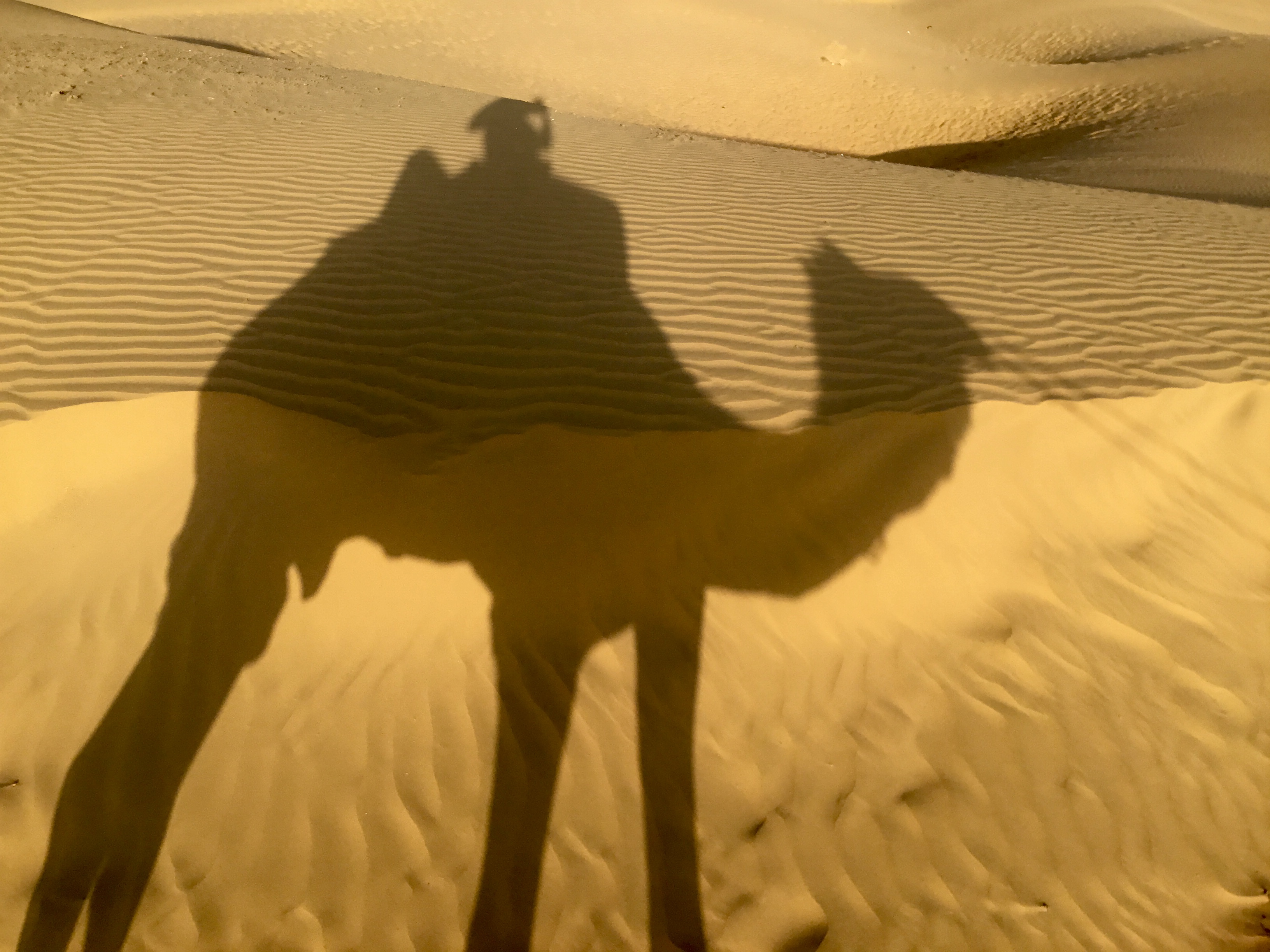
A: Art helps me explore and understand other cultures by revealing our shared humanity across space and time. For me art and travel are intertwined; there is no better education! My art-making has led me to visit fascinating places in search of source material, ideas, and inspiration: to Mexico, Guatemala, Brazil, Argentina, Uruguay, France, England, Italy, Bali, Java, Sri Lanka, and India. I have seen firsthand that people all over the world are the same.
Art has led me to undertake in-depth studies of intriguing subjects: drawing, color, composition, art, art history, the art business, film, film history, photography, mythology, literature, music, jazz, jazz history, and archaeology, particularly that of ancient Mesoamerica (Olmec, Zapotec, Mixtec, Aztec, and Maya), and South America (the Inca and their ancestors).
This rich mixture of creative influences continually grows. For anyone wanting to spend their time on earth studying, learning, and meeting new challenges, there is hardly anything more fascinating than to be a well-travelled, perpetually curious artist!
Comments are welcome!
Pearls from artists* # 428

View from Isla del Sol in Bolivia
* an ongoing series of quotations – mostly from artists, to artists – that offers wisdom, inspiration, and advice for the sometimes lonely road we are on.
In its spectacle and ritual the Carnival procession in Oururo bears an intriguing resemblance to the description given by Inca Garcilaso de la Vega of the great Inca festival of Inti Raymi, dedicated to the Sun. Even if Oururo’s festival did not develop directly from that of the Inca, the 16th-century text offers a perspective from the Andean tradition:
“The curacas (high dignitaries) came to their ceremony in their finest array, with garments and head-dresses richly ornamented with gold and silver.
Others, who claimed to descend from a lion, appeared, like Hercules himself, wearing the skin of this animal, including its head.
Others, still, came dressed as one imagines angels with the great wings of the bird called condor, which they considered to be their original ancestor. This bird is black and white in color, so large that the span of its wing can attain 14 or 15 feet, and so strong that many a Spaniard met death in contest with it.
Others wore masks that gave them the most horrible faces imaginable, and these were he Yuncas (people from the tropics), who came to the feast with the heads and gestures of madmen or idiots. To complete the picture, they carried appropriate instruments such as out-of-tune flutes and drums, with which they accompanied the antics.
Other curacas in the region came as well decorated or made up to symbolize their armorial bearings. Each nation presented its weapons: bows and arrows, lances, darts, slings, maces and hatchets, both short and long, depending upon whether they used them with one hand or two.
They also carried paintings, representing feats they had accomplished in the service of the Sun and of the Inca, and a whole retinue of musicians played on the timpani and trumpets they had brought with them. In other words, it may be said that each nation came to the feast with everything that could serve to enhance its renown and distinction, and if possible, its precedence over the others.”
El Carnaval de Oruro by Manuel Vargas in Mascaras de los Andes Bolivianos, Editorial Quipus and Banco Mercantil
Comments are welcome!
Pearls from artists* # 349
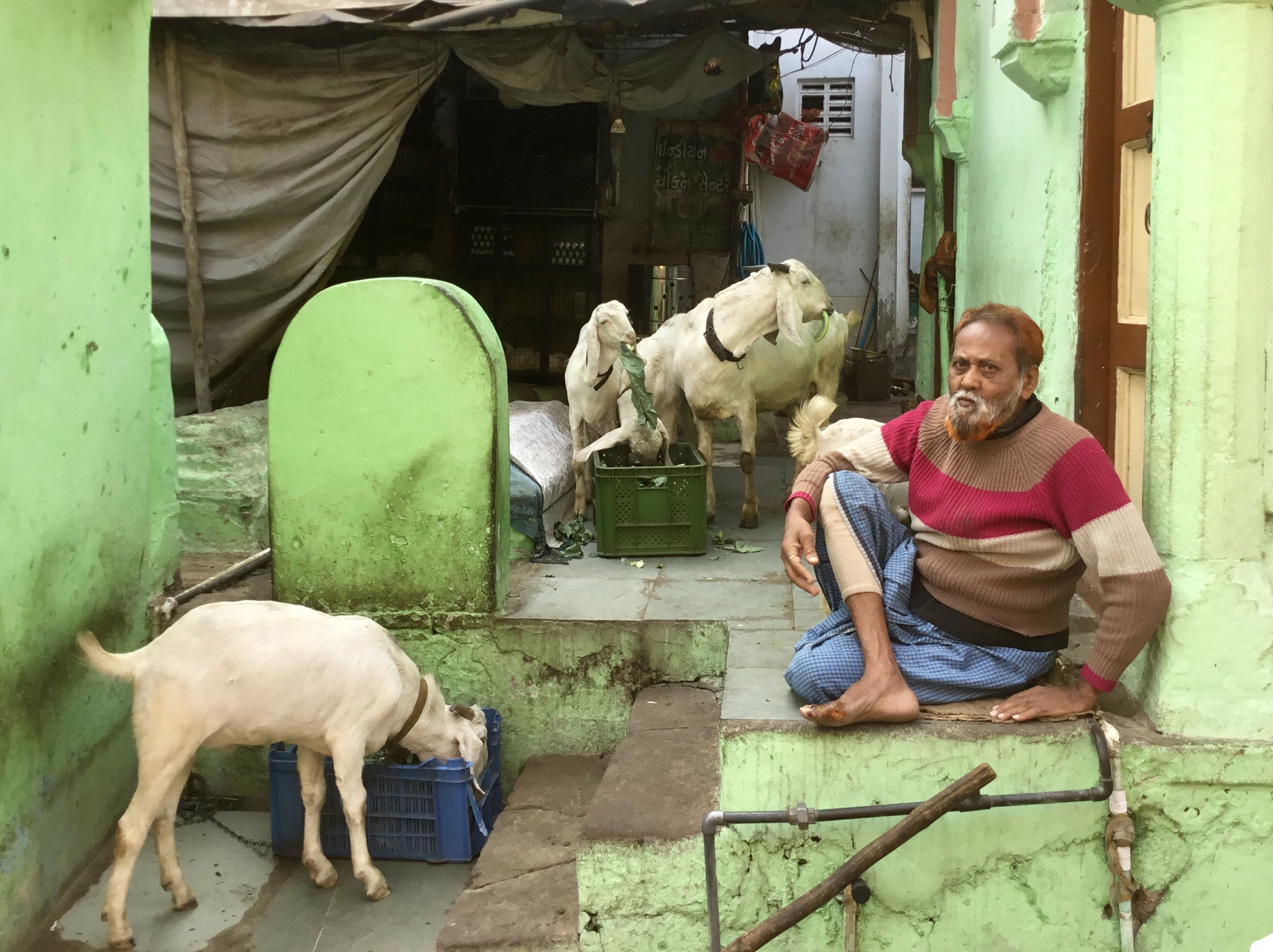
Ahmedabad, India
*an ongoing series of quotations – mostly from artists, to artists – that offers wisdom, inspiration, and advice for the sometimes lonely road we are on.
India presents to the visitor an overwhelmingly visual impression. It is beautiful, colorful, sensuous. It is captivating and intriguing, repugnant and puzzling. It combines the intimacy and familiarity of English four o’clock tea with the dazzling foreignness of carpisoned elephants or vast crowds bathing in the Ganga during an eclipse. India’s display of multi-armed images, it’s processions and pilgrimages, it’s beggars and kings, it’s street life and markets, it’s diversity of peoples – all appear to the eye in a kaleidoscope of images. Much that is removed from public view in the modern West and taken into the privacy of rest homes, asylums, and institutions is open and visible in the life of an Indian city or village. The elderly, the infirm, the dead awaiting cremation – these sights, while they may have been expunged from the childhood palace of the Buddha, are not isolated from the public eye in India. Rather, they are present daily in the visible world in which Hindus, and those who visit India, move in the course of ordinary activities. In India, one sees everything. One sees people at work and at prayer; one sees plump, well-endowed merchants, simple renouncers, fraudulent “holy” men, frail widows, and emaciated lepers; one sees the festival procession, the marriage procession, and the funeral procession. Whatever Hindus affirm of the meaning of life, death, and suffering, they affirm with their eyes wide open.
Diana L. Eck in Darsan: Seeing the Diving Image in India
Comments are welcome!
Q: Would you say there is a unifying quality to all of the work you have produced in the last thirty years?
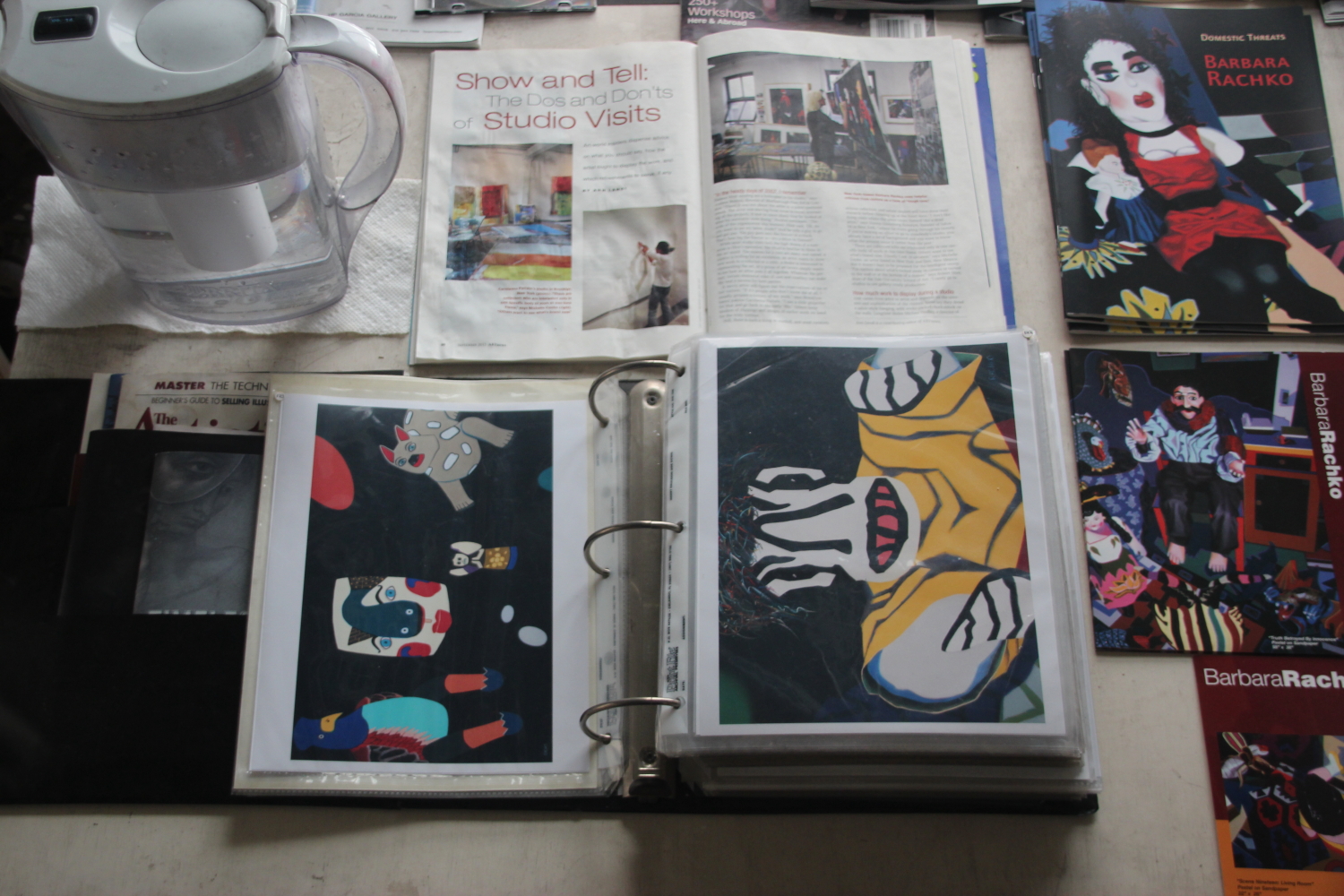
Barbara’s portfolio book
A: Yes, I can think of several. Whether making pastel paintings or printing photographs in the darkroom, I have always been concerned with quality and craftsmanship and never pronounce a work finished until it is the best thing I can make.
Although I started out as a maker of photorealist portraits in pastel, for twenty-odd years I have worked with Mexican folk art as my primary subject matter, treating these objects very differently in three separate series: “Black Paintings,” “Domestic Threats,” and “Gods and Monsters.” The first two are pastel-on-sandpaper paintings while the last is comprised of chromogenic photographs (c-prints). A few years ago I also started making “Teleidoscopes” using an iPad app to photograph my Mexican and Guatemalan folk art collection. This last one is just for fun; I do not offer them for sale.
Soft pastel is my first love and the two series of pastel paintings are my best-known work. My technique for using pastel continues to evolve in intriguing ways. I doubt I can ever learn all there is to know not only about color, but also about this medium. Pastel is endlessly fascinating, which is why I have never wanted to switch to anything else.
Comments are welcome!
Q: Why do people need art in their daily lives?
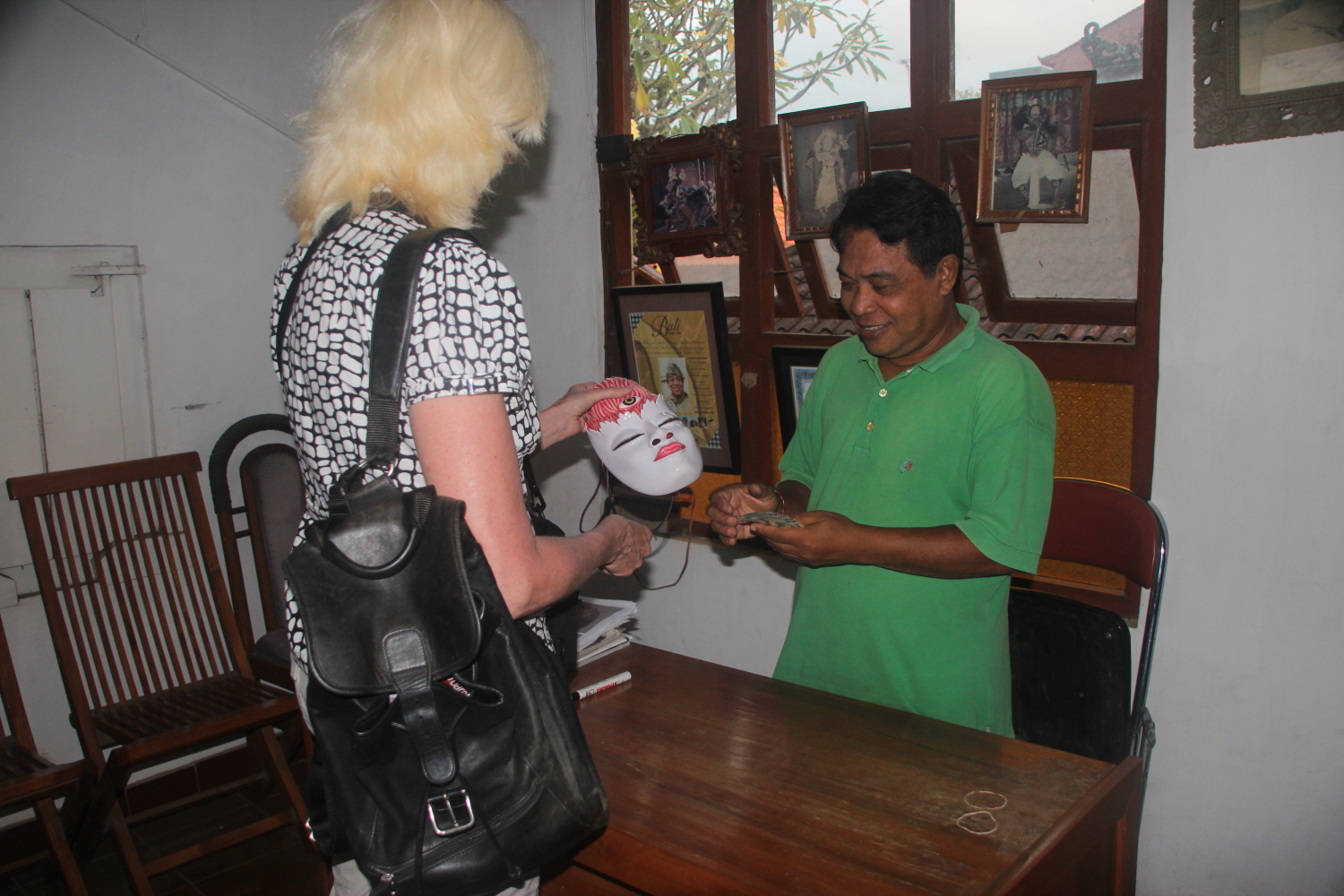
With Ida Bagus Anom, Mas, Bali; Photo: Donna Tang
A: That is for each person to decide, but as someone who devotes every waking moment to my work and to becoming a better artist, I cannot imagine my life without art.
I will tell you a little about what art has done for me. In my younger days boredom was a strong motivator. I left the active duty Navy out of boredom. I couldn’t bear not being intellectually challenged (most of my jobs consisted of paper-pushing), not using my flying skills (at 27 I was a licensed commercial pilot and Boeing-727 flight engineer), and not developing my artistic talents. In what surely must be a first, the Navy turned me into a hard-working and disciplined artist. And once I left the Navy there was no plan B. There was no time to waste. It was “full speed ahead.”
Art is a calling. You do not need to be told this if you are among those who are called. It’s all about “the work,” that all-consuming focus of an artist’s life. If a particular activity doesn’t seem likely to make me a better artist, I tend to avoid it. I work hard to nourish and protect my gifts. As artists we invent our own tasks, learn whatever we need in order to progress, and complete projects in our own time. It is life lived at its freest.
My art-making has led me to fascinating places: Mexico, Guatemala, Brazil, Argentina, Uruguay, France, England, Italy, Bali, Java, Sri Lanka, and more; and to in-depth studies of intriguing subjects: drawing, color, composition, art and art history, the art business, film and film history, photography, mythology, literature, music, jazz and jazz history, and archaeology, particularly that of ancient Mesoamerica (Olmec, Zapotec, Mixtec, Aztec, Maya, etc.). And this rich mixture continually grows! For anyone wanting to spend their time on earth learning and meeting new challenges, there is no better life!
Comments are welcome!


 barbararachkoscoloreddust.com
Q: What kind of internal conversations do you tend to have when you are in the process of making art? (Question from Vedica Art Studios and Gallery)
Jan 10
Posted by barbararachkoscoloreddust
A: When standing at my easel creating a pastel painting, I focus on formal properties: composition, shape, color, and line. I always strive to produce a painting I’ve never seen before. Even as (perhaps especially as) the creator, I want to be surprised by the final result. My studio days are spent thinking, looking, reacting, and adjusting colors and composition as I refine increasingly tiny details, ensuring all elements work harmoniously. I determine which areas need to recede or advance, which require intricate details to appear three-dimensional, and which are better left as flat areas of color.
These countless adjustments ensure viewers’ eyes are guided around the finished painting in intriguing ways. I often recall something collectors of my pastel paintings shared: they mentioned a New York Times review of a Nan Goldin exhibition, in which the writer stated, “All of the pleasure circuits are fired in looking.” The collectors agreed this is exactly how they feel when viewing my work. Artists live for appreciative comments like these!
Comments are welcome!
Share this:
Posted in 2026, An Artist's Life, Creative Process, Studio, Working methods
Comments Off on Q: What kind of internal conversations do you tend to have when you are in the process of making art? (Question from Vedica Art Studios and Gallery)
Tags: adjusting, adjustments, advance, agreed, always, appear, appreciative, areas, around, artists, “Magisterial”, “New York Times”, better, circuits, collectors, colors, comments, composition, countless, creating, creator, details, determine, elements, ensure, ensuring, especially, exactly, exhibition, finished, fired, formal, guided, harmoniously, increasingly, intricate, intriguing, looking, mentioned, Nan Goldin, painting, pastel painting, perhaps, pleasure, produce, properties, question, reacting, recall, recede, refine, require, result, review, shared, something, stated, strive, Studio, surprised, thinking, three-dimensional, Vedica Art Studios and Gallery, viewers, viewing, working, writer