Blog Archives
Pearls from artists* # 469

*an ongoing series of quotations – mostly from artists, to artists – that offers wisdom, inspiration, and advice for the sometimes lonely road we are on.
I feel artists are at the cutting edge of everything created by humans in our society. I would love for artists, young and old, to remember that for the Art World to exist, the first thing that is necessary is art. No gallerist, museum director, preparatory, or museum guard would have a job without an artwork having been created.
Without remembering this, artists can lose sight of their power and worth. We begin to believe that the Art World came first and that we need to change, appropriate, adjust, or edit ourselves and our work to fit into this world. This does not need to happen, and should not happen.
Stephanie Diamond, artist, New York, NY, in Art/Work: Everything You Need to Know (And Do) As You Pursue Your Art Career by Heather Darcy Bhandari and Jonathan Melber
Comments are welcome!
Pearls from artists* # 466

*an ongoing series of quotations – mostly from artists, to artists – that offers wisdom, inspiration, and advice for the sometimes lonely road we are on.
Within the initial artistic response to something is a core idea or feeling and most of our work comes from stripping away everything that is extraneous to it. To translate that vision means “to get across” the idea or feeling. How cleanly can that idea be isolated and honed, how much can be stripped away? Everything superfluous and tangential needs to be eliminated. Otherwise the idea may get buried and our intention deflected. And the viewer’s will also. The problem is seldom that an idea is too simple. Power comes from something deeply felt and simply stated. “Nothing astonishes men so much as common sense and plain dealing. All great actions have been simple, and all great pictures are.” (Quote from Ken Weber, The Eye of the Spirit, Shambala, 1998, p. 136).
Ian Roberts in Creative Authenticity: 16 Principles to Clarify and Deepen Your Artistic Vision
Comments are welcome!
Pearls from artists* # 460
*an ongoing series of quotations – mostly from artists, to artists – that offers wisdom, inspiration, and advice for the sometimes lonely road we are on.
Precious realm of painting! That silent power that speaks at first only to the eyes and then seizes and captivates every faculty of the soul! Here is your real spirit; here is your own true beauty, beautiful painting, so much insulted, so much misunderstood and delivered up to fools who exploit you. But there are still hearts ready to welcome you devoutly, souls who will no more be satisfied with mere phrases than with inventions and clever artifices. You have only to be seen in your masculine and simple vigor to give pleasure that is pure and absolute. I confess that I have worked logically, I, who have no love for logical painting. I see now that my turbulent mind needs activity, that it must break out and try a hundred different ways before reaching the goal towards which I am always straining. There is an old leaven working in me, some black depth that must be appeased. Unless I am writhing like a serpent in the coils of a pythoness I am cold. I must recognize this and accept it, and to do so is the greatest happiness. Everything good that I have ever done has come about in this way. No more ‘Don Quixotes’ and such unworthy things!
The Journal of Eugene Delacroix edited by Hubert Wellington
Comments are welcome!
Pearls from artists* # 458

*an ongoing series of quotations – mostly from artists, to artists – that offers wisdom, inspiration, and advice for the sometimes lonely road we are on.
When I have painted a fine picture I have not given expression to a thought! That is what they say. What fools people are! They would strip painting of all its advantages. A writer has to say almost everything in order to make himself understood, but in painting it is as if some mysterious bridge were set up between the spirit of the persons in the picture and the beholder. The beholder sees figures, the external appearance of nature, but inwardly he meditates; the true thinking that is common to all men. Some give substance to it in writing, but in so doing they lose the subtle essence. Hence, grosser minds are more easily moved by writers than by painters or musicians. The art of the painter is all the nearer to man’s heart because it seems to be more material. In painting, as in external nature, proper justice is done to what is finite and to what is infinite, in other words, to what the soul finds inwardly moving in objects that are known through the senses alone.
The Journal of Eugene Delacroix edited by Hubert Wellington
Comments are welcome!
Pearls from artists* # 449
*an ongoing series of quotations – mostly from artists, to artists – that offers wisdom, inspiration, and advice for the sometimes lonely road we are on.
I learned about the Japanese word irimi while studying Aikido, a Japanese martial art. Simply translated, irimi means ,’to enter’ but it can also be translated ‘choose death.’ When attacked you always have two options: to enter, irimi, or to go around, ura. Both when accomplished in the right manner, are creative. To enter or to ‘choose death’ means to enter fully with the acceptance, if necessary, of death. The only way to win is to risk everything and be fully willing to die. If this is an extreme notion to Occidental sensibilities, it does make sense in creative practice. To achieve the violence of decisiveness, one has to ‘choose death’ in the moment by acting fully and intuitively without pausing for reflection about whether it is the right decision or if it is going to provide the winning solution.
It is also valuable to know when to use ura, or going around. There is a time for ura, going around, and there is a time for irimi, entering. And these times can never be known in advance. You must sense the situation and act immediately. In the heat of creation, there is no time for reflection; there is only connection to what is happening. The analysis, the reflection and the criticism belong before and after, never during, the creative act.
Anne Bogart in “A Director Prepares: Seven Essays on Art and Theater”
Comments are welcome!
Q: What do you enjoy most about being an artist?
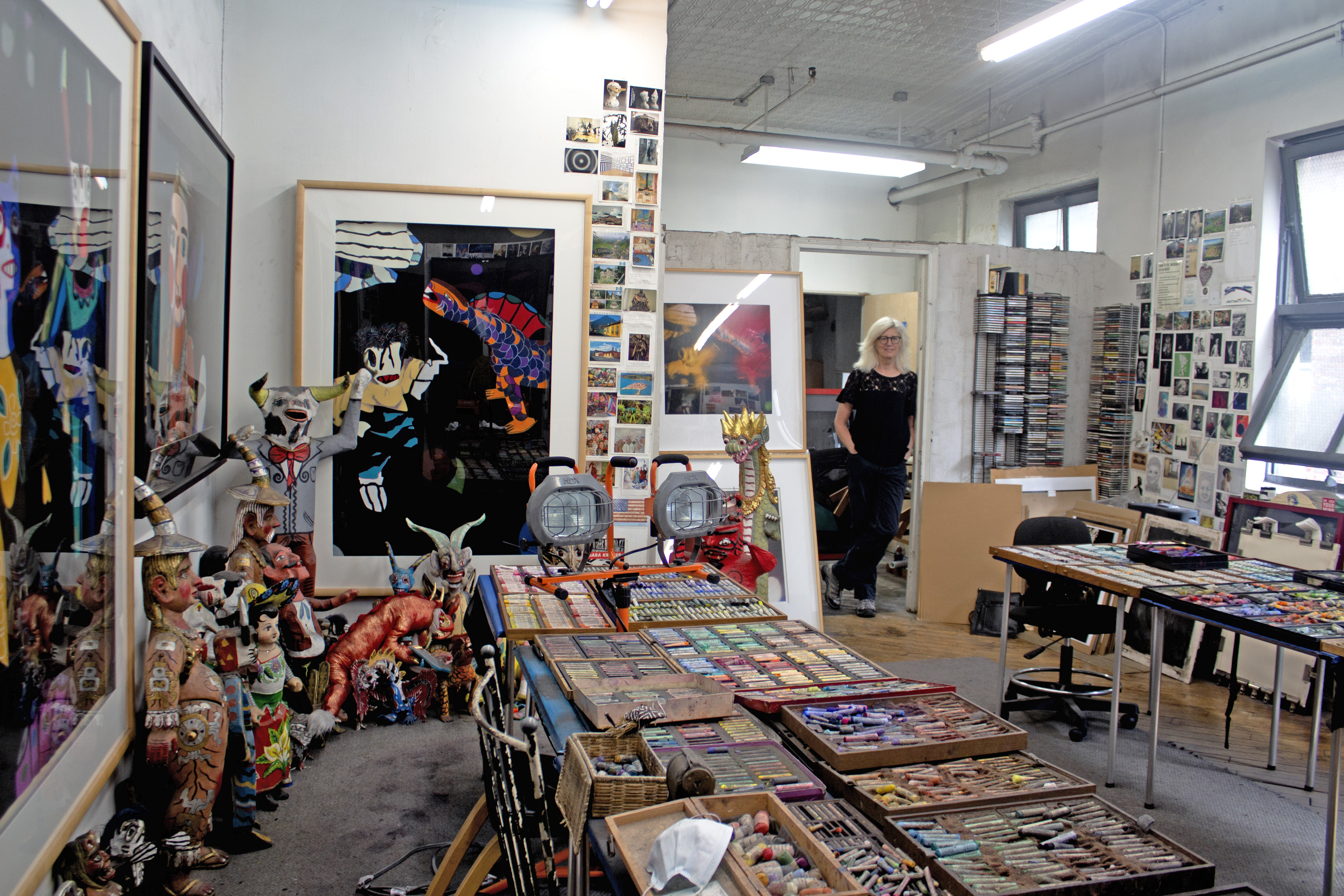
Barbara’s studio
A: This is a question I like to revisit every so often because life as an artist does not get easier; just the opposite, in fact. Visual artists tend to be “one man bands.” We do it all notwithstanding the fact that everything gets more difficult as we get older. It’s good to be reminded about what makes all the sacrifice and hard work worthwhile.
Even after thirty-four years as an artist, there are so many things to enjoy! I make my own schedule, set my own tasks, and follow new interests wherever they may lead. I am curious about everything and am rarely bored. I continually push my pastel technique as I strive to become a better artist. There is still so much to learn!
My relationship with collectors is another perk. I love to see pastel paintings hanging on collectors’ walls, especially when the work is newly installed and the owners are excited to take possession. This means that the piece has found a good home, that years of hard work have come full circle! And it’s often the start of a long friendship. After living with my pastel paintings for years, collectors tell me they see new details never noticed before and they appreciate the work more than ever. It’s extremely gratifying to have built a network of supportive art-loving friends around the country. I’m sure most artists would say the same!
Comments are welcome!
Pearls from artists* # 428

View from Isla del Sol in Bolivia
* an ongoing series of quotations – mostly from artists, to artists – that offers wisdom, inspiration, and advice for the sometimes lonely road we are on.
In its spectacle and ritual the Carnival procession in Oururo bears an intriguing resemblance to the description given by Inca Garcilaso de la Vega of the great Inca festival of Inti Raymi, dedicated to the Sun. Even if Oururo’s festival did not develop directly from that of the Inca, the 16th-century text offers a perspective from the Andean tradition:
“The curacas (high dignitaries) came to their ceremony in their finest array, with garments and head-dresses richly ornamented with gold and silver.
Others, who claimed to descend from a lion, appeared, like Hercules himself, wearing the skin of this animal, including its head.
Others, still, came dressed as one imagines angels with the great wings of the bird called condor, which they considered to be their original ancestor. This bird is black and white in color, so large that the span of its wing can attain 14 or 15 feet, and so strong that many a Spaniard met death in contest with it.
Others wore masks that gave them the most horrible faces imaginable, and these were he Yuncas (people from the tropics), who came to the feast with the heads and gestures of madmen or idiots. To complete the picture, they carried appropriate instruments such as out-of-tune flutes and drums, with which they accompanied the antics.
Other curacas in the region came as well decorated or made up to symbolize their armorial bearings. Each nation presented its weapons: bows and arrows, lances, darts, slings, maces and hatchets, both short and long, depending upon whether they used them with one hand or two.
They also carried paintings, representing feats they had accomplished in the service of the Sun and of the Inca, and a whole retinue of musicians played on the timpani and trumpets they had brought with them. In other words, it may be said that each nation came to the feast with everything that could serve to enhance its renown and distinction, and if possible, its precedence over the others.”
El Carnaval de Oruro by Manuel Vargas in Mascaras de los Andes Bolivianos, Editorial Quipus and Banco Mercantil
Comments are welcome!
Pearls from artists* # 427
Barbara’s studio
*an ongoing series of quotations – mostly from artists, to artists – that offers wisdom, inspiration, and advice for the sometimes lonely road we are on.
There should be a single Art Exchange in the world, to which an artist would simply send his works and be given in return as much as he needs. As it is, one has to be a merchant on top of everything else, and how badly one goes about it.
Ludwig von Beethoven quoted in Eric Maisel, A Life in the Arts: Practical Guidance and Inspiration for Creative and Performing Artists
Comments are welcome!
Pearls from artists* # 393
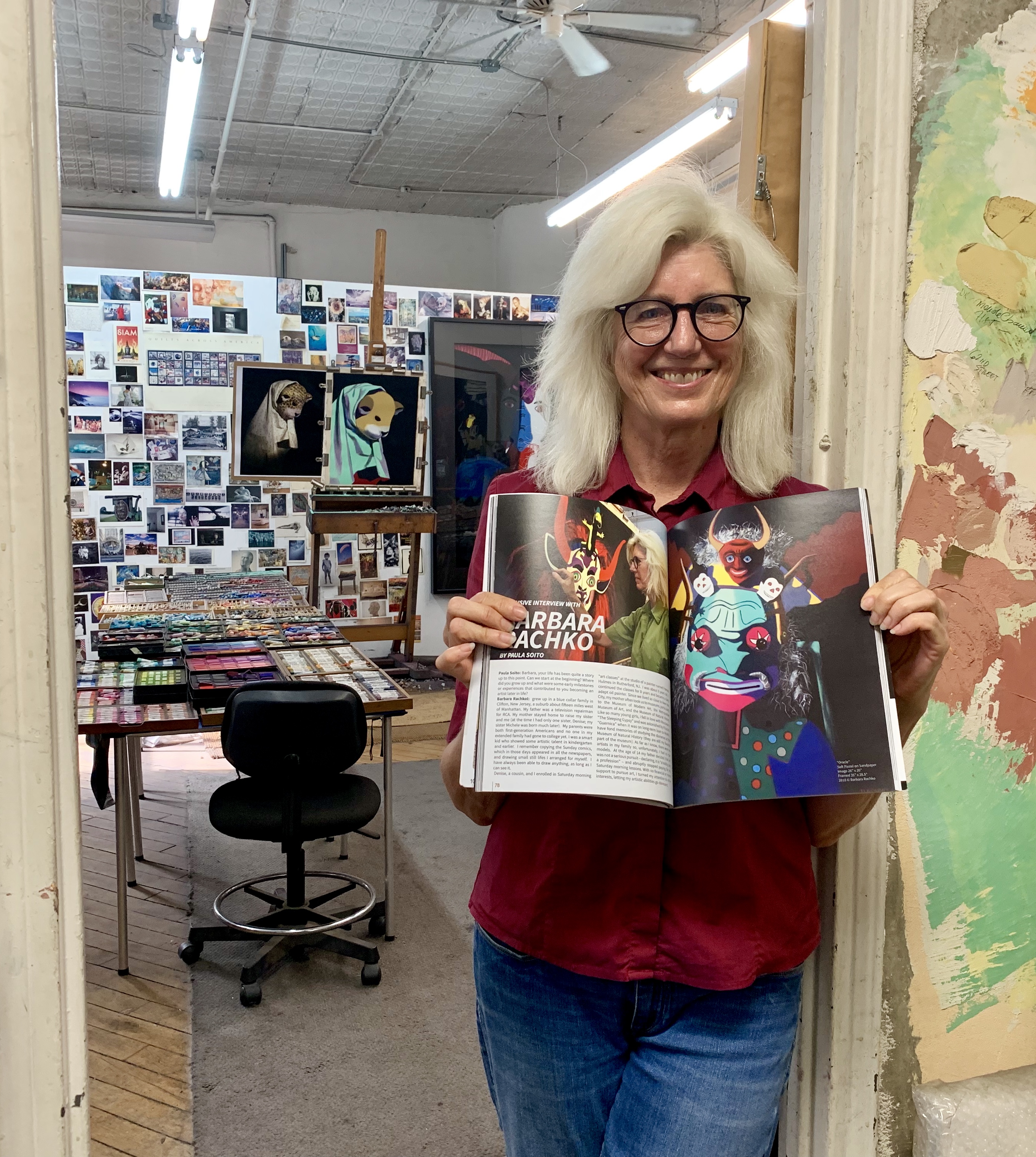
With my favorite interview
* an ongoing series of quotations – mostly from artists, to artists – that offers wisdom, inspiration, and advice for the sometimes lonely road we are on.
… Fernhoffer’s a man in love with our art, a man who sees higher and farther than other painters. He’s meditated on the nature of color, on the absolute truth of line, but by dint of so much research, he has come to doubt the very object of his investigations. In moments of despair, he claims that drawing doesn’t exist and that lines are only good for rendering geometrical figures, which is far from the truth, since with line and with black, which is not a color, we can create a human figure. There’s your proof that our art is like nature itself, composed of an infinity of elements: drawing accounts for the skeleton, color supplies life, but life without a skeleton is even more deficient than a skeleton without life. Lastly, there’s something even truer than all this, which is that practice and observation are everything to a painter; so that if reasoning and poetry argue with our brushes, we wind up in doubt, like our old man here, who’s as much a lunatic as he is a painter — a sublime painter who had the misfortune to be born into wealth, which has allowed him to wander far and wide. Don’t do that to yourself! A painter should philosophize only with a brush in his hand!
Honore Balzac in The Unknown Masterpiece
Comments are welcome!
Pearls from artists* # 376
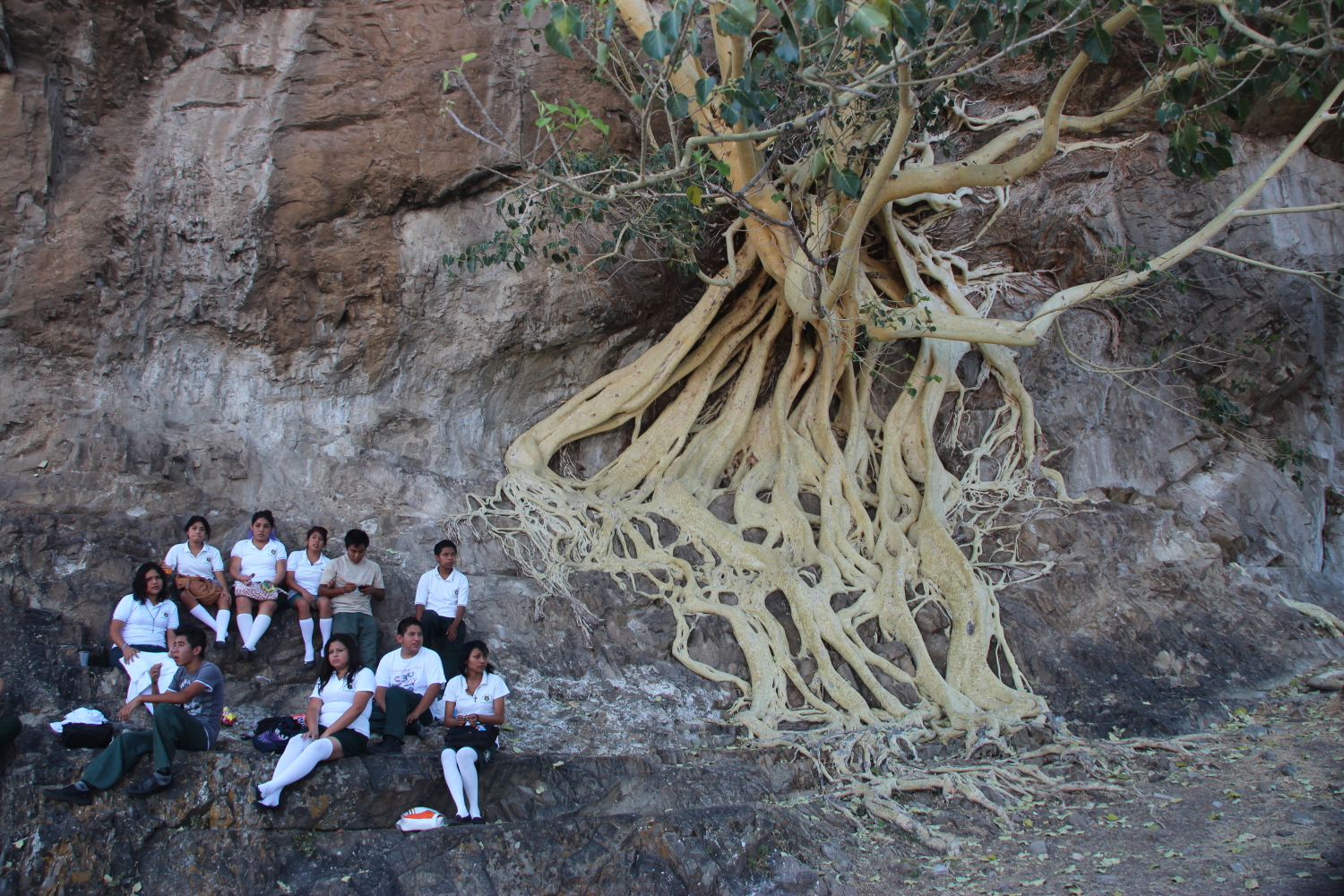
Chalcatzingo, Mexico
* an ongoing series of quotations – mostly from artists, to artists – that offers wisdom, inspiration, and advice for the sometimes lonely road we are on.
In the cemetery all the vultures began to circle, and the sky filled with birds. It was then that I began my series on birds – many of my bird photos came from this moment. All this to say that in life everything is connected: your pain and your imagination, which perhaps can help you forget reality. It’s a way of showing how you connect what you live with what you dream, and what you dream with what you do, and this is what remains on paper.
Graciela Iturbide in Eyes to Fly With: Portraits, Self-Portraits, and Other Photographs
Comments are welcome!



