Blog Archives
Q: Can you explain how you choose colors? (Question from Maria Cox via Instagram)

A: I am wild about color! As I work to create a pastel painting, I apply a color, back up from my easel to see how it interacts with and affects the rest of the painting, and then I make revisions. This process necessitates countless color changes and hundreds of hours during months of work. I apply pastel using a meticulous layering process. Were you to x-ray one of them, the earlier, discarded versions of a pastel painting would be visible. All the while I carefully fine-tune and refine how the colors and shapes interact with each other.
The goal is to make an exciting painting that no one, especially me as the maker, has ever seen before. I have no desire to repeat myself, to make art that resembles work by any other artist, or to be forced into a niche.
I try to select intense, vibrant colors that are exciting to look at, that work well in relationship to each other, and that will grab the viewer. Sometimes I deliberately choose colors for their symbolic meanings. For example, I selected a dark purple for the alternating triangles (the ones with the pink dots above) in “Overlord” because purple denotes royalty.
I have been working with soft pastel for 37 years so I have a fairly intricate science of color at my disposal. No doubt, many unconscious factors are at play, too. More on that in future posts.
Comments are welcome!

Pearls from artists* # 534

*an ongoing series of quotations – mostly from artists, to artists – that offers wisdom, inspiration, and advice for the sometimes lonely road we are on.
Today I am quoting myself:
I strive to always do what is best for my art practice. It’s difficult sometimes, but it’s important to ignore most of what other people say. They mean well, but advice to artists is often misguided, especially when it is unsolicited. Fortunately, our hearts are never wrong.
B. Rachko on a Facebook post
Comments are welcome!
Q: What is your process? (Question from artamour)
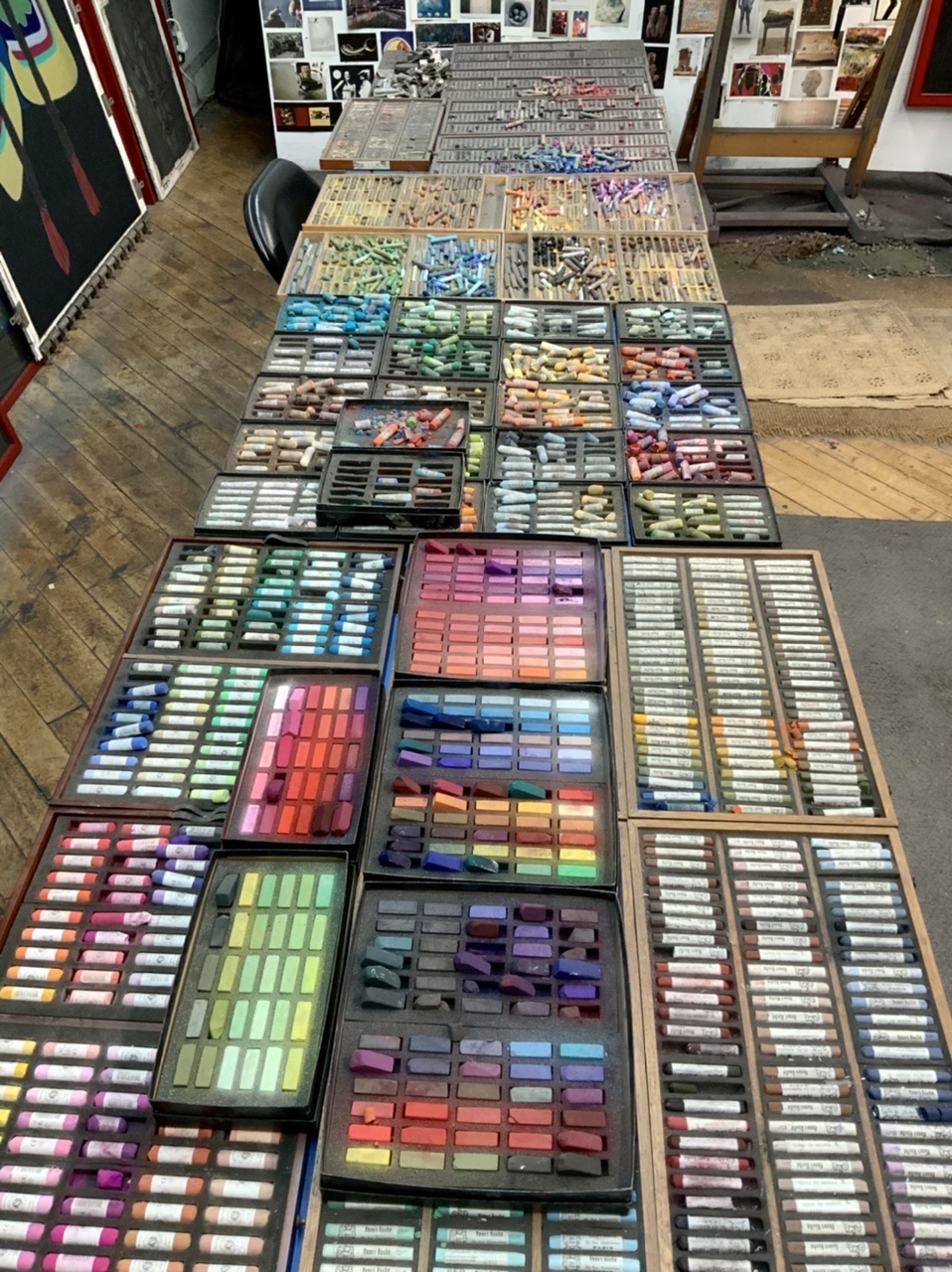
A: For thirty-six years I have worked exclusively in soft pastel on sandpaper. Pastel, which is pigment and a binder to hold it together, is as close to unadulterated color as an artist can get. It allows for very saturated color, especially employing the self-invented techniques I have developed and mastered. I believe my “science of color” is unique, completely unlike how any other artist works. I spend three to four months on each painting, applying pastel and blending the layers together to mix new colors on the paper.
The acid-free sandpaper support allows the buildup of 25 to 30 layers of pastel as I slowly and meticulously work for hundreds of hours to complete a painting. The paper is extremely forgiving. I can change my mind, correct, refine, etc. as much as I want until a painting is the best I can create at that moment in time.
My techniques for using soft pastel achieve rich velvety textures and exceptionally vibrant color. Blending with my fingers, I painstakingly apply dozens of layers of pastel onto the sandpaper. In addition to the thousands of pastels that I have to choose from, I make new colors directly on the paper. Regardless of size, each pastel painting takes three to four months and hundreds of hours to complete.
I have been devoted to soft pastel from the beginning. In my blog and in numerous interviews online and elsewhere, I continue to expound on its merits. For me no other fine art medium comes close.
My subject matter is unique. I am drawn to Mexican, Guatemalan, and Bolivian cultural objects—masks, carved wooden animals, papier mâché figures, and toys. On trips to these countries and elsewhere I frequent local mask shops, markets, and bazaars searching for the figures that will populate my pastel paintings. How, why, when, and where these objects come into my life is an important part of the creative process. Each pastel painting is a highly personal blend of reality, fantasy, and autobiography.
Comments are welcome!
Q: What’s on the easel today?
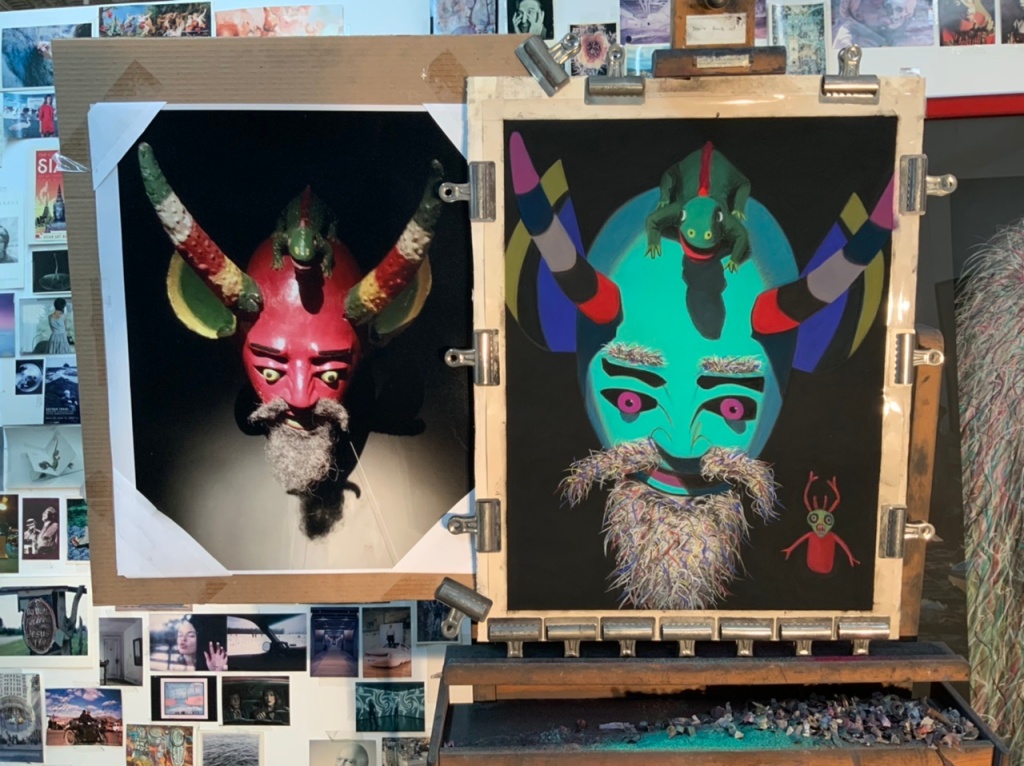
A: I’m still refining and adding details to “The Mentalist,” soft pastel on sandpaper, 26” x 20.” The frog especially needs more work.
Comments are welcome!
Pearls from artists* # 478

*an ongoing series of quotations – mostly from artists, to artists – that offers wisdom, inspiration, and advice for the sometimes lonely road we are on.
Artists, because of the demands of their personality, their sense of personal mission, and their need to create or perform, are driven people. Mixed with the love of work can be a terrible pressure to work. For many artists, and especially for the most productive ones, the line between love and obsession and between love and compulsion blurs or disappears entirely. Are such artists free or are they slaves to their work?
In The Artist and Society the psychiatrist Lawrence Hatterer said of such an artist:
His most recognizable trait is his recurring daily preoccupation with translating artistic activity into accomplishment. The consuming intensity of this artistic pursuit brooks no interference or obstacles. His absorption with the creative act is such that he experiences continually what the average artist feels only infrequently when he reaches unusual levels of creative energy with accompanying output. He appears to be incapable of willful nonproductivity.
This is Picasso working for 72 hours straight. This is van Gogh turning out 200 finished paintings during his 444 days in Arles. The artist who is “incapable of willful nonproductivity” is a workaholic for whom little in life, apart from his artistic productivity and accomplishment, may have any meaning.
Eric Maisel in A Life in the Arts: Practical Guidance and Inspiration for Creative and Performing Artists
Comments are welcome!
Pearls from artists* # 474

*an ongoing series of quotations – mostly from artists, to artists – that offers wisdom, inspiration, and advice for the sometimes lonely road we are on.
If ever an artist needed a degree of protection against his public, surely it is Vincent van Gogh. Reproductions of his most emblematic paintings, especially the gyrating nightscapes and the blazing series of sunflower studies made in his late years, adorn countless bedrooms, living rooms, and bathrooms all across what used to be known as the developed world. The popularity of the works executed in the great flowering of this last period, which began around the time of his revelatory visit in the autumn of 1885 to the newly completed Rijksmuseum, in Amsterdam, and ended when he died less than five years later at the age of thirty-seven, is unparalleled. Of the great ones among his contemporaries, and there were many, only Degas can come near to rivaling him as a mainstay of interior decoration.
John Banville in His Own Worst Enemy, The New York Review of Books, May 13, 2021
Comments are welcome!
Pearls from artists* # 467
*an ongoing series of quotations – mostly from artists, to artists – that offers wisdom, inspiration, and advice for the sometimes lonely road we are on.
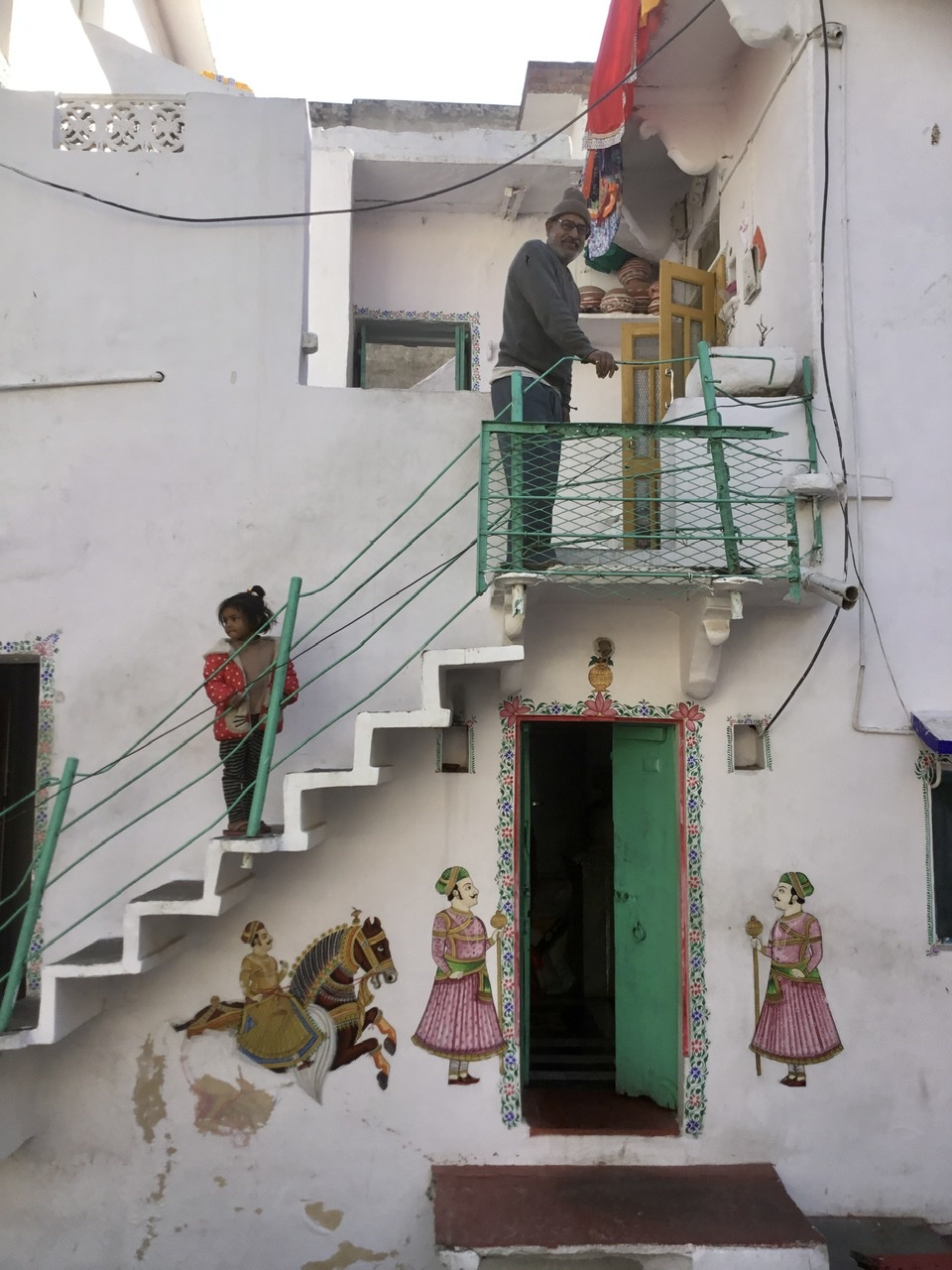
As students confronted with images of India through film and photography, we are challenged to begin to be self-conscious of who we are as “seers.” Part of the difficulty of entering the world of another culture, especially one with as intricate and elaborate a visual articulation as India’s, is that, for many of us, there are no “manageable models.” There are no self-evident ways of recognizing the shapes and forms of art, iconography, ritual life and daily life that we see. Who is Śiva, dancing wildly in a ring of fire? What is happening when the priest pours honey and yogurt over the image of Viṣṇu? Why does the woman touch the feet of the ascetic beggar? For those who enter the visible world of India through the medium of film, the onslaught of strange images raises a multitude of questions. These very questions should be the starting point for our learning. Without such self-conscious questions, we cannot begin to “think” with what we see and simply dismiss it as strange. Or worse, we are bound to misinterpret what we see by placing it solely within the context of what we already know from our own world of experience.
Diana L. Eck in Darsan: Seeing the Divine Image in India
Comments are welcome!
Q: What do you enjoy most about being an artist?
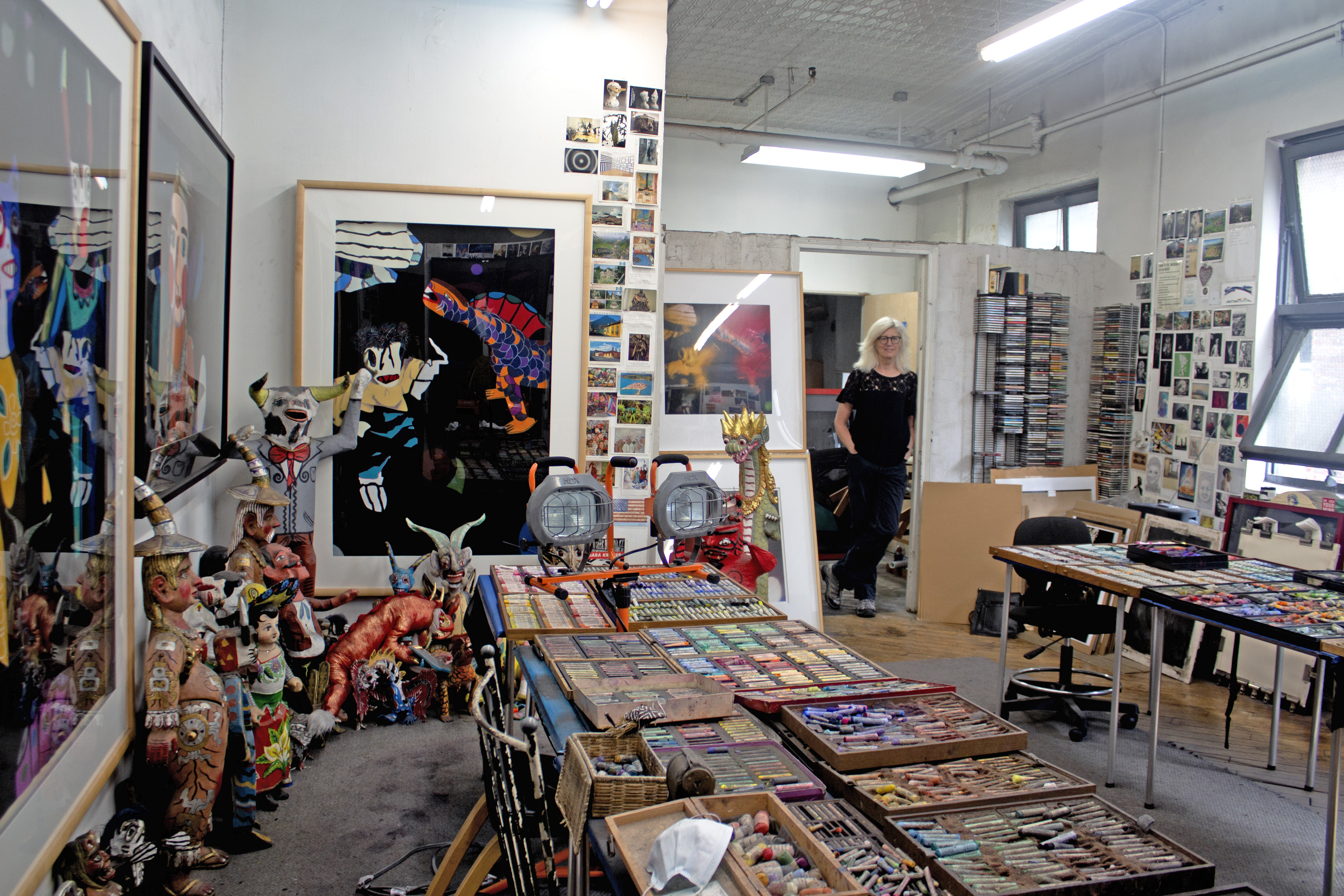
Barbara’s studio
A: This is a question I like to revisit every so often because life as an artist does not get easier; just the opposite, in fact. Visual artists tend to be “one man bands.” We do it all notwithstanding the fact that everything gets more difficult as we get older. It’s good to be reminded about what makes all the sacrifice and hard work worthwhile.
Even after thirty-four years as an artist, there are so many things to enjoy! I make my own schedule, set my own tasks, and follow new interests wherever they may lead. I am curious about everything and am rarely bored. I continually push my pastel technique as I strive to become a better artist. There is still so much to learn!
My relationship with collectors is another perk. I love to see pastel paintings hanging on collectors’ walls, especially when the work is newly installed and the owners are excited to take possession. This means that the piece has found a good home, that years of hard work have come full circle! And it’s often the start of a long friendship. After living with my pastel paintings for years, collectors tell me they see new details never noticed before and they appreciate the work more than ever. It’s extremely gratifying to have built a network of supportive art-loving friends around the country. I’m sure most artists would say the same!
Comments are welcome!
Pearls from artists* # 354

“Epiphany,” soft pastel on sandpaper, 38″ x 58″
*an ongoing series of quotations – mostly from artists, to artists – that offers wisdom, inspiration, and advice for the sometimes lonely road we are on.
My earlier work had taught me that artistic activity is a form of reasoning, in which perceiving and thinking are indivisibly intertwined. A person who paints, writes, composes, dances, I felt compelled to say, thinks with his senses. This union of perception and thought turned out to be not merely a specialty of the arts. A review of what is known about perception, and especially about sight, made me realize that the remarkable mechanisms by which the senses understand the environment are all but identical with the operations described by the psychology of thinking. Inversely, there was much evidence that truly productive thinking in whatever area of cognition takes place in the realm of imagery. This similarity of what the mind does in the arts and what it does elsewhere suggested taking a new look at the long-standing complaint about the isolation and neglect of the arts in society and education. Perhaps the real problem was more fundamental: a split between sense and thought, which caused various deficiency diseases in modern man.
Rudolph Arnheim in Visual Thinking
Comments are welcome!


 barbararachkoscoloreddust.com