Blog Archives
Q: You started the Bolivianos series in 2017. It has been 8 years since you created The Champ. This endeavor of focussing on a series for almost a decade’s timeline shows that you embody stability as against many artists who tend to hop on to the next inspiration they find. How has discipline, stability, focus and punctuality defined your works apart from being inspired by Bolivian culture for the series Bolivianos? (Question from Vedica Art Studios and Gallery)
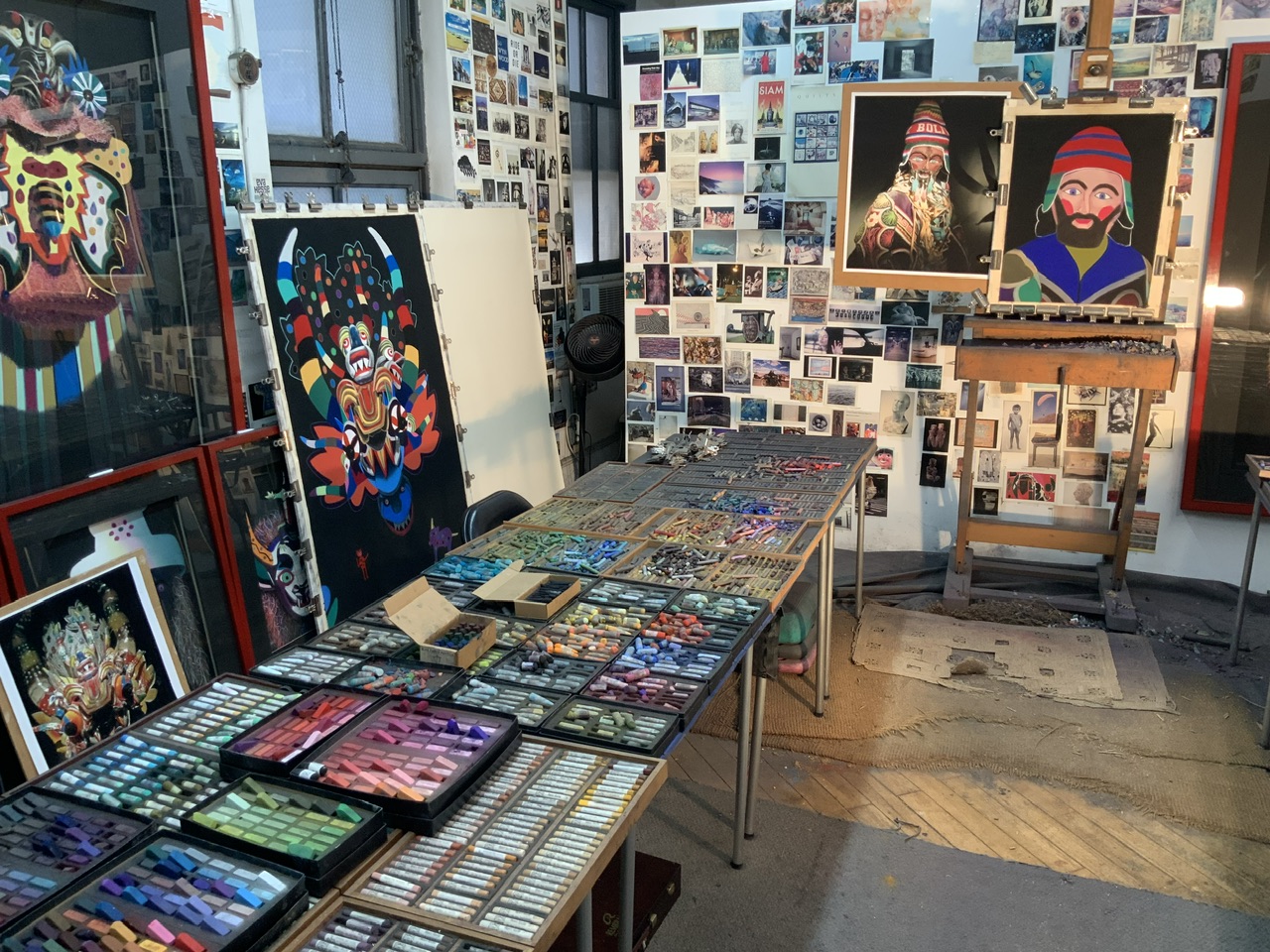
A: My first series, Domestic Threats, lasted fifteen years, and my second, Black Paintings, lasted ten. Stability and related qualities are likely natural parts of my personality, reinforced by my previous professional life. My prior careers as a Navy Commander, commercial pilot, and Boeing-727 Flight Engineer undoubtedly helped develop discipline, stability, focus, and punctuality. Details matter deeply to me; as a Naval Officer for twenty-one years, “attention to detail” was paramount. From my earliest days as an artist, I have been meticulous and dedicated to inventing new techniques and refining the craft of soft pastel.
I dislike wasting precious time. As a goal-oriented person, I continually strive to accomplish as much as possible. These qualities were influenced by my Navy career and further deepened by the tragic loss of my husband onboard the plane that crashed into the Pentagon on 9/11. I understand firsthand that life can change in an instant. Whenever I finish one task, I immediately look around and ask, “OK, what’s next?” I devote my studio time to pushing myself and pastel to new technical heights. There’s always more to accomplish as an artist!
Comments are welcome!
Pearls from artists* # 678
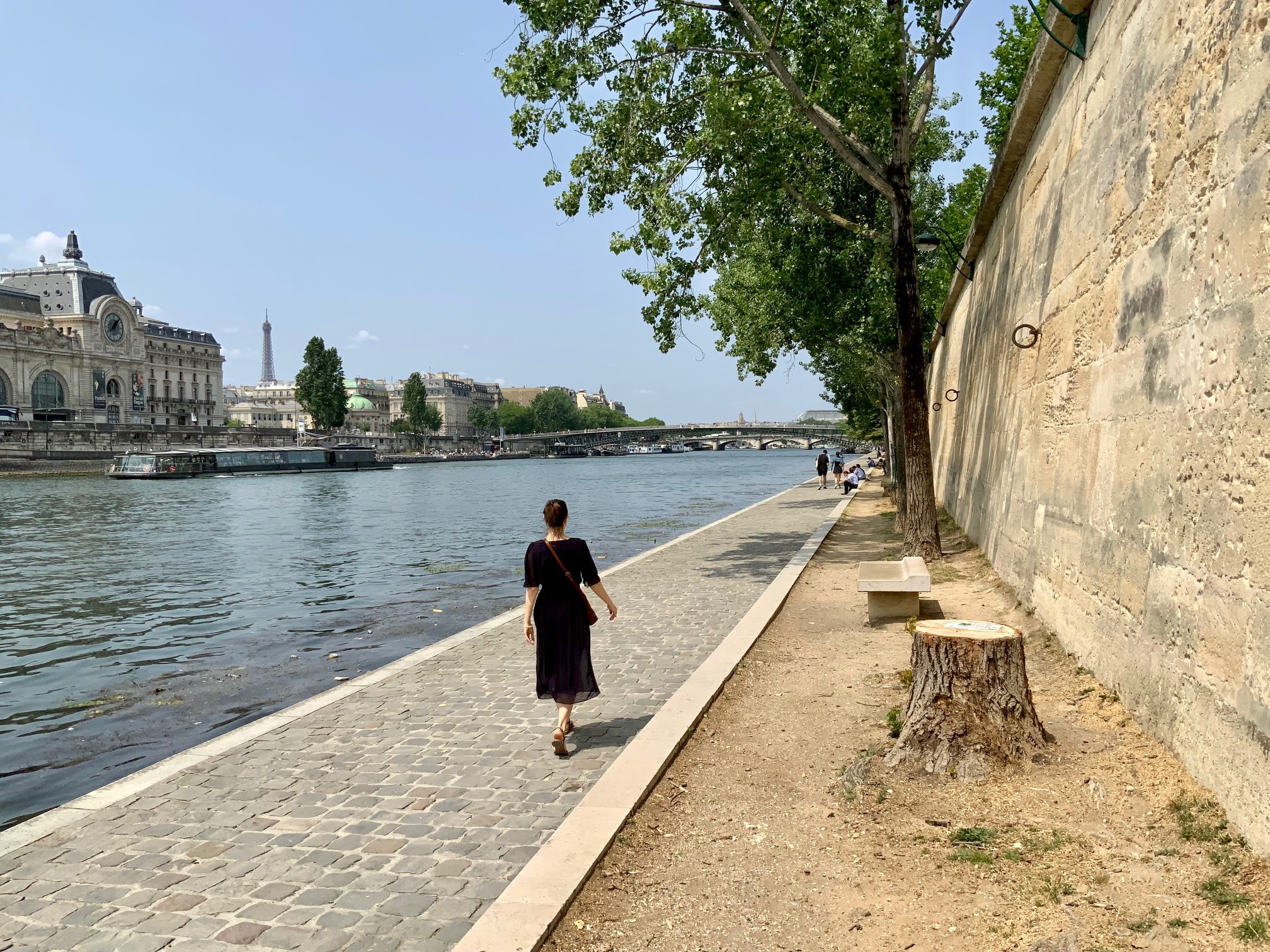
Along the Seine, Paris, France
*an ongoing series of quotations – mostly from artists, to artists – that offers wisdom, inspiration, and advice for the sometimes lonely road we are on.
When I was a bit weary, losing hope, I would go out and walk across Paris. Sometimes I would meet an art lover who would say a word to me, nothing binding for him, but all the same it would buck me up a bit. For example, he might say: “What are you up to? I’d love to see what you’ve done. I’ll come and see you on Thursday at eleven. I’d go home feeling like a new man; I’d tell my wife how enthusiastic I felt; but on Thursday at ten I’d get an express letter saying, “Dear friend, please excuse me, something has come up.” But that wouldn’t matter so much because I’d made a new start. The deal had fallen through, but it’d still helped because it had given me new momentum.
Chatting With Henri Matisse: The Lost 1941 Interview, Henri Matisse with Pierre Courthion, edited by Serge Guilbaut
Comments are welcome!
Pearls from artists* # 670

*an ongoing series of quotations – mostly from artists, to artists – that offers wisdom, inspiration, and advice for the sometimes lonely road we are on.
I’ve had to keep defining and defending myself as a writer every single day of my adult life – constantly reminding and re-reminding my soul and the cosmos that I’m very serious about the business of creative living, and that I will never stop creating, no matter what the outcome, and no matter how deep my anxieties and insecurities may be.
Over time I’ve found the right tone of voice for these assertions, too. It’s best to be insistent, but affable. Repeat yourself, but don’t get shrill. Speak to your darkest and most negative interior voices the way a hostage negotiator speaks to a violent psychopath: calmly, but firmly. Most of all, never back down. You cannot afford to back down. The life you are negotiating to save, after all, is your own.
Elizabeth Gilbert in Big Magic: Creative Living Beyond Fear
Comments are welcome!
Q: How do you decide when a pastel painting is finished?

Signing “Apparition,” soft pastel on sandpaper, 58” x 38”
A: During the several months that I work on a pastel painting, I search for the best, most eye-popping colors, as I build up and blend together as many as 25 to 30 layers of pigment. I am able to complete some areas, like the background, fairly easily – maybe with six or seven layers – but the more realistic parts take more applications because I am continually refining and adding details. Details always take time to perfect.
No matter how many pastel layers I apply, however, I never use fixatives. It is difficult to see this in reproductions of my work, but the finished surfaces achieve a texture akin to velvet. My technique involves blending each layer with my fingers, pushing pastel deep into the tooth of the sandpaper. The paper holds plenty of pigment and because the pastel doesn’t flake off, there is no need for fixatives.
I consider a given painting complete when it is as good as I can make it, when adding or subtracting anything would diminish what is there. I know my abilities and I know what each individual stick of pastel can do. I continually try to push myself and my materials to their limits.
Comments are welcome.
In celebration of the 13th anniversary of my blog three days from now, I am republishing the very first post from July 15, 2012. Q: What does it take to be an artist, especially one living and working in New York?
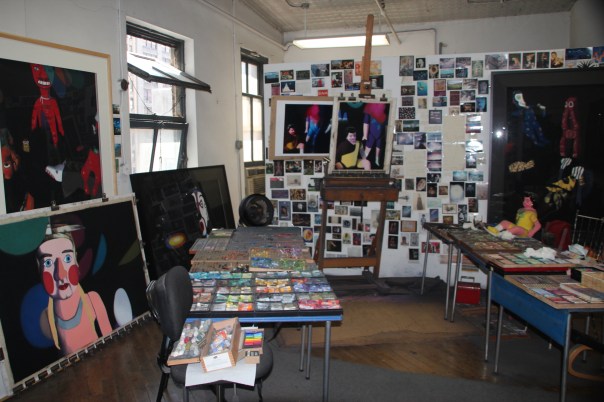
Barbara’s Studio (in 2012) with works in progress.
A: The three Big P’s – Patience, Persistence, and Passion. Without all three you will not have the stamina to work tirelessly for very little external reward. You can expect help from no one.
There are so many obstacles to art-making and countless reasons to just give up. When you really think about it, it’s amazing that great art gets made at all. So why do we do it? Above all it’s about making our time on earth matter, about devotion to our innate gifts and love of our hard-fought creative process.
And, my God, it even gets harder as we get older! So what do we do? We dig in that much deeper. It’s a most noble and sacred calling – you know when you have it – and that’s what separates those of us who are in it for the long haul from the wimps, fakers, and hangers-on. I say to my fellow artists who continue to work despite the endless challenges, we are all true heroes!
These words still ring true and it’s good, even for me, to occasionally be reminded.
Most importantly, THANK YOU to my 222,000+ subscribers for taking this journey with me. When I began this blog in 2012, I had no idea it would prove to be so popular… WOW!
Comments are welcome!
Pearls from artists* # 613
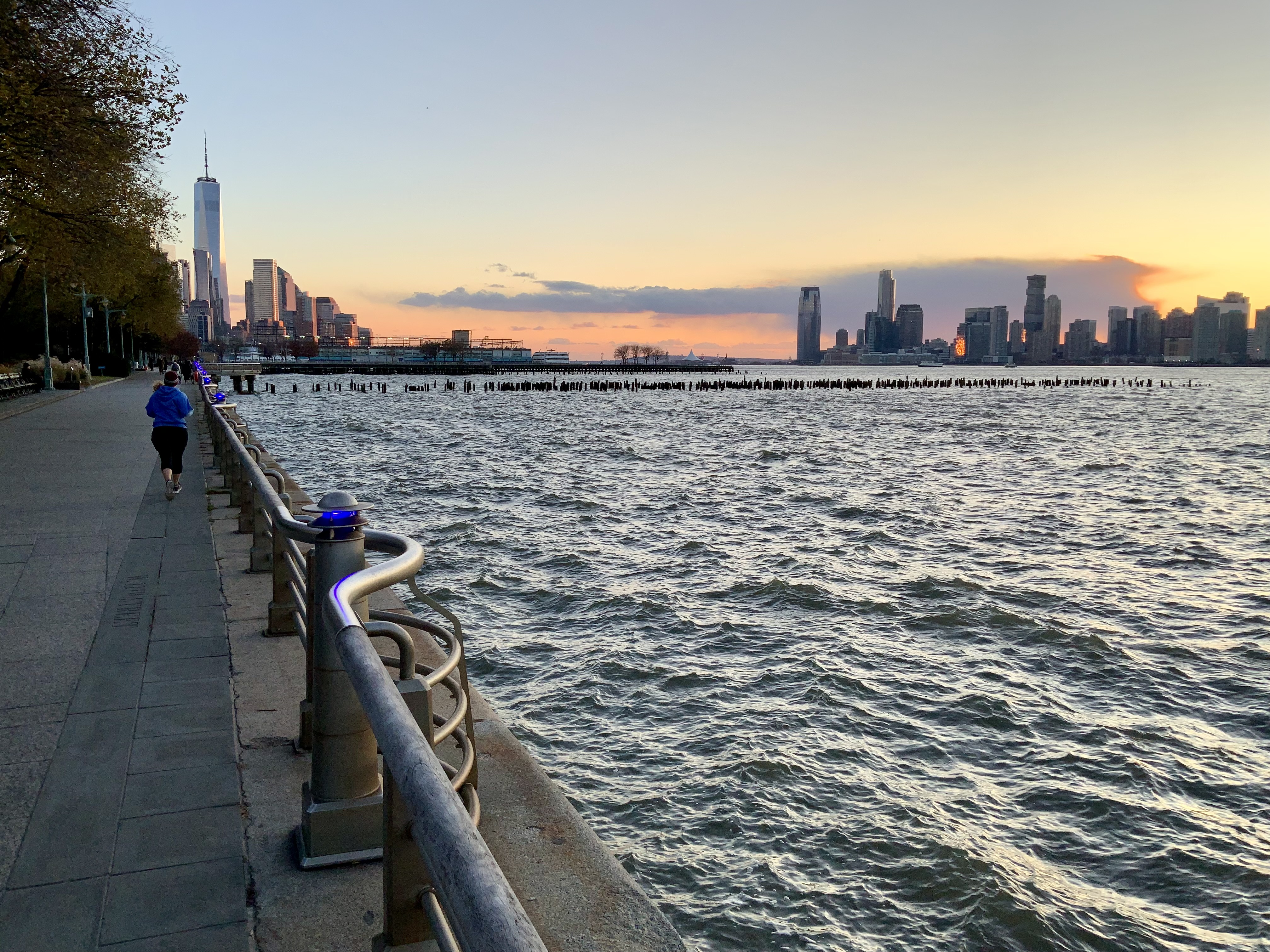
New York NY
*an ongoing series of quotations – mostly from artists, to artists – that offers wisdom, inspiration, and advice for the sometimes lonely road we are on.
A painting is a statement of the artist’s notions of reality in terms of plastic speech. In that sense the painter must be likened to the philosopher rather than to the scientist. For science is a statement of the laws that govern a specific phenomenon or category of matter or energy within the specified units and conditions of its operation. Philosophy, however, must combine all these specialized truths within a single system. It is because of this broad scope that Aristotle gives preeminence to the philosopher in the introduction to his Metaphysics, for he tells us that every man except the philosopher is an authority within his specific field, whereas the philosopher must have the acute knowledge that each man has in his own field plus the ability to relate all these fields to the operations of universality and eternity.
Therefore art, like philosophy, is of its own age; for the partial truths of each age differ from those of other ages, and the artist, like the philosopher, must constantly adjust eternity, as it were, to all the specifications of the moment. Art, too, creates at different times the notions of reality that the artist, as a man of the age, must inherit and develop and consider real along with the other intellectually conscious men of his time. His language, which is his plastic means, will also adjust itself to the possibility of making these notions manifest in their most coherent possibilities. The reality of the artist, therefore, reflects the understanding of his times, even as his creations shape those understandings. We posit this without wishing to attempt to untangle here the series of causes and effects, a process which would probably obscure more than it certified.
Mark Rothko in The Artist’s Reality: Philosophies of Art
Comments are welcome!
Pearls from artists* # 612
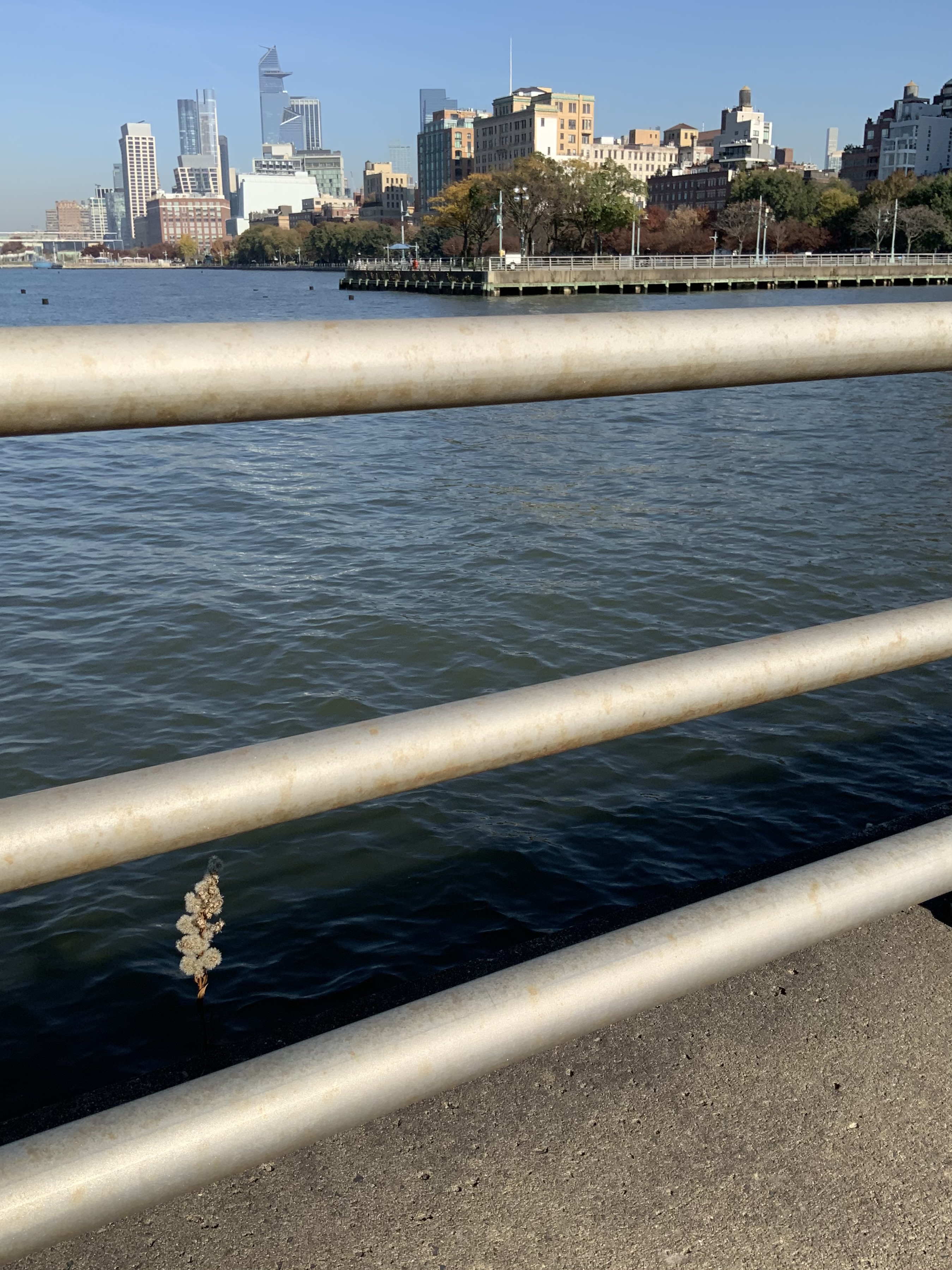
New York, NY
*an ongoing series of quotations – mostly from artists, to artists – that offers wisdom, inspiration, and advice for the sometimes lonely road we are on.
It is the poet and philosopher who provide the community of objectives in which the artist participates. Their chief preoccupation, like the artist, is the expression in concrete form of their notions of reality. Like him, they deal with verities of time and space, life and death, and the heights of exaltation as well as the depths of despair. The preoccupation with these external problems creates a common ground which transcends the disparity of the means used to achieve them. And it is in the language of the philosopher and poet or, for that matter, of other arts which share the same objective that we must speak if we are to establish some verbal equivalent of the significance of art.
Let us not for a moment conceive that the language of one is interchangeable with that of the other: that one can duplicate the sense of a picture by the sense of words or sounds, or that one can translate the truth of words by means of pictorial delineations. Not all odes of Pindar, framed and embroidered, could duplicate the portrayal by Apelles’ brush of the Hero of the Palaestra. The Pandemonium of Milton or Dante’s Inferno can never replace the vision of the Last Judgment by either Michelangelo or Signorelli. No more so than the Pastoral Symphony of Beethoven can be apprehended through the reading of idyllic poems, augmented by descriptions of woodland and fields, of torrents and streams, the study of ornithological sounds, and the laws of harmonics. Neither books on jurisprudence, nor costume plates, can possibly reconstruct Raphael’s School of Athens. And the man who knows a book or a picture through its critics, whatever his experience, has no experience of the art itself. The truth, the reality of each, is confined within its own boundaries and must be perceived in terms of the means generic to itself.
In speaking of art here, there is no thought of recreating the experience of the picture. If we compare one art to another, it is not with the intention of contrasting their actuality, but to speak rather of the motivations and properties such as are admissible to the world of verbal ideas. And if… we are partial to the philosopher – at the expense of those others who share with the artist his common objectives, it is not because we divine in his effort a greater sympathy to the artist, but because philosophy shares with art it’s preoccupation with ideas in the terms of logic.
Mark Rothko in The Artist’s Reality: Philosophies of Art
Comments are welcome!
Q: How do you persist despite the haters, nay-sayers, etc.? (Question from Bold Journey Publishing)

Barbara’s Studio
A: There are so many obstacles to art-making and countless reasons to just give up. When you really think about it, it’s amazing that great art gets made at all. So why do we do it? For artists I believe it’s all about making our time on earth matter, about devotion to our innate gifts, and a deep love of our hard-fought creative process.
I have been a full-time professional artist for 37 years. How and why do successful artists persist? It helps a lot to be stubborn! We just keep digging in that much deeper. Making art is a most noble and sacred calling – you know this if you are one of the called – and that’s what separates those of us who are in it for the long haul from the wimps, fakers, and hangers-on. I say to my fellow artists who continue to work despite the endless challenges, we artists who continue to struggle every day for recognition of our gifts are true heroes!
These words below by Mary Gabriel in Ninth Street Women, published in 2017, ring true for artists. It’s good, even for me, to occasionally reread them and be reminded.
The obstacles faced by women who hoped to leave a mark on humankind have, through the millennium, varied in height but not in stubborn persistence. And yet, a great many women have stubbornly ignored them. The desire to put words on a page or marks on a canvas was greater than the accrued social forces that told them they had no right to do so, that they were excluded by their gender from that priestly class called artist. The reason, according to Western tradition, was as old as creation itself: For many, God was the original artist and society had assigned its creator a gender – He. The woman who dared to declare herself an artist in defiance of centuries of such unwavering belief required monstrous strength, to fight not for equal recognition and reward but for something at once more basic and vital: her very life. Her art was her life. Without it, she was nothing. Having no faith that society would broaden its views on artists by dethroning men and accommodating women, in 1928 [Virginia] Woolf offered her fellow writers and painters a formula for survival that allowed them to create, if not with acceptance, then at least unimpeded. A woman artist, she said, needed but two possessions: “money and a room of her own.”
Furthermore, I think I persist because I do not believe in “big breaks.” Big breaks may sometimes happen, but in my experience an artist’s life is made up of single-minded dedication, persistence, hard work, and lots of small breaks. I recently finished reading “Failing Up: How to Take Risks, Aim Higher, and Never stop Learning” by Leslie Odom, Jr. I like what he has to say to artists here:
The biggest break is the one you give yourself by choosing to believe in your wisdom, in what you love, and in the gifts you have to offer the waiting world.
Comments are welcome!
Pearls from artists* # 586

Starting a new one!
*an ongoing series of quotations – mostly from artists, to artists – that offers wisdom, inspiration, and advice for the sometimes lonely road we are on.
The page is your mirror. What happens inside you is reflected back. You come face-to-face with your own resistance, lack of balance, self-loathing, and insatiable ego – and also with your singular vision, guts, and fortitude. No matter what you’ve achieved the day before, you begin each day at the bottom of the mountain. Isn’t this true for most of us? A surgeon about to perform a difficult operation is at the bottom of the mountain. A lawyer delivering a closing argument. An actor waiting in the wings. A teacher on the first day of school. Sometimes we may think that we’re in charge, or that we have things figured out. Life is usually right there, though, ready to knock us over when we get too sure of ourselves. Fortunately, if we have learned the lessons that years of practice have taught us, when this happens, we endure. We fail better. We sit up, dust ourselves off, and begin again.
Dani Shapiro in Still Writing: The Perils and Pleasures of a Creative Life
Comments are welcome!
Pearls from artists* # 579

New York, NY
*an ongoing series of quotations – mostly from artists, to artists – that offers wisdom, inspiration, and advice for the sometimes lonely road we are on.
An empirical fact about our lives is that we do not and cannot know what will happen a day or a moment in advance. The unexpected awaits us at every turn and every breath. The future is a vast perpetually regenerated mystery and the more we live and know, the greater the mystery. When we drop the blinders of our preconceptions, we are virtually propelled by every circumstance into the present time and the present mind: the moment, the whole moment, and nothing but the moment. This is a state of mind taught and strengthened by improvisation, a state of mind in which the here and now is not some trendy idea but a matter of life and death, upon which we can learn to reliably depend. We can depend on the world being a perpetual surprise in general motion and a perpetual invitation to create.
Stephen Nachmanovitch in Free Play: Improvisation in Life and Art
Comments are welcome!


 barbararachkoscoloreddust.com