Blog Archives
Q: Please introduce yourself and tell us what makes your work unique. (Question from Bold Journey)
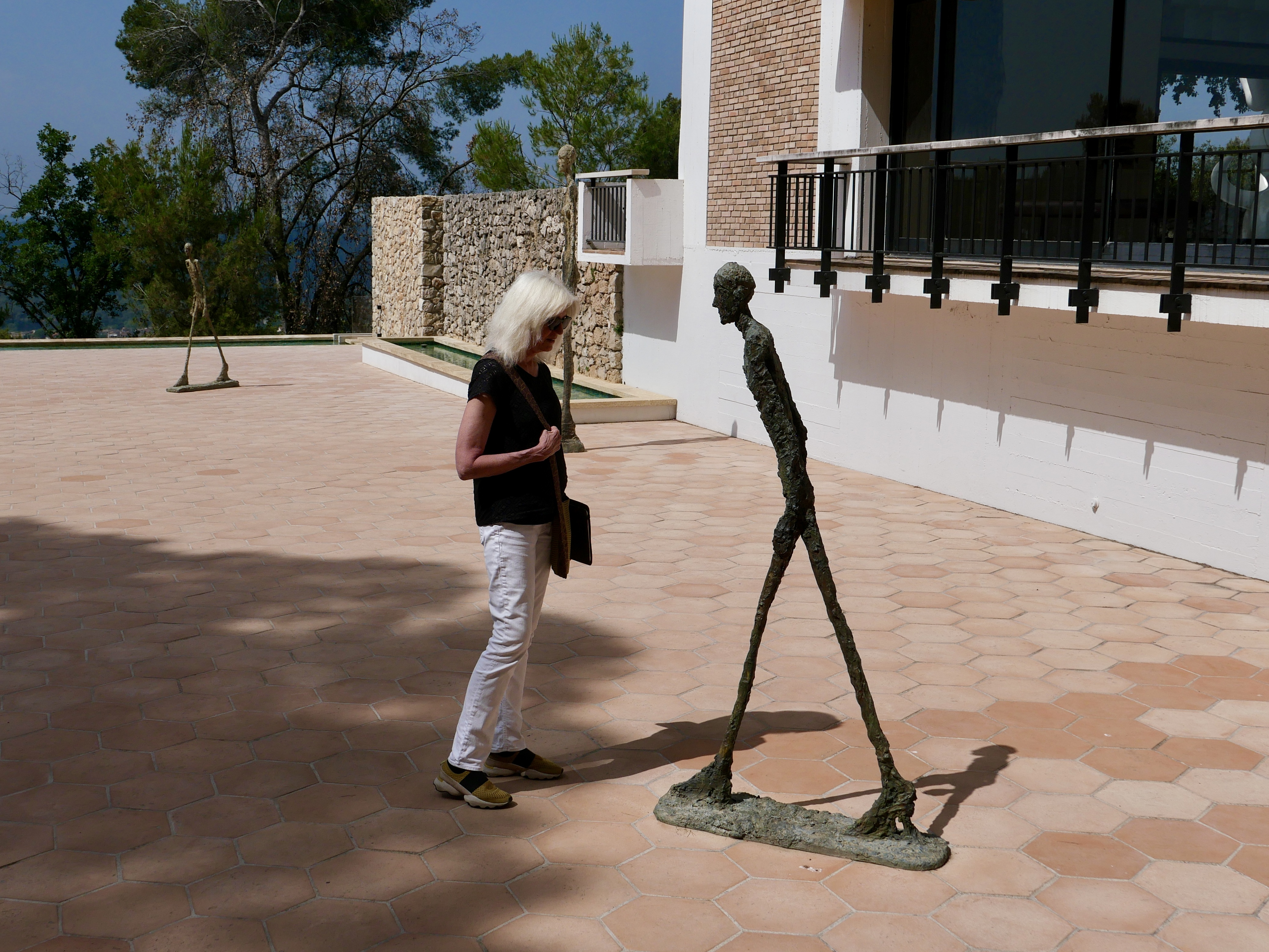
With a Giacometti at Fondation Maeght, St. Paul de Vence, France; Photo: Christine Marchal
A: I am a contemporary painter based in New York City, best known for large pastel-on-sandpaper paintings inspired by Bolivian Carnival masks and Latin American folk art. For more than 40 years, I have been committed to elevating pastel as a fine art medium.
My blog, Barbara Rachko’s Colored Dust, has 229,000 subscribers, and I’m the subject of the documentary Barbara Rachko: True Grit, available on YouTube. My e-book, From Pilot to Painter, tells my story of moving from Navy Commander, commercial pilot, and Boeing-727 Flight Engineer to professional artist.
My work has been developed into three major series—Domestic Threats, Black Paintings, and Bolivianos. In 2023, I was featured in a documentary that premiered at the Newport Beach Film Festival, winning both the Audience Award and Best in Category.
Comments are welcome!
Q: Would you please share your current bio?

A: Here it is.
Barbara Rachko, born in 1953 in Paterson, New Jersey, is a contemporary painter based in New York City, renowned for her large pastel-on-sandpaper paintings inspired by Bolivian Carnival masks. With nearly 40 years dedicated to revolutionizing pastel as a fine art medium, Rachko’s influential blog, Barbara Rachko’s Colored Dust, has garnered over 229,000 subscribers. She is the subject of the acclaimed documentary “Barbara Rachko: True Grit,” available on YouTube, and her ebook “From Pilot to Painter” captures her inspiring journey from a former pilot to an accomplished artist.
Rachko’s work explores the vibrant cultural heritage of Bolivian Carnival masks, and Mexican and Guatemalan folk art. Her meticulous attention to detail is showcased in notable series such as Bolivianos, Black Paintings, and Domestic Threats. In 2023, she was featured in a documentary that premiered at the Newport Beach Film Festival, earning the Audience Award and Best in Category Award, further cementing her impact on contemporary art.
Her solo exhibitions include the Joy Pratt Markham Gallery at Walton Arts Center (AR), Louise Jones Brown Gallery at Duke University (NC), Olin Gallery (VA), and La MaMa La Galleria (NY). She trained in photography at the International Center of Photography in New York and studied drawing and pastel techniques at the Art League School in Alexandria, VA. Her works are held in private collections worldwide and have been showcased at prestigious art fairs, including Art Basel Miami, Moon Art Fair in Hamburg, and Art Busan in Korea, affirming her global influence in pastel painting.
Comments are welcome!
Pearls from artists* # 638

Barbara’s Studio
*an ongoing series of quotations – mostly from artists, to artists – that offers wisdom, inspiration, and advice for the sometimes lonely road we are on.
I was in the presence of a woman [Grace Hartigan] who had sacrificed everything, including her only child, to be what she was: an artist. The rewards had been few, beyond a life well-lived (not materially, but spiritually) and the recognition in her waning years that she had been honest about who she was and what she needed. A rare accomplishment for a woman of any generation, it was particularly so of hers, when servitude to family was the only goal toward which a “healthy” woman was to aspire. Grace was living proof that, on the contrary, a life dreamed could be a life lived. All it took was courage, commitment, and humor. I remember both of us laughing a lot that afternoon. Though the subject was serious, the stories Grace told were fantastic and the woman who recounted them was as wild as the twenty-six-year-old who had abandoned everything in 1948 to paint, though she wasn’t even sure how.
Mary Gabriel in Ninth Street Women
Comments are welcome!
Q: Did you formally study art? (Question from “Cultured Focus Magazine”)

A: My bachelor’s degree in Psychology is from the University of Vermont. I did not formally study art, unless you want to count the several years-worth of drawing and painting classes I took at the Art League School in Alexandria, VA. I never went to art school so do not have a bachelor’s or master’s degree in art.
Much later, in the early 2000s, I was compelled to study photography at the International Center of Photography in New York. This is a rather long story.
On September 11, 2001, my husband Bryan Jack, a high-ranking federal government employee, a brilliant economist and a budget analyst at the Pentagon, was on his way to present his monthly guest lecture in economics at the Naval Postgraduate College in Monterey, CA. He was a passenger on the plane that departed from Dulles Airport and was high-jacked and crashed into the Pentagon.
Losing Bryan on 9/11 was the biggest shock of my life, devastating in every way imaginable. We were soulmates and newly married. I have lived with his loss every single day for more than twenty years now. Life has never been the same.
In the summer of 2002 I was beginning to feel ready to get back to work. Learning about photography and cameras became essential avenues to my well-being.
My first challenge was learning how to use Bryan’s 4 x 5 view camera. Bryan had always taken the 4 x 5 negatives from which I derived the reference photos that were essential tools for making pastel paintings. I enrolled in a one-week view camera workshop at the International Center of Photography in New York. Surprisingly, it was very easy. I had derived substantial technical knowledge just from watching Bryan for many years.
After the view camera workshop, I decided to throw myself into learning this new medium, beginning with Photography I. I spent the next few years taking many classes at ICP and learning as much as I could. Eventually, I learned how to use Bryan’s extensive collection of film cameras, to properly light the setups that served as subject material for my “Domestic Threats” pastel paintings, and to make my own large chromogenic prints in a darkroom.
Then in October 2009 I was invited to present a solo photography exhibition at a gallery in New York. Continuing to make art after Bryan’s death had seemed like such an impossibility. I remember thinking how proud he would have been to know I became a good photographer.
Comments are welcome!
Pearls from artists* # 605

*an ongoing series of quotations – mostly from artists, to artists – that offers wisdom, inspiration, and advice for the sometimes lonely road we are on.
At first the concept of the unconscious was limited to denoting the state of repressed or forgotten contents. Even with Freud, who makes the unconscious – at least metaphorically – take the stage as the acting subject, it is really nothing but the gathering place of forgotten and repressed contents, and has a functional significance thanks only to these. For Freud, accordingly, the unconscious is of an exclusively personal nature, although he was aware of its archaic and mythological thought forms.
A more or less superficial layer of the unconscious is undoubtedly personal. I call it the personal unconscious. But this personal unconscious rests upon a deeper layer, which does not derive from personal experience and is not a personal acquisition but is inborn. This deeper layer I call the collective unconscious. I have chosen the term “collective” because this part of the unconscious is not individual but universal; in contrast to the personal psyche, it has contents and modes of behavior that are more or less the same everywhere and in all individuals. It is, in other words, identical in all men and thus constitutes a common psychic substrate of a suprapersonal nature which is present in every one of us.
Carl Jung in The Archetypes and the Collective Unconscious, translated by RFC Hull
Comments are welcome!
Pearls from artists* # 582

*an ongoing series of quotations – mostly from artists, to artists – that offers wisdom, inspiration, and advice for the sometimes lonely road we are on.
Strange, but the artist has never made a fuss about being denied those estimable virtues other men would not do without: intellectuality, good judgment, a knowledge of the world, and rational conduct. It may be charged, that he has even fostered the myth. In his intimate journals Vollard tells us that Degas feigned deafness to escape disputations and harangues concerning things he considered false and distasteful. If the speaker or subject changed, his hearing immediately improved. We must marvel at his wisdom since he must have only surmised what we know definitely today: tThat the constant repetition of falsehood is more convincing than the demonstration of truth. It is understandable, then, how the artist might actually cultivate this moronic appearance, this deafness, this inarticulateness, in an effort to evade the million irrelevancies which daily accumulate concerning his work. For, while the authority of the doctor or plumber is never questioned, everyone deems himself a good judge and an adequate arbiter of what a work of art should be and how it should be done.
Mark Rothko in The Artist’s Reality: Philosophies of Art, edited by Christopher Rothko
Comments are welcome!
Q: The first pastel painting you see every morning when you arrive at your studio is “Myth Meets Dream.” It must have special meaning. Would you elaborate? (Question suggested by Marlissa Gardner via Facebook)

A: “Myth Meets Dream,” an early pastel painting from the “Domestic Threats” series, is one I have never wanted to sell. It marks the first time I included Mexican folk art figures in my work. In 1992 as a Christmas present, my future sister-in-law sent the two Oaxacan painted wooden figures you see depicted above – the blue winged creature and the red, white, and black figure behind it. The other three figures in this painting are hand-puppets.
Previously, I had been creating elaborate staged photographs in my Alexandria house using stuffed animals and hand-puppets. (The latter were made by a company called “Folk Tails”). I used the photos as reference material for pastel paintings. In other words, rather than work exclusively from life, I mostly looked at these photos while I made the painting. Although I have simplified my process since those early days, I still create pastel paintings using reference photographs.
In “Myth Meets Dream” you can see both puppets and my then new Oaxacan folk art figures. This pastel painting marks an important transition in subject matter and was the start of decades-worth of foreign travel, study, adventure, hard work, and yes, fun. It’s true that “Myth Meets Dream” hangs in my studio and is the first thing I see every morning. It brings back so many precious memories.
Every painting has a story!
If you’re interested to learn more, please see https://barbararachko.art/en/art-market
Comments are welcome!
Q: Why do you work in series?
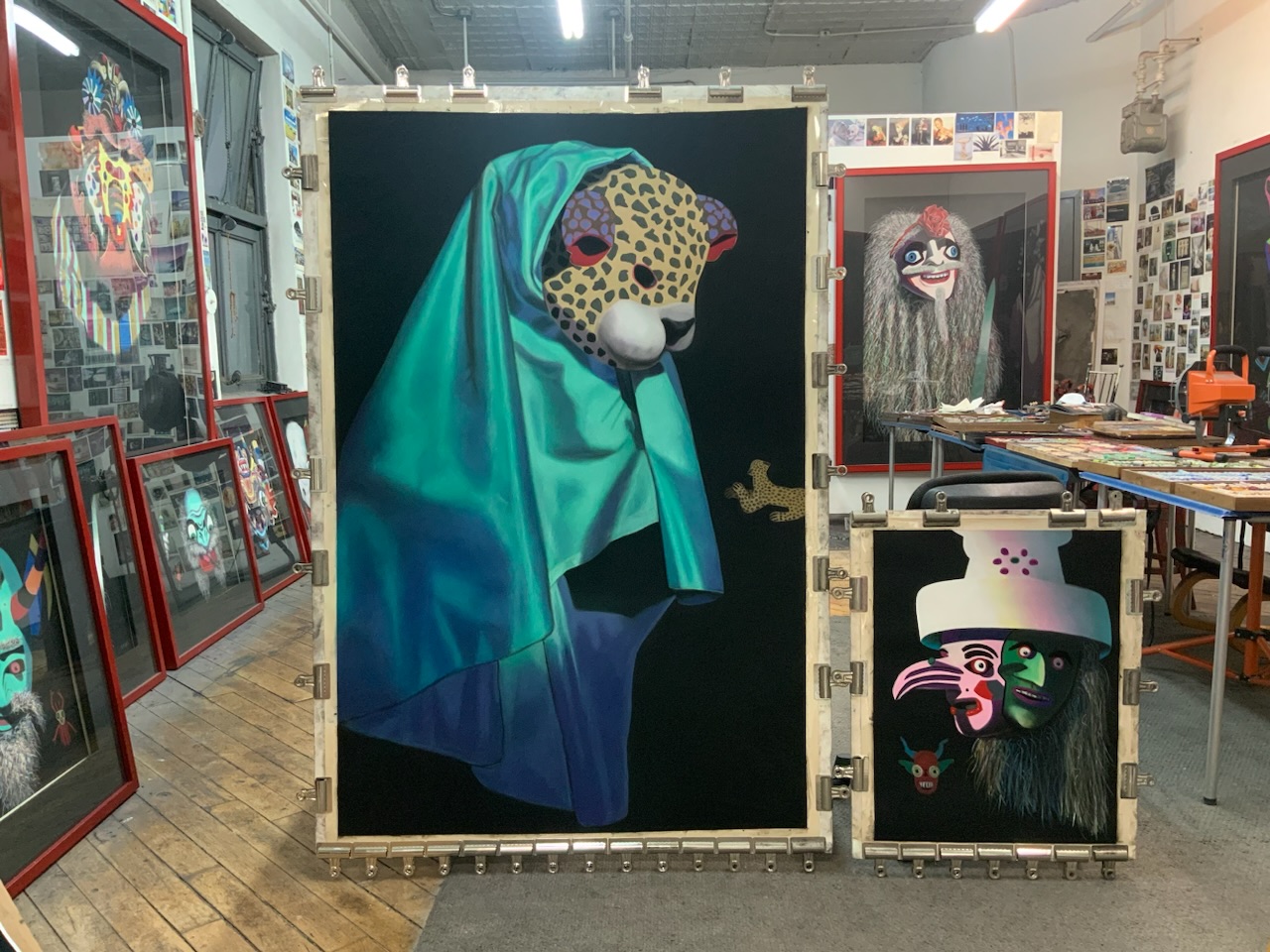
“Bolivianos” paintings in progress and on the walls and floor
A: I don’t really have any choice in the matter. It’s more or less the way I have always worked so it feels natural. Art-making comes from a deep place. In keeping with the aphorism ars longa, vita brevis, it’s a way of making one’s time on earth matter. Working in series mimics the more or less gradual way that our lives unfold, the way we slowly evolve and change over the years. Life-altering events happen, surely, but seldom do we wake up drastically different – in thinking, in behavior, etc. – from what we were the day before. Working in series feels authentic. It helps me eke out every lesson my paintings have to teach. With each completed piece, my ideas progress a step or two further.
I remember going to the Metropolitan Museum to see an exhibition called, “Matisse: In Search of True Painting.” It demonstrated how Matisse worked in series, examining a subject over time and producing multiple paintings of it. Matisse is my favorite artist of any period in history. I never tire of seeing his work and this particular exhibition was very enlightening. As I studied the masterpieces on the wall, I recognized a kindred spirit and thought, “Obviously, working in series was good enough for Matisse!”
Comments are welcome!
Q: What is your process? (Question from artamour)
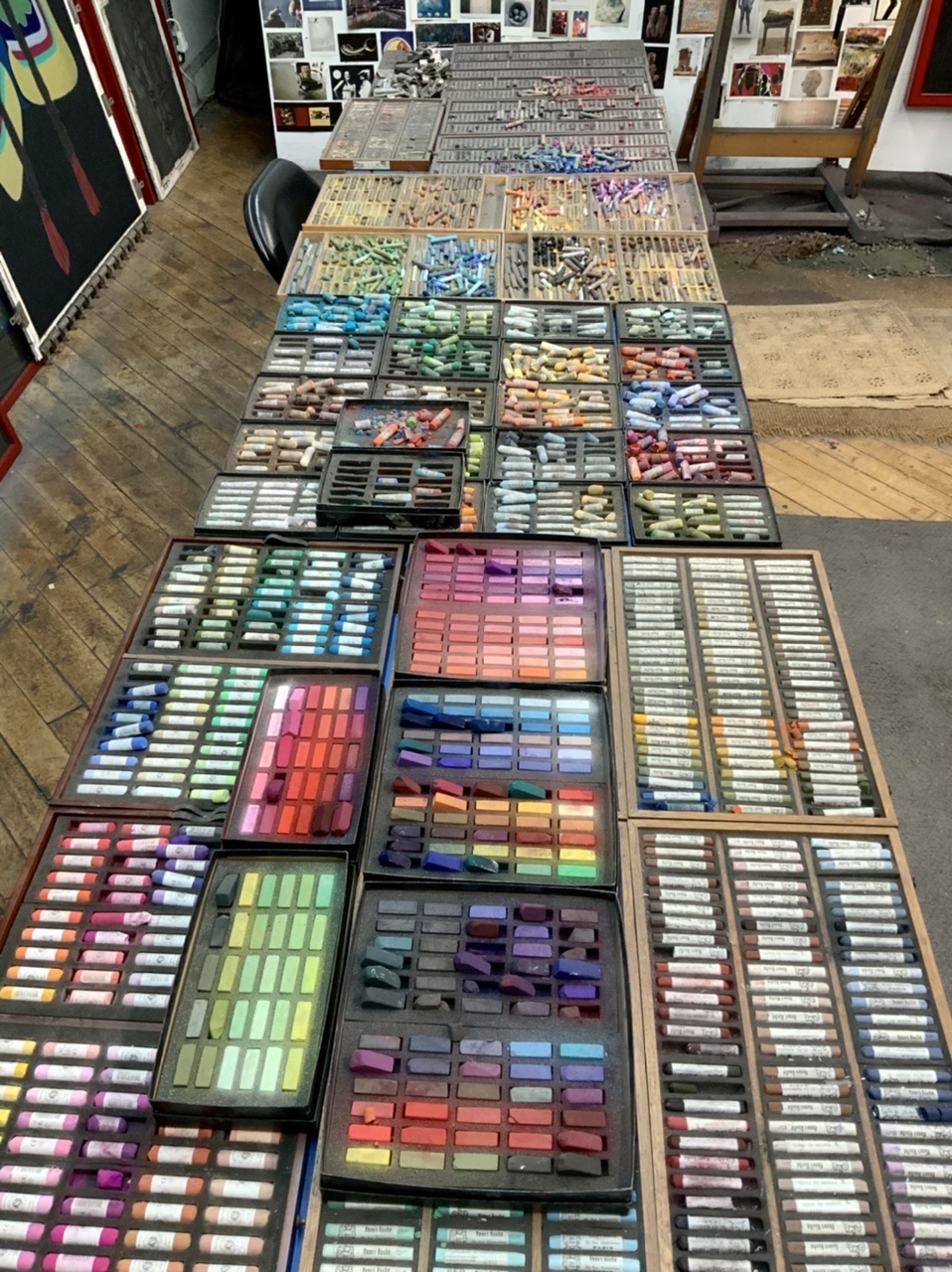
A: For thirty-six years I have worked exclusively in soft pastel on sandpaper. Pastel, which is pigment and a binder to hold it together, is as close to unadulterated color as an artist can get. It allows for very saturated color, especially employing the self-invented techniques I have developed and mastered. I believe my “science of color” is unique, completely unlike how any other artist works. I spend three to four months on each painting, applying pastel and blending the layers together to mix new colors on the paper.
The acid-free sandpaper support allows the buildup of 25 to 30 layers of pastel as I slowly and meticulously work for hundreds of hours to complete a painting. The paper is extremely forgiving. I can change my mind, correct, refine, etc. as much as I want until a painting is the best I can create at that moment in time.
My techniques for using soft pastel achieve rich velvety textures and exceptionally vibrant color. Blending with my fingers, I painstakingly apply dozens of layers of pastel onto the sandpaper. In addition to the thousands of pastels that I have to choose from, I make new colors directly on the paper. Regardless of size, each pastel painting takes three to four months and hundreds of hours to complete.
I have been devoted to soft pastel from the beginning. In my blog and in numerous interviews online and elsewhere, I continue to expound on its merits. For me no other fine art medium comes close.
My subject matter is unique. I am drawn to Mexican, Guatemalan, and Bolivian cultural objects—masks, carved wooden animals, papier mâché figures, and toys. On trips to these countries and elsewhere I frequent local mask shops, markets, and bazaars searching for the figures that will populate my pastel paintings. How, why, when, and where these objects come into my life is an important part of the creative process. Each pastel painting is a highly personal blend of reality, fantasy, and autobiography.
Comments are welcome!
Pearls from artists* # 493
*an ongoing series of quotations – mostly from artists, to artists – that offers wisdom, inspiration, and advice for the sometimes lonely road we are on.
Professional opportunities in the art world almost always come out of personal connections, and community – almost by definition – is the way to make them. That’s not a prescription for superficial networking or obnoxious self-promotion, neither of which will get you anywhere. It means realizing that the chance to get a piece into a group show or meet a gallerist will probably come through someone you know and rspect, who knows and respects you.
Depending on your temperament, building community can feel daunting, artificial, or fun. There’s no need to subject yourself to awkward conversation at stuffy cocktail parties. Just keep in touch with your friends and professors from art school, attend local openings, and be open to meeting new people at events. If you’re shy, bring a friend along. It’s easier to break your way into conversation when you have a sidekick, and then you can talk about each other’s work instead of your own.
In Art/Work: Everything You Need to Know (and Do) As You Pursue Your Art Career by Heather Darcy Bhandari and Jonathan Melber
Comments are welcome!


 barbararachkoscoloreddust.com