Blog Archives
Q: You read books on Friedrich Nietzsche and other philosophers. How has philosophy and your personal experience shaped the latest series, Bolivianos? (Question from Vedica Art Studios and Gallery)

A: It’s difficult to pinpoint how philosophy specifically shaped my work because my curiosity spans so many subjects. Some critics have described me as a Renaissance woman, remarking on my wide-ranging and voracious reading. It’s true—I’m genuinely interested in practically everything!
In pursuit of making art, I have undertaken in-depth studies of numerous intriguing fields: drawing, color, composition, gross anatomy, art and art history, the art business, film history, photography, psychology, mythology, literature, philosophy, religion, music, jazz history, and archaeology—particularly ancient Mesoamerica (Olmec, Zapotec, Mixtec, Aztec, and Maya) and South America (the Inca and their ancestors).
Since the early 1990s, my inspiration and subject matter have come primarily from international travel to remote parts of the globe, especially Mexico, Central America, and South America. Travel is by far the best education! By visiting distant destinations, I have developed a deep reverence for people and cultures around the world. People everywhere are connected by our shared humanity.
These travels, supplemented by extensive research at home, are essential parts of my creative process. Research can be solitary and demanding, but I truly enjoy it. I want to know as much as possible, and this curiosity generates ideas for new work, propelling me into unexplored creative realms.
Foreign travel always expands our ways of thinking. This rich mixture of creative influences continually evolves and finds its way into my pastel paintings. Working, learning, evolving, and growing—I am perpetually curious and can hardly imagine a better way to spend my time on Earth!
Comments are welcome!
Pearls from artists* # 628

*an ongoing series of quotations – mostly from artists, to artists – that offers wisdom, inspiration, and advice for the sometimes lonely road we are on.
Down the rabbit hole of my research, I’d stumbled into an odd conundrum: Even though art experts can’t agree on what art is, a large number of them are convinced that making and experiencing art is an innate human impulse. It’s not a learned pastime we dreamt up once we got bored of staring at blank walls or figured out how to live past age twenty, but a biological predisposition that has helped our species survive. (One we may share with songbirds, parrots, whales, and other animals that have their own “aesthetic culture,” writes evolutionary biologist Richard O. Prom.) One survival-of-the-most-artistic hypothesis contends that art is our version of peacock feathers: An extravagant, frivolous display by which Paleolithic humans showed potential mates that they were fit enough to hunt and gather and have time left-over to paint warty pigs. Another theory is that our art-inclined ancestors survived, thrived, and reproduced because making art offered a dress rehearsal for grappling with hostile conditions. (Nine-thousand-year-old Libyan rock paintings of spear-wielding figures sprinting after horned beasts come to mind.) The scholar Ellen Dissanayake, who’s dabbled in anthropology, archaeology, psychology, and art history, argues that art is a social glue that binds communities together and thus increases its members’ odds of survival. Also, she thinks the concept of “fine art” is a travesty that’s made us forget that “engaging with the arts is as universal, normal, and obvious in human behavior as sex or parenting.”
Bianca Bosker in Get the Picture: A Mind-Bending Journey Among the Inspired Artists and Obsessive Art Fiends Who Taught Me How to See
Comments are welcome!
Pearls from artists* # 576
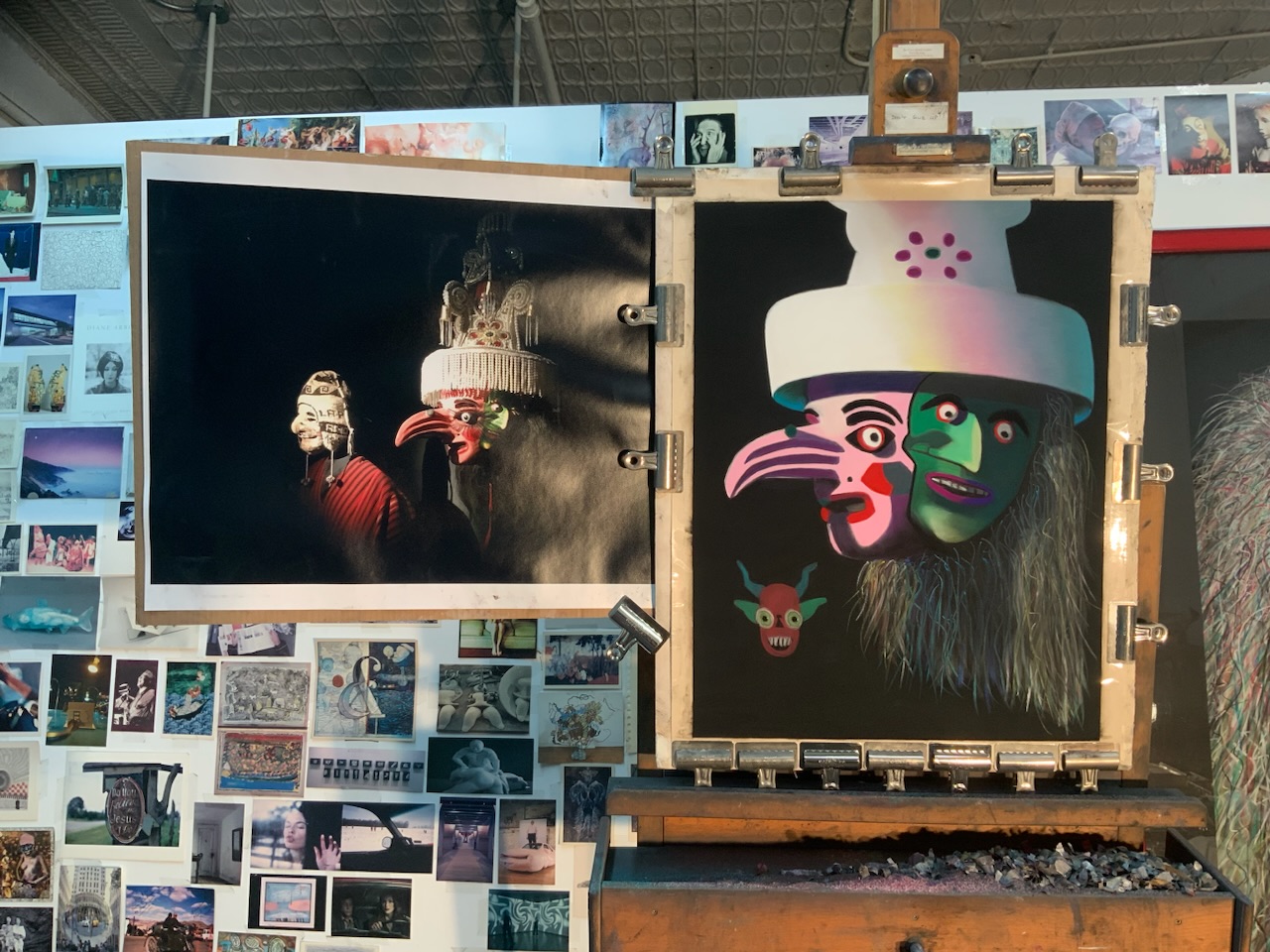
In progress: “Shadow,” soft pastel on sandpaper, 26” x 20”
*an ongoing series of quotations – mostly from artists, to artists – that offers wisdom, inspiration, and advice for the sometimes lonely road we are on.
A word derived from Latin, persona, originally referred to the masks worn by actors in ancient classical theatre. In Jungian psychology, this term refers to the inner character that we use to face the world. Drawn from societal expectations, cultural norms, and natural attributes, it is the person we want others to think we really are. Our persona is our brave face, our false front. It is the ongoing project of building our ideal self.
… the persona is our somewhat embellished view of ourselves, the shiny face that we want the world to see. It’s opposite, everything we reject about ourselves, is called the shadow.
… our shadow is the pain we’ve forgotten about. It is a complex within us, a split-off part our consciousness loaded with emotional weight. Our persona is what we want to be seen to be; shadow is what we least want to be.
Gary Bobroff in Carl Jung: Knowledge in a Nutshell
Comments are welcome!
Pearls from artists* # 397
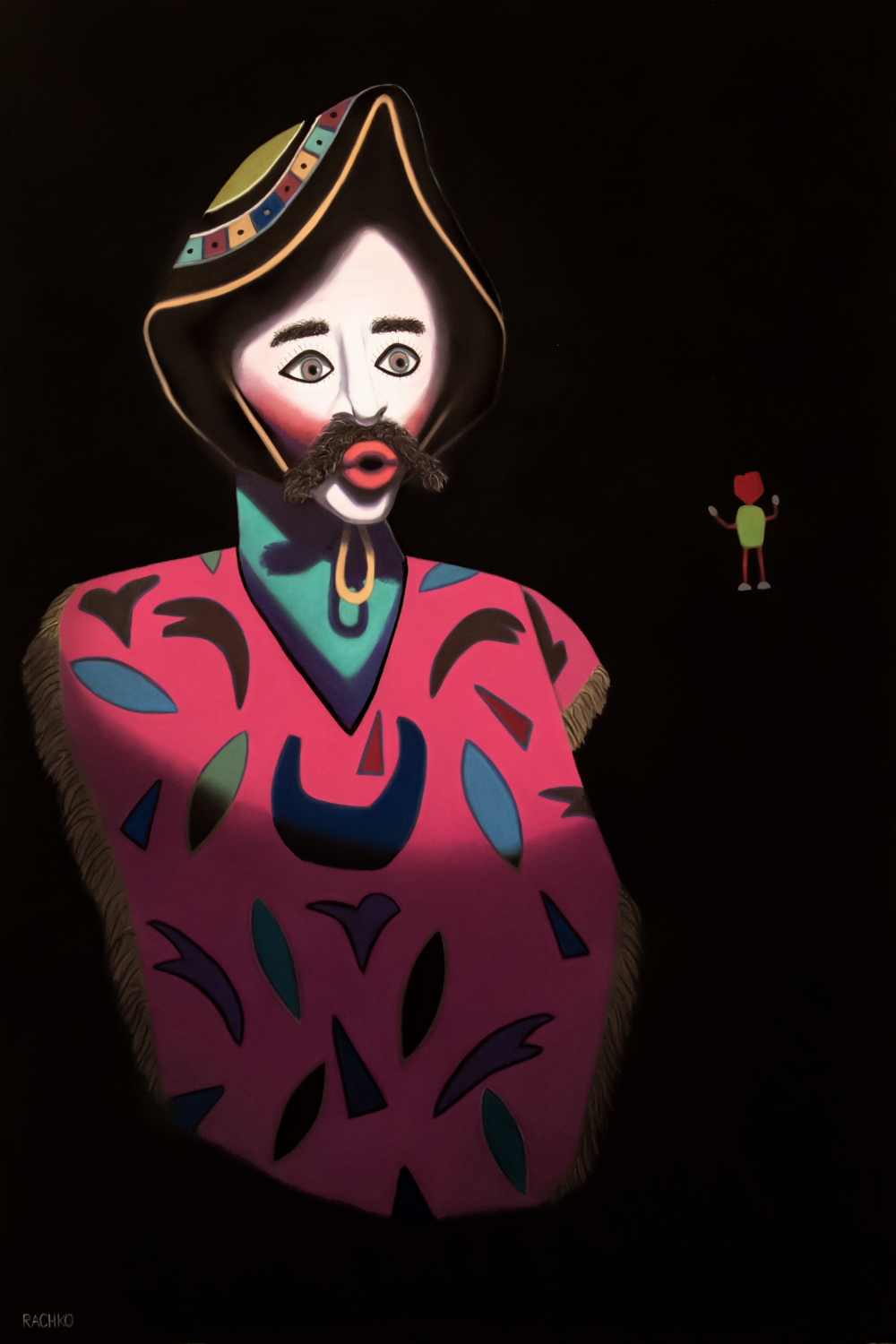
“Prophecy,” soft pastel on sandpaper, 58″ x 38″
* an ongoing series of quotations – mostly from artists, to artists – that offers wisdom, inspiration, and advice for the sometimes lonely road we are on.
Our species requires a greater capacity to see into the Real, not just the outer universe of the senses but also the inner cosmos of the psyche, the normally invisible dimensions. Near the end of his life, Jung said to an English journalist, “The only real danger that exists is man himself… His psyche should be studied because we are the origin of all coming evil.” It is a beautiful statement until the word studied comes up, at which point we are reminded that Jung at bottom was a rationalist: he refused to see that while psychology could talk brilliantly about the soul, it could never descend into its depths. For this we need imagination, madness, prophecy – art. We must understand that creative expression is not a pastime or distraction, but a psychonautic science in its own right. Allowed to operate in freedom, it can illuminate the darkness beyond our field of vision.
J.F. Martel in Reclaiming Art in the Age of Artifice: A Treatise, Critique, and Call to Action
Comments are welcome!
Q: You earned a degree in psychology. From that I’m sure you gained an in-depth understanding of humans and their stories. How has that influenced your art?
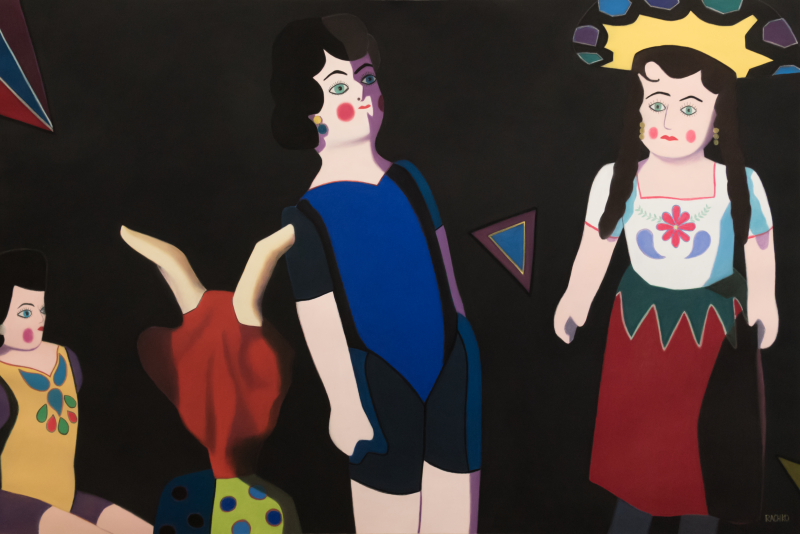
“Conundrum,” soft pastel on sandpaper, 38″ x 58″
A: I suppose there must be some deep connection, but I have never seen much of a correspondence between my psychology degree and the art I create. As an undergraduate psych major at the University of Vermont, my intent was to become a clinical psychologist. However, by the time I received my BA, I was no longer interested in making that my life’s work.
Comments are welcome!
Pearls from artists* # 354

“Epiphany,” soft pastel on sandpaper, 38″ x 58″
*an ongoing series of quotations – mostly from artists, to artists – that offers wisdom, inspiration, and advice for the sometimes lonely road we are on.
My earlier work had taught me that artistic activity is a form of reasoning, in which perceiving and thinking are indivisibly intertwined. A person who paints, writes, composes, dances, I felt compelled to say, thinks with his senses. This union of perception and thought turned out to be not merely a specialty of the arts. A review of what is known about perception, and especially about sight, made me realize that the remarkable mechanisms by which the senses understand the environment are all but identical with the operations described by the psychology of thinking. Inversely, there was much evidence that truly productive thinking in whatever area of cognition takes place in the realm of imagery. This similarity of what the mind does in the arts and what it does elsewhere suggested taking a new look at the long-standing complaint about the isolation and neglect of the arts in society and education. Perhaps the real problem was more fundamental: a split between sense and thought, which caused various deficiency diseases in modern man.
Rudolph Arnheim in Visual Thinking
Comments are welcome!
Pearls from artists* # 82
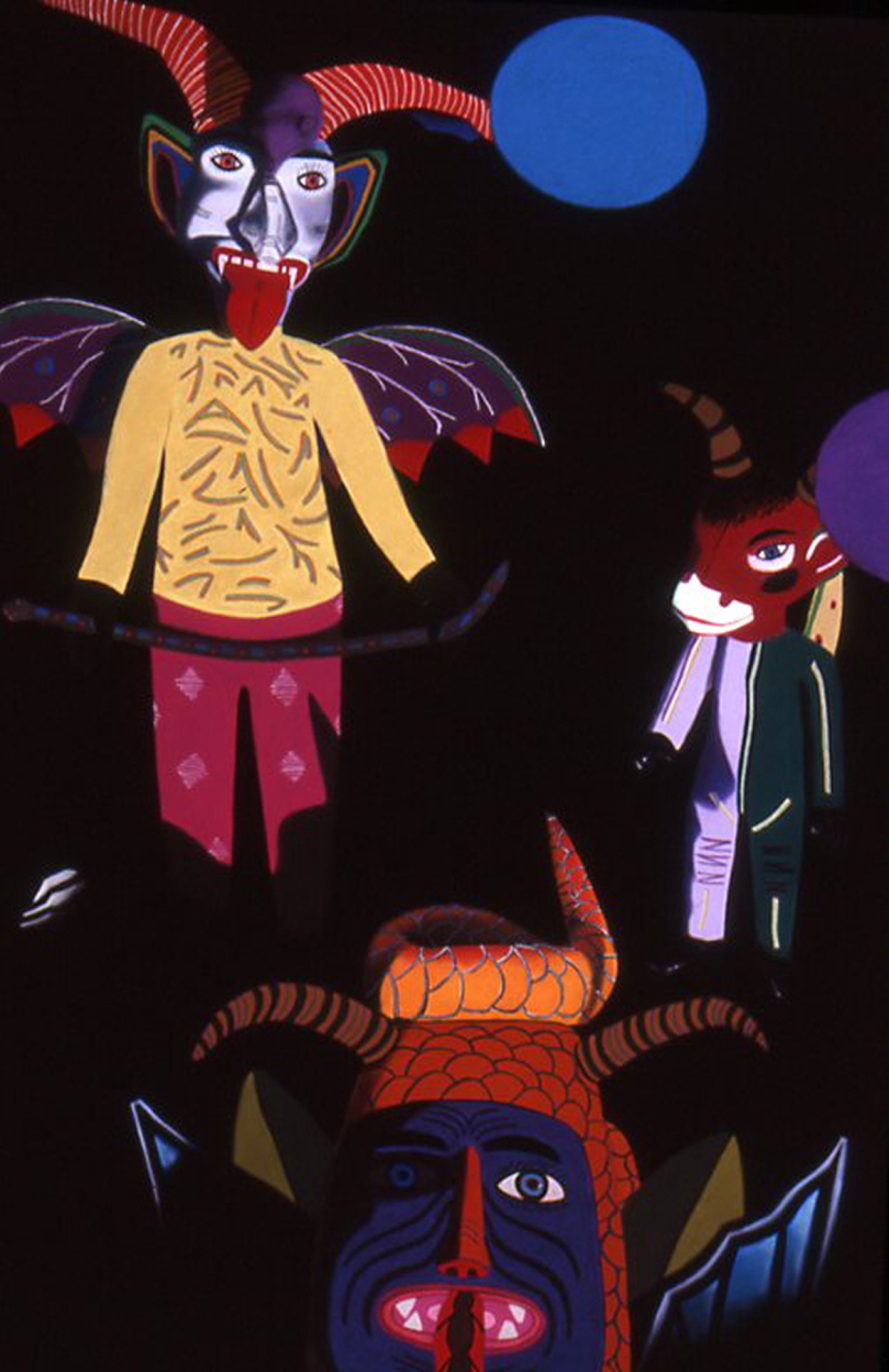
“The Sovereign,” soft pastel on sandpaper, 58″ x 38″
* an ongoing series of quotations – mostly from artists, to artists – that offers wisdom, inspiration, and advice for the sometimes lonely road we are on.
Art isn’t psychology. For one thing art deals in images, not language. Images precede language and are closer to feelings. They summon feelings before they’re named and categorized, when they’re still fresh and sometimes hard to recognize or identify.
For another thing, to translate his vision an artist uses materials that are, for lack of a better word, alchemical. Paint, for example, has this wonderful, mysterious quality – a smell and a sensuous, velvety feel and an ability to hold color and light – that unlocks and speeds up one’s creative metabolism. And paint captures my every impulse – from my broadest conceptions to the tiniest ticks and tremors of my wrist.
There are literally no words to describe what occurs when an image suddenly and unexpectedly appears on the canvas. Sometimes it’s serendipity, the result of a fortunate brushstroke. Sometimes I think it has to do with the inherent qualities of paint, or the slickness of a surface, or the fullness or acuity of a brush. And sometimes when I’ve got a good rhythm going and everything comes together, I feel as though it produces the purest expression of who I am and what I am and how I perceive the world.
Eric Fischl and Michael Stone in Bad Boy: My Life on and off the Canvas
Comments are welcome!


 barbararachkoscoloreddust.com