Blog Archives
Q: Can you speak about what draws you to the Mexican and Guatemalan figures that you collect?
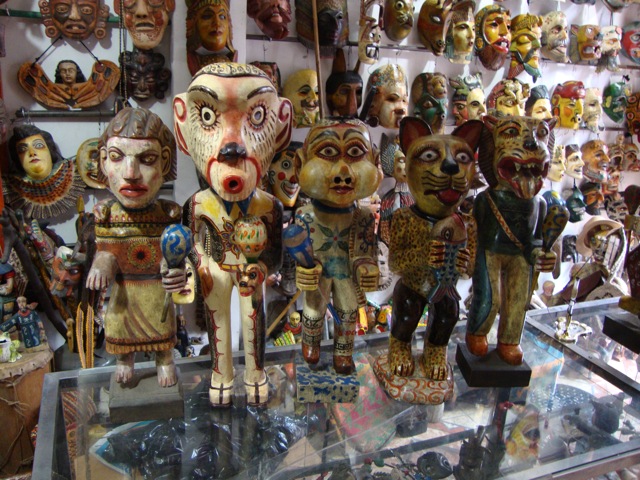
Shop in Panajachel, Guatemala, Photo: Donna Tang
A: I search the markets and bazaars of Mexico, Guatemala, and elsewhere for folk art objects – masks, carved wooden animals, papier mache figures, children’s toys – to bring back to New York to paint and photograph. Color is very important – the brighter and the more eye-catching the patterns are on these objects the better – plus they must be unique and have lots of personality. I try not to buy anything mass-produced or obviously made for the tourist trade. The objects must have been used or otherwise look like they’ve had a life (i.e., been part of religious festivities) to draw my attention. How and where each one comes into my possession is an important part of my creative process.
Finding, buying, and getting them back to the U.S. is always circuitous, but that, too, is part of the process, an adventure, and often a good story. Here’s an example. In 2009 I was in a small town on the shores of Lake Atitlan in Guatemala, called Panajachel. After returning from a boat ride across the lake, my friends and I were walking back to our hotel when we discovered a wonderful mask store. I spent some time looking around, made my selections, and was ready to buy five exquisitely-made standing wooden figures, when I learned that Tomas, the store owner, did not accept credit cards. I was heart-broken and thought, “Oh, no, I’ll have to leave them behind.” However, thanks to my good friend, Donna, whose Spanish is much more fluent than mine, the three of us brain-stormed until finally, Tomas had an idea. I could pay for the figures at the hotel up the block and in a few days when the hotel was paid by the credit card company, the hotel would pay Tomas. Fabulous! Tomas, Donna, and I walked to the hotel, where the transaction was made and the first hurdle was overcome. Working out the packing and shipping arrangements took another hour or two, but during that time Tomas and I became friends and exchanged telephone numbers (the store didn’t even have a telephone so he gave me the phone number of the post office next door, saying that when I called, he could easily run next door!). Most surprisingly, the package was waiting for me in New York when I returned home from Guatemala.
Comments are welcome!
Pearls from artists* # 58

Cabo San Lucas, Mexico
* an ongoing series of quotations – mostly from artists, to artists – that offers wisdom, inspiration, and advice for the sometimes lonely road we are on.
I remember as a teenager having a group of friends at school and another group whom I spent the weekends with. I functioned fine until on occasions when I was with friends from both groups at the same time. Then it became really difficult, because I was used to acting very differently with the two groups. With one I was the leader, very vocal and outspoken about my opinions. With the other group I wanted desperately to belong and so I adapted to fit in, which meant not really being myself.
The lack of authenticity is painful. It applies to all levels of life. If our voice as a painter is inauthentic, we’re in trouble. In the end there is nothing so compelling as to be yourself. This is why being an artist can be so exhilarating. If you want to uncover your truth, you have a daily technique to come to terms with your limitations and to overcome them. You have an opportunity to look at the limiting stories you have written in your head and heart and rewrite them with boldness and vision. The quality of your attention influences how you see things.
What you put your attention on grows stronger in your life. Life, if you look around you, whether inside or in nature, is one bubbling mass of creativity. Recognize we have no shortage of it. If you focus your attention on what you now decide is fundamental , that quality will grow in your life. Not what our parents or teachers or friends or media or anybody says or said. What we now put our attention on will grow in our life. If you want to paint and put your focus there you will unleash a torrent of energy and enthusiasm.
Ian Roberts in Creative Authenticity: 16 Principles to Clarify and Deepen Your Artistic Vision
Comments are welcome!
Q: Have you ever worked outside?

Reproductions of “Cardinal Rule” (top) and “Blue Ego,” originals are soft pastel on sandpaper, 30″ x 38″
A: As a pastel artist I’ve never worked outside – with so many pastels, it’s just not practical – but early on in the “Domestic Threats” series, I created two outdoor setups. Works in the series derived from elaborate scenes that I arranged and then photographed.
I used to take long walks along the Potomac River in Alexandria, VA, and there was a tree stump that was fascinating. It was mostly twisted roots, knotty branches, dark hidden spaces, etc. (top painting in photo). One morning I took several hand puppets and stuffed animals (my subject matter at the time) and carefully arranged them on the tree. Around me people were busy exercising their dogs. Soon I attracted quite a bit of attention – a tall blonde woman playing with puppets on a tree stump! Dogs came over to sniff. Their owners came over, too, and I was pressed into explaining, again and again, that I was an artist, that I was photographing this scene so I could paint it, etc. The interruptions were very annoying.
The second time I tried an outdoor setup was again along the Potomac River, but this time I selected a secluded strip of beach where I was undisturbed. I had forgotten to consider the light and inadvertently chose a cloudy day. I remember being disappointed that the light was flat and lacking shadows. The painting (bottom in photo) turned out to be one of my least favorites.
I resolved from then on to focus on interiors. Alfred Hitchcock famously used rear projection so that he could work in a studio rather than on location. One reason, he said, was that in a studio he had total control. I know what he meant. When I set up an interior scene and position the lights to make interesting shadows, indeed, I have control over the whole look. No aspect is left to chance. The accidents – improvements! – happen later when I work on the painting.
Comments are welcome!
Pearls from artists* # 46

Artist’s backyard
* an ongoing series of quotations – mostly from artists, to artists – that offers wisdom, inspiration, and advice for the sometimes lonely road we are on.
Some things will naturally excite us more than others. This is where art begins, when we separate our inner-directed impulse from the outer-directed deluge of other people’s work and opinion. “The artists are the ones who bare themselves to this experience of essence… Their vocation is to communicate that experience to others. Not to communicate it is to surrender the vision to atrophy; the artist must paint, or write, or sculpt – else the vision withers away and he or she is less apt to have it again.”
The trick is to be able to learn to juggle at least two things at once. We need to keep the initial impulse in its entirety before us as we start engaging in the execution of the parts.
Ian Roberts in Creative Authenticity: Sixteen Principles to Clarify and Deepen Your Artistic Vision
Comments are welcome!
Q: What is your best time of day to paint?

The High Line – Barbara’s morning commute to the studio
A: I have always been an early riser and a morning person, from my student pilot days when I’d be at an airport in New Jersey ready to takeoff in a Cessna by 6 a.m., through my days as a Naval officer starting work at the Pentagon at 7, until now when I typically get up before 6 (thanks to my cat, who likes to eat breakfast early). Always I am most energetic in the mornings so that’s when I am most productive and have my best ideas. Generally, I try to arrive at the studio before 10 a.m. and work until 5 p.m. or later.
Comments are welcome!
Q: What is it about soft pastel that you find so intriguing that you use it as your primary fine art medium?

Some of Barbara’s pastels
A: For starters it’s the medium that I fell in love with many years ago. I recently read this article online, “What is Pastel?” by Mike Mahon, and will quote it because it neatly sums up what I love about working with pastel.
Pastel is the most permanent of all media when applied to conservation ground and properly framed. Pastel has no liquid binder that may cause it to oxidize with the passage of time as oftentimes happens with other media.
In this instance, Pastel does not refer to pale colors, as the word is commonly used in cosmetic and fashion terminology. The pure, powdered pigment is ground into a paste with a minimum amount of gum binder, rolled into sticks and dried. The infinite variety of colors in the Pastel palette range from soft and subtle to hard and brilliant.
An artwork is created by stroking the stick of dry pigment across an abrasive ground, embedding the color in the “tooth” of the ground. If the ground is completely covered with Pastel, the work is considered a Pastel painting; whereas, leaving much of the ground exposed produces a Pastel sketch. Techniques vary with individual artists. The Pastel medium is favored by many artists because it allows a spontaneous approach. There is no drying time, therefore, no change in color occurs after drying as it does in other media.
Did you know that a particle of Pastel pigment seen under a microscope looks like a diamond with many facets? It does! Therefore, Pastel paintings reflect light like a prism. No other medium has the same power of color or stability.
Historically, Pastel can be traced back to the 16th century. Its invention is attributed to the German painter, Johann Thiele. A Venetian woman, Rosalba Camera, was the first to make consistent use of Pastel. Chardin did portraits with an open stroke, while La Tour preferred the blended finish. Thereafter, a galaxy of famous artists—Watteau, Copley, Delacroix, Millet, Manet, Renoir, Toulouse Lautrec, Vuillard, Bonnard, Glackens, Whistler, Hassam, William Merritt Chase—used Pastel for a finished work rather than for preliminary sketches.
Pastels from the 16th century exist today, as fresh as the day they were painted. Edgar Degas was the most prolific user of Pastel and its champion. His protégé, Mary Cassat, introduced Pastel to her friends in Philadelphia and Washington, and thus to the United States. In the Spring of 1983, Sotheby Parke Bernet sold at auction, two Degas Pastels for more than $3,000,000 each! Both Pastels were painted about 1880.
Note: Do not confuse Pastel with “colored chalk.” Chalk is a porous, limestone substance impregnated with dyes, whereas, Pastel is pure pigment—the same as is used in other permanent painting media.
Today, Pastel paintings have the stature of oil and watercolor as a major fine art medium. Many of our most renowned, living artists have distinguished themselves in Pastel and have enriched the art world with this beautiful medium.
So knowing all this, I often wonder, why don’t more artists use pastel? Is it because framing is a big issue? Works on paper need to be framed and pastel paintings have unique problems (see my April 27, 2013 blog post). Second only to the cost of maintaining a studio in New York City, frames are my single largest business expense. Sometimes I am grateful that pastel is a very slow medium. I typically finish 4 or 5 paintings in a year, which means I only have to pay for 4 or 5 frames!
Comments are welcome!
Pearls from artists* # 24
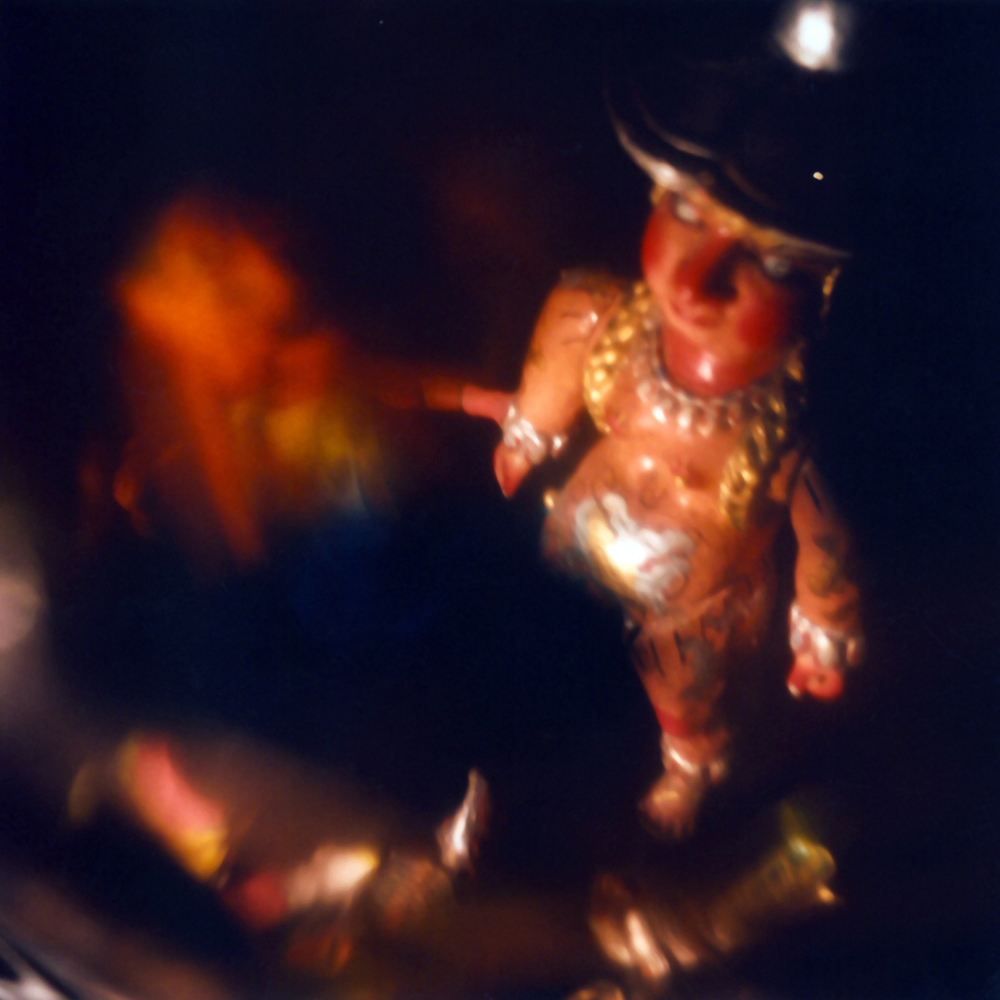
Untitled, chromogenic print, 24″ x 24,” edition of 5
* an ongoing series of quotations – mostly from artists, to artists – that offers wisdom, inspiration, and advice for the sometimes lonely road we are on.
A person is not an artist until he works at his art, no matter how eloquently he speaks during the cocktail hour or how fine are the images that come to his mind. As David Salle, the visual artist, put it, “It’s easy to be an artist in your head.” We, as artists, know this. We realize that often we are not able to translate our vision into splendid art. Even the finest artists write books that are not great, paint pictures that are not great, compose pieces that are not great, involve themselves in projects that are not great. But artists can only try – and must try.
When you love what you are doing, know what you are doing, and do it, a confidence is bred in you that is the best stretcher of limits. Then you can say, as the visual artist June Wayne said, “Now when I start something, I expect to carry it off.”
Eric Maisel, A Life in the Arts
Comments are welcome!
Pearls from artists* # 18

West Village
* an ongoing series of quotations – mostly from artists, to artists – that offers wisdom, inspiration, and advice for the sometimes lonely road we are on.
Those who would make art might well begin by reflecting on the fate of those who preceded them: most who began, quit. It’s a genuine tragedy. Worse yet, it’s an unnecessary tragedy. After all, artists who continue and artists who quit share an immense field of common emotional ground. (Viewed from the outside, in fact, they’re indistinguishable). We’re all subject to a familiar and universal progression of human troubles – troubles we routinely survive, but which are (oddly enough) routinely fatal to the art-making process. To survive as an artist requires confronting these troubles. Basically, those who continue to make art are those who have learned how to continue – or more precisely, have learned how to not quit.
But curiously, while artists always have a myriad of reasons to quit, they consistently wait for a handful of specific moments to quit. Artists quit when they convince themselves that their next effort is already doomed to fail. And artists quit when they lose the destination for their work – for the place their work belongs.
Virtually all artists encounter such moments. Fear that your next work will fail is a normal, recurring, and generally healthy part of the art-making cycle. It happens all the time: you focus on some new idea in your work, you try it out, run with it for awhile, reach a point of diminishing returns, and eventually decide it’s not worth pursuing further. Writers even have a phrase for it – “the pen has run dry” – but all media have their equivalents. In the normal artistic cycle this just tells you that you’ve come full circle, back to that point where you need to begin cultivating the next new idea. But in artistic death it marks the last thing that happens: you play out an idea, it stops working, you put the brush down… and thirty years later you confide to someone over coffee that, well, yes, you had wanted to paint when you were much younger. Quitting is fundamentally different from stopping. The latter happens all the time. Quitting happens once. Quitting means not starting again – and art is all about starting again.
David Bayles and Ted Orland, Art & Fear
Comments are welcome!
Q: Why do you have so many pastels?

Barbara’s pastels
A: Our eyes can see infinitely more colors than the relative few that are made into pastels. When I layer pigments onto the sandpaper, I mix new colors directly on the painting. The short answer is, I need lots of pastels so that I can make new colors.
I’ve been working exclusively with soft pastel for nearly 27 years. Whenever I feel myself getting into a rut in how I select and use my colors, I look around for new materials to try. I’m in one of those periods now and plan to buy soft pastels made by Henri Roché in Paris. (Not long ago I received a phone call from their artist’s liaison and was offered samples based on my preferences. Wow, what great colors!). Fortunately, new brands of soft pastels are continually coming onto the market. There are pastels that are handmade by artists – I love discovering these – and new ones manufactured by well-known art supply companies. Some sticks of soft pastel are oily, some are buttery, some more powdery, some crumble easily, some are more durable. Each one feels distinct in my hand.
Furthermore, they each have unique mixing properties. It’s an under-appreciated science that I stumbled upon (or maybe I invented it, I’m not sure since I can’t know on a deep level how other pastel painters work). In this respect soft pastel is very different from other paint media. Oil painters, for example, need only a few tubes of paint to make any color in the world. I don’t go in much for studying color theory as a formal discipline. If you want to really understand and learn how to use color, try soft pastel and spend 10,000+ hours (the amount of time Malcolm Gladwell says, in his book, “Outliers,” that it takes to master a skill) figuring it all out for yourself!
Comments are welcome.


 barbararachkoscoloreddust.com