Blog Archives
Q: What have been the defining wounds of your life—and how have you healed them? (Question from Bold Journey)

A: The deepest wound was losing Bryan on 9/11. I resolved not to become another victim of that tragedy and chose to continue living and making art.
Because I depend on reference photographs for my work, my first hurdle was learning to use Bryan’s 4×5 view camera. He had always taken the photos for me. In 2002, I enrolled in a photography workshop at the International Center of Photography in New York. To my surprise, I had absorbed a lot just from watching him, and I went on to formally study photography for several years. In 2009, I was invited to present a solo photography exhibition in New York.
By 2003, I resumed my Domestic Threats series. The first large pastel I completed from one of my own photographs was titled She Embraced It and Grew Stronger. It was autobiographical: “she” was me, and “it” was life without Bryan.
That series ended in 2007, by which time I was finding more peace. But then I faced a new challenge: creative block. For months I struggled, but I kept showing up daily. Eventually, a breakthrough came, and I began the Black Paintings series. The dark backgrounds represented the place I had emerged from; the vibrant figures symbolized resilience and life.
In 2017, inspired by a museum exhibition in La Paz, I began Bolivianos, based on Carnival masks. Many view this as my boldest and most exciting work yet.
Comments are welcome!
Pearls from artists* # 702
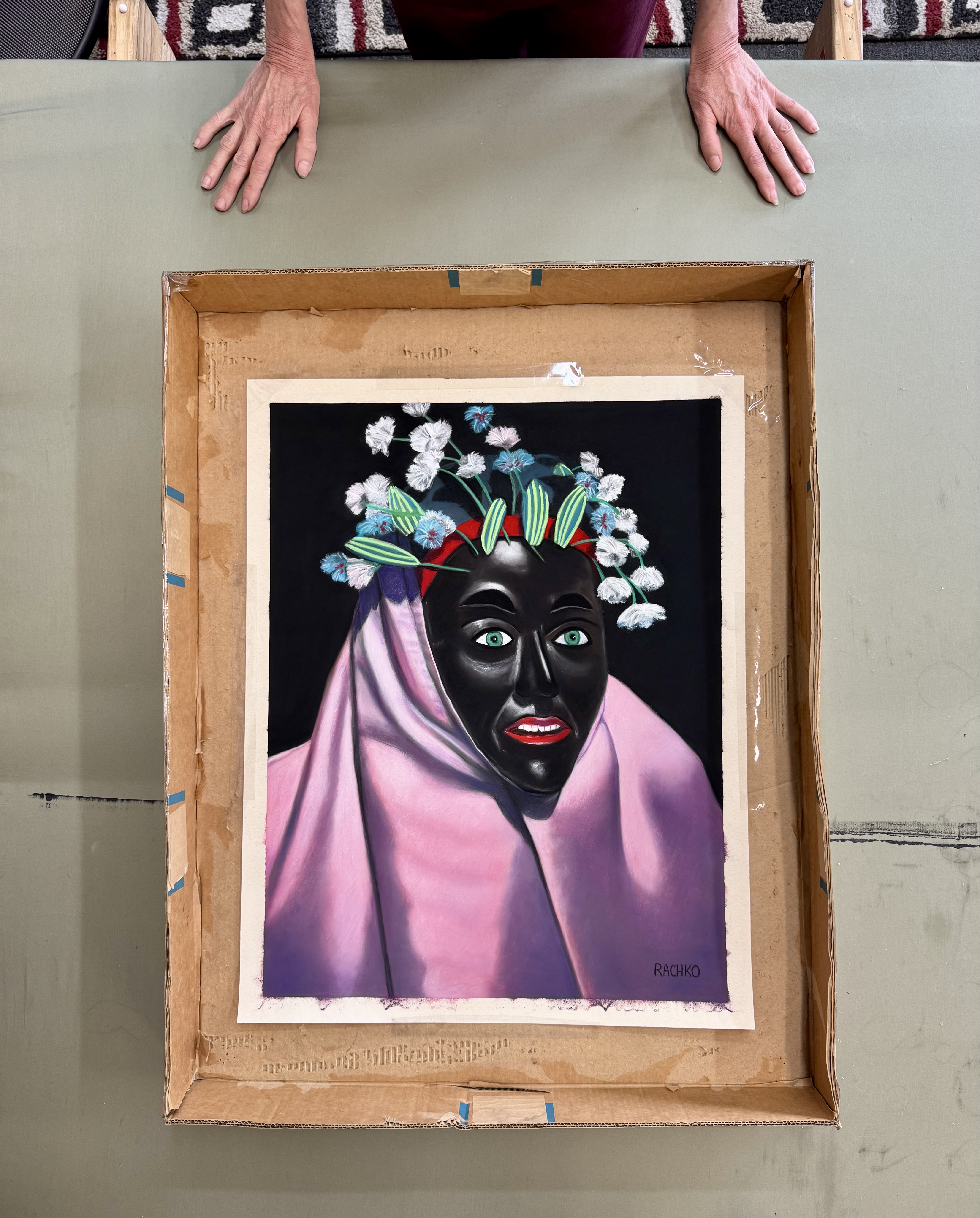
“Oblate,” soft pastel on sandpaper, 26” x 20”
*an ongoing series of quotations – mostly from artists, to artists – that offers wisdom, inspiration, and advice for the sometimes lonely road we are on.
The most noteworthy hurdle we face as artists is the brutal ‘Why should I care?’ Why, out of all the millions of art objects and experiences vying for our attention, should someone spend time on ours? We cannot share our visions with people if we cannot get them to stop and look at our work. Louise Bourgeois said, ‘Art is a seduction,’ but there are many different types of seduction. There should be something about our work that speaks to those with similar sensibilities, that sends them a secret signal.
Kate Kretz in Art From Your Core: A Holistic Guide to Visual Voice
Comments are welcome!
Q: Can you speak about what draws you to the Mexican and Guatemalan figures that you collect?
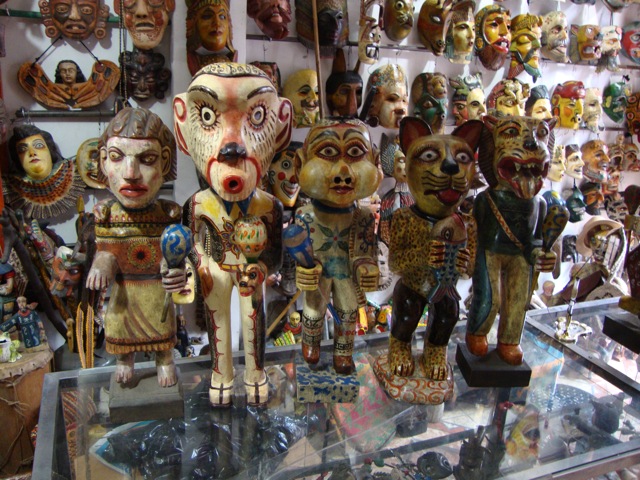
Shop in Panajachel, Guatemala, Photo: Donna Tang
A: I search the markets and bazaars of Mexico, Guatemala, and elsewhere for folk art objects – masks, carved wooden animals, papier mache figures, children’s toys – to bring back to New York to paint and photograph. Color is very important – the brighter and the more eye-catching the patterns are on these objects the better – plus they must be unique and have lots of personality. I try not to buy anything mass-produced or obviously made for the tourist trade. The objects must have been used or otherwise look like they’ve had a life (i.e., been part of religious festivities) to draw my attention. How and where each one comes into my possession is an important part of my creative process.
Finding, buying, and getting them back to the U.S. is always circuitous, but that, too, is part of the process, an adventure, and often a good story. Here’s an example. In 2009 I was in a small town on the shores of Lake Atitlan in Guatemala, called Panajachel. After returning from a boat ride across the lake, my friends and I were walking back to our hotel when we discovered a wonderful mask store. I spent some time looking around, made my selections, and was ready to buy five exquisitely-made standing wooden figures, when I learned that Tomas, the store owner, did not accept credit cards. I was heart-broken and thought, “Oh, no, I’ll have to leave them behind.” However, thanks to my good friend, Donna, whose Spanish is much more fluent than mine, the three of us brain-stormed until finally, Tomas had an idea. I could pay for the figures at the hotel up the block and in a few days when the hotel was paid by the credit card company, the hotel would pay Tomas. Fabulous! Tomas, Donna, and I walked to the hotel, where the transaction was made and the first hurdle was overcome. Working out the packing and shipping arrangements took another hour or two, but during that time Tomas and I became friends and exchanged telephone numbers (the store didn’t even have a telephone so he gave me the phone number of the post office next door, saying that when I called, he could easily run next door!). Most surprisingly, the package was waiting for me in New York when I returned home from Guatemala.
Comments are welcome!



