Blog Archives
Pearls from artists* # 680

“Sacrificial” (on the wall) and “Trickster” (on the floor)
*an ongoing series of quotations – mostly from artists, to artists – that offers wisdom, inspiration, and advice for the sometimes lonely road we are on.
What makes a work transcendent and powerful is a personal intensity, an ‘extra’ quality. Yet that intensity is exclusive to each artist: extra strangeness, subtlety, causticity, bravado, sensuality, rawness, grandiosity, succinctness, mystery, vulnerability, truth, etc. For an individual artist to infuse an object or an experience with their own ‘extra’ quality requires not only skill or ideas, but the profound benevolence of consistently delivering in spades.
It is this passion and genuine feeling, specific to each creator, that lives on in the art as a gift. It is wrapped up in the work, forever suspended in time. The artist says,
Here… everything I possessed in this moment is embodied in this object… All skills I have painstakingly learned, all of the knowledge I possess, the joy and pain I have felt and all the experiences I have lived. I spun these into the perfect, most sublime form, and packed it up, but for you to unwrap anytime you need sustenance. It will nourish, comfort, and surround you, because you have chosen it.
Each viewer selects which works of art speak to them… which embodied feelings, concepts, and knowledge they value. An empathic connection is forged through the art object or experience. What is love, but to say to someone, ‘you are truly seen and understood?’ Art offers this as well, by reaching out to puncture through the membrane of our emotional isolation, to articulate how we feel in the moments when we cannot find words. It tells the artist and viewer alike, ‘You are not alone. You are not alone in how your brain works. You are not alone in the pain you feel. You are not alone in what you notice or appreciate, or in how much love you have to give.’
Pour that love into an art object. It can handle all the devotion you pack into it, and more.
Kate Kretz in Art From Your Core: A Holistic Guide to Visual Voice
Comments are welcome!
Q: Does your work look different to you on days when you are sad, happy, etc.?

Barbara’s Studio
A: I am much more critical on days when I am sad so that the faults, imperfections, and things I wish I had done better stand out. Fortunately, all of my work is framed behind plexiglas so I can’t easily go back in to touch up perceived faults. I am reminded of the expression, “Always strive to improve, whenever possible. It is ALWAYS possible!” However, I’ve learned that re-working a painting is a bad idea. You are no longer deeply involved in making it and the zeitgeist has changed. The things you were concerned with are gone: some are forgotten, others are less urgent.
For most artists our work is autobiography. Art is personal. When I look at a completed pastel painting, I usually remember exactly what was happening in my life as I created it. Each piece is a snapshot – maybe a time capsule, if anyone could decode it – that reflects and records a particular moment. When I finally pronounce a piece finished and sign it, that’s it, THE END. It’s as good as I can make it at that point in time. I’ve incorporated everything I was thinking about, what I was reading, how I was feeling, what I valued, art exhibitions I visited, programs that I heard on the radio or watched on television, music that I listened to, what was going on in New York, in the country, and in the world.
It is still a mystery how this heady mix finds its way into the work. During the time that I spend on it, each particular painting teaches me everything it has to teach. A painting requires months of looking, reacting, correcting, searching, thinking, re-thinking, revising. Each choice is made for a reason and together these decisions dictate what the final piece looks like. On days when I’m sad I tend to forget that. On happier days I remember that the framed pastel paintings that you see have an inevitability to them. If all art is the result of one’s having gone through an experience to the end, as I believe it is, then the paintings could not, and should not, look any differently.
Comments are welcome.
Q: Why do you have so many pastels?

Barbara’s Studio
A: Our eyes can see infinitely more colors than the relative few that are made into pastels. When I layer pigments onto the sandpaper substrate, I mix new colors directly on the painting. This has the result of making many of my colors unrepeatable. The short answer is, I need lots of pastels so that I can mix new colors.
I have been working exclusively with soft pastel for nearly 40 years. Each pastel stick has unique mixing properties that depend on what was used as a binder to hold the dry pigment together. Some soft pastels are oily, some are buttery, some are powdery, some crumble easily, some are harder. Each one feels slightly different when I apply it to the sandpaper.
Soft pastel is distinct among paint media. Oil painters need only a few tubes of paint to make any number of colors, but pastels are not easily combined to form new colors. I learned how to mix colors by experimenting. In the process I developed a personal and unique science of color-mixing and blending. This is one of the factors that makes my work so recognizable and sets it apart from that of other pastel painters.
Comments are welcome.
Pearls from artists* # 628

*an ongoing series of quotations – mostly from artists, to artists – that offers wisdom, inspiration, and advice for the sometimes lonely road we are on.
Down the rabbit hole of my research, I’d stumbled into an odd conundrum: Even though art experts can’t agree on what art is, a large number of them are convinced that making and experiencing art is an innate human impulse. It’s not a learned pastime we dreamt up once we got bored of staring at blank walls or figured out how to live past age twenty, but a biological predisposition that has helped our species survive. (One we may share with songbirds, parrots, whales, and other animals that have their own “aesthetic culture,” writes evolutionary biologist Richard O. Prom.) One survival-of-the-most-artistic hypothesis contends that art is our version of peacock feathers: An extravagant, frivolous display by which Paleolithic humans showed potential mates that they were fit enough to hunt and gather and have time left-over to paint warty pigs. Another theory is that our art-inclined ancestors survived, thrived, and reproduced because making art offered a dress rehearsal for grappling with hostile conditions. (Nine-thousand-year-old Libyan rock paintings of spear-wielding figures sprinting after horned beasts come to mind.) The scholar Ellen Dissanayake, who’s dabbled in anthropology, archaeology, psychology, and art history, argues that art is a social glue that binds communities together and thus increases its members’ odds of survival. Also, she thinks the concept of “fine art” is a travesty that’s made us forget that “engaging with the arts is as universal, normal, and obvious in human behavior as sex or parenting.”
Bianca Bosker in Get the Picture: A Mind-Bending Journey Among the Inspired Artists and Obsessive Art Fiends Who Taught Me How to See
Comments are welcome!
Q: How has photography changed your approach to painting?
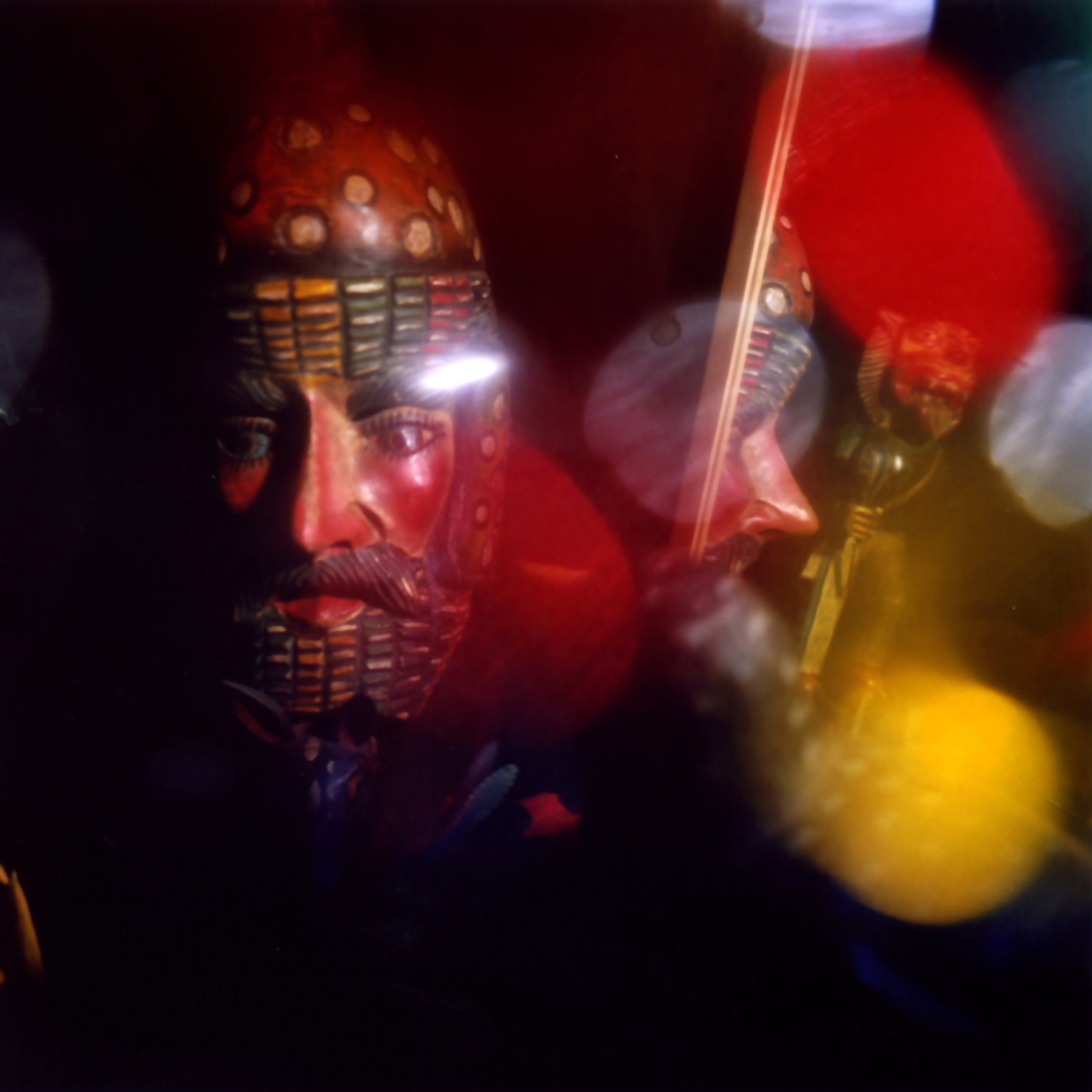
Untitled chromogenic print, 24″ x 24″ on 30″ x 40″ Fujicolor crystal archives paper, edition of 5
A: From the beginning in the 1980s I used photographs as reference material and my late husband, Bryan, would shoot 4” x 5” negatives of my elaborate setups using his Toyo-Omega view camera. In those days I rarely picked up a camera except when we were traveling.
After Bryan was killed on 9/11, I inherited his extensive camera collection – old Nikons, Leicas, Graphlex cameras, etc. – and I wanted to learn how to use them. Starting in 2002 I enrolled in a series of photography courses (about 10 over 4 years) at the International Center of Photography in New York. I learned how to use all of Bryan’s cameras and how to make my own big color prints in the darkroom.
Along the way I discovered that the sense of composition and color I had developed over many years as a painter translated well into photography. The camera was just another medium with which to express my ideas. Astonishingly, in 2009 I had my first solo photography exhibition in New York.
It’s wonderful to be both a painter and a photographer. Pastel painting will always be my first love, but photography lets me explore ideas much faster than I ever could as a painter. Paintings take months of work. Photographs – from the initial impulse to create a setup to hanging a framed chromogenic print on the wall – can be made in minutes.
Comments are welcome!
Q: Would you share a bit more about yourself? (Question from “Bold Journey”)

A: I am an American contemporary Master Pastel Artist who divides my time between residences in New York City and Alexandria, VA. I am best known for my pastel-on-sandpaper paintings, my eBook, “From Pilot to Painter,” and my popular blog, “Barbara Rachko’s Colored Dust,” which currently has more than 125,000 subscribers. I am proud to be represented by Apricus Art Collection (US), Art Client Services (US), Galleria Balmain (UK), Emillions (US), Interstellar (IN), and Galleri SoHo (SE). I am a member of the International Association of Visual artists.
I travel regularly to Mexico, Central America, South America, and Asia. Since 2017 I have been creating “Bolivianos,” a painting series based on an exhibition of Carnival masks I photographed at the Museum of Ethnography and Folklore in La Paz.
My life has been called “extraordinary and inspiring.” I learned to fly when I was 25 and became a Commercial Pilot and Boeing-727 Flight Engineer before joining the Navy. As a Naval Officer I spent many years working at the Pentagon and retired as a Commander. On 9/11 my husband Dr. Bryan Jack was killed onboard the plane that crashed into the Pentagon. Ever since that awful day, I have worked hard to overcome my husband’s tragic loss. Now I enjoy a thriving career as an internationally-known professional artist.
Comments are welcome!
Pearls from artists* # 586

Starting a new one!
*an ongoing series of quotations – mostly from artists, to artists – that offers wisdom, inspiration, and advice for the sometimes lonely road we are on.
The page is your mirror. What happens inside you is reflected back. You come face-to-face with your own resistance, lack of balance, self-loathing, and insatiable ego – and also with your singular vision, guts, and fortitude. No matter what you’ve achieved the day before, you begin each day at the bottom of the mountain. Isn’t this true for most of us? A surgeon about to perform a difficult operation is at the bottom of the mountain. A lawyer delivering a closing argument. An actor waiting in the wings. A teacher on the first day of school. Sometimes we may think that we’re in charge, or that we have things figured out. Life is usually right there, though, ready to knock us over when we get too sure of ourselves. Fortunately, if we have learned the lessons that years of practice have taught us, when this happens, we endure. We fail better. We sit up, dust ourselves off, and begin again.
Dani Shapiro in Still Writing: The Perils and Pleasures of a Creative Life
Comments are welcome!
Q: How do you get such fine detail with soft pastel? Do they make pencil-size pastels? (Question from Lucia Sommer via Facebook)

A: After 37 years as a pastel artist, I have learned all sorts of techniques and can do whatever I want with it. I used regular Rembrandt white pastels for the sweater in “Sam and Bobo,” above.
There are several brands of pastel pencils that are made especially for drawing fine details. Sam’s face, hair, and hands are mostly pastel pencil. (Now I probably would not use pastel pencils as much. These days I only use them to draw lines and sign my name).
Another technique for making fine lines is to break a pastel stick and work with an edge.
Years ago I used to sharpen my pastels into a point with a small handheld sharpener (I still have one that allows me to change the blades). Sometimes I rub a pastel stick against a sandpaper pad until I get a somewhat sharp point. The problem with both of these methods is they waste so much pastel and pastels are not cheap! For example, my favorite French brand is nearly $20 per stick. I would never think of sharpening those!
Comments are welcome!
Q: You make it look effortless when we know it is not. Would you explain how you started your blog 11 years ago? (Question from Colette C. McBratney via Facebook)
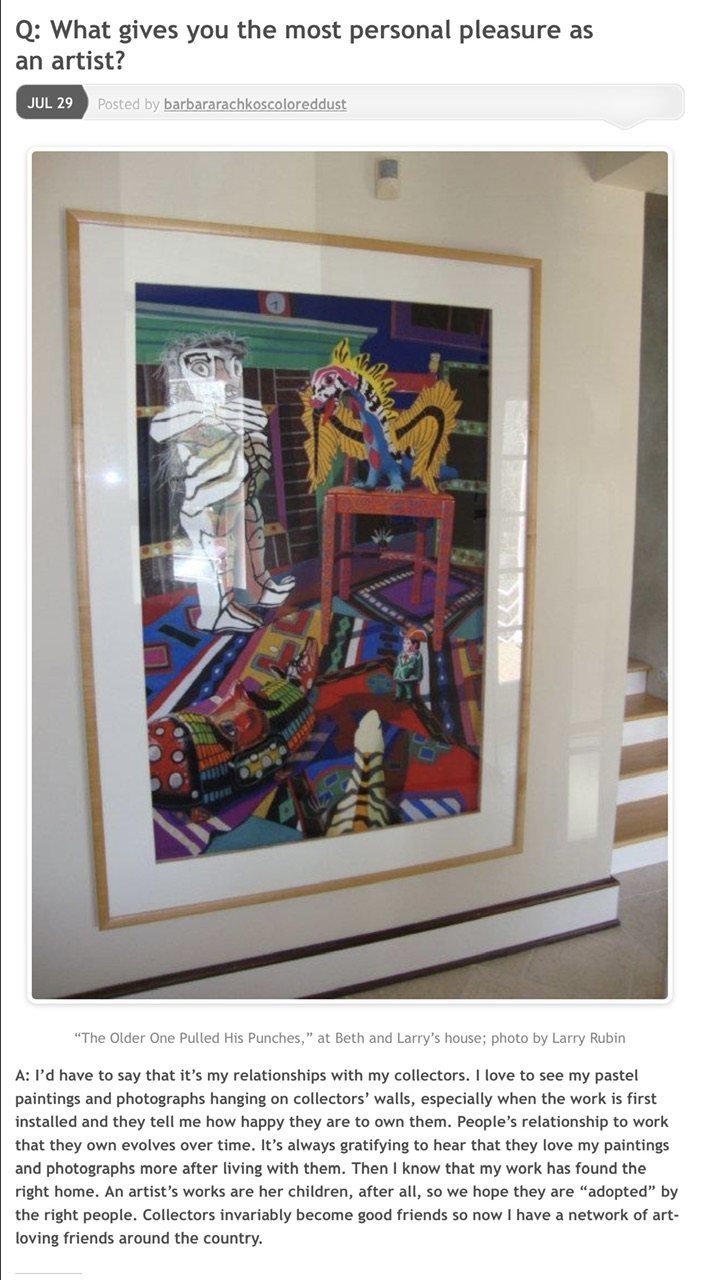
An Early Blog Post, Above
A: My blog turned 11 on July 15th. To learn how to set up, publish, and maintain a blog, I took a class at the International Center of Photography in New York. It was called “The Daily Blog” and that’s where I learned how to work with WordPress.
I decided to use a question and answer format because I had a backlog of material from interviews I had done over the years. During the class, which lasted five weeks, I published blog posts every day. Once the class ended, I cut back to a more manageable schedule of publishing posts twice a week.
Writing about my work quickly became an important part of my creative process. As most people probably know, I am very persistent so these days I just make sure to keep going!
Comments are welcome!
Q: How has the use of photography in your work changed over the decades?
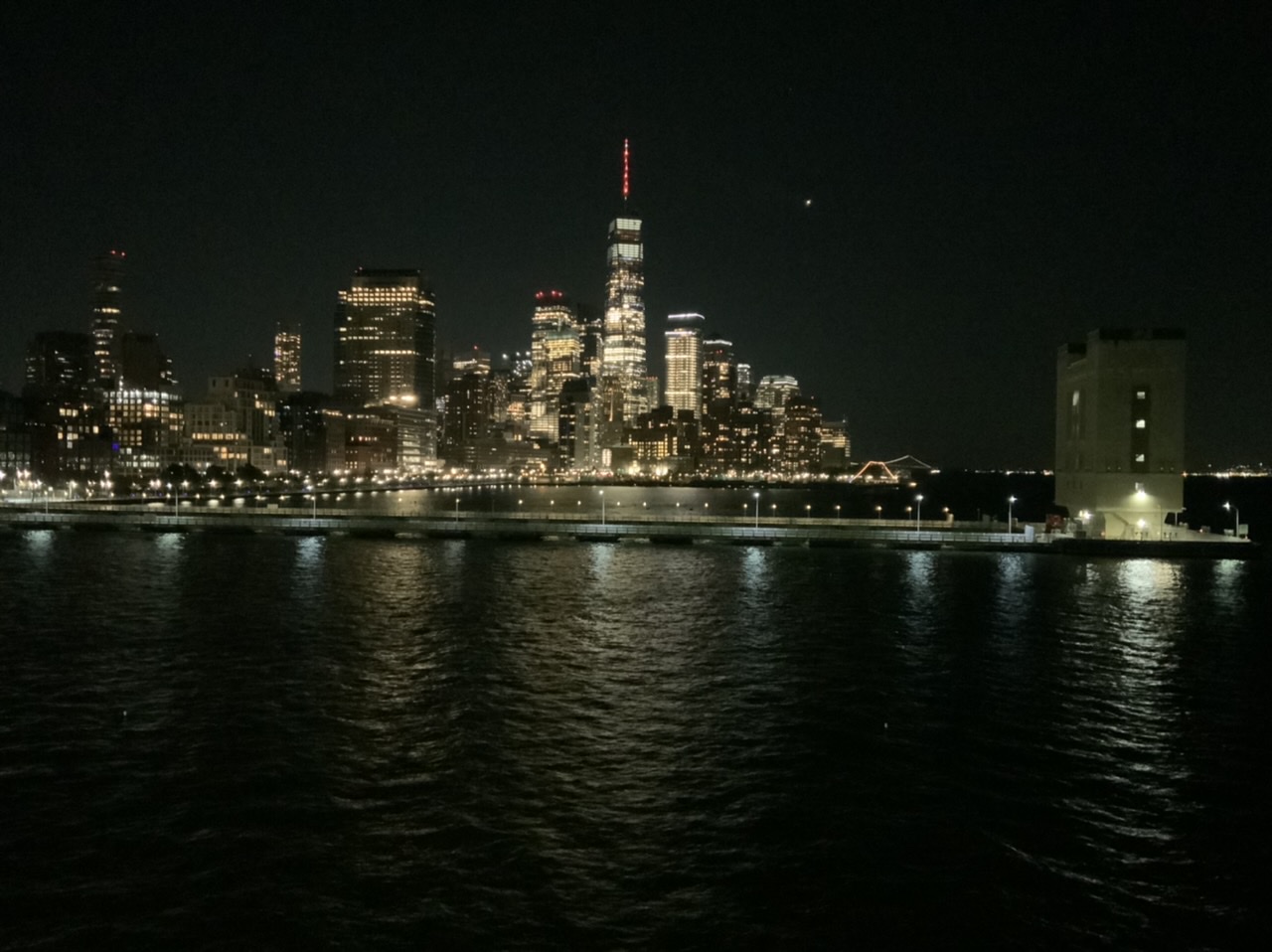
New York, NY
A: From the beginning in the mid-1980s I used photographs as reference material. My late husband, Bryan, would shoot 4” x 5” negatives of my elaborate setups using his Toyo-Omega view camera. In this respect Bryan was an integral part of my creative process as I developed the “Domestic Threats” pastel paintings. At that time I rarely picked up a camera, except to capture memories of our travels.
After Bryan was killed on 9/11, I inherited his extensive camera collection – old Nikons, Leicas, Graphlex cameras, and more. I wanted and needed to learn how to use them. Starting in 2002 I enrolled in a series of photography courses (about 10 over 4 years) at the International Center of Photography in New York. I learned how to use all of Bryan’s cameras and how to make my own big chromogenic prints in the darkroom.
Along the way I discovered that the sense of composition and color I had developed over many years as a painter translated well into photography. The camera was just another medium with which to express my ideas. Surprisingly, in 2009 I had my first solo photography exhibition at a gallery in New York. Bryan would have been so proud!
For several years now my camera of choice has been a 12.9” iPad Pro. It’s main advantage is that the large screen let’s me see every detail as I compose my photographs. I think of it as a portable, lightweight, and easy-to-use 8 x 10 view camera. My iPad is always with me when I travel and as I walk around exploring New York City.
It is a wonderful thing to be both a painter and a photographer! While pastel painting will always be my first love, photography has distinct advantages over my studio practice. Pastel paintings are labor-intensive, requiring months of painstaking work. Photography’s main advantage is speed. Photographs – from the initial impulse to hanging a print on a wall – can be made in minutes. Photography is instant gratification, allowing me to explore ideas much easier and faster than I ever could as a painter. Perhaps most importantly, composing photographs keeps my eye sharp whenever I am away from the studio. I credit photography as an important factor in the overall evolution of my work.
Comments are welcome!


 barbararachkoscoloreddust.com