Blog Archives
Pearls from artists* # 609
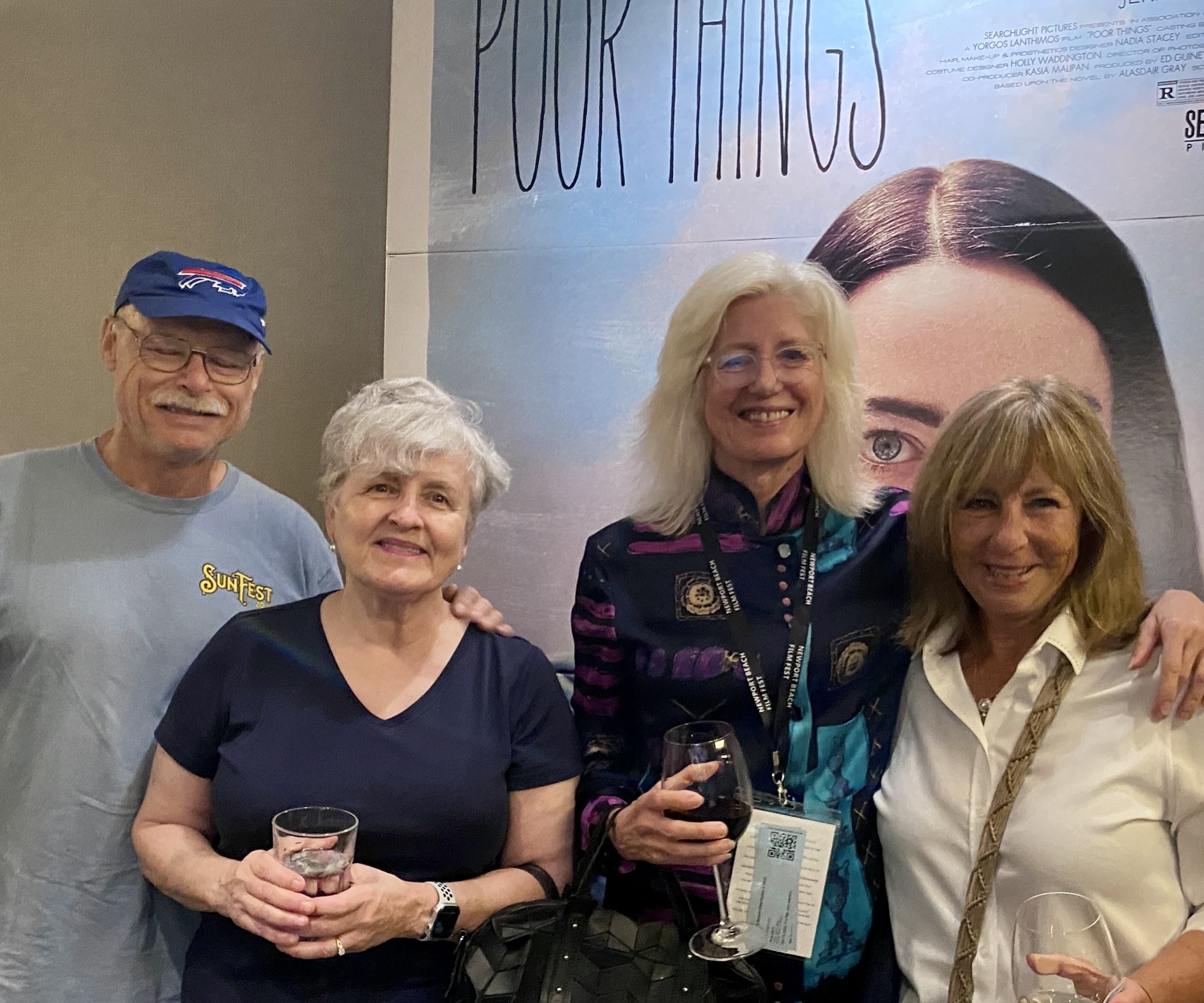
At the World Premier of “Barbara Rachko: True Grit” during the Newport Beach Film Festival
*an ongoing series of quotations – mostly from artists, to artists – that offers wisdom, inspiration, and advice for the sometimes lonely road we are on.
Whether we are creating high art or a meal, we improvise when we move with the flow of time and with our own evolving consciousness, rather than with a preordained script or recipe. In composed or scripted art forms, there are two kinds of time: the moment of inspiration in which a direct intuition of beauty or truth comes to the artist; then the often laborious struggle to hold onto it long enough to get it down on paper or canvas, film or stone. A novelist may have a moment (literally a flash) of insight into which the birth, meaning, and purpose of a new book reveal itself; but it may take years to write it. During this time he must not only keep the thought fresh and clear, he must also eat, live, make money, suffer, enjoy, be a friend, and everything else human beings do. In composed music or theater, moreover, there is yet a third kind of time: besides the moment (or moments) of inspiration and time it takes to write the score, there is the time of the actual performance. Often the music is not even performed until after the composer’s death.
Stephen Nachmanovitch in Free Play: Improvisation in Life and Art
Comments are welcome!
Q: Would you share a bit more about yourself? (Question from “Bold Journey”)

A: I am an American contemporary Master Pastel Artist who divides my time between residences in New York City and Alexandria, VA. I am best known for my pastel-on-sandpaper paintings, my eBook, “From Pilot to Painter,” and my popular blog, “Barbara Rachko’s Colored Dust,” which currently has more than 125,000 subscribers. I am proud to be represented by Apricus Art Collection (US), Art Client Services (US), Galleria Balmain (UK), Emillions (US), Interstellar (IN), and Galleri SoHo (SE). I am a member of the International Association of Visual artists.
I travel regularly to Mexico, Central America, South America, and Asia. Since 2017 I have been creating “Bolivianos,” a painting series based on an exhibition of Carnival masks I photographed at the Museum of Ethnography and Folklore in La Paz.
My life has been called “extraordinary and inspiring.” I learned to fly when I was 25 and became a Commercial Pilot and Boeing-727 Flight Engineer before joining the Navy. As a Naval Officer I spent many years working at the Pentagon and retired as a Commander. On 9/11 my husband Dr. Bryan Jack was killed onboard the plane that crashed into the Pentagon. Ever since that awful day, I have worked hard to overcome my husband’s tragic loss. Now I enjoy a thriving career as an internationally-known professional artist.
Comments are welcome!
Pearls from artists* # 597

Barbara’s Studio
*an ongoing series of quotations – mostly from artists, to artists – that offers wisdom, inspiration, and advice for the sometimes lonely road we are on.
From earliest childhood, the boys had been treated differently from their sister. They were allowed more freedom, encouraged to play outdoors and to engage in rough and tumble, and their lives were expanded early on when, at the age of seven, each was sent to St. Mary’s, the prep school of Stonyhurst College. It seemed as if the boys were being readied for adventure and excitement, but while their horizons were opening up, Leonora [Carrington] felt hers were being closed down – or more specifically, never explored. Her role, which was clear even when she was in the nursery, was to keep safe: not to rock any boats, not to take any chances. What they sought to teach her was that she should sit a certain way and behave a certain way: she should be supportive, helpful, polite. She should listen, especially to men, she should have traditional skills, such as playing music and speaking French. Drawing and painting, for which she showed altitude from an early age, were fine within reason. What harm could there be in Prim [Lenora] creating pictures? Especially if those pictures were of flowers and trees, family members and characters from fairy stories.
But art was Leonora’s secret weapon – and she hid it in plain sight, because her parents did not have the faintest idea where her talents might lead. Art, for them, was unthreatening and pretty. They had no idea that this skill their daughter was developing would be one the key to another life entirely; still less that art could never be a validation of the status quo, but meant a radical reappraisal of everything in the artists sight.
So what Leonora practiced in the nursery at Crookhey was the subversive silence of smoldering rebellion. Spared by the inherent unfairness that gave Pat, Gerard, and Arthur so much freedom; stoked by the growing realization that she had a talent that would lead, eventually, to Liberty. “I always painted, and I always knew it was what I would do,” she said many years later. As the Jesuits who educated her brothers at Stonyhurst might have said (but didn’t): show me a girl aged seven, and I will show you the woman.
Joanna Moorhead in Surreal Spaces: The Life and Art of Leonora Carrington
Comments are welcome!
Q: When you’re not creating art what’s your next favorite creative activity?

Hudson Yards, NYC iPad Photo
A: I love taking photographs with my iPad Pro! It has a 12.9″ screen so I can see every detail of the image. It is equivalent to using an 8 x 10 view camera with the advantages of being relatively lightweight and portable; does not require a tripod, a hood, or other special equipment like individual film holders; and the image appears right side up on the screen. It’s a perfect camera!
I have owned and used many film and digital cameras, but my iPad Pro has been my favorite for several years now. It’s great for my specific needs. I take it all over the world!
Comments are welcome!
Pearls from artists* # 574

Barbara’s Studio
*an ongoing series of quotations – mostly from artists, to artists – that offers wisdom, inspiration, and advice for the sometimes lonely road we are on.
A creative life is risky business. To follow your own course, not patterned on parents, peers, or institutions, involves a delicate balance of tradition and personal freedom, a delicate balance of sticking to your guns and remaining open to change. While on some dimensions living a normal life, you are nevertheless a pioneer, breaking away from the molds and models that inhibit the heart’s desire, creating life as it goes. Being, acting, creating in the moment without props and supports, without security, can be supreme play, and it can also be frightening, the very opposite of play. Stepping into the unknown can lead to delight, poetry, invention, humor, lifetime friendships, self-realization, and occasionally a great creative breakthrough. Stepping into the unknown can also lead to failure, disappointment, rejection, sickness, or death.
Stephen Nachmanovitch in Free Play: Improvisation in Life and Art
Comments are welcome!
Q: The first pastel painting you see every morning when you arrive at your studio is “Myth Meets Dream.” It must have special meaning. Would you elaborate? (Question suggested by Marlissa Gardner via Facebook)

A: “Myth Meets Dream,” an early pastel painting from the “Domestic Threats” series, is one I have never wanted to sell. It marks the first time I included Mexican folk art figures in my work. In 1992 as a Christmas present, my future sister-in-law sent the two Oaxacan painted wooden figures you see depicted above – the blue winged creature and the red, white, and black figure behind it. The other three figures in this painting are hand-puppets.
Previously, I had been creating elaborate staged photographs in my Alexandria house using stuffed animals and hand-puppets. (The latter were made by a company called “Folk Tails”). I used the photos as reference material for pastel paintings. In other words, rather than work exclusively from life, I mostly looked at these photos while I made the painting. Although I have simplified my process since those early days, I still create pastel paintings using reference photographs.
In “Myth Meets Dream” you can see both puppets and my then new Oaxacan folk art figures. This pastel painting marks an important transition in subject matter and was the start of decades-worth of foreign travel, study, adventure, hard work, and yes, fun. It’s true that “Myth Meets Dream” hangs in my studio and is the first thing I see every morning. It brings back so many precious memories.
Every painting has a story!
If you’re interested to learn more, please see https://barbararachko.art/en/art-market
Comments are welcome!
Q: There are so many instances in the art world where paintings are discovered to be fakes. Do you think this is a potential problem where your work is concerned? Can your pastel paintings be forged?


A: For the record, a little-appreciated fact about my pastel-on-sandpaper paintings is that they can never be forged. To detect a fake, you would only need to x-ray them. If dozens of layers of revisions are not visible under the final pastel painting, you are not looking at an original Rachko, period.
My completed paintings are the results of thousands of decisions. They are the product of an extremely meticulous, labor-intensive, and self-invented process. This is the difference between spending months thinking about and creating a painting, as I do, or a single day. It’s highly doubtful that my rigorous creative process can EVER be duplicated.
Comments are welcome!
Q: What makes you feel most alive?

A: Making art makes me feel alive, using all my gifts, my brain, my heart, and my hands to create something that never existed before and that can never be duplicated; knowing I’m the only person, ever, who could or would make this particular thing, as I strive to push my pastel techniques further each time out. Whether it’s a painting or a photograph, I enjoy making something from nothing… art that is well-crafted and has never been seen before.
Travel is the other activity that excites me. I thrive on adventure and I especially love new vistas. When I am in a country I have never visited before, with every step and around every bend there is something new to see. I am an explorer at heart!
Comments are welcome!
Q: Would you describe your current work in a few sentences?
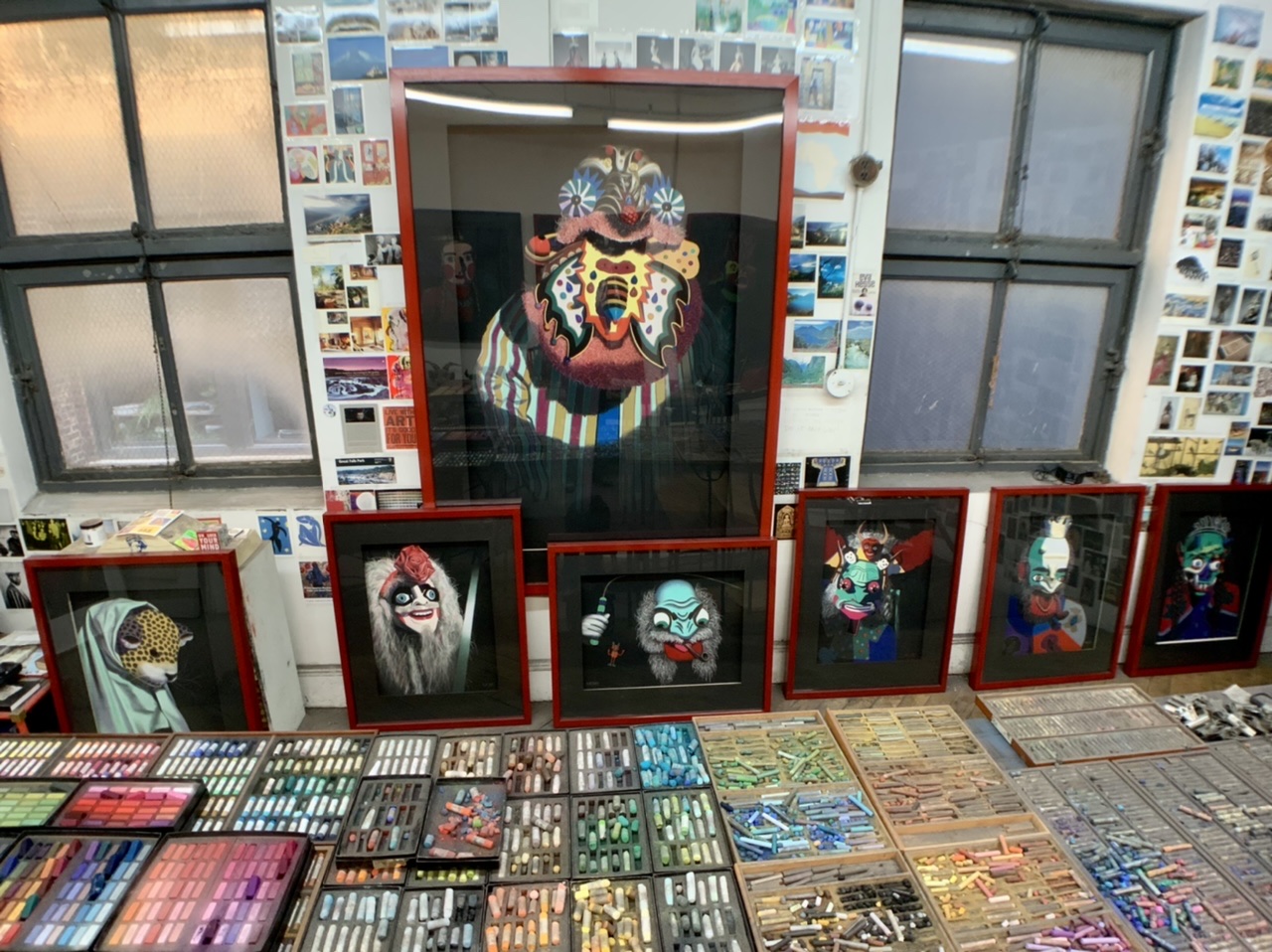
A: Of course, my art practice continually evolves and so does my thinking about its meaning. Using my own iPad photographs of Bolivian Carnival masks from Oruro as source material, for the past five years I have been slowly building a rogue’s gallery of beautiful, if somewhat misunderstood, characters probably best described as oddballs and misfits. For me, the paintings have a deeper meaning as archetypes of the collective unconscious. Creating this series is an act of genuine love. It is my hope that the ”Bolivianos” pastel paintings convey my deep respect and compassion for people around the world.
Comments are welcome!
Pearls from artists* # 473

*an ongoing series of quotations – mostly from artists, to artists – that offers wisdom, inspiration, and advice for the sometimes lonely road we are on.
… slow art arose in the later eighteenth century when two massive cultural changes converged, changes that have grown more acute ever since. First: acceleration, as capitalism and advances in technology quickened the pace of everyday life in unprecedented ways. It’s no coincidence that Harmut Rosa links the origin of modernity to the quickening movement of money, vehicles, and communication. The pressures of acceleration created the need for psychological breathers or timeouts. But second, and simultaneously: Western society grew more and more secularized. As a result, occasions to slow one’s tempo became harder to access – like devotional practices requiring viewers to focus intensely on single works over long periods of time. Hence an increased need met decreased opportunities to address that need. Slow art came to supplement older sacred practices by creating social spaces for getting off the train. In sum, as culture sped up and sacred aesthetic practices waned, slow art came to satisfy our need for downtime by producing works that require sustained attention in order to experience them.
Arden Reed in Slow Art: The Experience of Looking, Sacred Images to James Turrell
Comments are welcome!


 barbararachkoscoloreddust.com