Blog Archives
Q: What would you be if you were not an artist?

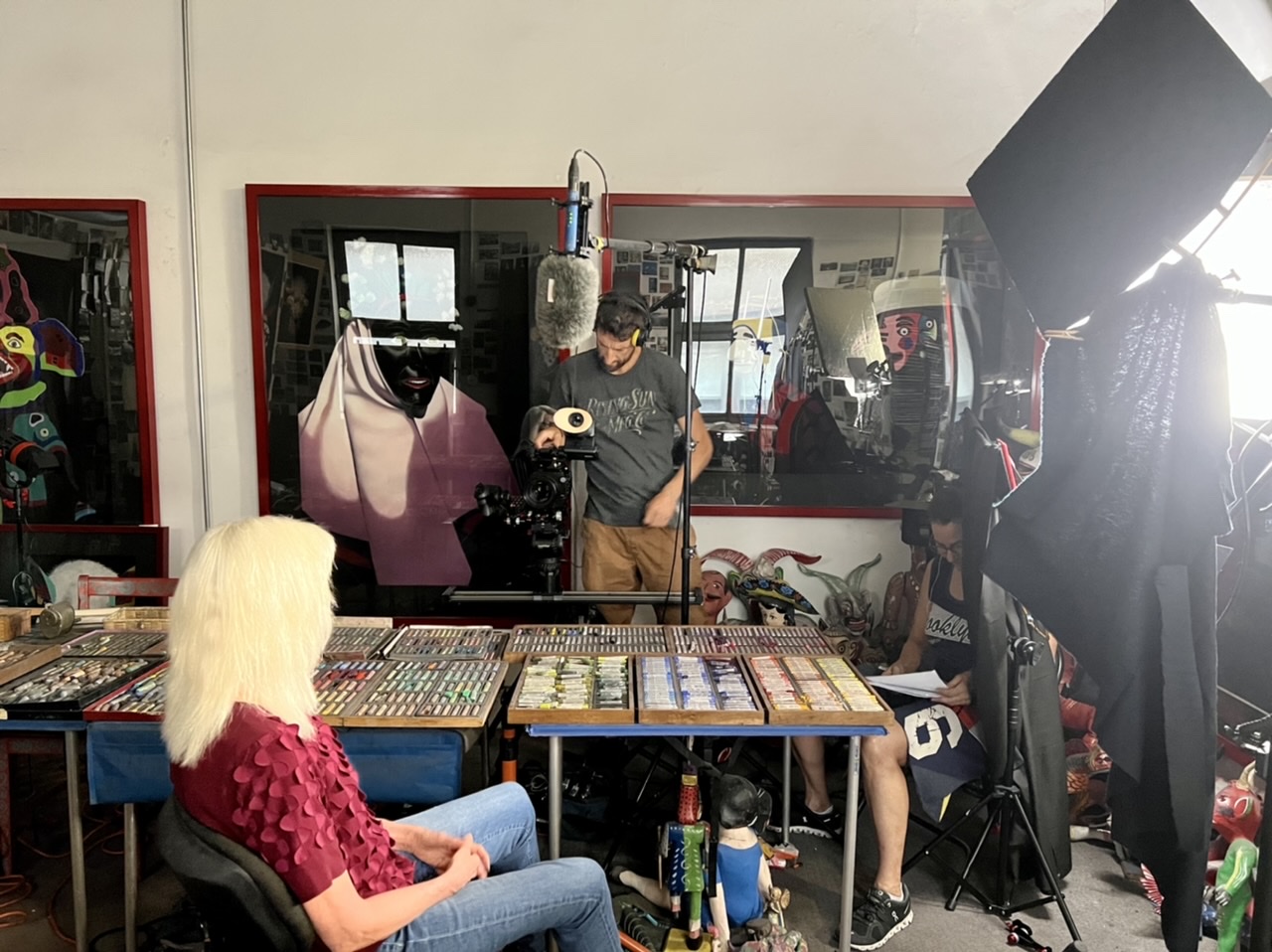
The studio with pastel paintings in progress!
A: I honestly have no idea, but whatever it might be, there is a good chance that I’d be bored! In my younger days boredom was a strong motivator. I left the active duty Navy out of boredom. I couldn’t bear not being intellectually challenged (most of my jobs consisted of paper-pushing), not using my flying skills (at 27 I was a licensed commercial pilot and Boeing 727 flight engineer), and not developing my artistic talent. In what surely must be a first, by spending a lot of time and money training me for jobs I hated, the Navy turned me into a hard-working artist! And once I left the Navy there was no plan B. There was no time to waste. It was “full speed ahead.”
Art is a calling. You do not need to be told this if you are among those who are called. It’s all about “the work,” that all-consuming focus of an artist’s life. If a particular activity doesn’t make you a better artist, you avoid it. You work hard to nourish and protect your gifts. As artists we invent our own tasks, learn whatever we need in order to progress, and complete projects in our own time. It is life lived at its freest.
My art-making has led me to fascinating places: Mexico, Guatemala, Brazil, Chile, Easter island, Argentina, Uruguay, France, England, Italy, Bali, Java, India, Bhutan, and more; and to in-depth studies of intriguing subjects: drawing, color, composition, art and art history, the art business, film and film history, photography, mythology, literature, music, jazz history, and archaeology, particularly that of ancient Mesoamerica (the Olmec, Zapotec, Mixtec, Aztec, Maya, etc.). And this rich mixture continually grows! For anyone wanting to spend their time on earth learning and meeting new challenges, there is no better life than that of an artist.
I SO agree with this exchange that I read years ago between between Trisha Brown and Mikhail Baryshnikov in the New York Times. I wrote it on a piece of paper and taped it to my studio wall:
Trisha: How do you think we keep going? Are we obsessed?
Mikhail: We do it because there’s nothing better. I’m serious. Because there is nothing more exciting than that. Life is so boring, that’s why we are driven to the mystery of creation.
Comments are welcome.
Pearls from artists* # 649

*an ongoing series of quotations – mostly from artists, to artists – that offers wisdom, inspiration, and advice for the sometimes lonely road we are on.
Some of us spend our entire creative lives digging at the buried parts of ourselves to solve unknown mysteries that we are not even aware of. Unearthing those aspects is not an easy process, because our true psychic reality does not lie in our daily waking thoughts. It exists in the unconscious, in the form of an unfathomable, nonverbal sensory language, one that is so complex and runs so deep that we can only grasp at it, to attain small, amorphous bits. These bits can take any form, even uncharacteristic, surprising ones. We access, process, and finally transform them into what Saint Augustine called ‘visible signs of invisible realities.’
Kate Kretz in Art From Your Core: A Holistic Guide to Visual Voice”
Comments are welcome!
Q: When did you begin drawing and painting? (Question from “Cultured Focus Magazine”)

A: This is a long story because my path to becoming a professional artist has been unusually circuitous.
I grew up in a blue collar family in suburban New Jersey. My parents were both first-generation Americans and no one in my family had gone to college. I was a smart kid, who showed some artistic talent in kindergarten and earlier. At the age of 6, my sister, my cousin, and I enrolled in Saturday morning painting classes at the studio of a local artist. I continued the classes for about 8 years and became a fairly adept oil painter.
At the age of 15 my father decided that art was not a serious pursuit – he called it a hobby, not a profession – and abruptly stopped paying for my Saturday morning lessons. Unfortunately, there were no artists or suitable role models in my family. So with neither financial nor moral support to pursue art, I turned my attention to very different interests.
Cut to ten years later. When I was 25, I earned my private pilot’s license and spent the next two years amassing other flying licenses and ratings, culminating in a Boeing-727 flight engineer’s certificate.
At 29, I joined the Navy. By then I was an accomplished civilian pilot with thousands of flight hours so I expected to fly jets. However, in the early 1980s women were not allowed in combat. There were very few women Navy pilots and those few were restricted to training male pilots. There were no women pilots landing on aircraft carriers.
In the mid-1980s I was in my early 30s, a lieutenant on active duty in the Navy, working a soul-crushing job as a computer analyst on the midnight shift in a Pentagon basement. It was literally and figuratively the lowest point of my life. I was completely bored and miserable.
Remembering the joyful Saturdays of my youth when I had taken art classes with a local New Jersey painter, I enrolled in a drawing class at the Art League School in Alexandria, Virginia. Initially I wasn’t very good, but it was wonderful to be around other women and a world away from the mentality of the Pentagon. I was having fun again! I enrolled in more classes and became a very motivated full-time art student who worked nights at the Pentagon. As I studied and improved my skills, I quickly discovered my preferred medium – soft pastel on sandpaper.
Although I knew I had found my calling, for more than a year I agonized over whether or not to leave the financial security of a Navy paycheck. Finally I did make up my mind and resigned my commission, effective on September 30, 1989. With Bryan’s (my then boyfriend’s) support, I left the Navy to devote my time to making art.
I’m probably one of the few people who can name THE day I became a professional artist! That day was October 1, 1989. Fortunately, I have never needed another job. I remained in the Navy Reserve for the next 14 years, working primarily at the Pentagon for two days each month and two weeks each year. I commuted by train to Washington, DC after I moved to Manhattan in 1997. Finally on November 1, 2003, I officially retired as a Navy Commander.
Life as a self-employed professional artist is endlessly varied, fulfilling, and interesting. I have never regretted my decision to pursue art full-time.
Comments are welcome!
Q: How do you persist despite the haters, nay-sayers, etc.? (Question from Bold Journey Publishing)

Barbara’s Studio
A: There are so many obstacles to art-making and countless reasons to just give up. When you really think about it, it’s amazing that great art gets made at all. So why do we do it? For artists I believe it’s all about making our time on earth matter, about devotion to our innate gifts, and a deep love of our hard-fought creative process.
I have been a full-time professional artist for 37 years. How and why do successful artists persist? It helps a lot to be stubborn! We just keep digging in that much deeper. Making art is a most noble and sacred calling – you know this if you are one of the called – and that’s what separates those of us who are in it for the long haul from the wimps, fakers, and hangers-on. I say to my fellow artists who continue to work despite the endless challenges, we artists who continue to struggle every day for recognition of our gifts are true heroes!
These words below by Mary Gabriel in Ninth Street Women, published in 2017, ring true for artists. It’s good, even for me, to occasionally reread them and be reminded.
The obstacles faced by women who hoped to leave a mark on humankind have, through the millennium, varied in height but not in stubborn persistence. And yet, a great many women have stubbornly ignored them. The desire to put words on a page or marks on a canvas was greater than the accrued social forces that told them they had no right to do so, that they were excluded by their gender from that priestly class called artist. The reason, according to Western tradition, was as old as creation itself: For many, God was the original artist and society had assigned its creator a gender – He. The woman who dared to declare herself an artist in defiance of centuries of such unwavering belief required monstrous strength, to fight not for equal recognition and reward but for something at once more basic and vital: her very life. Her art was her life. Without it, she was nothing. Having no faith that society would broaden its views on artists by dethroning men and accommodating women, in 1928 [Virginia] Woolf offered her fellow writers and painters a formula for survival that allowed them to create, if not with acceptance, then at least unimpeded. A woman artist, she said, needed but two possessions: “money and a room of her own.”
Furthermore, I think I persist because I do not believe in “big breaks.” Big breaks may sometimes happen, but in my experience an artist’s life is made up of single-minded dedication, persistence, hard work, and lots of small breaks. I recently finished reading “Failing Up: How to Take Risks, Aim Higher, and Never stop Learning” by Leslie Odom, Jr. I like what he has to say to artists here:
The biggest break is the one you give yourself by choosing to believe in your wisdom, in what you love, and in the gifts you have to offer the waiting world.
Comments are welcome!
Pearls from artists* # 581

With recent “Bolivianos”
*an ongoing series of quotations – mostly from artists, to artists – that offers wisdom, inspiration, and advice for the sometimes lonely road we are on.
The essence of style is this: We have something in us, about us; it can be called many things, but for now let’s call it our original nature. We are born with our original nature, but on top of that, as we grow up, we accommodate to the patterns and habits of our culture, family, physical environment, and the daily business of the life we have taken on. What we are taught solidifies as “reality.” Our persona, the mask we show the world, develops out of our experience and training, step by step from infancy to adulthood. We construct our world through the actions of perception, learning, and expectation. We construct our “self” through the same actions of perception, learning, and expectation. World and self interlock and match each other, step by step and shape by shape. If the two constructions, self and world, mesh, we grow from child to adult becoming “normally adjusted individuals.” If they do not mesh so well, we may experience feelings of inner division, loneliness, or alienation.
If we should happen to become artists, our work takes on, to a certain extent, the style of the time: the clothing in which we are dressed by our generation, our country and language, our surroundings, the people who have influenced us.
But somehow, even when we are grown up and “adjusted,” everything we do and are – our handwriting, the vibrato of our voice, the way we handle the bow or breathe into the instrument, our way of using language, the look in our eyes, the pattern of whirling fingerprints on our hand – all these things are symptomatic of our original nature. They all show the imprint of our own deeper style or character.
Stephen Nachmanovitch in Free Play: Improvisation in Life and Art
Comments are welcome!
Pearls from artists* # 519
*an ongoing series of quotations – mostly from artists, to artists – that offers wisdom, inspiration, and advice for the sometimes lonely road we are on.
Because the arts are the products of a process that stands apart from so much of our social, economic, and political life, they move us and excite us unlike anything else in our lives. When we rush to label them – as radical, conservative, liberal, gay,straight, feminist, Black, or white – we may describe a part of what they are, but we’ve failed to account for their freestanding value. And without that the arts are nothing. The artist in the act of creation – working through particular words, sounds, colors, shapes, and their infinite combinations – almost inevitably risks irrelevance. But the decision to reject doing in favor of making, which some have described as a retreat into self-absorption and narcissism, is in fact an act of courage. Artists reenter the world by sending the work that they’ve made back into the world, where it lives on – independent, inviolable – in what Auden called ”the valley of its making.” That is a place apart – paradoxically, triumphantly apart.
Jed Perl in Authority and Freedom: A Defense of the Arts
Comments are welcome!
Pearls from artists* # 509
* an ongoing series of quotations – mostly from artists to artists – that offers wisdom, inspiration, and advice for the sometimes lonely road we are on.
Which left me with nothing but a dazzled heart and the sense that I live in a most remarkable world, thick with mysteries. It all called to mind the British physicist Sir Arthur Eddington’s memorable explanation of how the universe works: “Something unknown is doing we don’t know what.“
But the best part is: I don’t need to know what.
I don’t demand a translation of the unknown. I don’t need to understand what it all means, or where ideas are originally conceived, or why creativity plays out as unpredictably as it does. I don’t need to know why we are sometimes able to converse freely with inspiration, when at other times we labor hard in solitude and come up with nothing. I don’t need to know why an idea visited you today and not me. Or why it visited us both. Or why it abandoned us both.
None of us can know such things, for these are among the great enigmas.
All I know for certain is that this is how I want to spend my life – collaborating to the best of my ability with forces of inspiration that I can neither see, nor prove, nor command, nor understand.
It’s a strange line of work, admittedly.
I cannot think of a better way to pass my days.
Elizabeth Gilbert in Big Magic: Creative Living Beyond Fear
Comments are welcome!

Pearls from artists* # 482

*an ongoing series of quotations – mostly from artists, to artists – that offers wisdom, inspiration, and advice for the sometimes lonely road we are on.
Devils’ heads with daring and disturbing eyes, twisted horns, abundant grey hair and hooked noses hang on the blue walls of Antonio Viscarra’s house. Long benches covered with old, multi-colored cushions in Bolivian motifs surround the concrete floor of the small room. Several dozen of these hanging faces, which seem to watch in silence from the darkness, are ready to be used in festivals and traditional dances.
The maskmaker or “maestro” as he is called, lives [deceased now] in the area of Avenida Buenos Aires, far from the political and administrative center of the city of La Paz, but rather at the very center of the other La Paz (Chuquiago in the Aymara language) where many peasant immigrants have settled, and which for that reason, is the center of the city’s popular culture.
Viscarra is the oldest creator of masks in La Paz, and his work has helped to conserve, and at the same time to rejuvenate, the tradition of using masks in Bolivian dances. If economic progress and alienation have contributed to the excessive adornment of new masks with glass and other foreign materials, Viscarra, in an attempt to recover the distinctive, original forms, has gone back to the 100-year-old molds used by his grandfather. His work has been exhibited in Europe, in the United States and in South America, Most important, however, is that Viscarra is transmitting his knowledge to his children, ensuring that this form of authentic Bolivian culture will never die.
…Viscarra inherited the old mask molds from his grandfather and was told to take good care of them because some day he might need them. After keeping them carefully put away for 50 years, the maestro used them again for an exhibition of masks prepared in 1984, slowly recreating the original masks, beautiful in their simplicity, in their delicate craftsmanship and in their cultural value. In this way, the masks which emerged from the old molds are regaining their past prestige and importance.
Antonio Viscarra, The mask Maker by Wendy McFarren in Masks of the Bolivian Andes, Editorial Quipus and Banco Mercantil
Comments are welcome!
Q: What’s on the easel today?
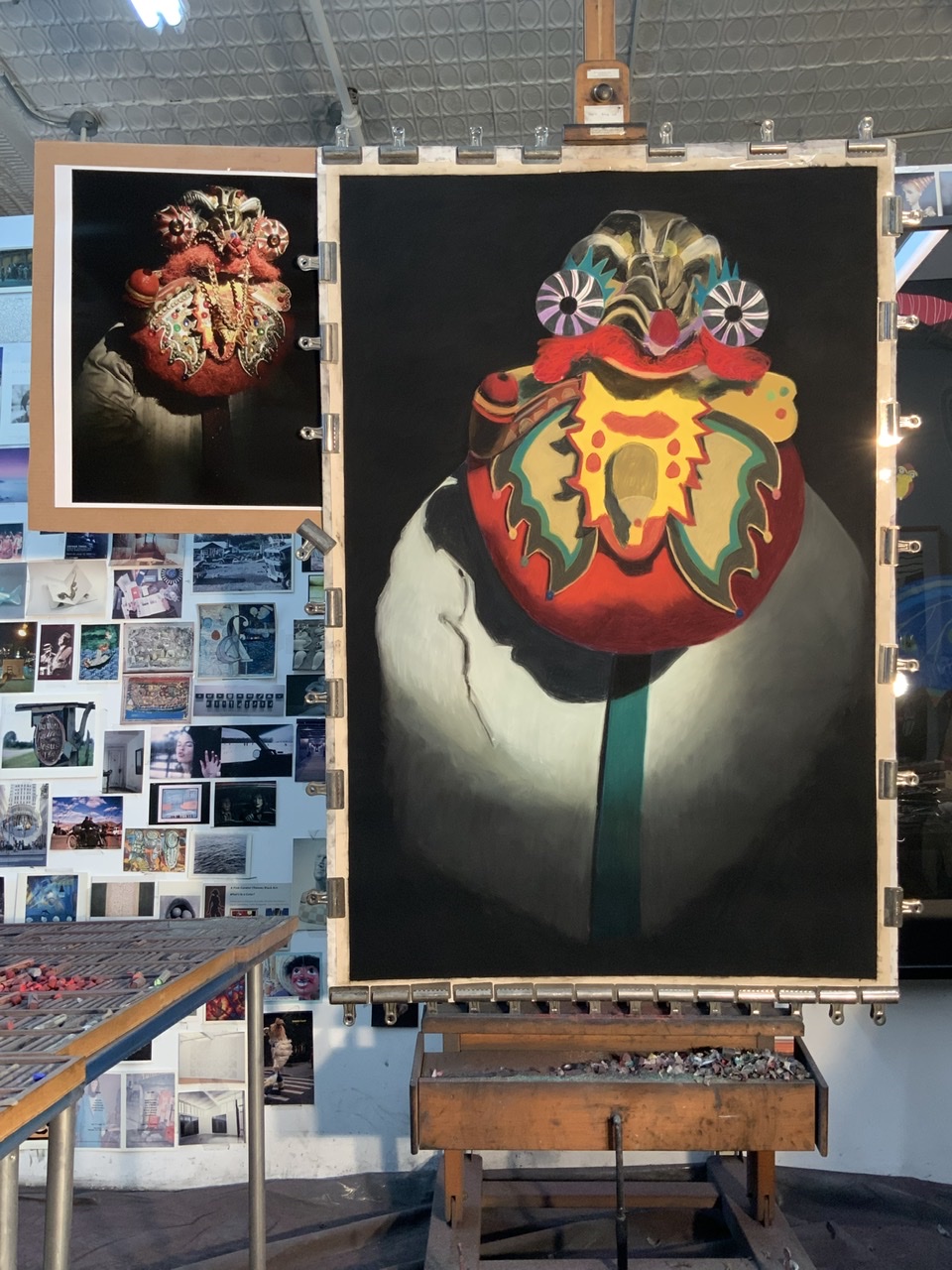
Work in progress
A: I continue working on a large 58” x 38” pastel painting tentatively called, “Jokester.”
Comments are welcome!


 barbararachkoscoloreddust.com