Blog Archives
Pearls from artists* # 628

*an ongoing series of quotations – mostly from artists, to artists – that offers wisdom, inspiration, and advice for the sometimes lonely road we are on.
Down the rabbit hole of my research, I’d stumbled into an odd conundrum: Even though art experts can’t agree on what art is, a large number of them are convinced that making and experiencing art is an innate human impulse. It’s not a learned pastime we dreamt up once we got bored of staring at blank walls or figured out how to live past age twenty, but a biological predisposition that has helped our species survive. (One we may share with songbirds, parrots, whales, and other animals that have their own “aesthetic culture,” writes evolutionary biologist Richard O. Prom.) One survival-of-the-most-artistic hypothesis contends that art is our version of peacock feathers: An extravagant, frivolous display by which Paleolithic humans showed potential mates that they were fit enough to hunt and gather and have time left-over to paint warty pigs. Another theory is that our art-inclined ancestors survived, thrived, and reproduced because making art offered a dress rehearsal for grappling with hostile conditions. (Nine-thousand-year-old Libyan rock paintings of spear-wielding figures sprinting after horned beasts come to mind.) The scholar Ellen Dissanayake, who’s dabbled in anthropology, archaeology, psychology, and art history, argues that art is a social glue that binds communities together and thus increases its members’ odds of survival. Also, she thinks the concept of “fine art” is a travesty that’s made us forget that “engaging with the arts is as universal, normal, and obvious in human behavior as sex or parenting.”
Bianca Bosker in Get the Picture: A Mind-Bending Journey Among the Inspired Artists and Obsessive Art Fiends Who Taught Me How to See
Comments are welcome!
Q: The first pastel painting you see every morning when you arrive at your studio is “Myth Meets Dream.” It must have special meaning. Would you elaborate? (Question suggested by Marlissa Gardner via Facebook)

A: “Myth Meets Dream,” an early pastel painting from the “Domestic Threats” series, is one I have never wanted to sell. It marks the first time I included Mexican folk art figures in my work. In 1992 as a Christmas present, my future sister-in-law sent the two Oaxacan painted wooden figures you see depicted above – the blue winged creature and the red, white, and black figure behind it. The other three figures in this painting are hand-puppets.
Previously, I had been creating elaborate staged photographs in my Alexandria house using stuffed animals and hand-puppets. (The latter were made by a company called “Folk Tails”). I used the photos as reference material for pastel paintings. In other words, rather than work exclusively from life, I mostly looked at these photos while I made the painting. Although I have simplified my process since those early days, I still create pastel paintings using reference photographs.
In “Myth Meets Dream” you can see both puppets and my then new Oaxacan folk art figures. This pastel painting marks an important transition in subject matter and was the start of decades-worth of foreign travel, study, adventure, hard work, and yes, fun. It’s true that “Myth Meets Dream” hangs in my studio and is the first thing I see every morning. It brings back so many precious memories.
Every painting has a story!
If you’re interested to learn more, please see https://barbararachko.art/en/art-market
Comments are welcome!
Q: What is your process? (Question from artamour)
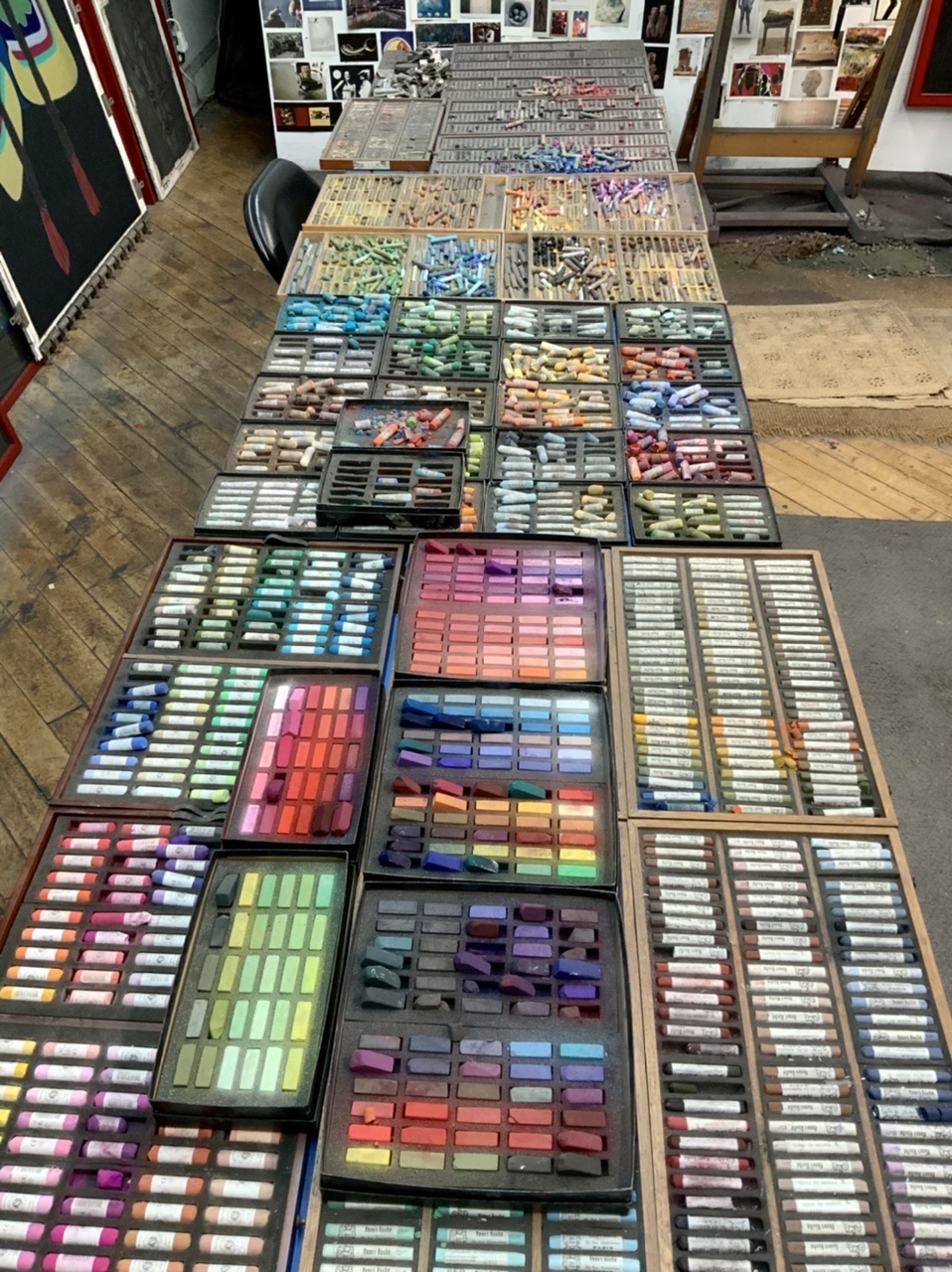
A: For thirty-six years I have worked exclusively in soft pastel on sandpaper. Pastel, which is pigment and a binder to hold it together, is as close to unadulterated color as an artist can get. It allows for very saturated color, especially employing the self-invented techniques I have developed and mastered. I believe my “science of color” is unique, completely unlike how any other artist works. I spend three to four months on each painting, applying pastel and blending the layers together to mix new colors on the paper.
The acid-free sandpaper support allows the buildup of 25 to 30 layers of pastel as I slowly and meticulously work for hundreds of hours to complete a painting. The paper is extremely forgiving. I can change my mind, correct, refine, etc. as much as I want until a painting is the best I can create at that moment in time.
My techniques for using soft pastel achieve rich velvety textures and exceptionally vibrant color. Blending with my fingers, I painstakingly apply dozens of layers of pastel onto the sandpaper. In addition to the thousands of pastels that I have to choose from, I make new colors directly on the paper. Regardless of size, each pastel painting takes three to four months and hundreds of hours to complete.
I have been devoted to soft pastel from the beginning. In my blog and in numerous interviews online and elsewhere, I continue to expound on its merits. For me no other fine art medium comes close.
My subject matter is unique. I am drawn to Mexican, Guatemalan, and Bolivian cultural objects—masks, carved wooden animals, papier mâché figures, and toys. On trips to these countries and elsewhere I frequent local mask shops, markets, and bazaars searching for the figures that will populate my pastel paintings. How, why, when, and where these objects come into my life is an important part of the creative process. Each pastel painting is a highly personal blend of reality, fantasy, and autobiography.
Comments are welcome!
Q: What art project(s) are you working on currently? What is your inspiration or motivation for this? (Question from artamour)

A: While traveling in Bolivia in 2017, I visited a mask exhibition at the National Museum of Ethnography and Folklore in La Paz. The masks were presented against black walls, spot-lit, and looked eerily like 3D versions of my Black Paintings, the series I was working on at the time. I immediately knew I had stumbled upon a gift. To date I have completed seventeen pastel paintings in the Bolivianos series. One awaits finishing touches, another is in progress, and I am planning the next two, one large and one small pastel painting.
The following text is from my “Bolivianos” artist’s statement.
“My long-standing fascination with traditional masks took a leap forward in the spring of 2017 when I visited the National Museum of Ethnography and Folklore in La Paz, Bolivia. One particular exhibition on view, with more than fifty festival masks, was completely spell-binding.
The masks were old and had been crafted in Oruro, a former tin-mining center about 140 miles south of La Paz on the cold Altiplano (elevation 12,000’). Depicting important figures from Bolivian folklore traditions, the masks were created for use in Carnival celebrations that happen each year in late February or early March.
Carnival in Oruro revolves around three great dances. The dance of “The Incas” records the conquest and death of Atahualpa, the Inca emperor when the Spanish arrived in 1532. “The Morenada” dance was once assumed to represent black slaves who worked in the mines, but the truth is more complicated (and uncertain) since only mitayo Indians were permitted to do this work. The dance of “The Diablada” depicts Saint Michael fighting against Lucifer and the seven deadly sins. The latter were originally disguised in seven different masks derived from medieval Christian symbols and mostly devoid of pre-Columbian elements (except for totemic animals that became attached to Christianity after the Conquest). Typically, in these dances the cock represents Pride, the dog Envy, the pig Greed, the female devil Lust, etc.
The exhibition in La Paz was stunning and dramatic. Each mask was meticulously installed against a dark black wall and strategically spotlighted so that it became alive. The whole effect was uncanny. The masks looked like 3D versions of my “Black Paintings,” a pastel paintings series I have been creating for ten years. This experience was a gift… I could hardly believe my good fortune!
Knowing I was looking at the birth of a new series – I said as much to my companions as I remained behind while they explored other parts of the museum – I spent considerable time composing photographs. Consequently, I have enough reference material to create new pastel paintings in the studio for several years. The series, entitled “Bolivianos,” is arguably my strongest and most striking work to date.”
Comments are welcome!
Q: Can you briefly explain how the Bolivian Carnival masks you depict in your work are used?

Museum of Ethnography and Folklore, La Paz, Bolivia
A: The masks depict important figures from Bolivian folklore traditions and are used in Carnival celebrations in the town of Oruro. Carnival occurs every year in late February or early March. I had hoped to visit again this year, but political instability in Bolivia made a trip too risky.
Carnival in Oruro revolves around three great dances. The dance of “The Incas” records the conquest and death of Atahualpa, the Inca emperor when the Spanish arrived in 1532. “The Morenada” music and dance style from the Bolivian Andes was possibly inspired by the suffering of African slaves brought to work in the silver mines of Potosi. The dance of “The Diablada” depicts Saint Michael fighting against Lucifer and the seven deadly sins. Lucifer was disguised in seven different masks derived from medieval Christian symbols aor totemic animals that became nd mostly devoid of pre-Columbian elements (except that became attached to Christianity after the Conquest). Typically, in these dances the cock represents Pride, the dog Envy, the pig Greed, the female devil Lust, etc.
Comments are welcome!
Q: Can you talk a little bit about your process? What happens before you even begin a pastel painting?

Barbara in Bali (far right)
A: My process is extremely slow and labor-intensive.
First, there is foreign travel – often to Mexico, Guatemala or someplace in Asia – to find the cultural objects – masks, carved wooden animals, paper mâché figures, and toys – that are my subject matter. I search the local markets, bazaars, and mask shops for these folk art objects. I look for things that are old, that look like they have a history, and were probably used in religious festivals of some kind. Typically, they are colorful, one-of-a- kind objects that have lots of inherent personality. How they enter my life and how I get them back to my New York studio is an important part of my art-making practice.
My working methods have changed dramatically over the nearly thirty years that I have been an artist. My current process is a much simplified version of how I used to work. As I pared down my imagery in the current series, “Black Paintings,” my creative process quite naturally pared down, too.
One constant is that I have always worked in series with each pastel painting leading quite naturally to the next. Another is that I always set up a scene, plan exactly how to light and photograph it, and work with a 20″ x 24″ photograph as the primary reference material.
In the setups I look for eye-catching compositions and interesting colors, patterns, and shadows. Sometimes I make up a story about the interaction that is occurring between the “actors,” as I call them.
In the “Domestic Threats” series I photographed the scene with a 4″ x 5″ Toyo Omega view camera. In my “Gods and Monsters” series I shot rolls of 220 film using a Mamiya 6. I still like to use an old analog camera for fine art work, although I have been rethinking this practice.
Nowadays the first step is to decide which photo I want to make into a painting (currently I have a backlog of photographs to choose from) and to order a 19 1/2″ x 19 1/2″ image (my Mamiya 6 shoots square images) printed on 20″ x 24″ paper. They recently closed, but I used to have the prints made at Manhattan Photo on West 20th Street in New York. Now I go to Duggal. Typically I have in mind the next two or three paintings that I want to create.
Once I have the reference photograph in hand, I make a preliminary tonal charcoal sketch on a piece of white drawing paper. The sketch helps me think about how to proceed and points out potential problem areas ahead.
Only then am I ready to start actually making the painting.
Comments are welcome!
Q: Can you speak about what draws you to the Mexican and Guatemalan figures that you collect?
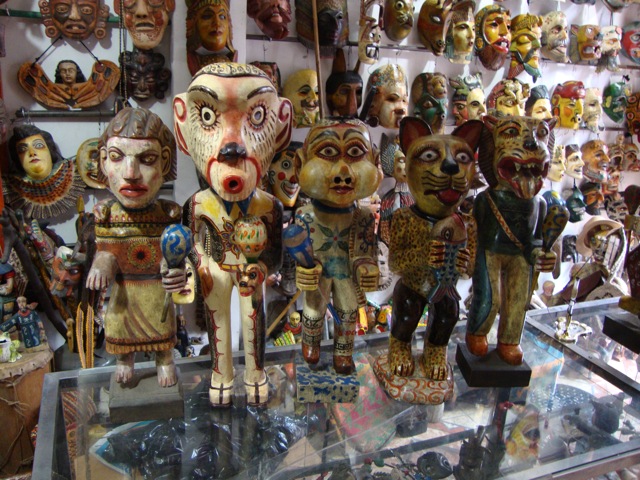
Shop in Panajachel, Guatemala, Photo: Donna Tang
A: I search the markets and bazaars of Mexico, Guatemala, and elsewhere for folk art objects – masks, carved wooden animals, papier mache figures, children’s toys – to bring back to New York to paint and photograph. Color is very important – the brighter and the more eye-catching the patterns are on these objects the better – plus they must be unique and have lots of personality. I try not to buy anything mass-produced or obviously made for the tourist trade. The objects must have been used or otherwise look like they’ve had a life (i.e., been part of religious festivities) to draw my attention. How and where each one comes into my possession is an important part of my creative process.
Finding, buying, and getting them back to the U.S. is always circuitous, but that, too, is part of the process, an adventure, and often a good story. Here’s an example. In 2009 I was in a small town on the shores of Lake Atitlan in Guatemala, called Panajachel. After returning from a boat ride across the lake, my friends and I were walking back to our hotel when we discovered a wonderful mask store. I spent some time looking around, made my selections, and was ready to buy five exquisitely-made standing wooden figures, when I learned that Tomas, the store owner, did not accept credit cards. I was heart-broken and thought, “Oh, no, I’ll have to leave them behind.” However, thanks to my good friend, Donna, whose Spanish is much more fluent than mine, the three of us brain-stormed until finally, Tomas had an idea. I could pay for the figures at the hotel up the block and in a few days when the hotel was paid by the credit card company, the hotel would pay Tomas. Fabulous! Tomas, Donna, and I walked to the hotel, where the transaction was made and the first hurdle was overcome. Working out the packing and shipping arrangements took another hour or two, but during that time Tomas and I became friends and exchanged telephone numbers (the store didn’t even have a telephone so he gave me the phone number of the post office next door, saying that when I called, he could easily run next door!). Most surprisingly, the package was waiting for me in New York when I returned home from Guatemala.
Comments are welcome!


 barbararachkoscoloreddust.com