Blog Archives
Q: Can you discuss your process, including how you actually use Mexican and Guatemalan folk art figures in your art?

A corner of Barbara’s studio
A: When I set up the figures to photograph for a painting, I work very intuitively, so how I actually cast them in an artwork is difficult to say. Looks count a lot – I select an object and put it in a particular place, look at it, move it or let it stay, and sometimes develop a storyline. I spend time arranging lights and looking for interesting cast shadows. With my first “Domestic Threats” series, all of this was done so that Bryan, my late husband, or I could shoot a couple of negatives with his Toyo Omega 4″ x 5″ view camera. For my “Black Paintings” series, begun in 2007, I shoot medium format negatives with a Mamiya 6 camera.
I always look at a 20″ x 24″ photograph for reference as I make a pastel-on-sandpaper painting, plus I also work from the ‘live’ objects. The photograph is mainly a catalyst because finished paintings are always quite different from their associated reference photos. Also, since I spend months creating them, the paintings’ interpretative development goes way beyond that of the photo.
I once completed 6 large (58” x 38”) pastel paintings in a single year, but more recently 4 or 5 per year is common. It takes approximately 3 months to make each one. During that time I layer and blend together as many as 25 to 30 layers of pastel. Of course, the colors get more intense as the painting progresses and the pigment accumulates on the sandpaper.
Comments are welcome!
Q: What have you learned about the people of Mexico through your travels, reading, and research?
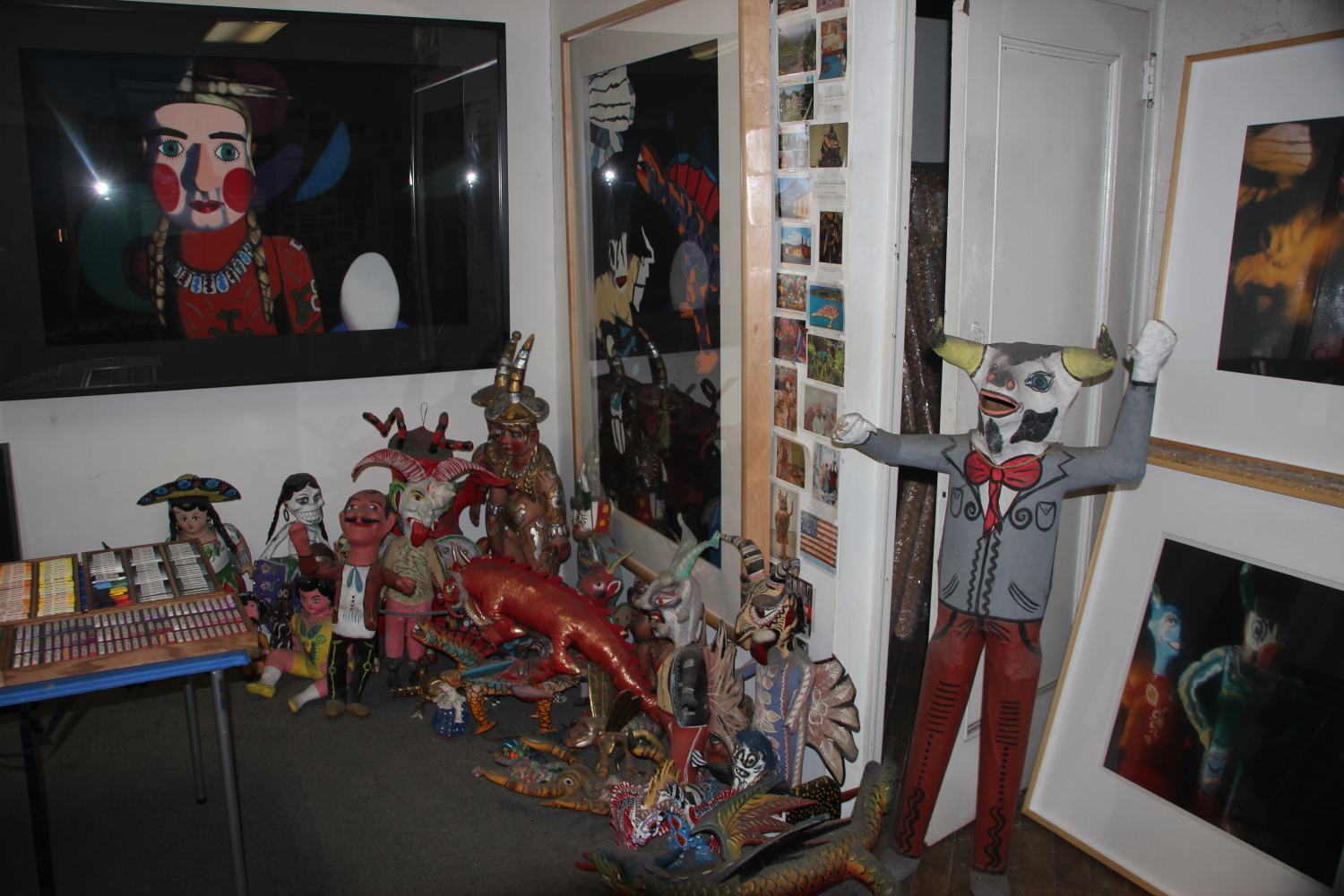
A corner of the studio
A: It didn’t take long to become smitten with these beautiful people. It happened on my first trip there in 1992 when Bryan and I, along with busloads of other tourists, were visiting the Oaxacan cemeteries on The Day of the Dead. The Oaxaquenos tending their ancestor’s graves were so dignified and so gracious, even with so many mostly-American tourists tromping around on a sacred night, that I couldn’t help being taken with them and with their beliefs. My studies since that time have given me a deeper appreciation for the art, architecture, history, mythology, etc. that comprise the extremely rich and complex story of Mexico as a cradle of civilization in the West. It is a wonderfully heady mix and hopefully some of it comes through in my work as a painter and a photographer.
By the way I often wonder why the narrative of Mexico’s fascinating history was not taught in American public schools, at least not where I went to public school in suburban New Jersey. Mexico is our neighbor, for goodness sake, but when I speak to many Americans about Mexico they have never learned anything about the place! It’s shocking, but many people think only “Spring Break” and/or “Drug Wars,” when they hear the word “Mexico.” As a kid I remember learning about Egypt, Mesopotamia, Greece, and other early civilizations in the Middle East, Europe, and Asia, but very little about Mexico. We learned about the Maya, when it was still believed that they were a peaceful people who devoted their lives to scientific and religious pursuits, but that story was debunked years ago. And I am fairly sure that not many Americans even know that Maya still exist in the world … in Mexico and in Guatemala. There are a few remote places that were not completely destroyed by Spanish Conquistadores in the 16th century and later. I’ve been to Mayan villages in Guatemala and seen shamans performing ancient rituals. For an artist from a place as rooted in the present moment as New York, it’s an astounding thing to witness!
Comments are welcome!
Q: How do you select a photograph to use as reference material to make a pastel painting?
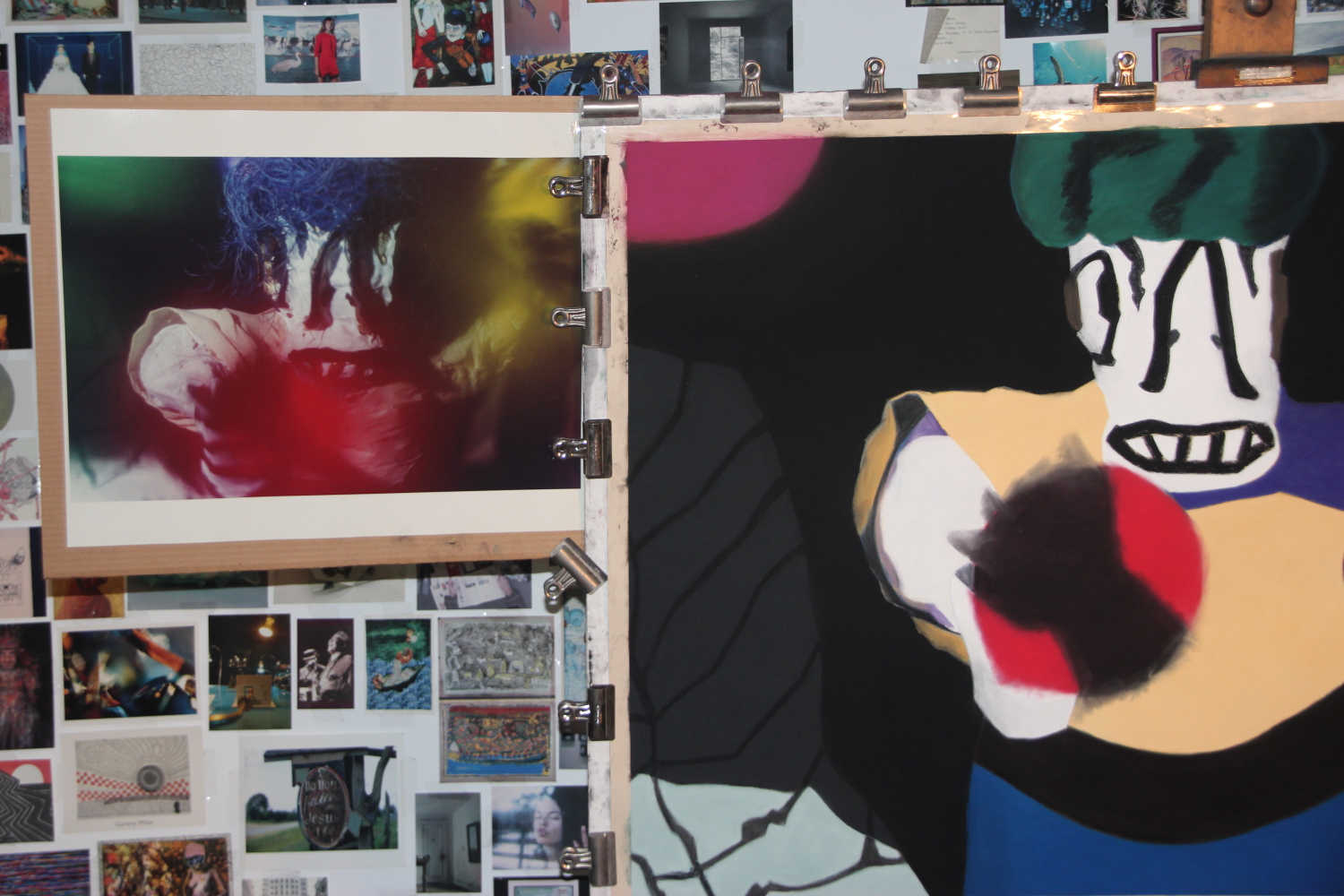
Photograph, left, and work in progress
A: Like everything else associated with my studio practice, my use of photographs from which to work has changed considerably. Beginning in the early 1990s all of the paintings in my first series, “Domestic Threats,” started out as elaborately staged, well-lit scenes that either my husband, Bryan, or I photographed with Bryan’s Toyo Omega 4 x 5 view camera using a wide-angle lens. Depending on where I was living at the time, I set up the scenes in one of three places: our house in Alexandria, VA, a six-floor walkup apartment on West 13th Street in New York, or my current Bank Street condominium. Then one of us shot two pieces of 4 x 5 film at different exposures and I’d usually select the more detailed one to be made into a 20″ x 24″ photo to use as a reference.
Just as the imagery in my paintings has simplified and emptied out over the years, my creative process has simplified, too. I often wonder if this is a natural progression that happens as an artist gets older. More recently I have been shooting photos independently of how exactly I will use them in my work. Only later do I decide which ones to make into paintings; sometimes it’s YEARS later. For example, the pastel painting that is on my easel now is based on a relatively old (2002) photograph that I have always liked, but only now felt ready to tackle in pastel.
Comments are welcome!
Pearls from artists* # 64

High Line, New York, NY
* an ongoing series of quotations – mostly from artists, to artists – that offers wisdom, inspiration, and advice for the sometimes lonely road we are on.
As soon as an artist has located the vital center of his activities, nothing will be more important than for him to remain within this center and never move further away from it (which is, of course, also the center of his nature, of his world) than the interior walls of his quietly and steadily expanding achievement. His place is not, never, not even for a moment, next to the beholder and critic (at least no longer in an environment where all that is visible becomes ambiguous and preliminary, an auxiliary construction and temporary scaffolding for something else). And one basically needs to be an acrobat to leap back safely and unharmed from this point of view into one’s inner center (the distances are too great and all the spots too destabilized to risk such an entirely inquisitive feat). Most artists today use up their strength in this back-and-forth, and in addition to wasting their energy they get terribly confused and lose a part of their essential innocence to the sin of having taken their work from the outside by surprise, to have tasted it, to have joined others in enjoying it!
Ulrich Baer, editor, The Wisdom of Rilke
Comments are welcome!
Pearls from artists* # 63

Untitled, chromogenic print, 24″ x 24,” edition of 5
* an ongoing series of quotations – mostly from artists, to artists – that offers wisdom, inspiration, and advice for the sometimes lonely road we are on.
The artist’s job is to get in touch with the dark places of the soul and then shed light there. Sharing the process with others is the point. Within the context of our post-Cold War, post-9/11 climate, shedding light in newly fecund dark places is a valuable activity. The dark places of the soul that haunt our dreams are understandably matched by a tendency to shut out the issues with the busy work of the daylight hours. But without looking into those dark places, as Carl Jung suggested, we will lose touch with our essential humanity.
Anne Bogart, and then, you act: making art in an unpredictable world
Comments are welcome!
Pearls from artists* # 62
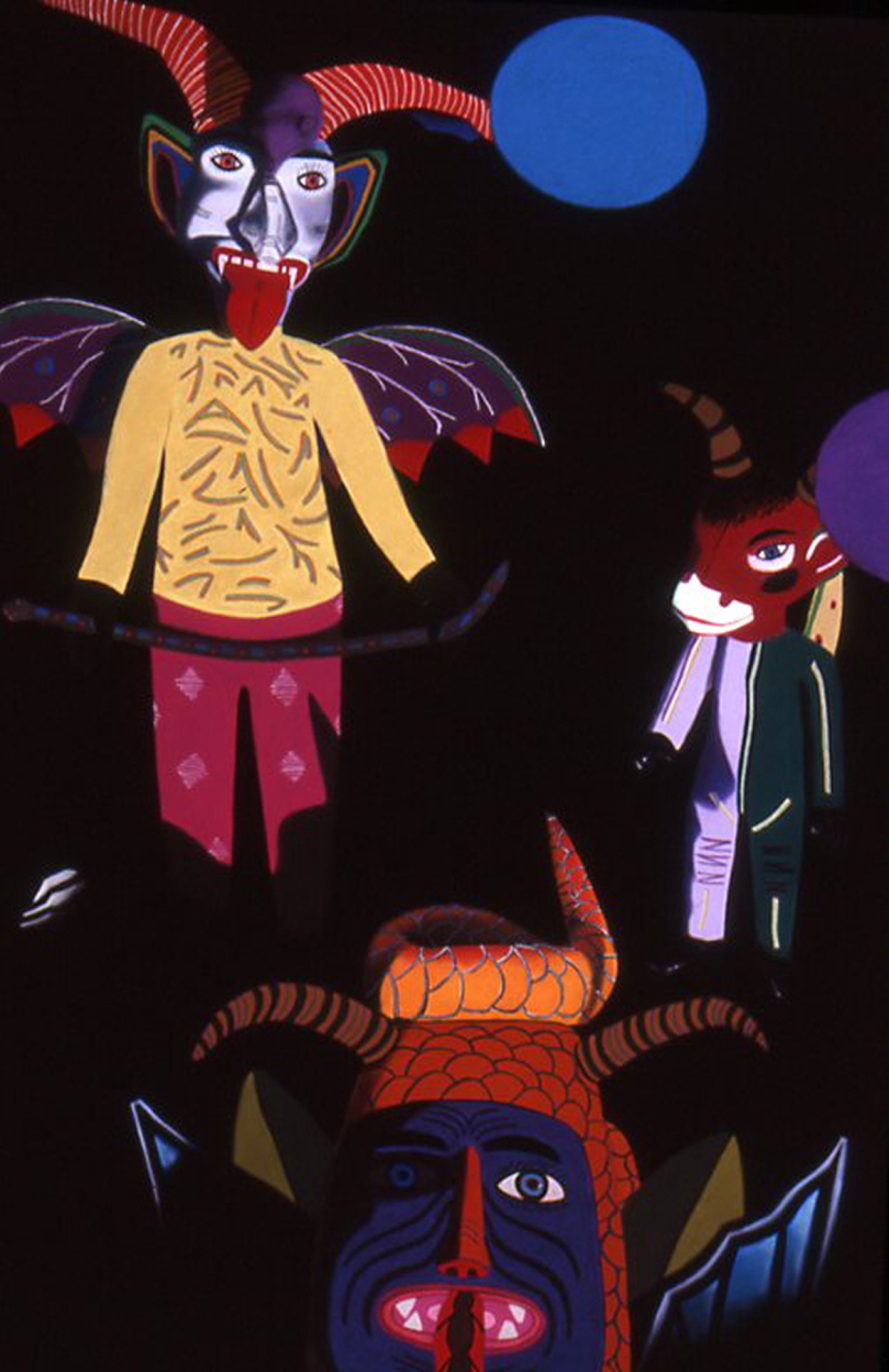
“The Sovereign,” soft pastel on sandpaper, 58″ x 38″
* an ongoing series of quotations – mostly from artists, to artists – that offers wisdom, inspiration, and advice for the sometimes lonely road we are on.
Yes, I’m formalistically obsessed. I see in a picture what I see in nature – everything has its place and is integrated. Like a tree or a human body, the image is put together for a greater whole. If you chop off something, you immediately destroy the organism. Form is crucial to what I do, and I believe that the form, in a way, creates the content. If you don’t have the form, you don’t get the content. If you get the maximum formal relationships in a precise, organic, metaphoric methodology, then you have a better chance of bringing out the content to its full degree. Of course, a picture doesn’t stand alone by its form. You can have forms that relate but offer no meaning. Ultimately, a picture is judged by its meaning, and I think that’s what a lot of people lose sight of.
Interview with Roger Ballen in Lines, Marks, and Drawings: Through the Lens of Roger Ballen, Craig Allen Subler and Christine Mullen Kreamer
Comments are welcome!
Pearls from artists* # 48

“Big Deal,” with double portrait of the author
* an ongoing series of quotations – mostly from artists, to artists – that offers wisdom, inspiration, and advice for the sometimes lonely road we are on.
Until the invention of photography, the painted (or sculptural) portrait was the only means of recording and presenting the likeness of a person. Photography took over this role from painting and at the same time raised our standards for judging how much an informative likeness should include.
This is not to say that photographs are in all ways superior to painted portraits. They are more informative, more psychologically revealing, and in general more accurate. But they are less tensely unified. Unity in a work of art is achieved as a result of the limitations of the medium. Every element has to be transformed in order to have its proper place within these limitations. In photography the transformation is to a considerable extent mechanical. In a painting each transformation is largely the result of a conscious decision by the artist. Thus the unity of a painting is permeated by a far higher degree of intention. The total effect of a painting (as distinct from its truthfulness) is less arbitrary than that of a photograph; its construction is more intensely socialized because it is dependent on a greater number of human decisions. A photographic portrait may be more revealing and accurate about the likeness and character of the sitter; but it is likely to be less persuasive, less (in the very strict sense of the word) conclusive. For example, if the portraitist’s intention is to flatter or idealize, he will be able to do so far more convincingly in a painting than with a photograph.
Geoff Dyer, editor, Selected Essays: John Berger
Comments are welcome!
Q: How do you decide on the titles for your pastel paintings?

“Stigmata,” soft pastel on sandpaper, 28″ x 48″
A: Usually a title suggests itself over the course of the months I spend on a painting. Sometimes it comes from a book I’m reading, from a piece of music, a film, bits of overheard conversation. A title can come from anywhere, but finding the best one is key. I like what Jean Cocteau says about this:
One title alone exists. It will be, so it is. Time conceals it from me. How discover it, concealed by a hundred others? I have to avoid the this, the that. Avoid the image. Avoid the descriptive and the undescriptive. Avoid the exact meaning and the inexact. The soft, the hard. Neither long nor short. Right to catch the eye, the ear, the mind. Simple to read and to remember. I had announced several. I had to repeat them twice and the journalists still got them wrong. My real title defies me. It enjoys its hiding place, like a child one keeps calling, and whom one believes drowned in the pond.
Once I have the best title, I make sure it fits the painting exactly. How I do that is difficult to explain. It’s an intuitive process that involves adjusting colors, shapes, and images so that they fit the painting’s meaning, i.e., the meaning hinted at by the title.
Comments are welcome!
Pearls from artists* # 41
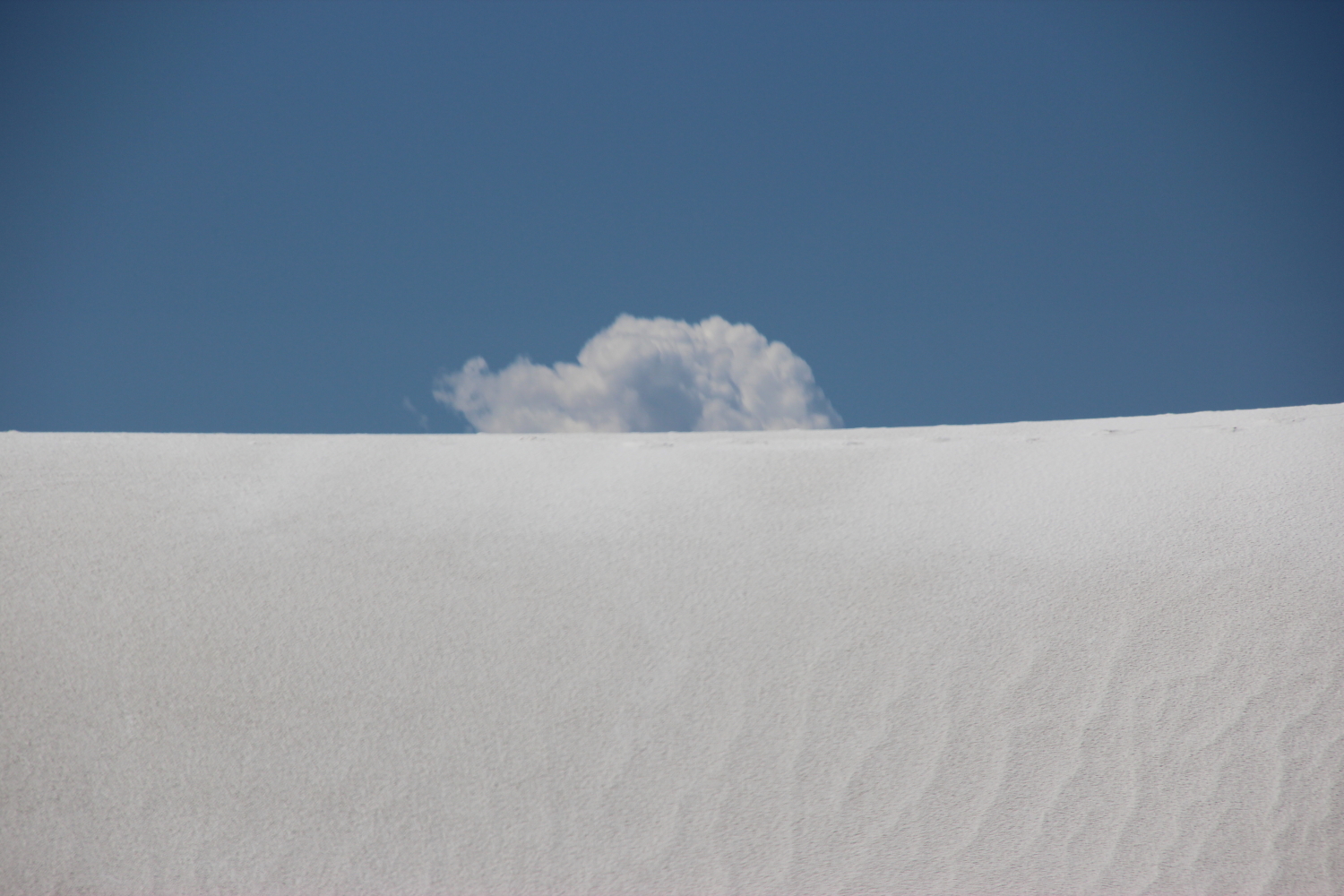
White Sands, NM
* an ongoing series of quotations – mostly from artists, to artists – that offers wisdom, inspiration, and advice for the sometimes lonely road we are on.
If you look at the work of an artist over a lifetime there is always transformation. Some hit a lively place early and then seem to lose it later. Others find that place progressively throughout their life; others still, find it late. But regardless, they are all learning to isolate the poetic place within them. That focus on the poetic in our own work increases our appreciation of the beauty around us, increases our growth, and increases our divine connection.
One thing you see in many artists’ work is that as they continue over the decades to translate their experience of the poetic into form, they learn to communicate better. They strip away all the extraneous stuff and artistic baggage they had. They say more with less.
The problem is seldom that what we truly, deeply experience is too simple to simplify. There is power in stripping everyhing away to reveal the vision. That’s what takes a lifetime.
Ian Roberts in Creative Authenticity: 16 Principles to Clarify and Deepen Your Artistic Vision
Comments are welcome!
Pearls from artists* # 21
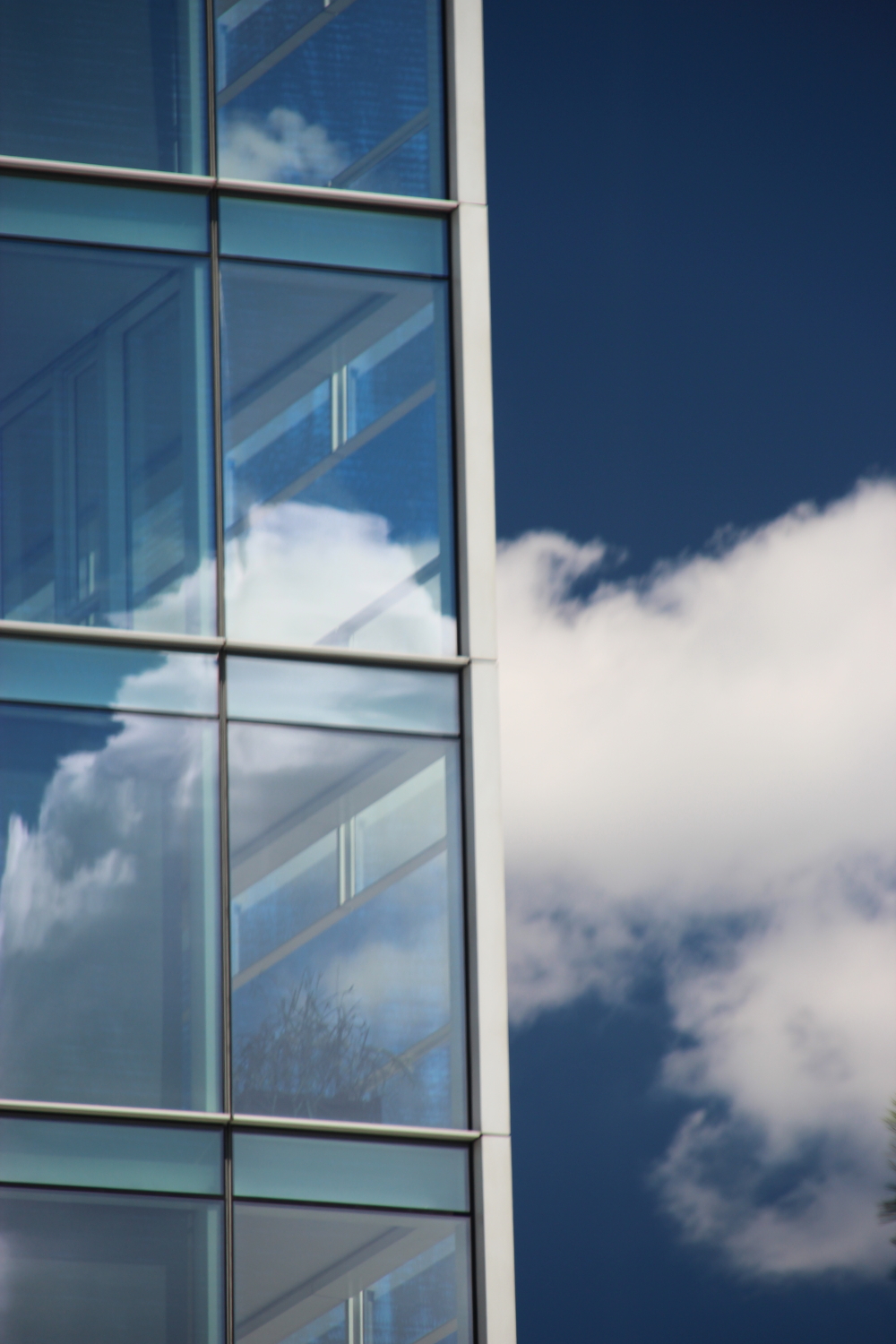
Apartment building, New York City
* an ongoing series of quotations – mostly from artists, to artists – that offers wisdom, inspiration, and advice for the sometimes lonely road we are on.
It is the beginning of a work that the writer throws away.
A painting covers its tracks. Painters work from the ground up. The latest version of a painting overlays earlier versions, and obliterates them. Writers, on the other hand, work from left to right. The discardable chapters are on the left. The latest version of a literary work begins somewhere in the work’s middle, and hardens toward the end. The earlier version remains lumpishly on the left; the work’s beginning greets the reader with the wrong hand. In those early pages and chapters anyone may find bold leaps to nowhere, read the brave beginnings of dropped themes, hear a tone since abandoned, discover blind alleys, track red herrings, and laboriously learn a setting now false.
Several delusions weaken the writer’s resolve to throw away work. If he has read his pages too often, those pages will have a necessary quality, the ring of the inevitable, like poetry known by heart; they will perfectly answer their own familiar rhythms. He will retain them. He may retain those pages if they possess some virtues, such as power in themselves, though they lack the cardinal virtue, which is pertinence to, and unity with, the book’s thrust. Sometimes the writer leaves his early chapters in place from gratitude; he cannot contemplate them or read them without feeling again the blessed relief that exalted him when the words first appeared – relief that he was writing anything at all. That beginning served to get him where he was going, after all; surely the reader needs it, too, as groundwork. But no.
Every year the aspiring photographer brought a stack of his best prints to an old, honored photographer, seeking his judgment. Every year the old man studied the prints and painstakingly ordered them into two piles, bad and good. Every year the old man moved a certain landscape print into the bad stack. At length he turned to the young man: “You submit this same landscape every year, and every year I put it in the bad stack. Why do you like it so much?” The young photographer said, “Because I had to climb a mountain to get it.”
Annie Dillard, The Writing Life
Comments are welcome!


 barbararachkoscoloreddust.com