Blog Archives
Q: Why do people need art in their daily lives?
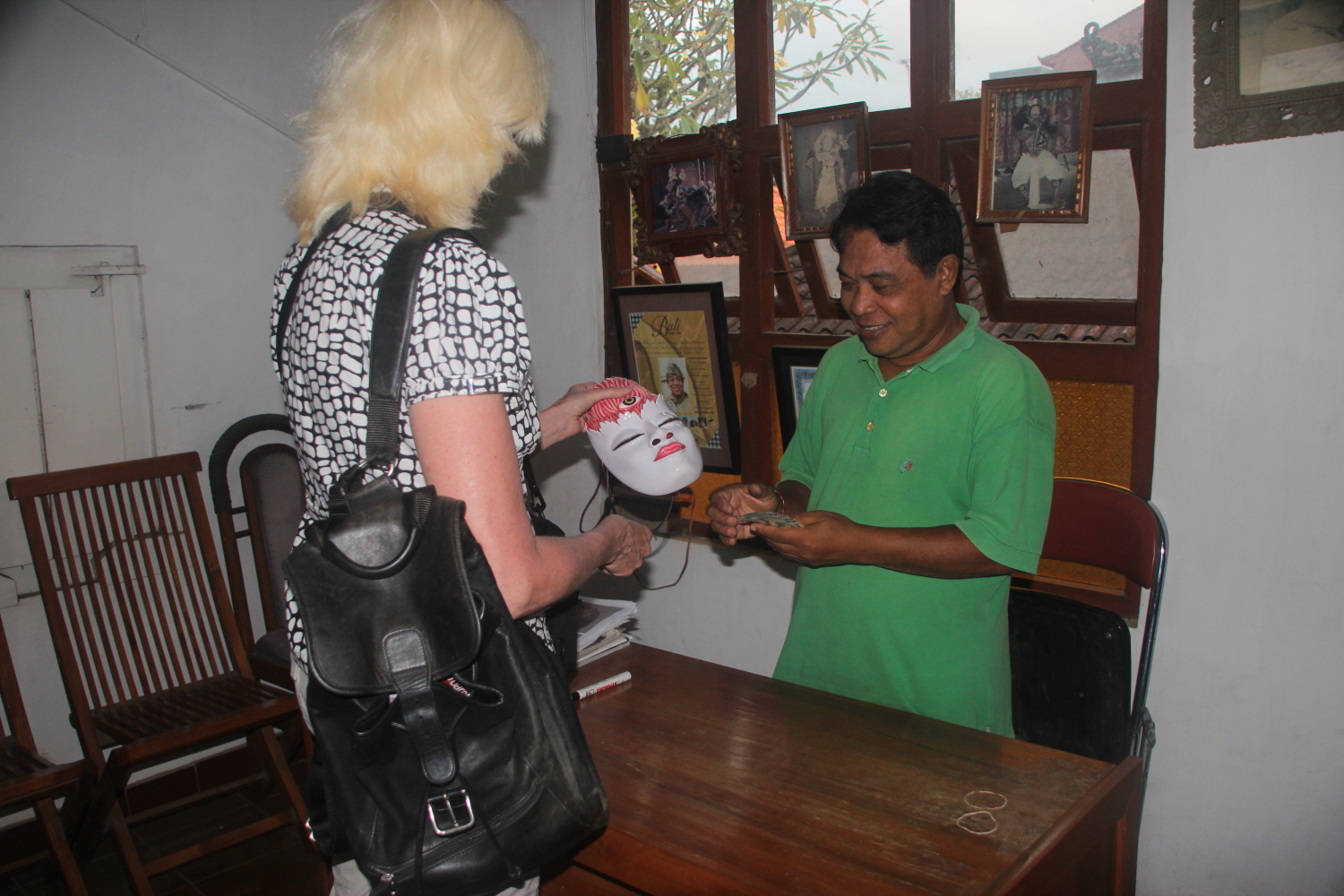
With Ida Bagus Anom, Mas, Bali; Photo: Donna Tang
A: That is for each person to decide, but as someone who devotes every waking moment to my work and to becoming a better artist, I cannot imagine my life without art.
I will tell you a little about what art has done for me. In my younger days boredom was a strong motivator. I left the active duty Navy out of boredom. I couldn’t bear not being intellectually challenged (most of my jobs consisted of paper-pushing), not using my flying skills (at 27 I was a licensed commercial pilot and Boeing-727 flight engineer), and not developing my artistic talents. In what surely must be a first, the Navy turned me into a hard-working and disciplined artist. And once I left the Navy there was no plan B. There was no time to waste. It was “full speed ahead.”
Art is a calling. You do not need to be told this if you are among those who are called. It’s all about “the work,” that all-consuming focus of an artist’s life. If a particular activity doesn’t seem likely to make me a better artist, I tend to avoid it. I work hard to nourish and protect my gifts. As artists we invent our own tasks, learn whatever we need in order to progress, and complete projects in our own time. It is life lived at its freest.
My art-making has led me to fascinating places: Mexico, Guatemala, Brazil, Argentina, Uruguay, France, England, Italy, Bali, Java, Sri Lanka, and more; and to in-depth studies of intriguing subjects: drawing, color, composition, art and art history, the art business, film and film history, photography, mythology, literature, music, jazz and jazz history, and archaeology, particularly that of ancient Mesoamerica (Olmec, Zapotec, Mixtec, Aztec, Maya, etc.). And this rich mixture continually grows! For anyone wanting to spend their time on earth learning and meeting new challenges, there is no better life!
Comments are welcome!
Q: Where do you want your work to go in the future?
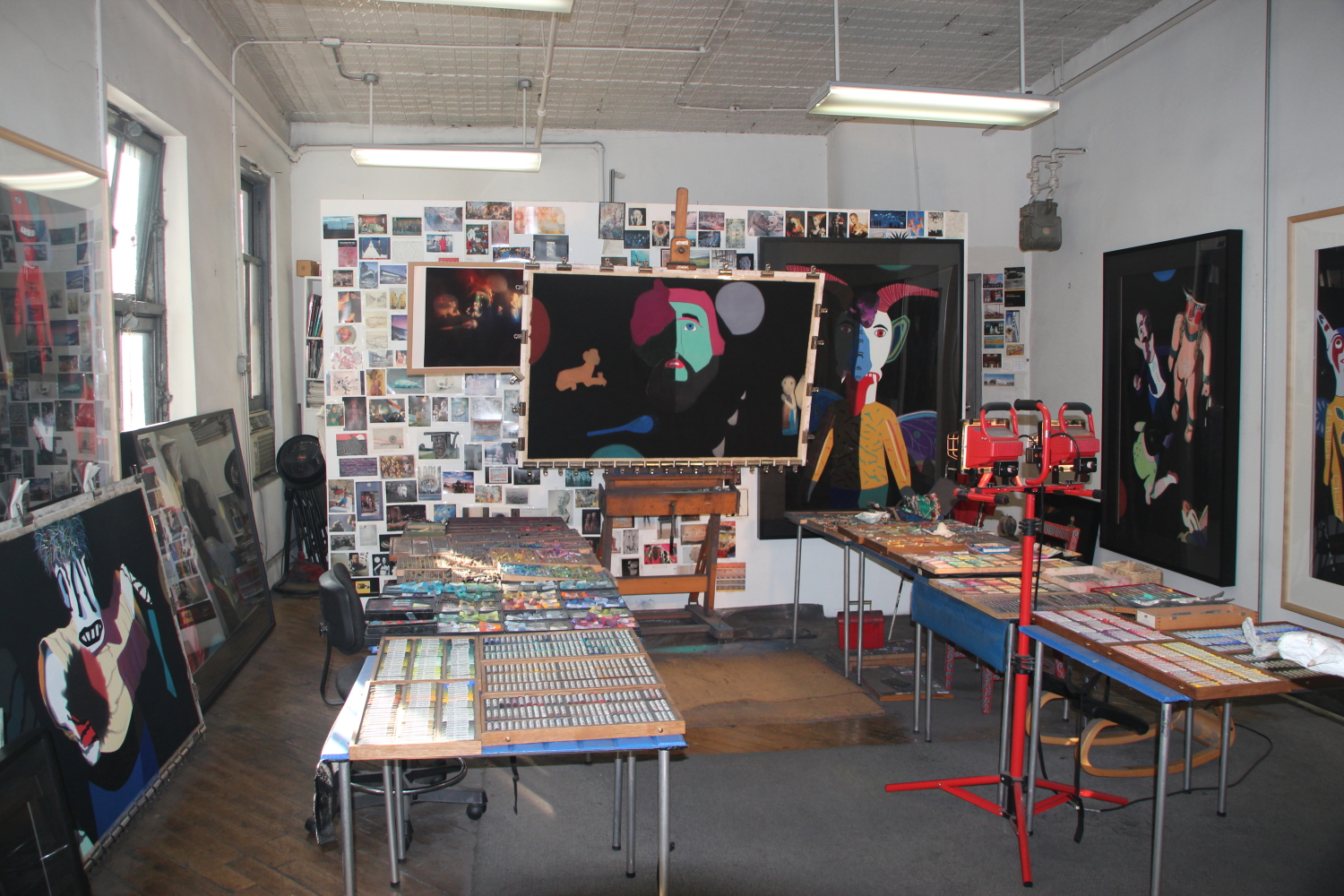
Barbara’s studio
A: Recently I answered a question about why I create, but now that I think about it, the same answer applies to what I want to do as an artist in the future:
~ to create bold and vibrant pastel paintings and photographs that have never existed before
~ to continue to push my primary medium – soft pastel on sandpaper – as far as I can and to use it in more innovative ways
~ to create opportunities for artistic dialogue with people who understand and value the work to which I am devoting my life
The last has always been the toughest. I sometimes think of myself as Sisyphus because expanding the audience for my art is an ongoing uphill battle. Many artist friends tell me they feel the same way about building their audience. It’s one of the most difficult tasks that we have to do as artists. I heard Annie Leibovitz interviewed on the radio once and remember her saying that after 40 years as a photographer, everything just gets richer. Notice that she didn’t say it gets any easier; she said, “it just gets richer.” I have been a painter for nearly 30 years and a photographer for 11. I agree completely. All artists have to go wherever our work goes. Creating art and watching the process evolve is an endlessly fascinating intellectual journey. I wouldn’t want to be spending my time on earth doing anything else!
Comments are welcome!
Q: What have you learned about the people of Mexico through your travels, reading, and research?
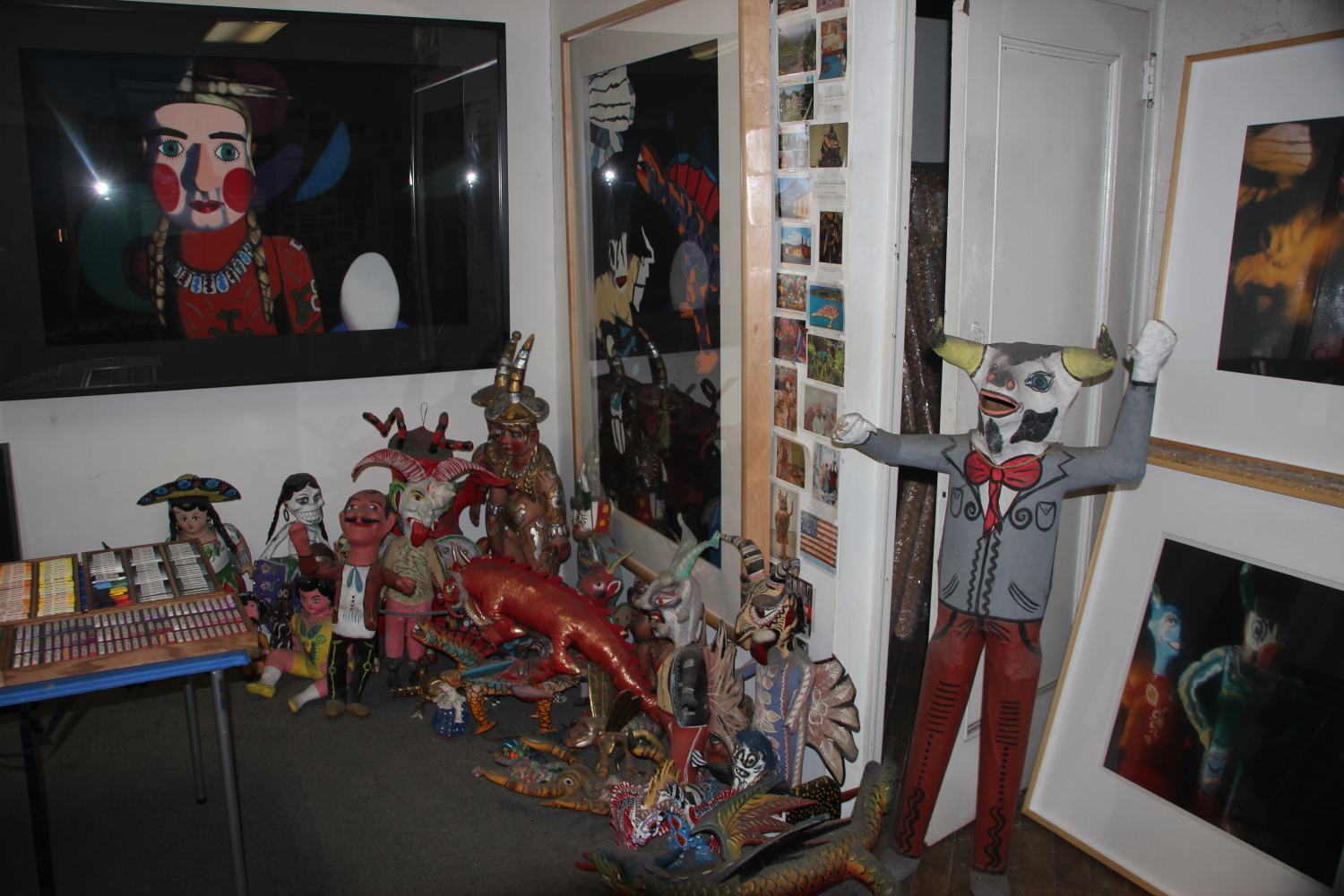
A corner of the studio
A: It didn’t take long to become smitten with these beautiful people. It happened on my first trip there in 1992 when Bryan and I, along with busloads of other tourists, were visiting the Oaxacan cemeteries on The Day of the Dead. The Oaxaquenos tending their ancestor’s graves were so dignified and so gracious, even with so many mostly-American tourists tromping around on a sacred night, that I couldn’t help being taken with them and with their beliefs. My studies since that time have given me a deeper appreciation for the art, architecture, history, mythology, etc. that comprise the extremely rich and complex story of Mexico as a cradle of civilization in the West. It is a wonderfully heady mix and hopefully some of it comes through in my work as a painter and a photographer.
By the way I often wonder why the narrative of Mexico’s fascinating history was not taught in American public schools, at least not where I went to public school in suburban New Jersey. Mexico is our neighbor, for goodness sake, but when I speak to many Americans about Mexico they have never learned anything about the place! It’s shocking, but many people think only “Spring Break” and/or “Drug Wars,” when they hear the word “Mexico.” As a kid I remember learning about Egypt, Mesopotamia, Greece, and other early civilizations in the Middle East, Europe, and Asia, but very little about Mexico. We learned about the Maya, when it was still believed that they were a peaceful people who devoted their lives to scientific and religious pursuits, but that story was debunked years ago. And I am fairly sure that not many Americans even know that Maya still exist in the world … in Mexico and in Guatemala. There are a few remote places that were not completely destroyed by Spanish Conquistadores in the 16th century and later. I’ve been to Mayan villages in Guatemala and seen shamans performing ancient rituals. For an artist from a place as rooted in the present moment as New York, it’s an astounding thing to witness!
Comments are welcome!
Pearls from artists* # 59

Studio
* an ongoing series of quotations – mostly from artists, to artists – that offers wisdom, inspiration, and advice for the sometimes lonely road we are on.
Friends sometimes ask, “Don’t you get lonely sitting by yourself all day?” At first it seemed odd to hear myself say No. Then I realized that I was not alone; I was in the book; I was with the characters. I was with my Self.
Not only do I not feel alone with my characters; they are more vivid and interesting to me than the people in my real life. If you think about it, the case can’t be otherwise. In order for a book (or any project or enterprise) to hold our attention for the length of time it takes to unfold itself, it has to plug into some internal perplexity or passion that is of paramount importance to us. The problem becomes the theme of our work, even if we can’t at the start understand or articulate it. As the characters arise, each embodies infallibly an aspect of that dilemma, that perplexity. These characters might not be interesting to anyone else but they’re absolutely fascinating to us. They are us. Meaner, smarter, sexier versions of ourselves. It’s fun to be with them because they’re wrestling with the same issue that has its hooks into us. They’re our soul mates, our lovers, our best friends. Even the villains. Especially the villains.
Stephen Pressfield in The War of Art
Comments are welcome!
Q: You recently spent several weeks in Sri Lanka. After experiencing so many new sights and sounds, is it difficult to get back to work in your studio?
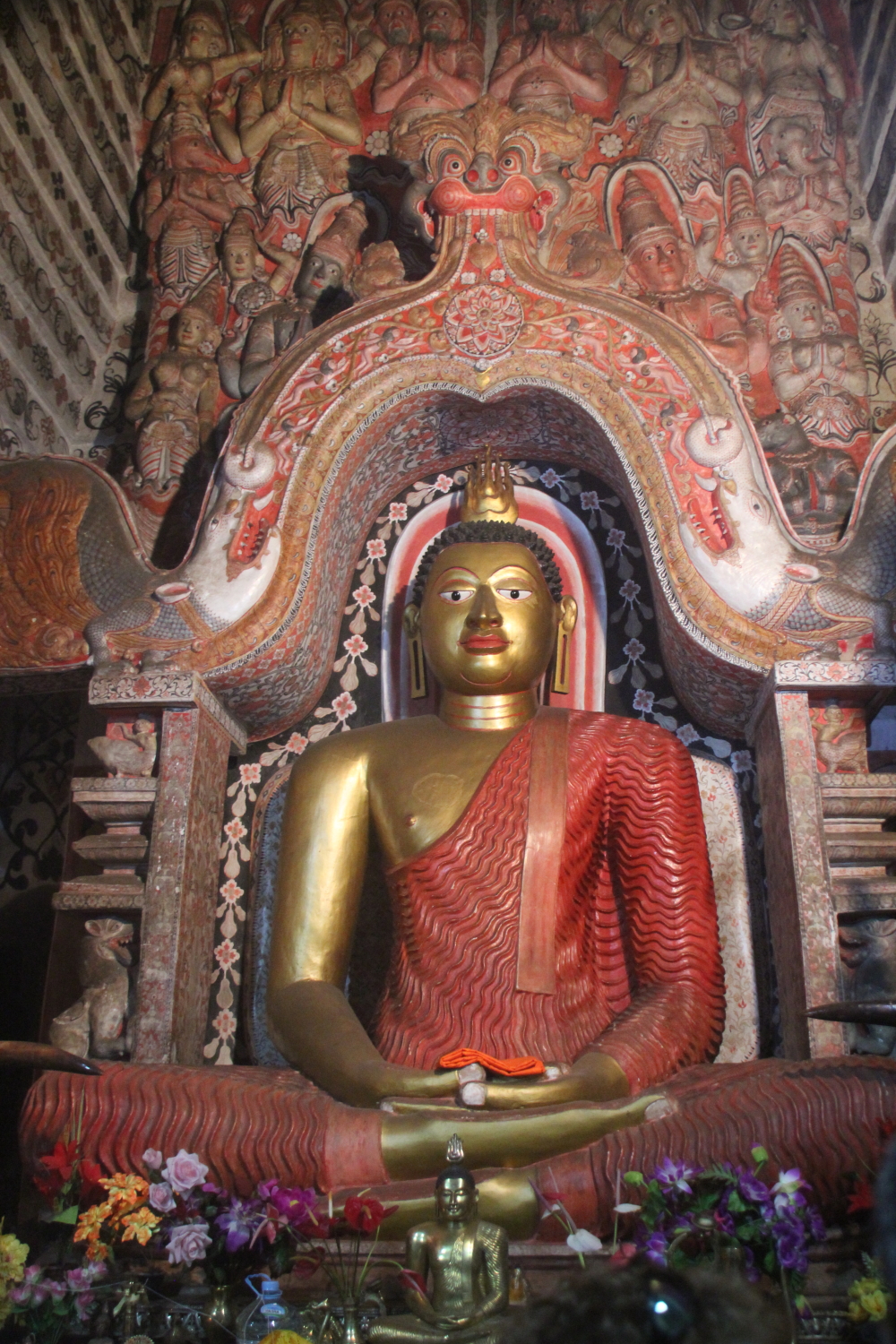
Cave temple at Natha Devale, Sri Lanka
A: It definitely requires some readjustment and a period – maybe a day or two – during which I feel removed from the painting on my easel and need time to become reacquainted with it. It’s a time to refocus, stay put, and reflect. For weeks I’ve led an action-packed life, exploring a fascinating country on the other side of the world. Over time, all of the experiences I’ve had will stay with me, or not, and in some ways begin to influence my work.
It’s funny. I often think of my studio as a cave. It’s a rather dark place and sometimes I have to force myself to go. In Sri Lanka I saw many ancient Buddhist cave temples, wild and vibrant, with colorful paintings on the walls and ceilings, chock full of statues of Buddha and other deities. My travels have given me a new appreciation of the riches to be found in caves of all sorts, including (especially) my own studio!
Comments are welcome!
Q: Have you ever worked outside?

Reproductions of “Cardinal Rule” (top) and “Blue Ego,” originals are soft pastel on sandpaper, 30″ x 38″
A: As a pastel artist I’ve never worked outside – with so many pastels, it’s just not practical – but early on in the “Domestic Threats” series, I created two outdoor setups. Works in the series derived from elaborate scenes that I arranged and then photographed.
I used to take long walks along the Potomac River in Alexandria, VA, and there was a tree stump that was fascinating. It was mostly twisted roots, knotty branches, dark hidden spaces, etc. (top painting in photo). One morning I took several hand puppets and stuffed animals (my subject matter at the time) and carefully arranged them on the tree. Around me people were busy exercising their dogs. Soon I attracted quite a bit of attention – a tall blonde woman playing with puppets on a tree stump! Dogs came over to sniff. Their owners came over, too, and I was pressed into explaining, again and again, that I was an artist, that I was photographing this scene so I could paint it, etc. The interruptions were very annoying.
The second time I tried an outdoor setup was again along the Potomac River, but this time I selected a secluded strip of beach where I was undisturbed. I had forgotten to consider the light and inadvertently chose a cloudy day. I remember being disappointed that the light was flat and lacking shadows. The painting (bottom in photo) turned out to be one of my least favorites.
I resolved from then on to focus on interiors. Alfred Hitchcock famously used rear projection so that he could work in a studio rather than on location. One reason, he said, was that in a studio he had total control. I know what he meant. When I set up an interior scene and position the lights to make interesting shadows, indeed, I have control over the whole look. No aspect is left to chance. The accidents – improvements! – happen later when I work on the painting.
Comments are welcome!
Q: Is there an overarching narrative in your photographs with Mexican and Guatemalan figures?
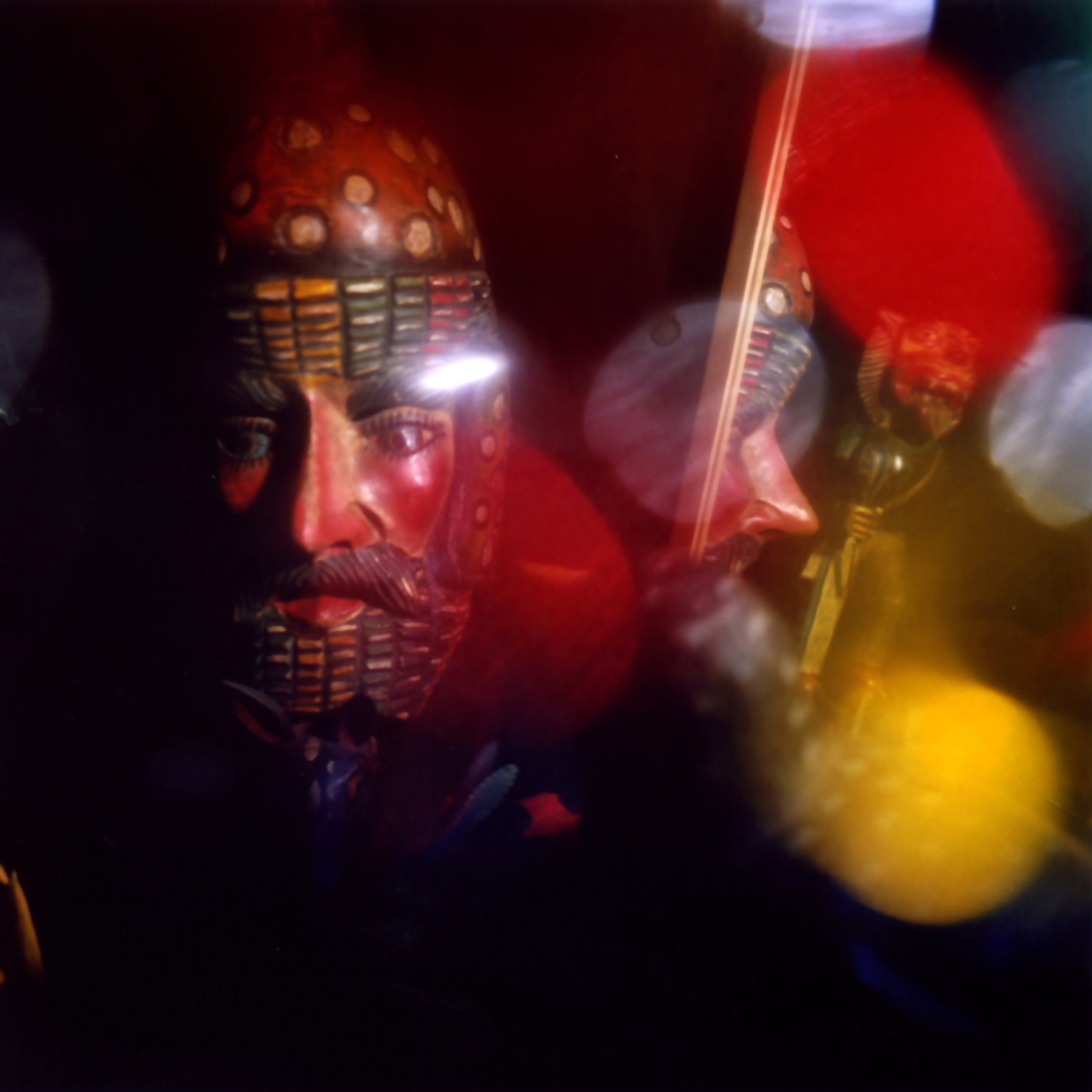
Untitled chromogenic print, 24″ x 24,” edition of 5
A: Maybe, but that’s something for the viewer to judge. I never specify exactly what my work is about for a couple of reasons: my thinking about the meaning of my work constantly evolves, plus I wouldn’t want to cut off other people’s interpretations. Everything is equally valid. I heard Annie Leibovitz interviewed some time ago on the radio. She said that after 40 years as a photographer, everything just gets richer. It doesn’t get easier, it just gets richer. I’ve been a painter for 27 years, a photographer for 11, and I agree completely. Creating this work is an endlessly fascinating intellectual journey. I realize that I am only one voice in a vast art world, but I hope that through the ongoing series of questions and answers on my blog, I am conveying some sense of how artists work and think.
Comments are welcome!
Q: What first intrigued you about Mexico?

“Myth Meets Dream,” 1993, soft pastel on sandpaper, first painting that includes Oaxacan figures
A: In the early 90’s my husband, Bryan, and I made our first trip to Oaxaca and to Mexico City. At the time I had become fascinated with the Mexican “Day of the Dead” celebrations so our trip was timed to see them firsthand. Along with busloads of other tourists, we visited several cemeteries in small Oaxacan towns. The indigenous people tending their ancestor’s graves were so dignified and so gracious, even with so many mostly-American tourists tromping around on a sacred night, that I couldn’t help being taken with these beautiful people and their beliefs. From Oaxaca we traveled to Mexico City, where again I was entranced, but this time by the rich and ancient history. On our first trip we visited the National Museum of Anthropology, where I was introduced to the fascinating story of ancient Meso-American civilizations (it is still one of my favorite museums in the world); the ancient city of Teotihuacan, which the Aztecs discovered as an abandoned city and then occupied as their own; and the Templo Mayor, the historic center of the Aztec empire, infamous as a place of human sacrifice. I was astounded! Why had I never learned in school about Mexico, this highly developed cradle of western civilization in our own hemisphere, when so much time had been devoted to the cultures of Egypt, Greece, and elsewhere? When I returned home to Virginia I began reading everything I could find about ancient Mexican civilizations, including the Olmec, Zapotec, Mixtec, Aztec, and Maya. This first trip to Mexico opened up a whole new world and was to profoundly influence my future work. I would return there many more times.
Comments are welcome!
Q: When you set up your figures to photograph, do you create a story?
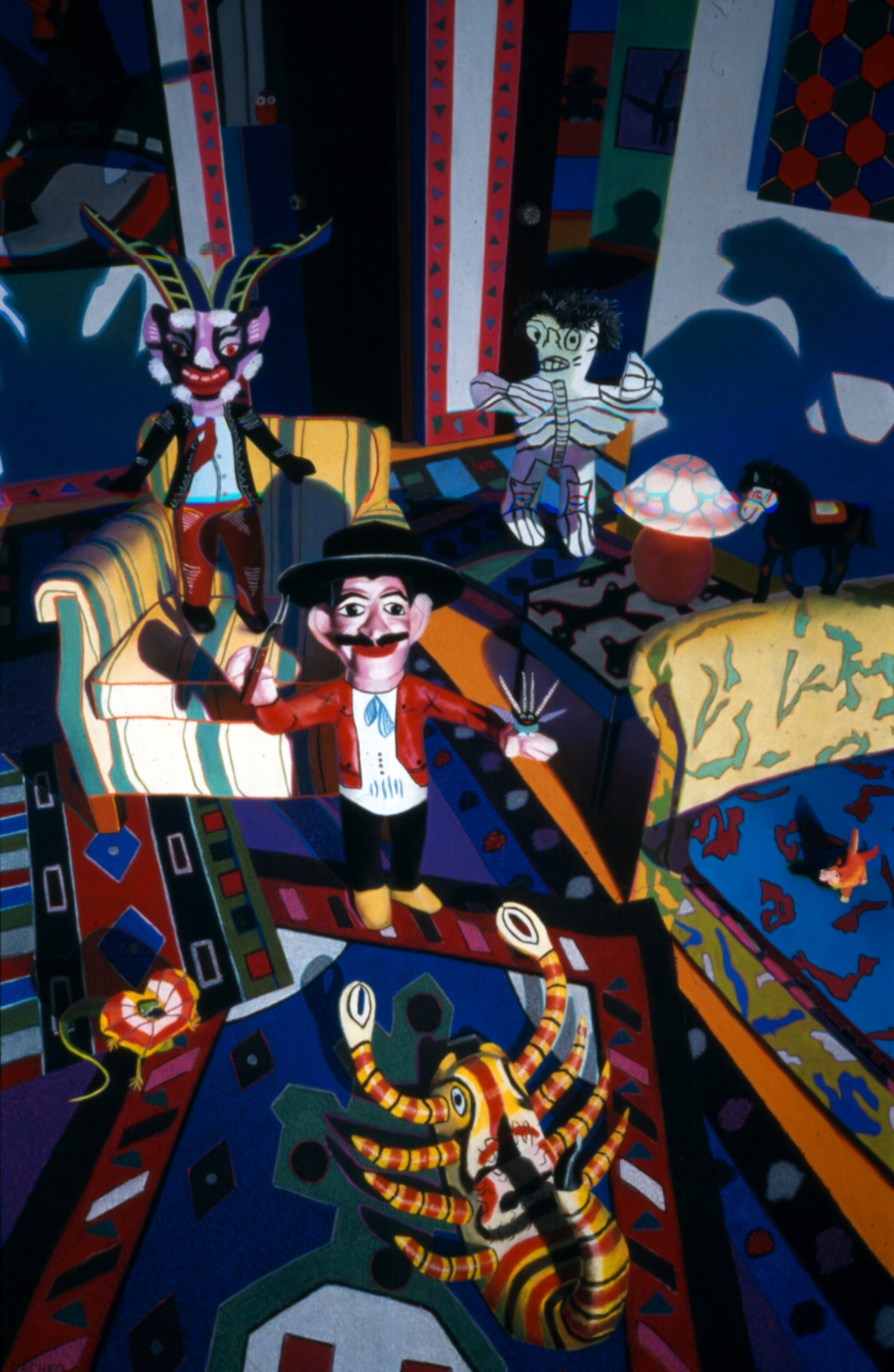
“He Just Stood There Grinning,” soft pastel on sandpaper, ” 58″ x 38″
A: I always did so with my “Domestic Threats” paintings, but not with my current work. As I set up a group of figures to photograph, I would make up a story about what was happening between them: what the Day of the Dead skeleton I bought in Mexico City was saying to the frog/fish/human mask from Guerrero, for example. I was a big kid playing with my favorite toys! The stories were the spark to get me started on a new project, but I usually forgot about them afterwards. They were necessary, yet incidental to my creative process, which is probably why I have never written them down.
Years ago I had the experience of being at one of my solo shows when a group of elementary school children came along with their teacher. The teacher asked them to act out one of the stories in a particular painting. Ever curious about how people relate to my work, I didn’t introduce myself as the creator of the pieces hanging on the walls. I no longer remember the details, but their interpretations soon had me laughing. It is a constant surprise to hear from people encountering my work for the first time what they see in it, especially when those people are young kids with wild imaginations!
Comments are welcome!
Q: I understand that you recently traveled to Bali. What did you see and do there?
A: Bali is such a fascinating place and I have so many great memories! I shot lots of photographs on this trip. Here are a few of my favorites.

A floating Hindu temple
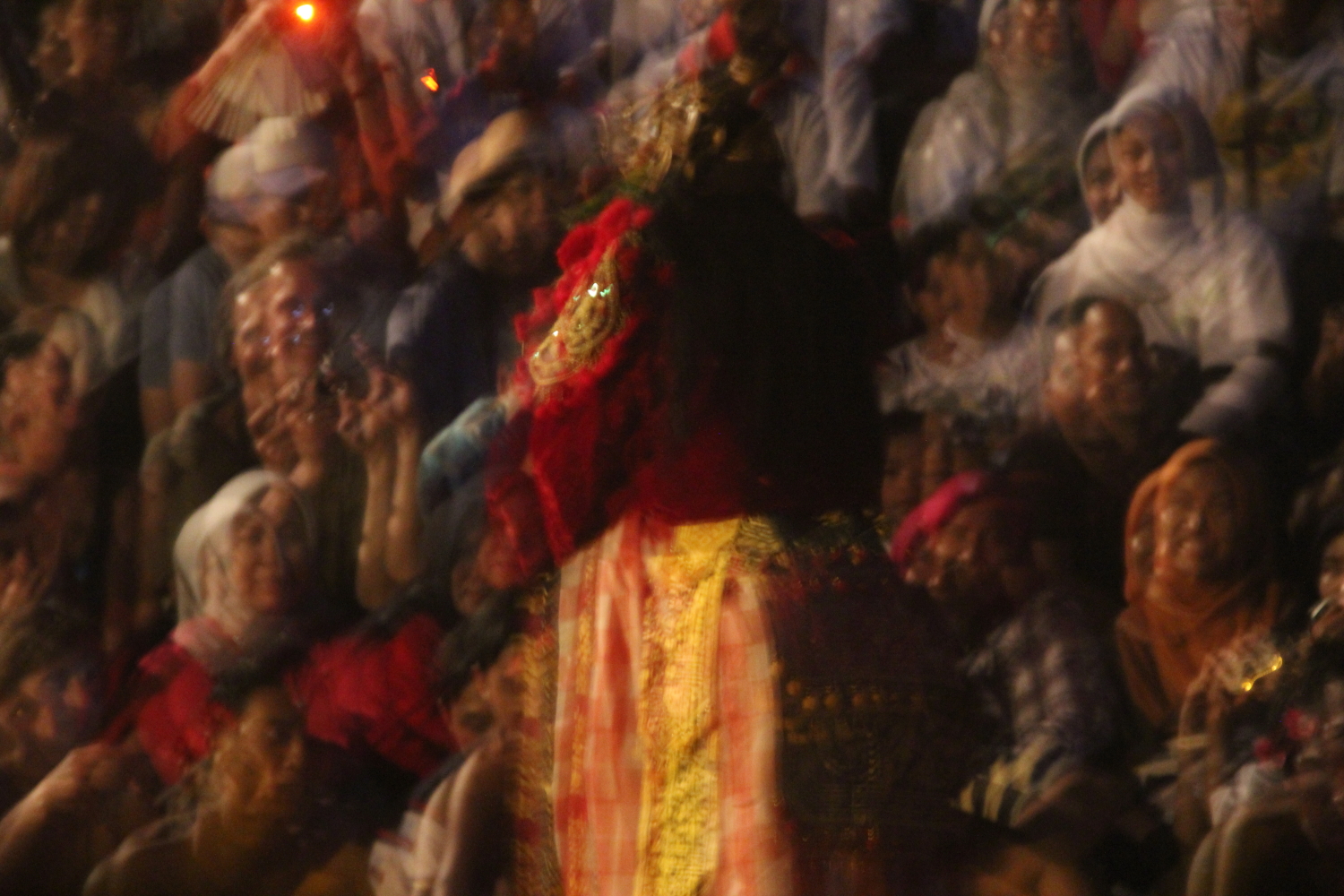
Kecak dance performance under the full moon in Uluwatu
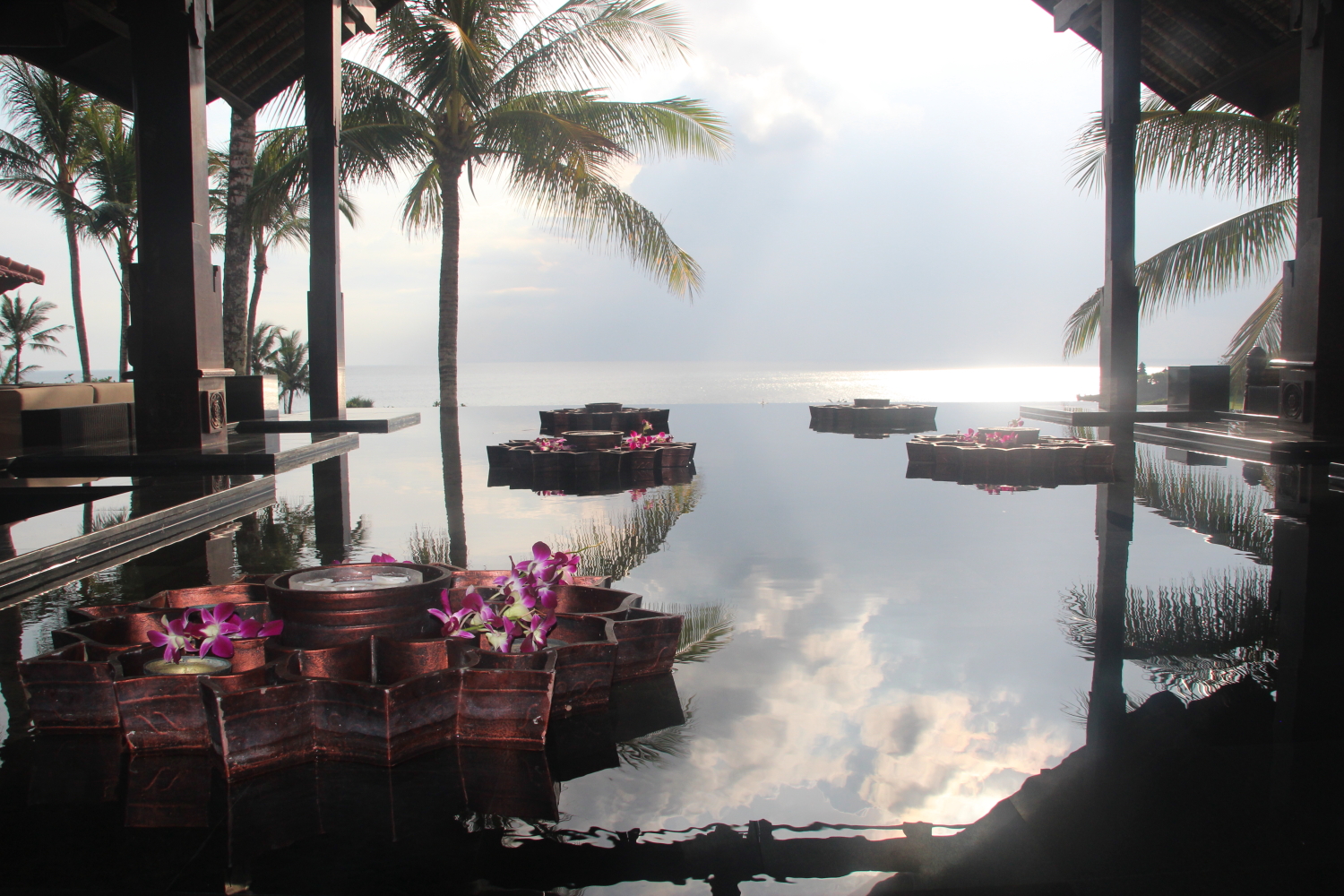
Hotel on the Indian Ocean in Tanah Lot

Boy in traditional Hindu dress at a fifty year festival in Blahbatuh

Ancient rice field terraces in Jatiiluwih


 barbararachkoscoloreddust.com