Blog Archives
Pearls from artists* # 648

“Apparition,” soft pastel on sandpaper, 58” x 38”
*an ongoing series of quotations – mostly from artists, to artists – that offers wisdom, inspiration, and advice for the sometimes lonely road we are on.
I prefer to speak in terms of the artist’s voice. Voice is deeper, manifested from the very core of your being. It is a synthesis of the experiences, intellectual concepts, and aesthetic interests you possess, executed in your distinctive way, in the formal, emotional, and intellectual language of your chosen medium. When successful, the realization of your voice follows a gestalt principle. The combination of your ideas and the work’s physical embodiment is greater than the sum of its parts and distinguishes your outcome from everyone else’s. If we wrote down a single concept and handed it to a dozen artists, we would get very different responses from each of them, and some works would be a stronger synthesis of ideas and execution. As Frank Stella once said, “There are no good ideas for paintings, there are only good paintings… the painting IS the idea (Saltz, 2020:42).”
The art that we recognize as having singular, identifying features, those formal aspects that allow us to immediately see a work as ‘a David Wojnarowicz’ or ‘a Julie Mehretu,’ were not the product of a singular flash of brilliance. These qualities evolved as part of a sustained, life-long, ever-deepening investigation to articulate their specific and singular vision. Our voice comes from tapping into the depths of our own consciousness, then distilling the most powerful aspects of that awareness. Voice also expands and deepens over time. It evolves along with the artist.
Kate Kretz in Art From Your Core: A Holistic Guide to Visual Voice
Comments are welcome!
Q: How large is your collection of Mexican folk art objects?

Part of my collection
A: I began collecting these figures in the early 1990s. I haven’t counted them, but my guess is that I have amassed around 200 pieces of various sizes. This includes some Guatemalan figures. I went to Guatemala in 2009 and 2010. Since I divide my time between a house in Alexandria, VA, an apartment in Manhattan, and a studio in Chelsea, a portion of my folk art collection resides in each of these places.
Since 2017 I have been creating pastel paintings in the “Bolivianos” series, which exclusively use my photographs of Bolivian Carnival masks as source material. Occasionally, I will add one of my smaller Mexican or Guatemalan figures to improve and enrich a painting’s composition. Otherwise, my Mexican collection sits gathering dust. My thinking and my ideas, not to mention my travels, have evolved and just naturally moved on with time.
Comments are welcome!
Q: With so many soft pastels to choose from, do you have a way of organizing them so that you can find the color you need?
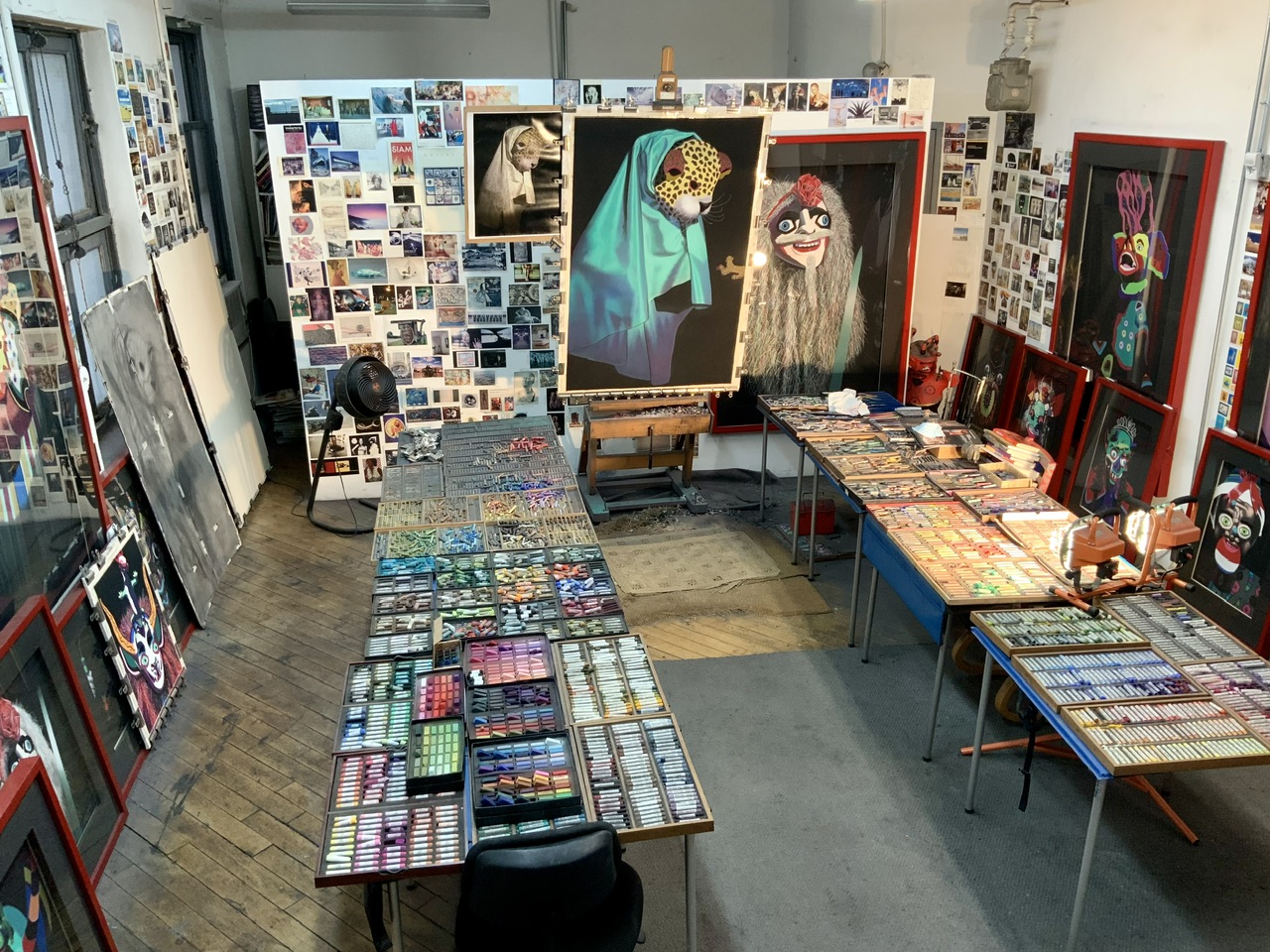
Barbara’s Studio
A: The arrangement of my pastels evolved organically. I keep them in their original trays. My oldest pastel sets are closer to the easel and the newest ones are the furthest away. After 37 years of experience working in pastel, I am well-acquainted with their individual properties. I know exactly where to find each color based on which manufacturer makes it.
Comments are welcome!
Q: When did you start using the sandpaper technique and why (Question from “Arte Realizzata”)

A: In the late 1980s when I was studying at the Art League School in Alexandria, VA, I enrolled in a three-day pastel workshop with Albert Handel, an artist known for his southwest landscapes in pastel and oil paint. I had just begun working with soft pastel and was experimenting with paper. Handel suggested I try Ersta fine sandpaper. I did and nearly three decades later, I’ve never used anything else.
This paper is acid-free and accepts dry media, mainly pastel and charcoal. It allows me to build up layer upon layer of pigment and blend, without having to use a fixative. The tooth of the paper almost never gets filled up so it continues to hold pastel. (On the rare occasion when the tooth DOES fill up, which sometimes happens with problem areas that are difficult to resolve, I take a bristle paintbrush, dust off the unwanted pigment, and start again). My entire technique – slowly applying soft pastel, blending and creating new colors directly on the paper, making countless corrections and adjustments, rendering minute details, looking for the best and/or most vivid colors – evolved in conjunction with this paper.
I used to say that if Ersta ever went out of business and stopped making sandpaper, my artist days would be over. Thankfully, when that DID happen, UArt began making a very similar paper. I buy it in two sizes – 22″ x 28″ sheets and 56″ wide by 10-yard-long rolls. The newer version of the rolled paper is actually better than the old, because when I unroll it, it lays flat immediately. With Ersta I would lay the paper out on the floor for weeks before the curl would give way and it was flat enough to work on.
Comments are welcome!
Q: How do you work and approach your subject? (Question from “Arts Illustrated”)
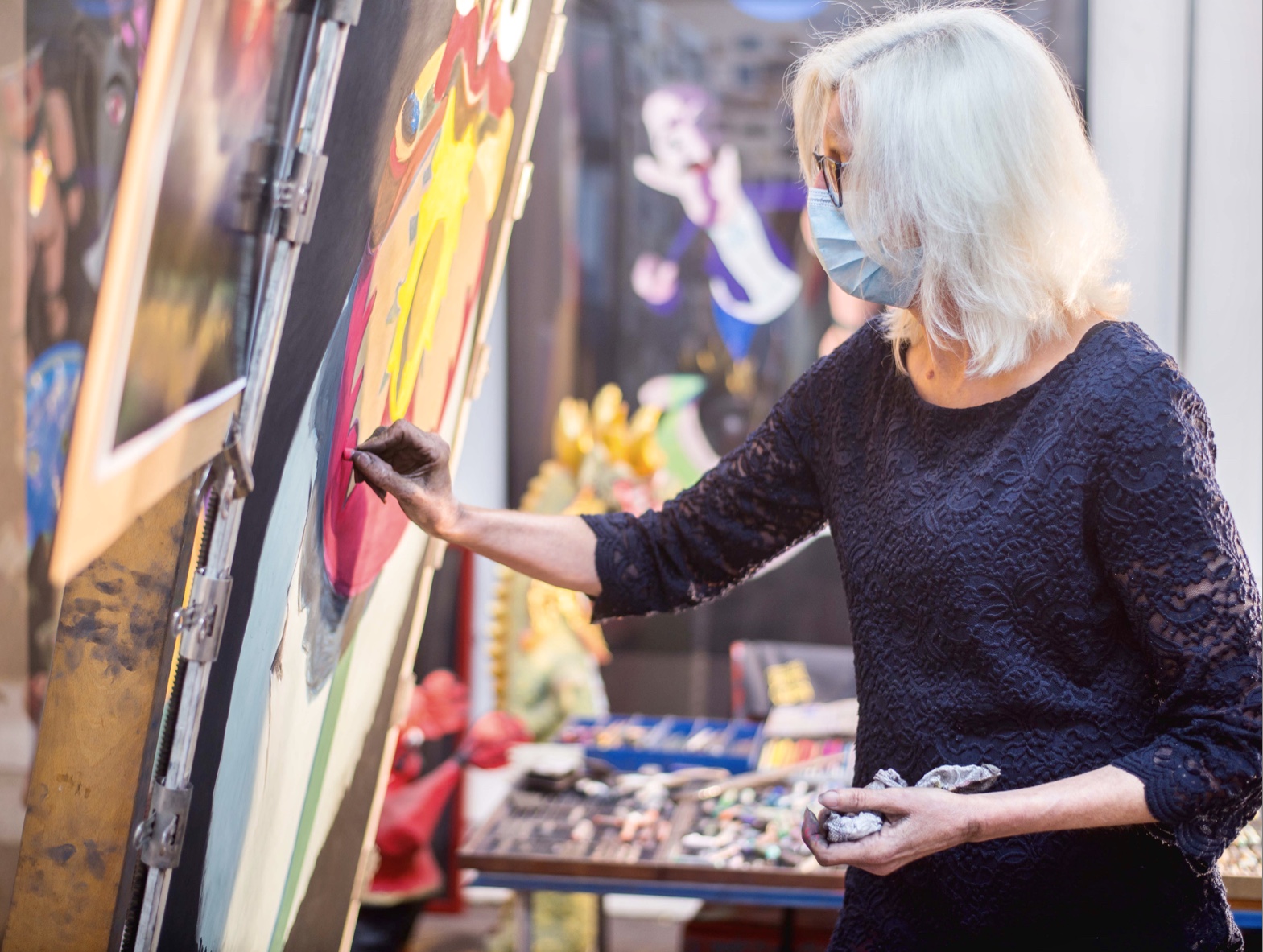
A: Undoubtedly, I could not make my work without UART sandpaper since my entire pastel technique evolved around it. I use 400 0r 500 grit. My favorite thing about it is its ‘tooth’ (i.e. texture or roughness).
Over the many months I spend creating a pastel painting, I build layer upon layer of soft pastel. Because the paper I use is relatively “toothy,” it accepts all of the pastel the painting needs. And as many people know, I own and use thousands of soft pastels!
Many layers of soft pastel and several months of studio time go into creating each painting. My self-invented technique is analogous to the glazing techniques used by the Old Masters, who slowly built up layers of thin oil paint to achieve a high degree of finish. Colors were not only mixed physically, but optically.
Similarly, I gradually build up layers of soft pastel, as many as thirty, to create a pastel painting. After applying a color, I blend it with my fingers and push it into the sandpaper’s tooth. It mixes with the color beneath to create a new color, continually adding richness, saturation, and intensity to the piece. By the time a pastel painting is finished, the colors are bold, vibrant, and exciting.
From the beginning in the 1980s I used photographs as reference material and my late husband, Bryan, would shoot 4” x 5” negatives of my elaborate setups with his Toyo-Omega view camera. In those days I rarely picked up a camera except when we were traveling. After Bryan was killed on 9/11, I inherited his extensive camera collection – old Nikons, Leicas, Graphlex cameras, etc. – and I wanted to learn how to use them. In 2002 I enrolled in a series of photography courses (about 10 over 4 years) at the International Center of Photography in New York. I learned how to use all of Bryan’s cameras and how to make my own big color prints in the darkroom.
Along the way I discovered that the sense of composition, form, and color I developed over many years as a painter translated well into photography. The camera was just another medium with which to express my ideas. Astonishingly, in 2009 I had my first solo photography exhibition in New York.
It’s wonderful to be both a painter and a photographer. Pastel painting will always be my first love, but photography lets me explore ideas much faster than I ever could as a painter. Paintings take months of work. To me, photographs – from the initial impulse to hanging a framed print on the wall – are instant gratification.
For several years I have been using my iPad Pro to capture thousands of travel photographs. Most recently, I visited Gujarat and Rajasthan in India. I have never been inclined to use a sketchbook so composing photos on my iPad keeps my eye sharp while I’m halfway around the world, far from my studio practice.
My blog, “Barbara Rachko’s Colored Dust,” continues to be a crucial part of my overall art practice. Blogging twice a week forces me to think deeply about my work and to explain it clearly to others. The process has helped me develop a better understanding about why I make art and, I like to think, has helped me to become a better writer.
Comments are welcome!
Q: Why do you make art?

“Why Do I Make Art” by Ursula von Rydingsvard
A: Last spring I viewed Ursula von Rydingsvard’s exhibition at the National Museum of Women in the Arts. One thing that stayed with me is her wall text, “Why Do I Make Art by Ursula von Rydingsvard” in which she listed a few dozen benefits that art-making has brought to her life.
I want to share some of my own personal reasons here, in no particular order. My list keeps changing, but these are true at least for today.
1. Because I love the entire years-long creative process – from foreign travel whereby I discover new source material, to deciding what I will make, to the months spent in the studio realizing my ideas, to packing up my newest pastel painting and bringing it to my Virginia framer’s shop, to seeing the framed piece hanging on a collector’s wall, to staying in touch with collectors over the years and learning how their relationship to the work changes.
2. Because I love walking into my studio in the morning and seeing all of that color! No matter what mood I am in, my spirit is immediately uplifted.
3. Because my studio is my favorite place to be… in the entire world. I’d say that it is my most precious creation. It’s taken more than twenty-two years to get it this way. I hope I never have to move!
4. Because I get to listen to my favorite music all day or to Public Radio stations.
5. Because when I am working in the studio, if I want, I can tune out the world and all of it’s urgent problems. The same goes for whatever personal problems I am experiencing.
6. Because I am devoted to my medium. How I use pastel continually evolves. It’s exciting to keep learning about its properties and to see what new techniques will develop.
7. Because I have been given certain gifts and abilities and that entails a sacred obligation to USE them. I could not live with myself were I to do otherwise.
8. Because art-making gives meaning and purpose to my life. I never wake up in the morning wondering, how should I spend the day? I have important work to do and a place to do it. I know this is how I am supposed to be spending my time on earth.
9. Because I have an enviable commute. To get to my studio it’s a thirty-minute walk, often on the High Line early in the morning before throngs of tourists have arrived.
10. Because life as an artist is never easy. It’s a continual challenge to keep forging ahead, but the effort is also never boring.
11. Because each day in the studio is different from all the rest.
12. Because I love the physicality of it. I stand all day. I’m always moving and staying fit.
13. Because I have always been a thinker more than a talker. I enjoy and crave solitude. I am often reminded of the expression, “She who travels the farthest, travels alone.” In my work I travel anywhere.
14. Because spending so much solitary time helps me understand what I think and feel and to reflect on the twists and turns of my unexpected and fascinating life.
15. Because I learn about the world. I read and do research that gets incorporated into the work.
16. Because I get to make all the rules. I set the challenges and the goals, then decide what is succeeding and what isn’t. It is working life at its most free.
17. Because I enjoy figuring things out for myself instead of being told what to do or how to think.
18. Because despite enormous obstacles, I am still able to do it. Art-making has been the focus of my life for thirty-three years – I was a late bloomer – and I intend to continue as long as possible.
19. Because I have been through tremendous tragedy and deserve to spend the rest of my life doing exactly what I love. The art world has not caught up yet, but so be it. This is my passion and my life’s work and nothing will change that.
20. Because thanks to the internet and via social media, my work can be seen in places I have never been to and probably will never go.
21. Because I would like to be remembered. The idea of leaving art behind for future generations to appreciate and enjoy is appealing.
Comments are welcome!
Q: I especially enjoy your “Black Paintings” series. You mention being influenced by the story of how Miles Davis developed cool jazz, making this work uniquely American all around. How did you use jazz history in this series?

“Between,” soft pastel on sandpaper, 20″ x 26″
A: In 2007 I finished the Domestic Threats series and was blocked, certain that a strong body of work was behind me. But what would come next?
The idea for the Black Paintings began when I attended a jazz history course at Lincoln Center and learned how Miles Davis developed cool jazz from bebop. In bebop the notes were played hard and fast as musicians showcased their musical virtuosity. Cool jazz was a much more relaxed style with fewer notes being played. In other words, the music was pared down to its essentials. Similarly, the Black Paintings evolved from dense, intricate compositions into paintings that depicted only the essential elements. As the series evolved, what was left out became more important, resulting in more demands being placed on the viewer.
Eventually, after much reflection, I had an epiphany and my painful creative block ended. “Between,” with drastically simplified imagery, was the first in a new series called Black Paintings. I like to think this series includes work that is richer and more profound than the previous Domestic Threats.
Comments are welcome!
Pearls from artists* # 349
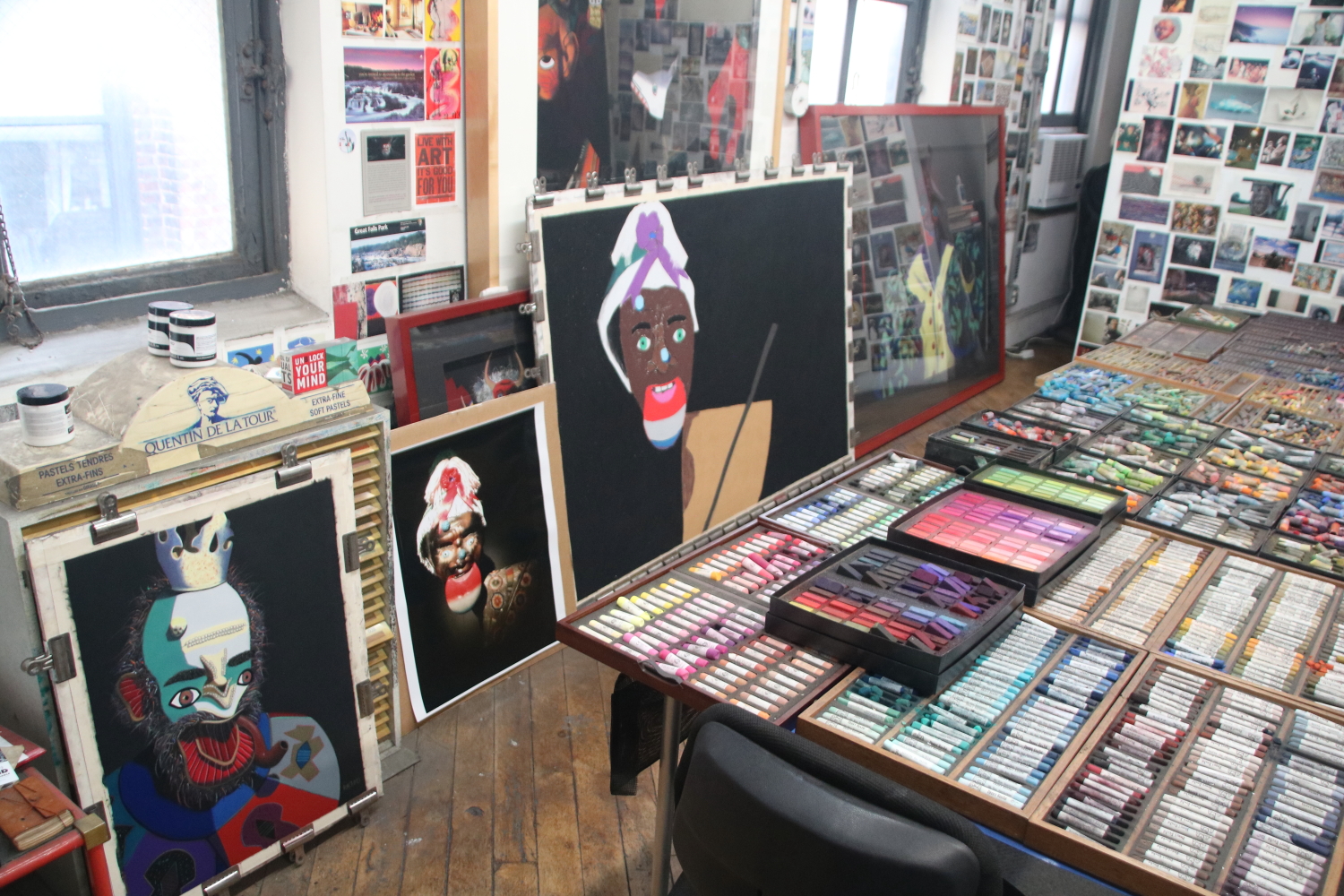
Barbara’s studio
*an ongoing series of quotations – mostly from artists, to artists – that offers wisdom, inspiration, and advice for the sometimes lonely road we are on.
If Dostoyevsky, Flaubert, and so many others were able to create great artistic works, it was because they were able to pull off something few adults can find it in themselves to do: they were able to suspend all final judgments about life and the universe in order to play…
The spirit of work is concerned with self-preservation. It evaluates concepts and ideas in terms of their practical value. Building roads, raising walls, running elections, debating policies, educating the young – all of these are purposive actions ultimately aimed at upholding social structures, changing those structures, or promoting one’s place within society. The spirit of work is the home of the ego, the part of us that has evolved to survive and thrive. One of the conditions of the artistic creation seems to be the ability to move frame this frame of mind into the spirit of play. As many artist have said in varying ways, the trick is to forget everything and create for the sake of creating. No worthwhile play, of course, is without effort. As the painstaking care Flaubert put into every line of his books makes clear, the spirit of play is sometimes the most exciting. Nevertheless, art remains in essence a game, an activity undertaken for its own sake, no matter how difficult. Like all games, it requires the establishment of a perimeter within which things that one might take very seriously in ordinary life are given only relative value. The perimeter suspends all the conventional rules, allowing the artist to turn the world on its head and let the imagination roam freely.
No sooner have we entered the spirit of play than we see things differently.
J.F. Martel in Reclaiming Art in the Age of Artifice: A Treatise, Critique, and Call to Action
Comments are welcome!
Q: What one piece of artistic “equipment” could you not live without?
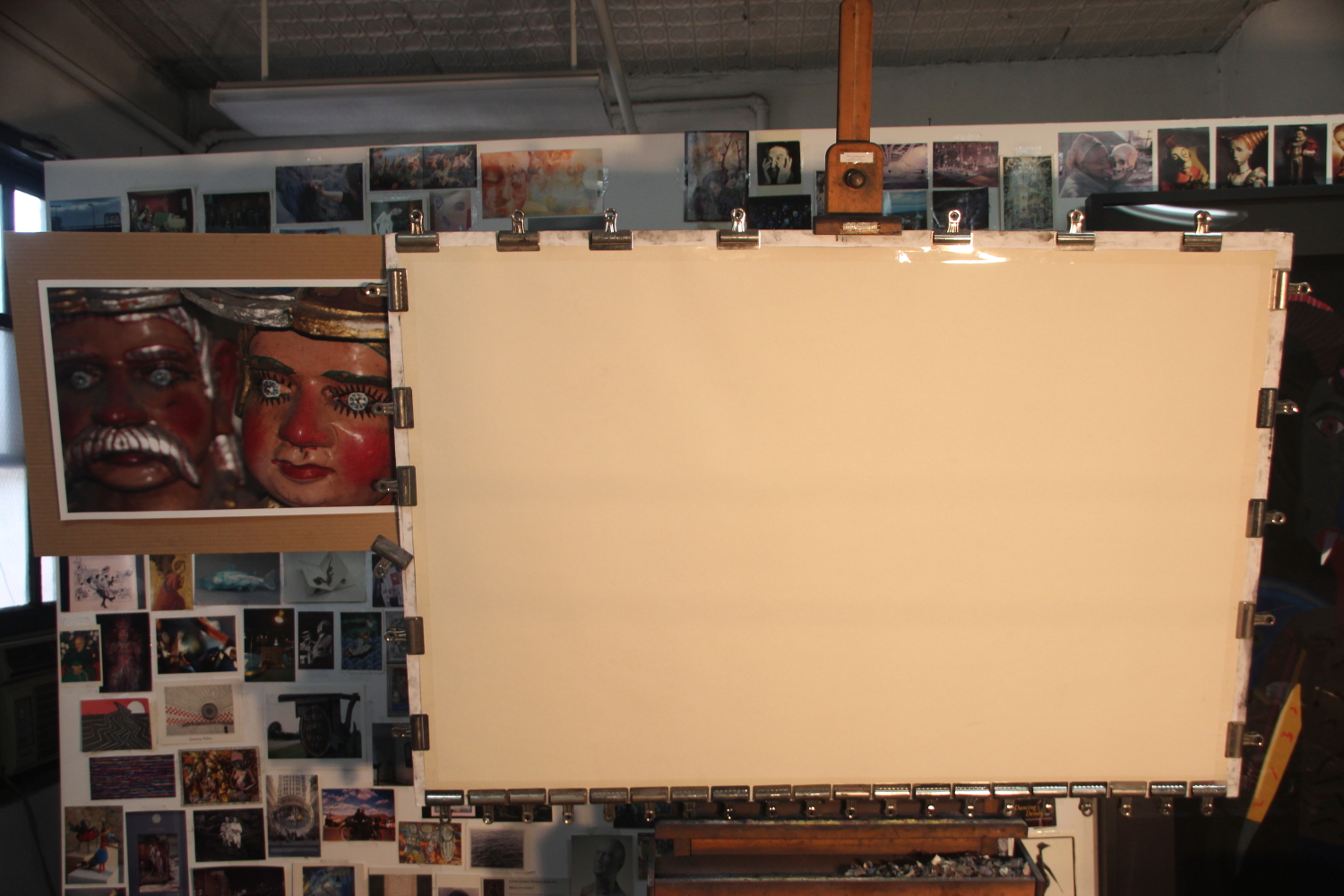
Untouched sandpaper
A: Undoubtedly, I could not make my work without UART sandpaper. Over the many months I spend creating a painting, I build layer upon layer of soft pastel. Because this paper is so “toothy,” it accepts all of the pastel the painting needs.
As many people know, I own and use a lot of soft pastel! My entire technique evolved around this sandpaper, which allows me to add and blend as many as thirty layers.
Comments are welcome!
Pearls from artists* # 145

“Stalemate,” soft pastel on sandpaper, 38″ x 58″
* an ongoing series of quotations – mostly from artists, to artists – that offers wisdom, inspiration, and advice for the sometimes lonely road we are on.
It is a mistake for a sculptor or a painter to speak or write very often about his work. It releases tension needed for his job. By trying to express his aims with rounded-off logical exactness, he can easily become a theorist whose actual work is only a caged-in exposition of conceptions evolved in terms of logic and words.
But though the nonlogical, instinctive, subconscious part of the mind must play its part in his work, he also has a conscious mind which is not inactive. The artist works with a concentration of his whole personality, and the conscious part of it resolves conflicts, organizes memories, and prevents him from trying to walk in two directions at the same time.
Henry Moore: Notes on Sculpture in The Creative Process, edited by Brewster Ghiselin
Comments are welcome!


 barbararachkoscoloreddust.com