Category Archives: Inspiration
Pearls from artists* # 471

*an ongoing series of quotations – mostly from artists, to artists – that offers wisdom, inspiration, and advice for the sometimes lonely road we are on.
Impresario Peter Sellars remarks how “Vermeer [spent] hours, days, and weeks painting a small corner of a small room in an act of ritualistically informed meditation that leads to new possibilities of awareness and love.” The time of making, Sellars adds, influences the time of viewing: “The act [of painting] itself opens up and refines consciousness by slowing down time as it focuses the eye.” Sellars’ language of ritual and meditation anticipates my purposes. He associates painting not only with materiality but also with spiritual practices – indeed, he yokes the two: “The act of painting has always been charged with shamanic energies. Using bits of animal bone, hair, and sinew, mixing them with earth, and applying them steadily and with great concentration to a cave wall, a parchment, or a human face is an act of calling and recalling.”
Arden Reed in Slow Art: The Experience of Looking, Sacred Images to James Turrell
Comments are welcome!
Pearls from artists* # 470
*an ongoing series of quotations – mostly from artists, to artists – that offers wisdom, inspiration, and advice for the sometimes lonely road we are on.
Find something that is really meaningful to you – that’s the most important thing at the end of the day. Even if everything goes well, there are still those moments when you see through it all. Once you see through the fame, money, and social life and ask yourself, “What is this all about? What does it mean to me?,” it’s great if you can see your work clearly and what you see is important to you.
That same thing goes on the other side. When you wonder why you go through all this hell and you’re struggling, at least you see that you really enjoy what you do, you are fulfilled by what you make, and you believe in it.
Charles Long, artist, Mount Baldy, CA, in Art/Work: Everything You Need to Know (And Do) As You Pursue Your Art Career by Heather Darcy Bhandari and Jonathan Melber
Comments are welcome!
Pearls from artists* # 469

*an ongoing series of quotations – mostly from artists, to artists – that offers wisdom, inspiration, and advice for the sometimes lonely road we are on.
I feel artists are at the cutting edge of everything created by humans in our society. I would love for artists, young and old, to remember that for the Art World to exist, the first thing that is necessary is art. No gallerist, museum director, preparatory, or museum guard would have a job without an artwork having been created.
Without remembering this, artists can lose sight of their power and worth. We begin to believe that the Art World came first and that we need to change, appropriate, adjust, or edit ourselves and our work to fit into this world. This does not need to happen, and should not happen.
Stephanie Diamond, artist, New York, NY, in Art/Work: Everything You Need to Know (And Do) As You Pursue Your Art Career by Heather Darcy Bhandari and Jonathan Melber
Comments are welcome!
Pearls from artists* # 468

*an ongoing series of quotations – mostly from artists, to artists – that offers wisdom, inspiration, and advice for the sometimes lonely road we are on.
Why does art elicit such different reactions from us? How can a work that bowls one person over leave another cold? Doesn’t the variability of the aesthetic feeling support the view that art is culturally determined and relative? Maybe not, if we consider the possibility that the artistic experience depends not on some subjective mood but on an individually acquired (hence variable) power to be affected by art, a capacity developed through one’s culture in tandem with one’s unique character. For evidence of this we can point to works that seem to ignore cultural boundaries altogether, affecting people of different backgrounds in comparable ways even though a specific articulation of their personal responses continues to vary. Consider the plays of William Shakespeare or Greek theater, or the fairy tales that have sprung up in similar forms on every continent. We could not be further removed from the people who painted in the Chauvet Cave, nor could we be more oblivious as to the significance they ascribed to their pictures. Yet their work affects us across the millennia. Everyone responds to them differently, of course, and the spirit in which people are likely to receive them now probably differs significantly from how it was at the beginning. But these permutations revolve around a solid core, something present in the images themselves.
J.F. Martel in Reclaiming Art in the Age of Artifice: A Treatise, Critique, and Call to Action
Comments are welcome!
Pearls from artists* # 467
*an ongoing series of quotations – mostly from artists, to artists – that offers wisdom, inspiration, and advice for the sometimes lonely road we are on.
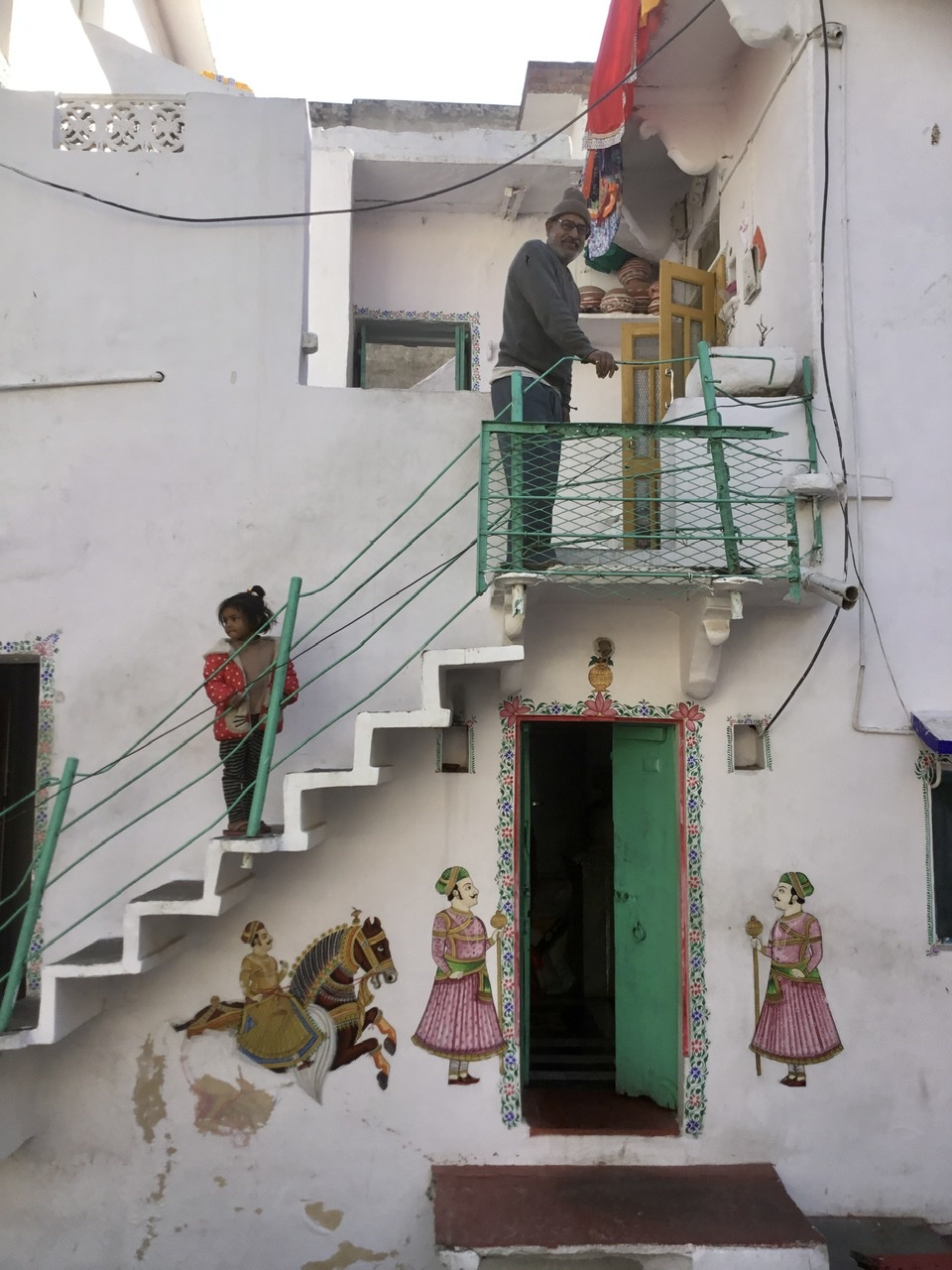
As students confronted with images of India through film and photography, we are challenged to begin to be self-conscious of who we are as “seers.” Part of the difficulty of entering the world of another culture, especially one with as intricate and elaborate a visual articulation as India’s, is that, for many of us, there are no “manageable models.” There are no self-evident ways of recognizing the shapes and forms of art, iconography, ritual life and daily life that we see. Who is Śiva, dancing wildly in a ring of fire? What is happening when the priest pours honey and yogurt over the image of Viṣṇu? Why does the woman touch the feet of the ascetic beggar? For those who enter the visible world of India through the medium of film, the onslaught of strange images raises a multitude of questions. These very questions should be the starting point for our learning. Without such self-conscious questions, we cannot begin to “think” with what we see and simply dismiss it as strange. Or worse, we are bound to misinterpret what we see by placing it solely within the context of what we already know from our own world of experience.
Diana L. Eck in Darsan: Seeing the Divine Image in India
Comments are welcome!
Pearls from artists* # 466

*an ongoing series of quotations – mostly from artists, to artists – that offers wisdom, inspiration, and advice for the sometimes lonely road we are on.
Within the initial artistic response to something is a core idea or feeling and most of our work comes from stripping away everything that is extraneous to it. To translate that vision means “to get across” the idea or feeling. How cleanly can that idea be isolated and honed, how much can be stripped away? Everything superfluous and tangential needs to be eliminated. Otherwise the idea may get buried and our intention deflected. And the viewer’s will also. The problem is seldom that an idea is too simple. Power comes from something deeply felt and simply stated. “Nothing astonishes men so much as common sense and plain dealing. All great actions have been simple, and all great pictures are.” (Quote from Ken Weber, The Eye of the Spirit, Shambala, 1998, p. 136).
Ian Roberts in Creative Authenticity: 16 Principles to Clarify and Deepen Your Artistic Vision
Comments are welcome!

Pearls from artists* # 465
*an ongoing series of quotations – mostly from artists, to artists – that offers wisdom, inspiration, and advice for the sometimes lonely road we are on.
In his 1970 Nobel Prize lecture, Aleksander Solzhenitsyn proposed that if art has never been revealed its intrinsic “function” to us, it is because such a thing is beyond our ken. For the Russian writer, we are mistaken when we call art a human innovation; we ought instead to see it as a gift, something that came to us from beyond the bounds of our world. Solzhenitsyn illustrates his point by comparing the work of art to the technological marvel that a man from the proverbial Stone Age comes across in the wilderness. Unable to penetrate its secrets, the man can only turn the object this way and that, looking for “some arbitrary use to which he can put it, without suspecting an extraordinary one.” Solzhenitsyn goes on:
“So also we, holding art in our hands, confidently consider ourselves to be its masters, boldly we direct it, reform and manifest it; we sell it for money, use it to please those in power; turn to it at one moment for amusement… and at another… for the passing needs of politics and for narrow-minded social ends. But art is not defiled by our efforts, neither does it thereby depart from its true nature, but on each occasion and in each application it gives us a part of its secret inner light.”
JF Martel in Reclaiming Art in the Age of Artifice: A Treatise, Critique, and Call to Action
Comments are welcome!
Pearls from artists* # 464
*an ongoing series of quotations – mostly from artists, to artists – that offers wisdom, inspiration, and advice for the sometimes lonely road we are on.
Only through art can human beings express and share the archetypal powers that shape the universe.
To abandon art would mean forfeiting the gift of vision, which, by all appearances, was given to humans alone.
To reclaim it might enable us to recover our faith in this world, and act in accordance with that faith for the benefit of life on earth.
JF Martel in Reclaiming Art in the Age of Artifice: A Treatise, Critique, and Call to Action
Comments are welcome!
Pearls from artists* # 463
*an ongoing series of quotations – mostly from artists, to artists – that offers wisdom, inspiration, and advice for the sometimes lonely road we are on.
When in doubt, when you are lost, don’t stop. Instead, concentrate on detail. Look around, find a detail to concentrate on and do that. Forget the big picture for a while. Just put your energy into the details of what is already there. The big picture will eventually open up and reveal itself if you can stay out of the way for a while. It won’t open up if you stop. You have to stay involved but you don’t always have to stay involved with the big picture.
While paying attention to the details and welcoming insecurity, while walking the tightrope between control and chaos and using accidents, while allowing yourself to go off balance and going through the back door, while creating the circumstances in which something might happen and being ready for the leap, while not hiding and being ready to stop doing homework, something is bound to happen. And it will probably be appropriately embarrassing.
Anne Bogart in A Director Prepares: Seven Essays on Art and Theatre
Comments are welcome!
Pearls from artists* # 462
*an ongoing series of quotations – mostly from artists, to artists – that offers wisdom, inspiration, and advice for the sometimes lonely road we are on.
It seems contradictory to call an artist both shy and conceited, introverted and extraverted, empathic and self-centered, highly independent and hungry for community – until we realize that all of these qualities can be dynamically present in one and the same person.
Indeed, this dynamism regularly perplexes and buffets the artist. He may begin to consider himself crazy for longing to perform even though public performance frightens him, or neurotic for feeling competent at the piano but incompetent in the world. He may come to possess the vain hope that he can live quietly, like other people, his personality statically integrated in some fashion, and then feel like a failure when the contradictory forces at play in him prevent him from feeling relaxed even for a minute. Once he realizes, however, that this puzzling contradiction is his personality, he is better able to accept himslef and to understand his motives and actions.
Eric Maisel in “A Life in the Arts: Practical Guidance and Inspiration for Creative and Performing Artists”
Comments are welcome!


 barbararachkoscoloreddust.com