Blog Archives
Pearls from artists* # 636

*an ongoing series of quotations – mostly from artists, to artists – that offers wisdom, inspiration, and advice for the sometimes lonely road we are on.
Some artists will rework a piece for half a lifetime before they know it is finished. An improviser may have to practice for years before being able to play a totally spontaneous minute of music in which every detail is right for its own fleeting moment. The great scientists and scholars are not those who publish or perish at any cost, but rather those who are willing to wait until the pieces of the puzzle come together in nature’s own design. The fruits of improvising, composing, writing, inventing, and discovering may flower spontaneously, but they arise from soil that we have prepared, fertilized, and tended in the faith that they will ripen in nature’s own time.
Stephen Nachmanovitch in Free Play: Improvisation in Life and Art
Comments are welcome!
Pearls from artists* # 616
*an ongoing series of quotations – mostly from artists, to artists – that offers wisdom, inspiration, and advice for the sometimes lonely road we are on.
This may be the most important piece of advice I can give you: The Internet is nothing like a cigarette break. If anything, it’s the opposite. One of the most difficult practical challenges facing writers in this age of connectivity is the fact that the very instrument on which most of us write is also a portal to the outside world. I once heard Ron Carlson say that composing on a computer is like writing in an amusement park. Stuck for a nanosecond? Why feel it? With the single click of a key we can remove ourselves and take a ride on a log flume instead.
By the time we return to work – if, indeed, we return to our work at all – we will be further away from our deepest impulses rather than closer to them. Where were we? Oh, yes. We were stuck. We were feeling uncomfortable and lost. We have gained nothing in the way of waking-dream time. Our thoughts have not drifted, but rather, have ricocheted from one bright and shiny thing to another.
Dani Shapiro in Still Writing: The Perils and Pleasures of a Creative Life
Comments are welcome!
Pearls from artists* # 592
The Studio
*an ongoing series of quotations – mostly from artists, to artists – that offers wisdom, inspiration, and advice for the sometimes lonely road we are on.
There are millions of ways of composing and structuring artwork. Each piece, whether improvised or written down, danced or painted, can evolve its own structure, its own world. The word creative comes from “to make grow,” as in the act of cultivating plants. We grow or evolve a set of rules to incorporate the unfolding of our imagination. We create new rules of progression, fresh channels in which play can flow.
Stephen Nachmanovitch in Free Play: Improvisation in Life and Art
Comments are welcome!
Q: How has the use of photography in your work changed over the decades?
New York, NY
A: From the beginning in the mid-1980s I used photographs as reference material. My late husband, Bryan, would shoot 4” x 5” negatives of my elaborate setups using his Toyo-Omega view camera. In this respect Bryan was an integral part of my creative process as I developed the “Domestic Threats” pastel paintings. At that time I rarely picked up a camera, except to capture memories of our travels.
After Bryan was killed on 9/11, I inherited his extensive camera collection – old Nikons, Leicas, Graphlex cameras, and more. I wanted and needed to learn how to use them. Starting in 2002 I enrolled in a series of photography courses (about 10 over 4 years) at the International Center of Photography in New York. I learned how to use all of Bryan’s cameras and how to make my own big chromogenic prints in the darkroom.
Along the way I discovered that the sense of composition and color I had developed over many years as a painter translated well into photography. The camera was just another medium with which to express my ideas. Surprisingly, in 2009 I had my first solo photography exhibition at a gallery in New York. Bryan would have been so proud!
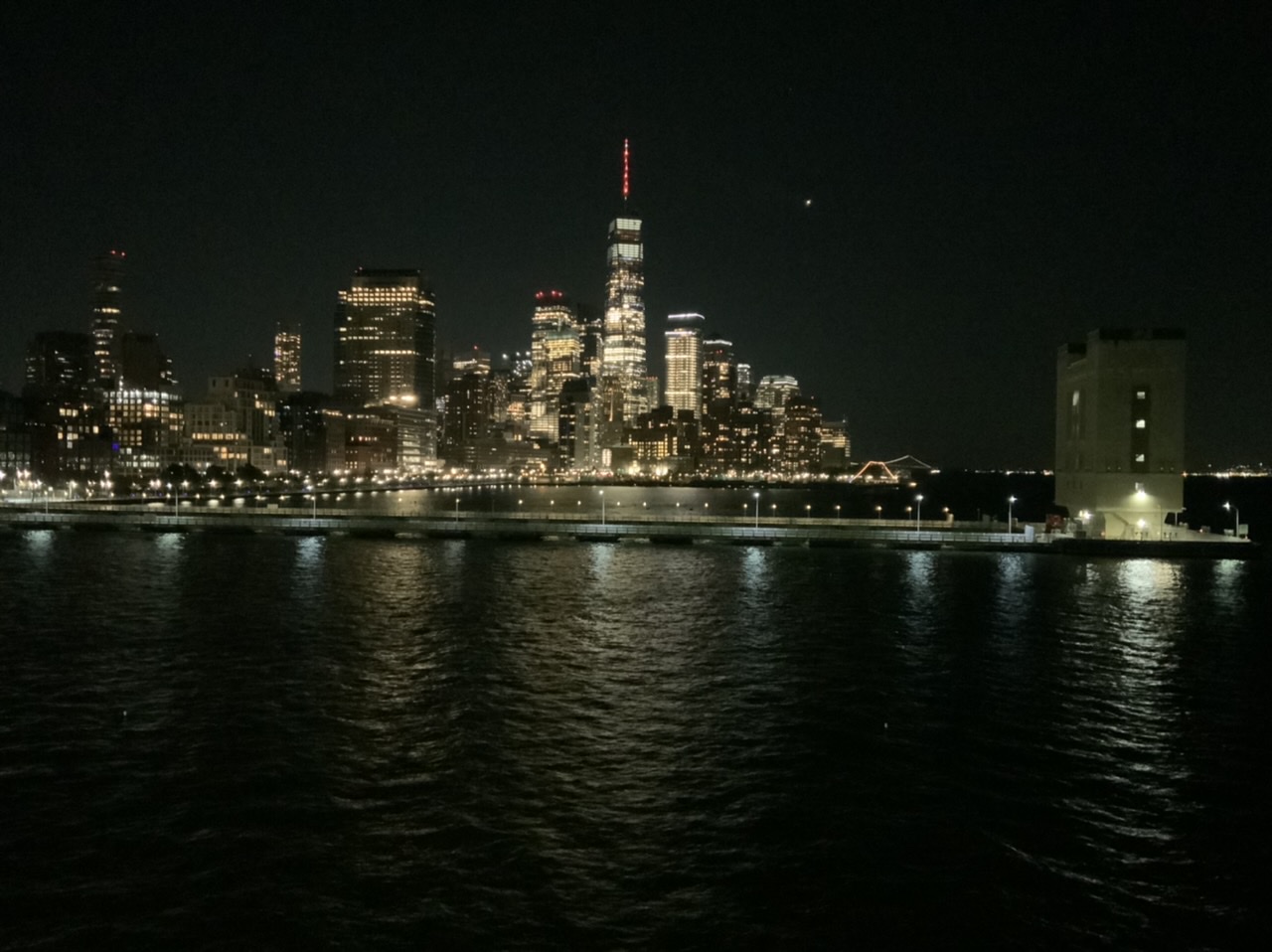
For several years now my camera of choice has been a 12.9” iPad Pro. It’s main advantage is that the large screen let’s me see every detail as I compose my photographs. I think of it as a portable, lightweight, and easy-to-use 8 x 10 view camera. My iPad is always with me when I travel and as I walk around exploring New York City.
It is a wonderful thing to be both a painter and a photographer! While pastel painting will always be my first love, photography has distinct advantages over my studio practice. Pastel paintings are labor-intensive, requiring months of painstaking work. Photography’s main advantage is speed. Photographs – from the initial impulse to hanging a print on a wall – can be made in minutes. Photography is instant gratification, allowing me to explore ideas much easier and faster than I ever could as a painter. Perhaps most importantly, composing photographs keeps my eye sharp whenever I am away from the studio. I credit photography as an important factor in the overall evolution of my work.
Comments are welcome!
Q: What art project(s) are you working on currently? What is your inspiration or motivation for this? (Question from artamour)

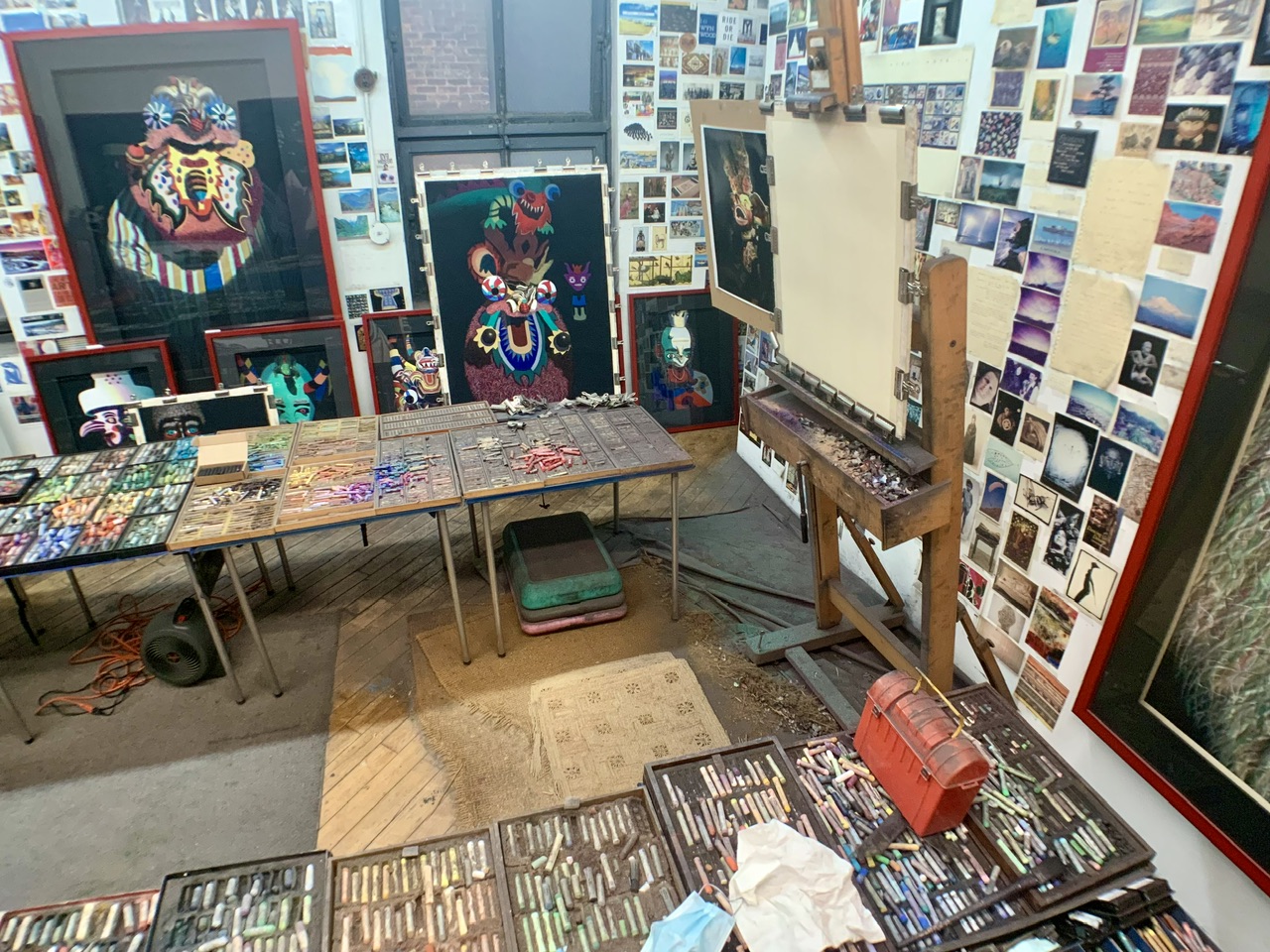
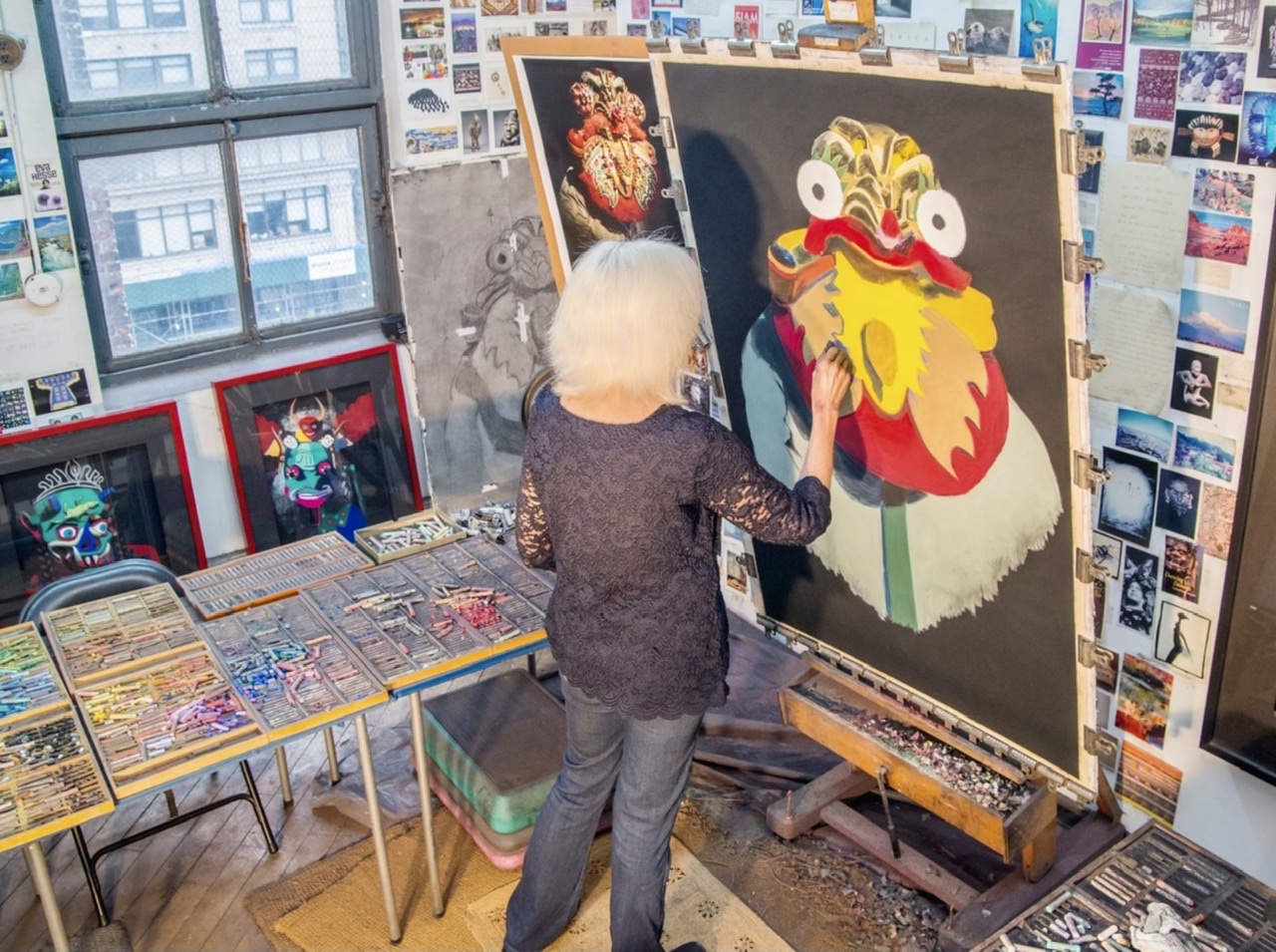
A: While traveling in Bolivia in 2017, I visited a mask exhibition at the National Museum of Ethnography and Folklore in La Paz. The masks were presented against black walls, spot-lit, and looked eerily like 3D versions of my Black Paintings, the series I was working on at the time. I immediately knew I had stumbled upon a gift. To date I have completed seventeen pastel paintings in the Bolivianos series. One awaits finishing touches, another is in progress, and I am planning the next two, one large and one small pastel painting.
The following text is from my “Bolivianos” artist’s statement.
“My long-standing fascination with traditional masks took a leap forward in the spring of 2017 when I visited the National Museum of Ethnography and Folklore in La Paz, Bolivia. One particular exhibition on view, with more than fifty festival masks, was completely spell-binding.
The masks were old and had been crafted in Oruro, a former tin-mining center about 140 miles south of La Paz on the cold Altiplano (elevation 12,000’). Depicting important figures from Bolivian folklore traditions, the masks were created for use in Carnival celebrations that happen each year in late February or early March.
Carnival in Oruro revolves around three great dances. The dance of “The Incas” records the conquest and death of Atahualpa, the Inca emperor when the Spanish arrived in 1532. “The Morenada” dance was once assumed to represent black slaves who worked in the mines, but the truth is more complicated (and uncertain) since only mitayo Indians were permitted to do this work. The dance of “The Diablada” depicts Saint Michael fighting against Lucifer and the seven deadly sins. The latter were originally disguised in seven different masks derived from medieval Christian symbols and mostly devoid of pre-Columbian elements (except for totemic animals that became attached to Christianity after the Conquest). Typically, in these dances the cock represents Pride, the dog Envy, the pig Greed, the female devil Lust, etc.
The exhibition in La Paz was stunning and dramatic. Each mask was meticulously installed against a dark black wall and strategically spotlighted so that it became alive. The whole effect was uncanny. The masks looked like 3D versions of my “Black Paintings,” a pastel paintings series I have been creating for ten years. This experience was a gift… I could hardly believe my good fortune!
Knowing I was looking at the birth of a new series – I said as much to my companions as I remained behind while they explored other parts of the museum – I spent considerable time composing photographs. Consequently, I have enough reference material to create new pastel paintings in the studio for several years. The series, entitled “Bolivianos,” is arguably my strongest and most striking work to date.”
Comments are welcome!
Pearls from artists* # 479
*an ongoing series of quotations – mostly from artists, to artists – that offers wisdom, inspiration, and advice for the sometimes lonely road we are on.
… a gift is a thing we cannot get by our own efforts. We cannot buy it; we cannot acquire it through an act of will. It is bestowed upon us. Thus we rightly speak of talent as a “gift,” for although a talent can be performed through an effort of the will, no effort in the world can cause its initial appearance. Mozart, composing on the harpsicord at the age of four, had a gift.
We also rightly speak of intuition or inspiration as a gift. As the artist works, some portion of his creation is bestowed upon him. An idea pops into his head, a tune begins to play, a phrase comes to mind, a color falls into place on the canvas. Usually, in fact, the artist does not find himself engaged or exhilarated by the work, nor does it seem authentic, until this gratuitous element has appeared so that along with any true creation comes the uncanny sense that “I,” the artist, did not make the work. “Not I, not I, but the wind that blows through me,” says D.H. Lawrence. Not all artists emphasize the gift phase of their creations to the degree Lawrence does, but all artists feel it.
Lewis Hyde in The Gift: Imagination and the Erotic Life of Property
Comments are welcome!
Q: How do you work and approach your subject? (Question from “Arts Illustrated”)
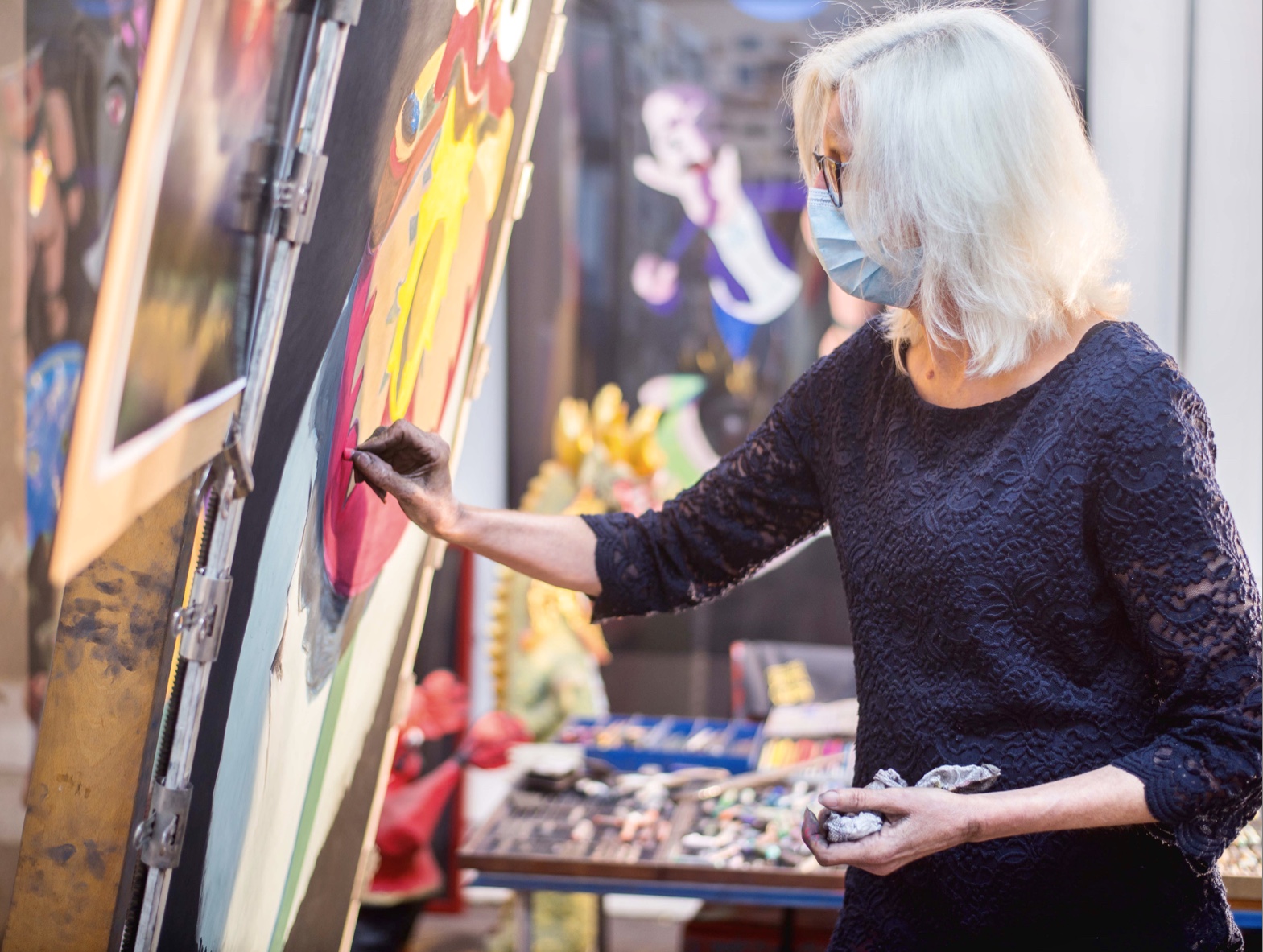
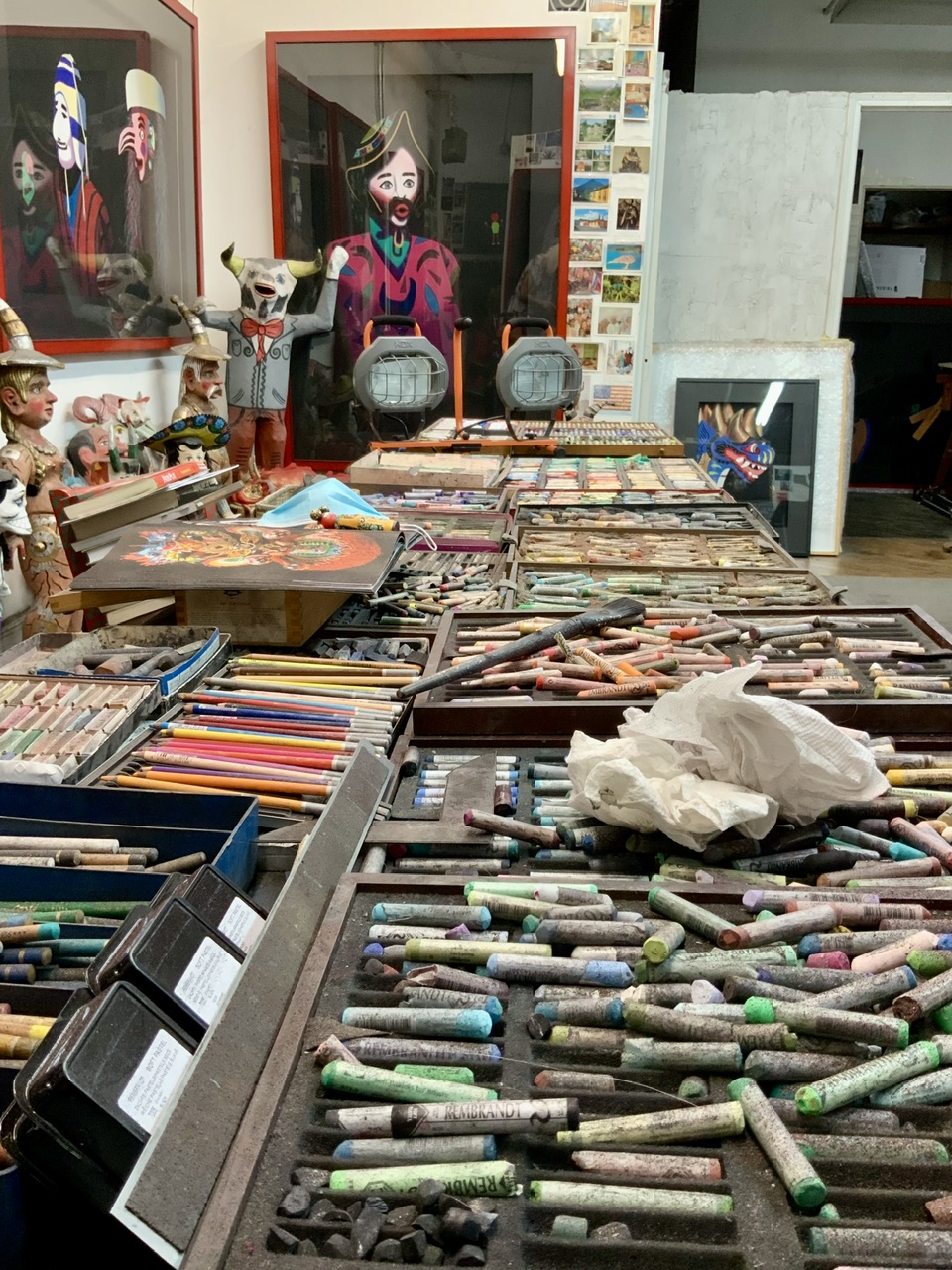
A: Undoubtedly, I could not make my work without UART sandpaper since my entire pastel technique evolved around it. I use 400 0r 500 grit. My favorite thing about it is its ‘tooth’ (i.e. texture or roughness).
Over the many months I spend creating a pastel painting, I build layer upon layer of soft pastel. Because the paper I use is relatively “toothy,” it accepts all of the pastel the painting needs. And as many people know, I own and use thousands of soft pastels!
Many layers of soft pastel and several months of studio time go into creating each painting. My self-invented technique is analogous to the glazing techniques used by the Old Masters, who slowly built up layers of thin oil paint to achieve a high degree of finish. Colors were not only mixed physically, but optically.
Similarly, I gradually build up layers of soft pastel, as many as thirty, to create a pastel painting. After applying a color, I blend it with my fingers and push it into the sandpaper’s tooth. It mixes with the color beneath to create a new color, continually adding richness, saturation, and intensity to the piece. By the time a pastel painting is finished, the colors are bold, vibrant, and exciting.
From the beginning in the 1980s I used photographs as reference material and my late husband, Bryan, would shoot 4” x 5” negatives of my elaborate setups with his Toyo-Omega view camera. In those days I rarely picked up a camera except when we were traveling. After Bryan was killed on 9/11, I inherited his extensive camera collection – old Nikons, Leicas, Graphlex cameras, etc. – and I wanted to learn how to use them. In 2002 I enrolled in a series of photography courses (about 10 over 4 years) at the International Center of Photography in New York. I learned how to use all of Bryan’s cameras and how to make my own big color prints in the darkroom.
Along the way I discovered that the sense of composition, form, and color I developed over many years as a painter translated well into photography. The camera was just another medium with which to express my ideas. Astonishingly, in 2009 I had my first solo photography exhibition in New York.
It’s wonderful to be both a painter and a photographer. Pastel painting will always be my first love, but photography lets me explore ideas much faster than I ever could as a painter. Paintings take months of work. To me, photographs – from the initial impulse to hanging a framed print on the wall – are instant gratification.
For several years I have been using my iPad Pro to capture thousands of travel photographs. Most recently, I visited Gujarat and Rajasthan in India. I have never been inclined to use a sketchbook so composing photos on my iPad keeps my eye sharp while I’m halfway around the world, far from my studio practice.
My blog, “Barbara Rachko’s Colored Dust,” continues to be a crucial part of my overall art practice. Blogging twice a week forces me to think deeply about my work and to explain it clearly to others. The process has helped me develop a better understanding about why I make art and, I like to think, has helped me to become a better writer.
Comments are welcome!
Pearls from artists* # 375

Tile worker in South India
* an ongoing series of quotations – mostly from artists, to artists – that offers wisdom, inspiration, and advice for the sometimes lonely road we are on.
With the camera you interpret reality. Photography is not truth. The photographer interprets reality and, above all, constructs his own reality according to his own awareness or his own emotions. Sometimes it’s complicated because it’s a kind of schizophrenic phenomenon. Without the camera, you see the world in one way, with the camera, in another. Through the window, you’re composing, and even dreaming about, this reality as if, through the camera, you were synthesizing what you are with what you’ve learned of a certain place. Then you make your own image, your own interpretation. The same thing happens to a writer as to a photographer. It’s impossible to capture the truth of life.
Graciela Iturbide in Eyes to Fly With: Portraits, Self-Portraits, and Other Photographs
Comments are welcome!
Q: You are a multi-talented woman! Tell us about your book, “From Pilot to Painter,” and how writing, for you, compares to painting and photography. Which do you prefer?
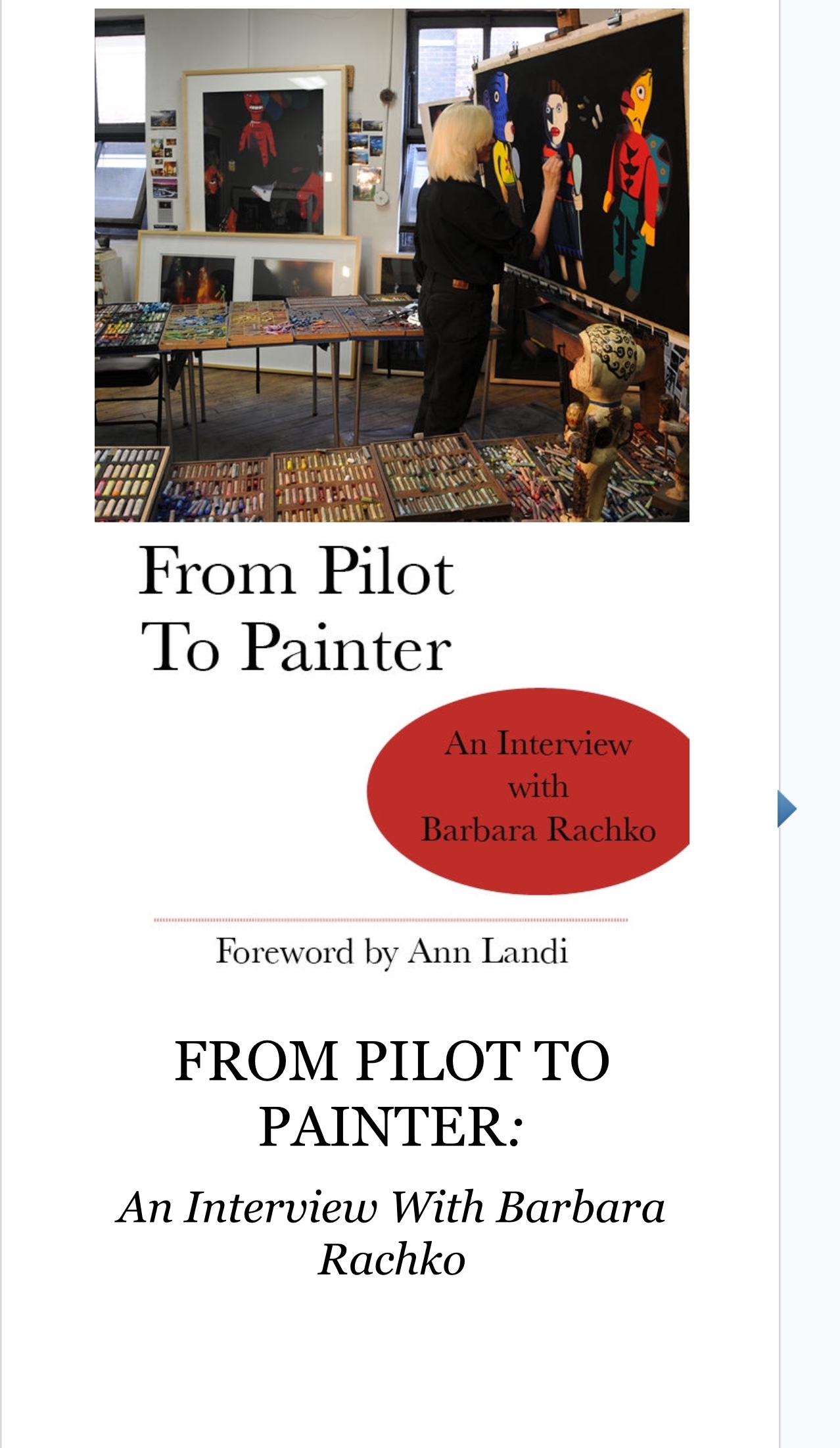
“From Pilot to Painter”
A: I am pleased that my eBook FROM PILOT TO PAINTER is available on Amazon and iTunes. It is based on my blog and is part memoir, including my personal loss on 9/11, insights into my creative practice, and intimate reflections on what it’s like to be an artist living in New York City now. The eBook includes new material not found on the blog, plus 25+ reproductions of my vibrant pastel-on-sandpaper paintings, a Foreword by Ann Landi (who writes for ARTnews and The Wall Street Journal), and more.
“Barbara Rachko’s Colored Dust” (the title of my blog) continues to be a crucial part of my overall art practice. Blogging twice a week forces me to think deeply about my work and to explain it clearly to others. The process has helped me develop a better understanding about why I make art and has encouraged me to become a better writer.
From the beginning in the 1980s I used photographs as reference material and Bryan would shoot 4” x 5” negatives of my elaborate setups with his Toyo-Omega view camera. In those days I rarely picked up a camera except when we were traveling. After Bryan was killed on 9/11, I inherited his extensive camera collection – old Nikons, Leicas, Graphlex cameras, etc. – and I wanted to learn how to use them. In 2002 I enrolled in a series of photography courses (about 10 over 4 years) at the International Center of Photography in New York. I learned how to use all of Bryan’s cameras and how to make my own big color prints in the darkroom. Along the way I discovered that the sense of composition, form, and color I developed over many years as a painter translated well into photography. The camera was just another medium with which to express my ideas. Astonishingly, in 2009 I had my first solo photography exhibition in New York.
It’s wonderful to be both a painter and a photographer. Pastel painting will always be my first love, but photography lets me explore ideas much faster than I ever could as a painter. Paintings take months of work. To me, photographs – from the initial impulse to hanging a framed print on the wall – are instant gratification.
For two years I have been using my iPad Pro to capture thousands of travel photographs. Most recently, I visited Gujarat and Rajasthan in India. I have never been inclined to use a sketchbook so composing photos on my iPad keeps my eye sharp while I’m halfway around the world, far from my studio practice.
Comments are welcome!
Q: As an artist what would you say is your particular ‘superpower’?

Barbara’s studio
A: I have been told that it is my unique way of composing images or, in other words, how I deliberately move the viewer’s eye around the picture. More exactly, it’s the way I combine flat shapes, patterns, angles, forms, modeling, decoration, details, lights, and darks in surprising ways when I make pastel paintings or pick up a camera.
But I think there’s a secondary, more subtle element: my understanding of and sensitivity to using color for psychological effect. The way I use color in pastel paintings is intuitive. This is something I haven’t reflected on very much yet, but will examine in a future post.
Comments are welcome!


 barbararachkoscoloreddust.com