Blog Archives
Q: What makes you just want to run back to the studio and start something new?

Beginnings
A: For nearly four decades, I have always worked in series, which means that one pastel painting leads quite naturally into the next. Considerable thought and planning go into each one before I ever begin, so it would be uncharacteristic for me to just start something new out of nowhere.
That said, my favorite part of the months-long creative process is when I am starting a brand new pastel painting. I get excited each time I begin a new piece because beginnings are full of so much possibility! Soon I will be looking at something I have never created before. I’ll watch it gradually take shape over months and will be challenged to solve unforeseeable problems, to continually refine and improve it along the way. The goal is always, of course, to resolve it into some sort of successful existence. Whatever happens, I know I am about to go on a very intriguing journey that will undoubtedly expand my technical knowledge and make me a much better artist.
Comments are welcome!
Pearls from artists* # 629

Basquiat X Warhol Exhibition at Fondation Louis Vuitton, Paris. Photo: Christine Marchal
*an ongoing series of quotations – mostly from artists, to artists – that offers wisdom, inspiration, and advice for the sometimes lonely road we are on.
… scientists are right there with artists in insisting art is fundamental to being human. Art is one of our oldest creations (humans invented paint long before the wheel), one of our earliest means of communication (we drew long, long, long before we could write), and one of our most universal urges (we all engage with art, whether preschoolers, Parisians, or Paleolithic cave dwellers). I began to notice that art – or what scientists dispassionately call “human-made two- or three-dimensional structures that remain unchanged: – was everywhere: hung over the register at the hardware store, spray-painted on a bakery window, cock-eyed in a dive-bar bathroom. As humans, we’ve filled our lives with art since practically forever. The earliest known painting keeps getting older, but the last time I checked, archaeologists had traced the oldest portrait to a cave in Indonesia, where around 45,000 years ago, artists put their finishing touches on a fat figure with purple testifies for a chin. In other words, before Neanderthals went extinct, before mammoths died out, before we figured out how to harvest food or heal bloody wounds, humans applied themselves to painting a portrait of a warty pig. “It is clear that the creation of beautiful and symbolic objects is a characteristic feature of the human way of life,” wrote the biologist J.Z. Young. “They are as necessary as food or sex.”
Bianca Booker in Get the Picture: A Mind-Bending Journey Among the Inspired Artists and Obsessive Art Fiends Who Taught Me How to See
Comments are welcome!
Pearls from artists* # 625

Downtown Manhattan
*an ongoing series of quotations – mostly from artists, to artists – that offers wisdom, inspiration, and advice for the sometimes lonely road we are on.
Think of one of those rare, truly exceptional outings to the cinema. In the lobby afterward the experience elicits from us a language of paralysis and disappearance: “I forgot myself. It could have gone on forever.” Stepping out onto the street, we feel that somehow nothing is as it was before. The passing cars, the night sky above the glass towers, the streetlights reflected on the wet pavement: everything glows with a strange immediacy and newness. It is as if the film had done something to the world. A similar thing might happen when we put down a great novel or take in a powerful piece of music.
The Book of Revelation contains a memorable line: “Behold, I make all things new.” Reflecting on this ancient text, the critic Northrop Frye defined the Apocalypse as “the way the world looks once the ego has disappeared.” Every great artistic work is a quiet apocalypse. It tears off the veil of ego, replacing old impressions with new ones at once inexorably alien and profoundly meaningful. Great works of art have a unique capacity to arrest the discursive mind, raising it to a level of reality that is more expansive than the egoic dimension we normally inhabit. In this sense, art is the transfiguration of the world.
J.F. Martel in Reclaiming Art in the Age of Artifice: A Treatise,Critique, and Call to Action
Comments are welcome!

Q: I saw your book of photos. Very nice. How do you keep track of inventory? I have struggled with that. (Question from Laura Fischer Saxon via Facebook).
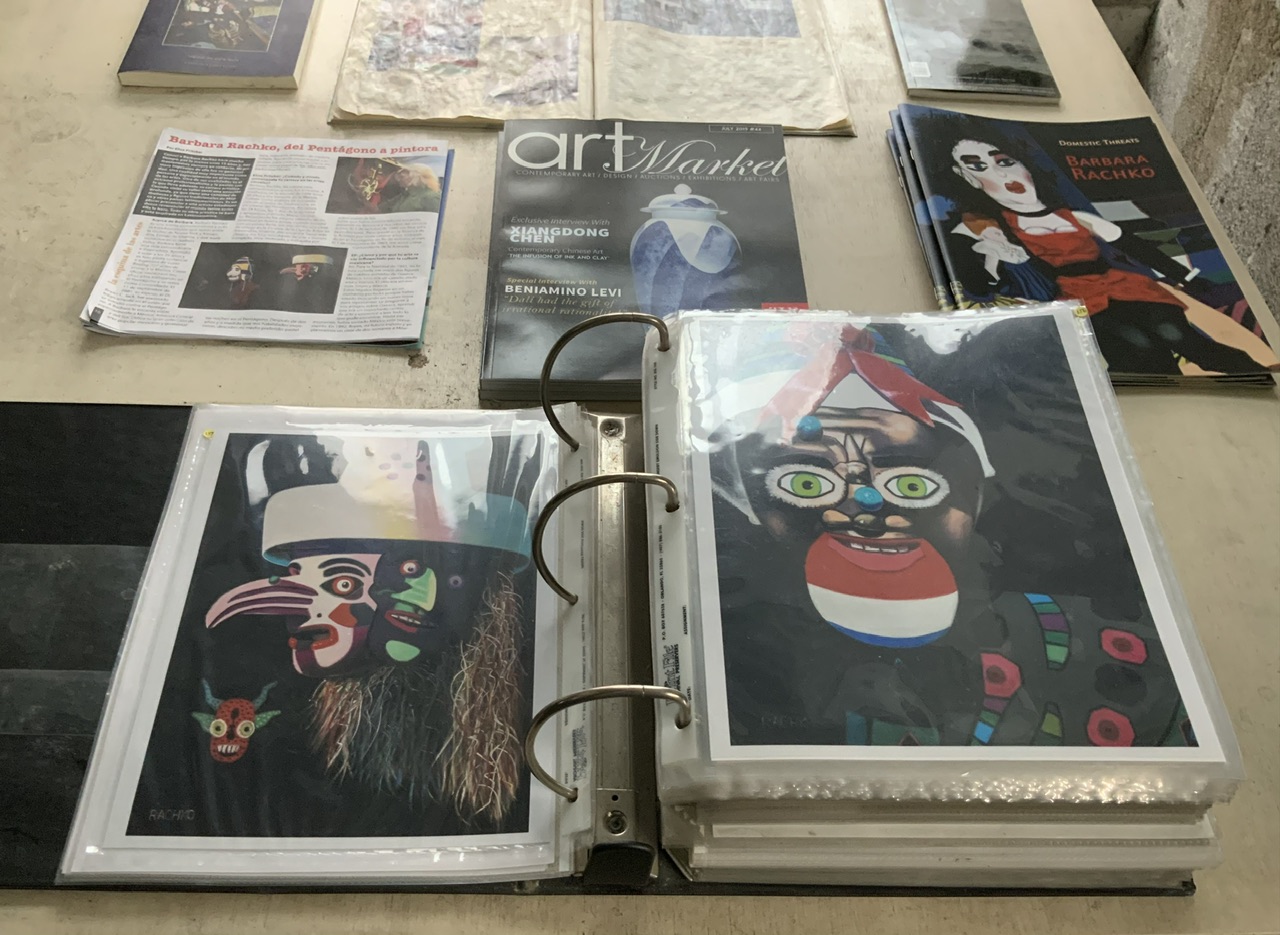
Barbara’s portfolio book
A: Every time I finish a pastel painting I order an 8” x 10” c-print at Duggal Visual Solutions. I started doing this in the 1980s when I was a portrait artist and the company that represented me needed photos of my work to show to potential clients. I’ve just continued making 8” x 10”photos all these years in order to document my work!
Pastel is an extremely slow medium so even though I have been working more than 37 years, the two pastel paintings in progress now are numbers 160 and 161. The portfolio book also has early press clippings, reviews from before the internet (when everything was on paper), and a few photos of early solo exhibitions in the 1990s.
BTW what a great question! No one has ever asked me this before!
Comments are welcome!
Q: Many of the world’s cultures have a mask tradition. Is there something special about Bolivian masks that first attracted you to them?

Bolivian Carnival Mask
A: My subject matter emerges directly from my travels. I visited Bolivia in 2017. What I especially liked then – and now – about Bolivian Carnival masks, is that they include additional textures – feathers, fur, costume jewelry, sequins, fabric, etc. that add to their physical presence. Masks from most of the other countries I’ve visited tend to be made of wood and/or paper mache and nothing else. In my view such masks are not as dramatic nor do they offer much expressive potential. They feel dead. They lack a certain “soulfulness.”
Furthermore, textures are challenging to render in soft pastel. For more than three decades I have been striving to improve my pastel techniques. By now I have a vast repertoire from which to select. As was true in my earlier series, with “Bolivianos” an important personal goal is to keep adding to the repertoire.
It takes months to create a pastel painting, which means I need masks that will hold my attention every day over the course of three or four months. I never want to be bored in the studio. If I am bored while making the work, those feelings will be directly transferred and I will make a boring pastel painting, something I hope never to do! The masks need to have a really strong ‘presence.’ Then as I slowly make a pastel painting, one that is exciting to work on from start to finish, I can transform my subject into something surprising and powerful that has never existed before!
Comments are welcome!
Q: Why do you work in series?
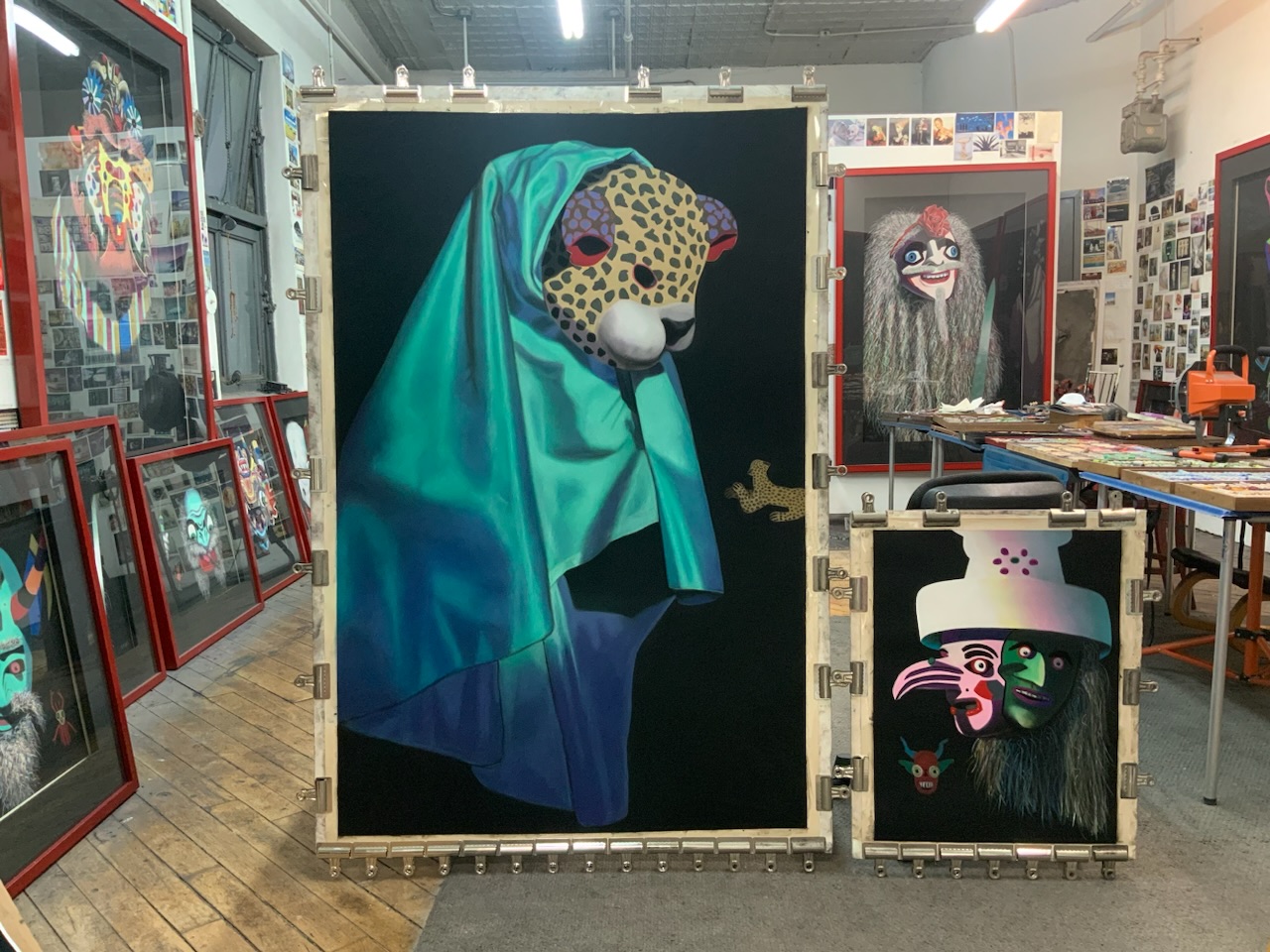
“Bolivianos” paintings in progress and on the walls and floor
A: I don’t really have any choice in the matter. It’s more or less the way I have always worked so it feels natural. Art-making comes from a deep place. In keeping with the aphorism ars longa, vita brevis, it’s a way of making one’s time on earth matter. Working in series mimics the more or less gradual way that our lives unfold, the way we slowly evolve and change over the years. Life-altering events happen, surely, but seldom do we wake up drastically different – in thinking, in behavior, etc. – from what we were the day before. Working in series feels authentic. It helps me eke out every lesson my paintings have to teach. With each completed piece, my ideas progress a step or two further.
I remember going to the Metropolitan Museum to see an exhibition called, “Matisse: In Search of True Painting.” It demonstrated how Matisse worked in series, examining a subject over time and producing multiple paintings of it. Matisse is my favorite artist of any period in history. I never tire of seeing his work and this particular exhibition was very enlightening. As I studied the masterpieces on the wall, I recognized a kindred spirit and thought, “Obviously, working in series was good enough for Matisse!”
Comments are welcome!
Q: Love your selection of pastels! Do you have favorites that you need to force yourself not to continually return to? (Question from Donina Asera via Facebook)

A: No, I don’t think so. Certainly, I do have general preferences. I prefer dark, vivid, intense colors so many of my pale pastels go mostly unused. The single pastel that I use most is Rembrandt black – I buy them buy the dozens – because it takes many layers of pigment to achieve my dark black backgrounds. Otherwise, I strive to be open to whatever the painting needs. My goal – always! – is to make a pastel painting that is exciting to look at and different from anything I have created before.
Thank you very much for the great question!
Comments are welcome!
Pearls from artists* # 557

*an ongoing series of quotations – mostly from artists, to artists – that offers wisdom, inspiration, and advice for the sometimes lonely road we are on.
It is true that art, while indebted to tradition, is usually at odds with it; art is about the thrill of mutiny. Young painters and sculptors are particularly unwilling to be hampered by the past, especially if that past is encased in the cement shoes of gender. But familiarity with tradition can be liberating for an artist because it provides a map illustrating the route other people have taken, which is especially valuable at the start of such a perilous journey. Male artists can inspire and instruct, surely. Artistic concerns are gender neutral. But there are social and personal issues a woman artist faces that cannot be found in the stories of men; these are the obstacles confronted and obstacles overcome. The poet Adrienne Rich wrote, “For spiritual values and a creative tradition to continue unbroken we need concrete artifacts, the work of hands, written words to read, images to look at, a dialogue with brave and imaginative women who came before us.” It’s instructive as well as comforting to know how other women have managed and what other women have dared. It’s also gratifying to find in their stories an occasional energizing dose of inspiration.
Mary Gabriel in Ninth Street Women
Comments are welcome!
Q: Can you explain how you choose colors? (Question from Maria Cox via Instagram)

A: I am wild about color! As I work to create a pastel painting, I apply a color, back up from my easel to see how it interacts with and affects the rest of the painting, and then I make revisions. This process necessitates countless color changes and hundreds of hours during months of work. I apply pastel using a meticulous layering process. Were you to x-ray one of them, the earlier, discarded versions of a pastel painting would be visible. All the while I carefully fine-tune and refine how the colors and shapes interact with each other.
The goal is to make an exciting painting that no one, especially me as the maker, has ever seen before. I have no desire to repeat myself, to make art that resembles work by any other artist, or to be forced into a niche.
I try to select intense, vibrant colors that are exciting to look at, that work well in relationship to each other, and that will grab the viewer. Sometimes I deliberately choose colors for their symbolic meanings. For example, I selected a dark purple for the alternating triangles (the ones with the pink dots above) in “Overlord” because purple denotes royalty.
I have been working with soft pastel for 37 years so I have a fairly intricate science of color at my disposal. No doubt, many unconscious factors are at play, too. More on that in future posts.
Comments are welcome!
Q: What makes you feel most alive?

A: Making art makes me feel alive, using all my gifts, my brain, my heart, and my hands to create something that never existed before and that can never be duplicated; knowing I’m the only person, ever, who could or would make this particular thing, as I strive to push my pastel techniques further each time out. Whether it’s a painting or a photograph, I enjoy making something from nothing… art that is well-crafted and has never been seen before.
Travel is the other activity that excites me. I thrive on adventure and I especially love new vistas. When I am in a country I have never visited before, with every step and around every bend there is something new to see. I am an explorer at heart!
Comments are welcome!


 barbararachkoscoloreddust.com