Blog Archives
Pearls from artists* # 631

With “Maestro,” soft pastel on sandpaper, 35” x 28.5” framed
*an ongoing series of quotations – mostly from artists, to artists – that offers wisdom, inspiration, and advice for the sometimes lonely road we are on.
Selling your art is harder than creating it. Every artist dreams of being able to sell his/her art and make a considerable profit from it and/or build a business based on art. This would give artists the opportunity to make art full-time. However, the process is neither easy nor quick. It requires determination, discipline, and consistency. The idea of becoming a successful artist overnight almost doesn’t exist. All the artists who seem to be “overnight successes” put in a lot of hard work for years.
Dr. Bianca Turner in The Business of Art: A Guide for Visual Artists to Become Successful Entrepreneurs
Comments are welcome!
Q: What inspires you to create? (Question from “Cultured Focus Magazine”)
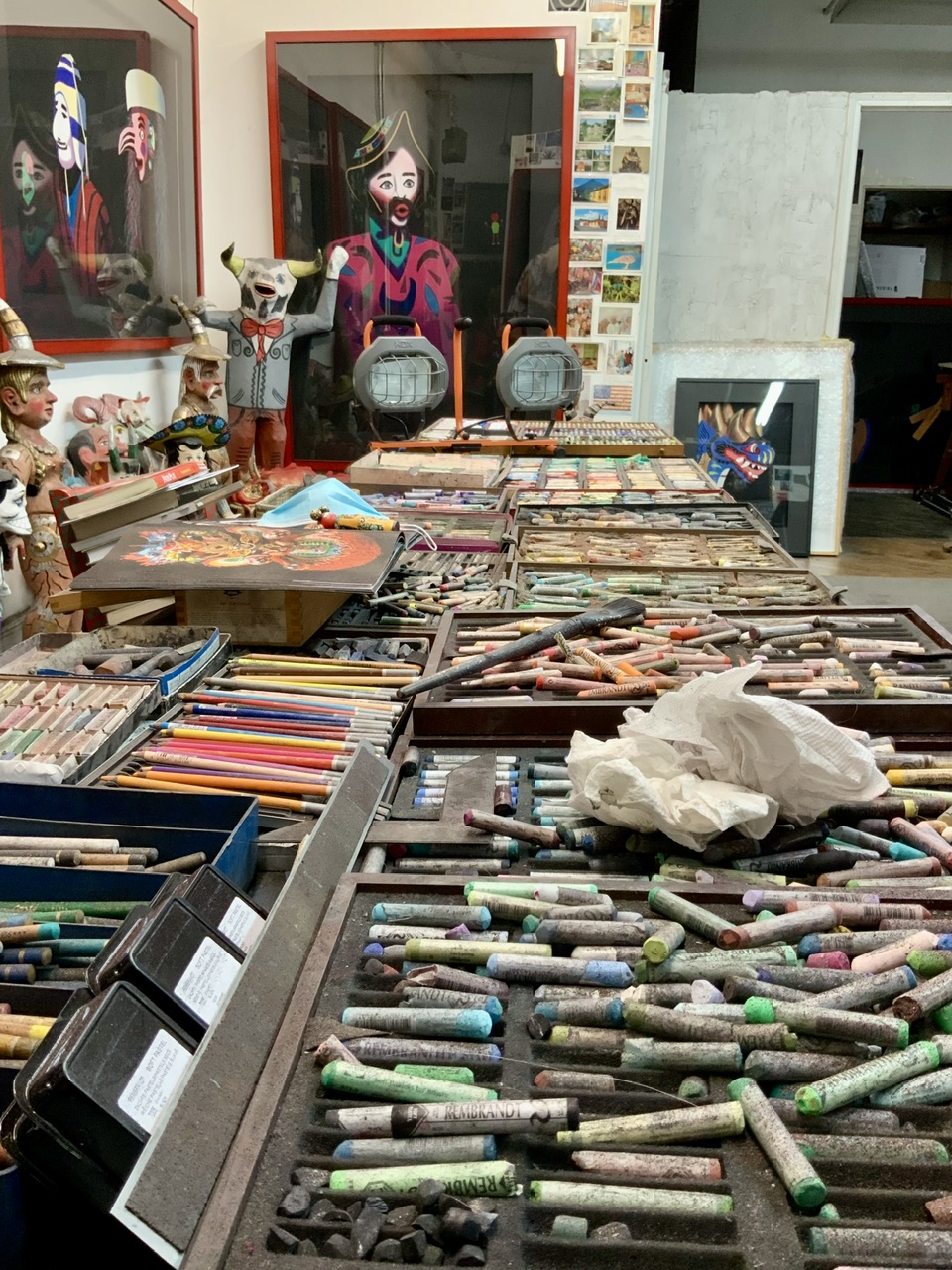
A: You remember the expression, to whom much is given, much is expected? Having discovered around the age of 5 or so that I could draw anything I could see, I know I have been given a tremendous gift. I remember being completely surprised as a kid to realize that not everyone can do this.
Therefore, I feel a kind of sacred obligation to develop my abilities as far as possible, to make the most of my short time on this earth. It is a thrill to see not only what is going to happen next in the studio, but also in my life. For example, I have become a world traveler. I wonder, which new country will I visit next?
Comments are welcome!
Q: When did you begin drawing and painting? (Question from “Cultured Focus Magazine”)

A: This is a long story because my path to becoming a professional artist has been unusually circuitous.
I grew up in a blue collar family in suburban New Jersey. My parents were both first-generation Americans and no one in my family had gone to college. I was a smart kid, who showed some artistic talent in kindergarten and earlier. At the age of 6, my sister, my cousin, and I enrolled in Saturday morning painting classes at the studio of a local artist. I continued the classes for about 8 years and became a fairly adept oil painter.
At the age of 15 my father decided that art was not a serious pursuit – he called it a hobby, not a profession – and abruptly stopped paying for my Saturday morning lessons. Unfortunately, there were no artists or suitable role models in my family. So with neither financial nor moral support to pursue art, I turned my attention to very different interests.
Cut to ten years later. When I was 25, I earned my private pilot’s license and spent the next two years amassing other flying licenses and ratings, culminating in a Boeing-727 flight engineer’s certificate.
At 29, I joined the Navy. By then I was an accomplished civilian pilot with thousands of flight hours so I expected to fly jets. However, in the early 1980s women were not allowed in combat. There were very few women Navy pilots and those few were restricted to training male pilots. There were no women pilots landing on aircraft carriers.
In the mid-1980s I was in my early 30s, a lieutenant on active duty in the Navy, working a soul-crushing job as a computer analyst on the midnight shift in a Pentagon basement. It was literally and figuratively the lowest point of my life. I was completely bored and miserable.
Remembering the joyful Saturdays of my youth when I had taken art classes with a local New Jersey painter, I enrolled in a drawing class at the Art League School in Alexandria, Virginia. Initially I wasn’t very good, but it was wonderful to be around other women and a world away from the mentality of the Pentagon. I was having fun again! I enrolled in more classes and became a very motivated full-time art student who worked nights at the Pentagon. As I studied and improved my skills, I quickly discovered my preferred medium – soft pastel on sandpaper.
Although I knew I had found my calling, for more than a year I agonized over whether or not to leave the financial security of a Navy paycheck. Finally I did make up my mind and resigned my commission, effective on September 30, 1989. With Bryan’s (my then boyfriend’s) support, I left the Navy to devote my time to making art.
I’m probably one of the few people who can name THE day I became a professional artist! That day was October 1, 1989. Fortunately, I have never needed another job. I remained in the Navy Reserve for the next 14 years, working primarily at the Pentagon for two days each month and two weeks each year. I commuted by train to Washington, DC after I moved to Manhattan in 1997. Finally on November 1, 2003, I officially retired as a Navy Commander.
Life as a self-employed professional artist is endlessly varied, fulfilling, and interesting. I have never regretted my decision to pursue art full-time.
Comments are welcome!
Pearls from artists* # 630

*an ongoing series of quotations – mostly from artists, to artists – that offers wisdom, inspiration, and advice for the sometimes lonely road we are on.
During the Victorian age, women, with their ‘smaller,’ less ‘creative’ brains, were considered incapable of becoming professional artists and were often restricted to ‘craft’ or ‘design’ (genres not considered ‘fine art’ by the establishment). This perception made it very difficult not only for women to be taken seriously as artists, but for their (and their female predecessors’) work to be sold. In order to get around this, nineteenth-century art dealers were known to scratch out a female artist’s signature and replace it with that of a male contemporary, which explains why many works by women have only just come to light. (No wonder so many of them hid self-portraits among their still lifes).
Katy Hessel in The Story of Art Without Men
Comments are welcome!
Q: Do you have any rituals that you do before beginning a day’s work in the studio?

The Studio!
A: When I arrive at the studio in the morning it’s rare for me to immediately start working. Usually I read something art-related – books written by artists, about creativity, etc. At the moment I’m reading The Artist’s Reality: Philosophies of Art by Mark Rothko. As usual I am struggling to understand aspects of the art business and figure out what I need to do next to get my work seen and collected by a wider audience. The Artist’s Reality reminds me why I decided to make art in the first place. It helps reconnect with temporarily forgotten parts of myself and is a much-needed reminder of what I love about being an artist, especially in light of the business side that is becoming so complex and demanding of attention now.
Balancing the creative and business aspects of being an artist is a continual struggle. Both are so important. An artist needs an appreciative audience – very few artists devote their lives to art-making so that the work will remain in a closet – but I also believe this (from a note I wrote years ago and tacked to the studio wall): “Just make the work. None of the rest matters.”
Comments are welcome!
Pearls from artists* # 596

Film still from “Barbara Rachko: True Grit,” Directed by Jennifer Cox, Moto Films LLC
*an ongoing series of quotations – mostly from artists, to artists – that offers wisdom, inspiration, and advice for the sometimes lonely road we are on.
Being an artist is very hard work. Not only do you have to constantly develop your discipline, but if you have a desire to make a living, you have to be a good businessperson.
Agents, business managers, etc., etc., are not the authors of your career. They make suggestions. They are a part of your research team. You are the author. You are the center of your career. You have to run the show. I hope your show is about more than gold digging. I hope your show is about becoming the most engaging, enchanting, magical person that you can be – through your art. Art is ultimately transcendent. That’s a fact.
Anna Deavere Smith in Letters to a Young Artist: Straight-Up Advice on Making a Life in the Arts – For Actors, Performers, Writers, and Artists of Every Kind
Comments are welcome!
Pearls from artists* # 581
With recent “Bolivianos”
*an ongoing series of quotations – mostly from artists, to artists – that offers wisdom, inspiration, and advice for the sometimes lonely road we are on.
The essence of style is this: We have something in us, about us; it can be called many things, but for now let’s call it our original nature. We are born with our original nature, but on top of that, as we grow up, we accommodate to the patterns and habits of our culture, family, physical environment, and the daily business of the life we have taken on. What we are taught solidifies as “reality.” Our persona, the mask we show the world, develops out of our experience and training, step by step from infancy to adulthood. We construct our world through the actions of perception, learning, and expectation. We construct our “self” through the same actions of perception, learning, and expectation. World and self interlock and match each other, step by step and shape by shape. If the two constructions, self and world, mesh, we grow from child to adult becoming “normally adjusted individuals.” If they do not mesh so well, we may experience feelings of inner division, loneliness, or alienation.
If we should happen to become artists, our work takes on, to a certain extent, the style of the time: the clothing in which we are dressed by our generation, our country and language, our surroundings, the people who have influenced us.
But somehow, even when we are grown up and “adjusted,” everything we do and are – our handwriting, the vibrato of our voice, the way we handle the bow or breathe into the instrument, our way of using language, the look in our eyes, the pattern of whirling fingerprints on our hand – all these things are symptomatic of our original nature. They all show the imprint of our own deeper style or character.
Stephen Nachmanovitch in Free Play: Improvisation in Life and Art
Comments are welcome!
Q: Would you speak about someone who made a difference in your professional life?
A: The first person who comes to mind is my favorite aunt, Teddie. In 1997 she was headed to northern California to attend a three-year-plus silent Tibetan Buddhist retreat at her teacher’s center. Teddie offered me her West 13th Street 6th-floor walkup apartment to live in while she was away. At the time I was based in Alexandria, VA and had just had my first solo exhibition at an important West 57th Street gallery, Brewster Fine Arts. I was becoming increasingly frustrated with the limited Washington, DC art scene, had outgrown everything it had to offer, and felt New York pulling me towards new and exciting professional adventures.
Teddie, recognizing my talent and ambition, made it possible for me to afford to move to New York. She had practiced Tibetan Buddhism for 35 years and was soon to become a Buddhist lama. She had an extraordinary mind and thought deeply about life. We used to talk for hours. Teddie was 7 years older and seemed more like a sister than an aunt. Indeed, she was my first soul mate. (I have been extremely fortunate to have had two such relationships in my life. The other was my late husband, Bryan).
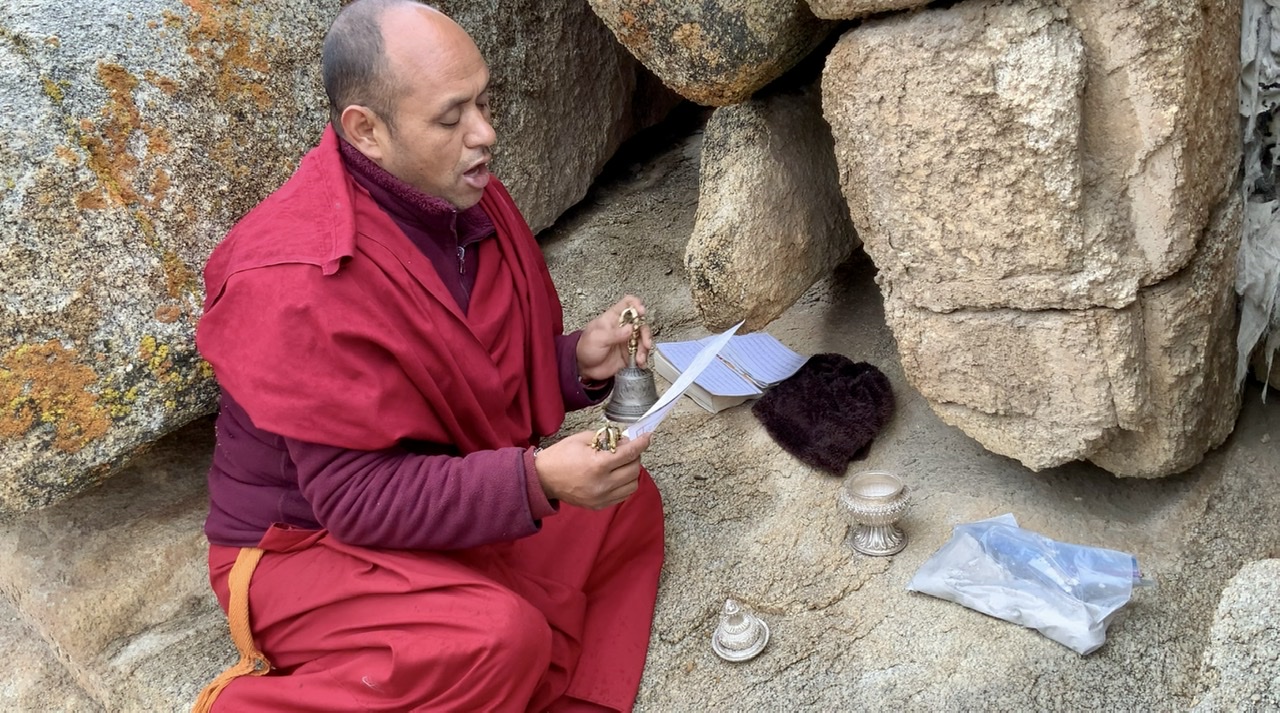
Unfortunately, dear Aunt Teddie died at the age of 67 of breast cancer. Recently, on September 25 I honored her life in a short ceremony on a mountain cliff in Leh, Ladakh (India). A Tibetan Buddhist monk recited prayers as he placed her ashes among the rocks.
Comments are welcome!
Q: What’s on the easel today?
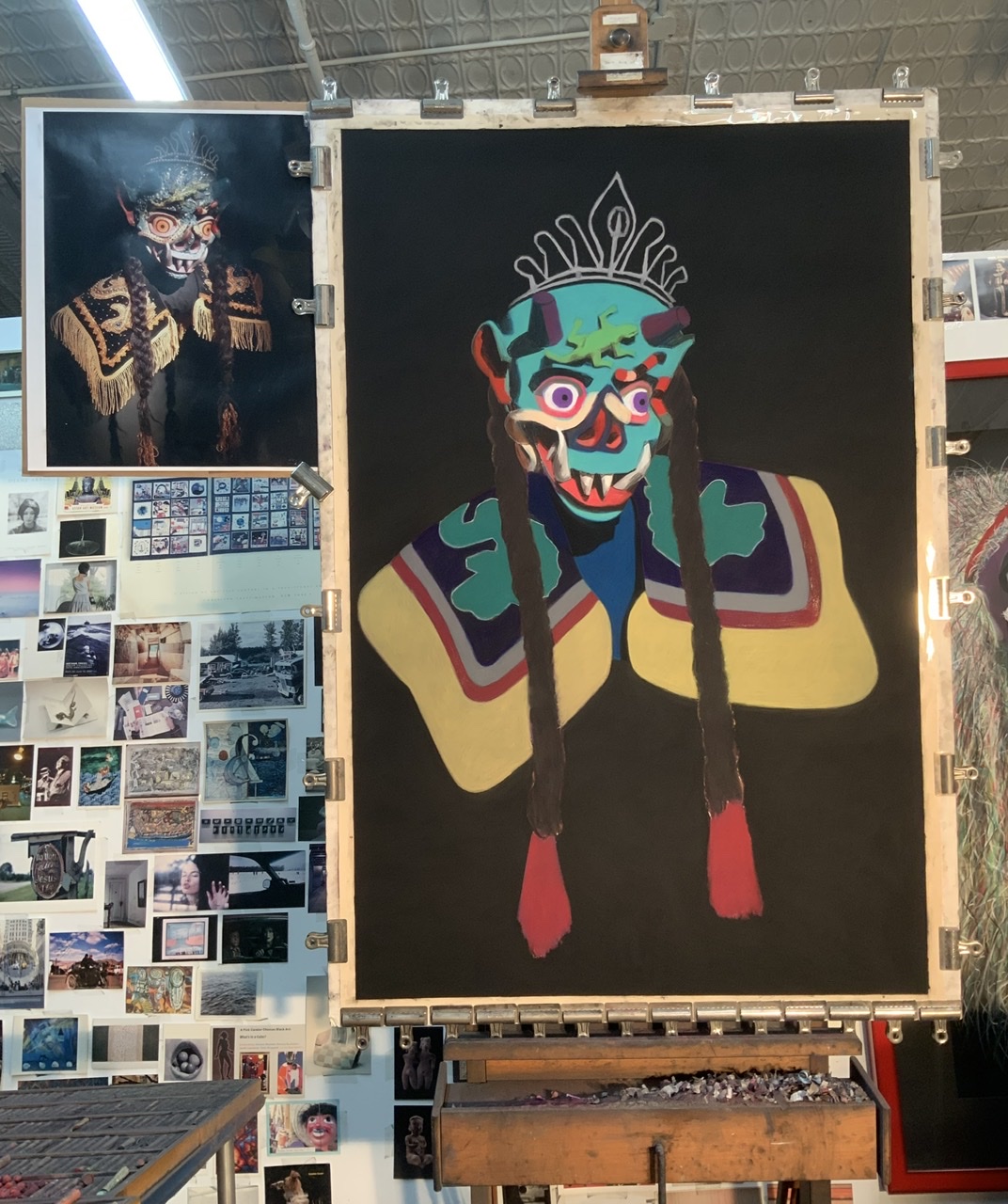
A: I’m working on a 58” x 38” pastel painting that is number 20 in the ”Bolivianos” series. It does not yet have a title. The mask depicted is a Supay. From Wikipedia:
In the Quechua, Aymara, and Inca mythologies, Supay was both the god of death and ruler of the Ukha, Pacha, and the Incan underworld, as well as a race of demons. Supay is associated with miners’ rituals.
With the Spanish colonization of the Americas, Christian priests used the name “Supay” to refer to the Christian Devil. However, unlike Europeans in relation to the Christian Devil, the indigenous people did not repudiate Supay but, being scared of him, they invoked him and begged him not to harm them.
Supay acquired a syncretic symbolism, becoming a main character of the diabladas of Bolivia (seen in the Carnival of Oruro), Peru and other Andean countries. The name Supay is now roughly translated into diablo (Spanish for devil) in most Southern American countries. In some of them, for example the northern region of Argentina, the underworld where Supay rules, is called “Salamanca”.
Comments are welcome!
Pearls from artists* # 445
*an ongoing series of quotations – mostly from artists, to artists – that offers wisdom, inspiration, and advice for the sometimes lonely road we are on.
My good friend the writer Charles L. Mee, Jr helped me to recognize the relationship between art and the way societies are structured. He suggested that, as societies develop, it is the artists who articulate the necessary myths that embody our experience of life and provide parameters for ethics and values. Every so often the inherited myths lose their value because they become too small and confined to contain the complexities of the ever-transforming and expanding societies. In that moment new myths are needed to encompass who we are becoming. These new constructs do not eliminate anything already in the mix; rather, they include fresh influences and engender new formations. The new mythologies always include ideas, cultures and people formerly excluded from the previous mythologies. So, deduces Mee, the history of art is the history of inclusion.
I believe that the new mythologies will be created and articulated in art, in literature, painting and poetry. It is the artists who will create a livable future through their ability to articulate in the face of flux and change.
Anne Bogart in A Director Prepares: Seven Essays on Art and Theater
Comments are welcome!


 barbararachkoscoloreddust.com