Blog Archives
Q: What historical art movement do you most identify with?

Barbara’s studio
A: I’d have to say that I identify most with surrealism, although my work does not exactly fit into any particular art historical movement. When I was first finding my way as an artist, I read everything I could find about surrealism in art and in literature. This research still res0nates deeply and is a tremendous influence on my studio practice. Elements of surrealism DO fit my work. Here’s an excerpt from Wikipedia:
Surrealism is a cultural movement that began in the early 20s and is best known for its visual artworks and writings. The aim was to “resolve the previously contradictory conditions of dream and reality.” Artists painted unnerving, illogical scenes with photographic precision, created strange creatures from everyday objects and developed painting techniques that allowed the unconscious to express itself.
Surrealist works feature the element of surprise, unexpected juxtapositions and non sequitur; however, many Surrealist artists and writers regard their work as an expression of the philosophical movement first and foremost, with the works being an artifact. Leader Andre Breton was explicit in his assertion that Surrealism was, above all, a revolutionary movement.
I hope to expand on this in a future post.
Comments are welcome!
Pearls from artists* # 199
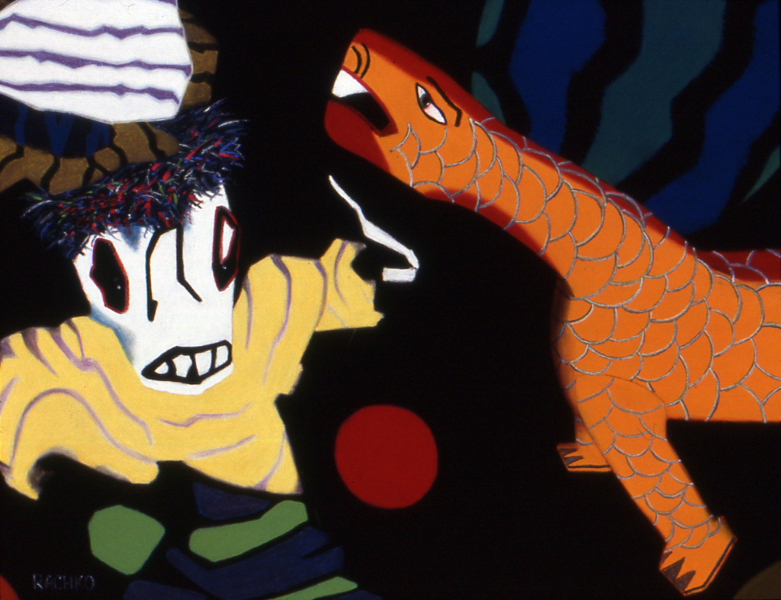
“Trio,” soft pastel on sandpaper, 20″ x 26″
* an ongoing series of quotations – mostly from artists, to artists – that offers wisdom, inspiration, and advice for the sometimes lonely road we are on.
Writers, like all artists, are concerned to represent reality, to create a more absolute and complete reality than reality itself. They must, if they are to accomplish this, assume a moral position, a clearly conceived political, social, and philosophical attitude; in consequence, their beliefs are, of course, going to find their way into their work. What artists believe, however, is of secondary importance, ancillary to the work itself. A writer survives in spite of his beliefs. Lawrence will be read whatever one thinks of his notions on sex. Dante is read in the Soviet Union.
A work of art, on the other hand, has a representative and expressive function. In this representation the author’s ideas, his judgments, the author himself, are engaged with reality.
Alberto Moravia in Writers at Work: The Paris Review Interviews First Series, edited and with an introduction by Malcolm Cowley
Comments are welcome!
Pearls from artists* # 155
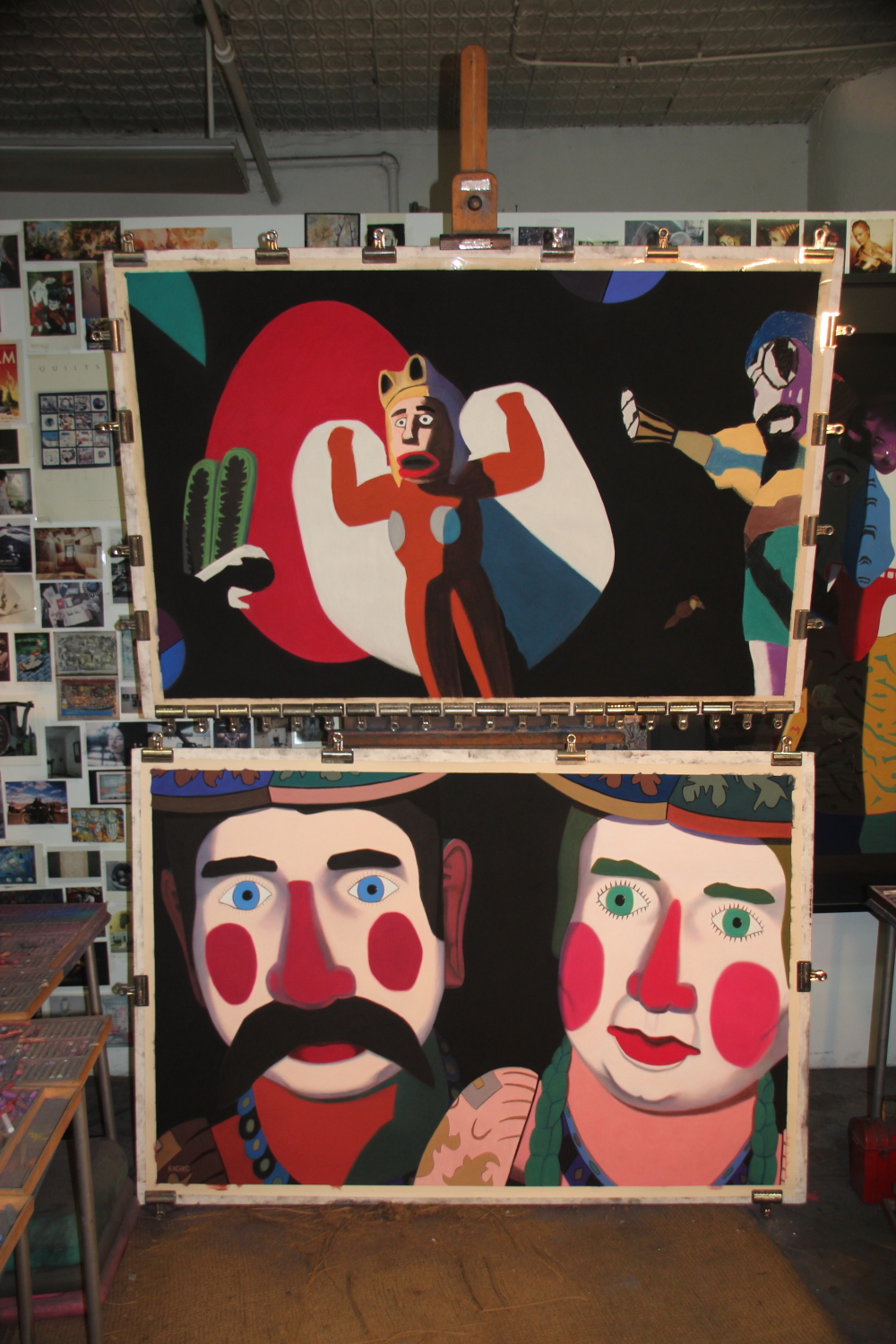
Works in progress
* an ongoing series of quotations – mostly from artists, to artists – that offers wisdom, inspiration, and advice for the sometimes lonely road we are on.
Throughout these many years of painting I have practiced starting my work from reality stating the facts before me. Then I paint without the object for a certain length of time, combining reality and imagination.
I have often obtained in painting directly from the object that which appears to be real results at the very first shot, but when that does happen, I purposely destroy what I have accomplished and re-do it over and over again. In other words that which comes easily I distrust. When I have condensed and simplified sufficiently I know that I have achieved more than reality.
Yasuo Kumiyoshi: East to West in The Creative Process, edited by Brewster Ghiselin
Comments are welcome!
Pearls from artists* # 154
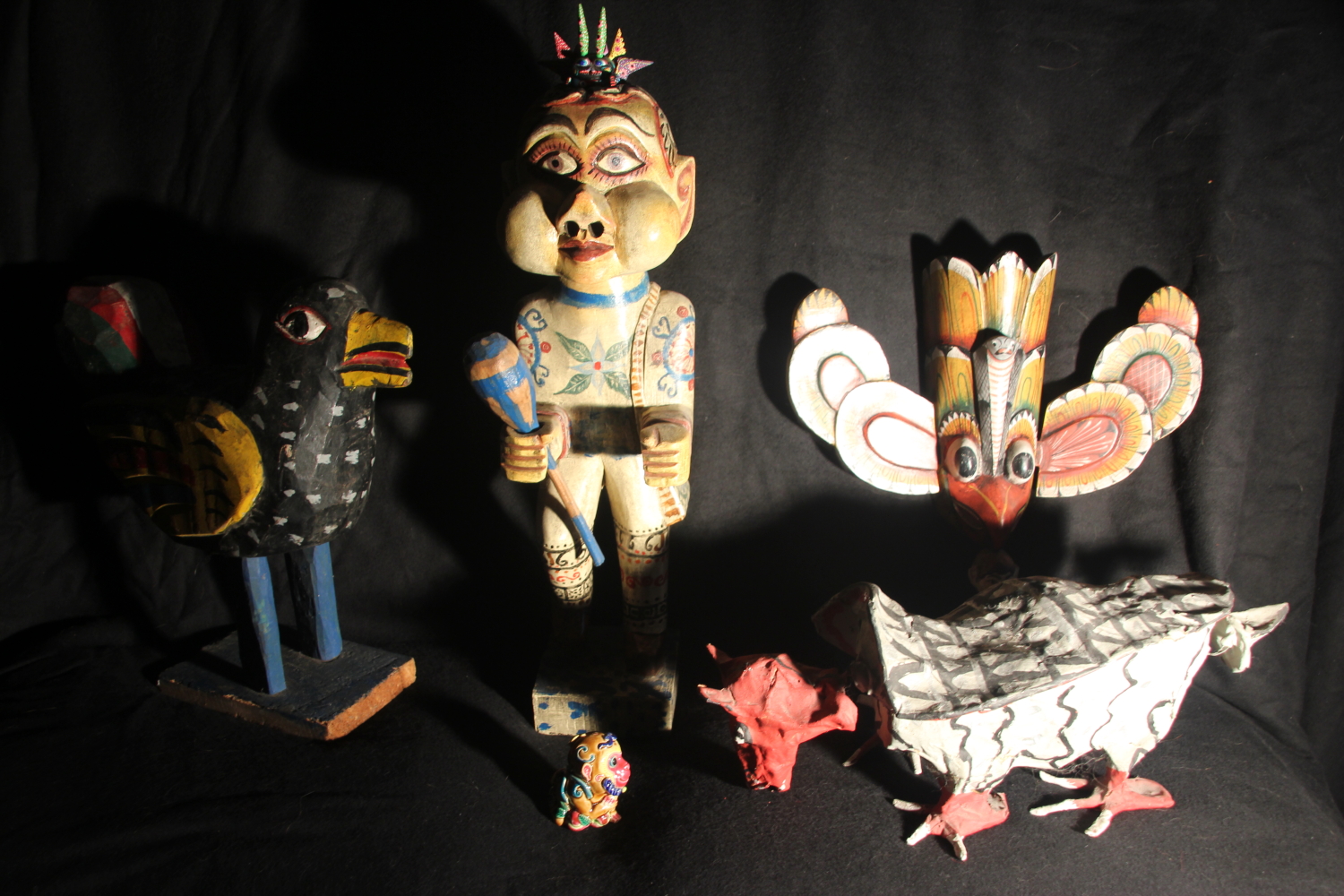
Idea for a painting
* an ongoing series of quotations – mostly from artists, to artists – that offers wisdom, inspiration, and advice for the sometimes lonely road we are on.
Often the public forms an idea of inspiration that is quite false, almost a religious notion. Alas! I do not believe that inspiration falls from heaven. I think it rather the result of a profound indolence and of our incapacity to put to work certain forces in ourselves. These unknown forces work deep within us, with the aid of the elements of daily life, its scenes and passions, and, they burden us and oblige us to conquer the kind of somnolence in which we indulge ourselves like invalids who try to prolong dream and dread resuming contact with reality, in short when the work that makes itself in us and in spite of us demands to be born, we can believe that this work comes to us from beyond and is offered by the gods. The artist is more slumberous in order that he shall not work. By a thousand ruses, he prevents his nocturnal work from seeing the light of day.
For it is at the moment that consciousness must take a precedence and that it becomes necessary to find the means which permit the unformed work to take form, to render it visible to all. To write, to conquer ink and paper, accumulate letters and paragraphs, divide them with periods and commas, is a different matter than carrying the dream of a play or of a book.
Jean Cocteau: The Process of Inspiration in The Creative Process, edited by Brewster Ghiselin
Comments are welcome!
Q: You have written about how you came to your current subject matter, but what led you away from photorealism to work that while not exactly abstract, leans more in that direction?
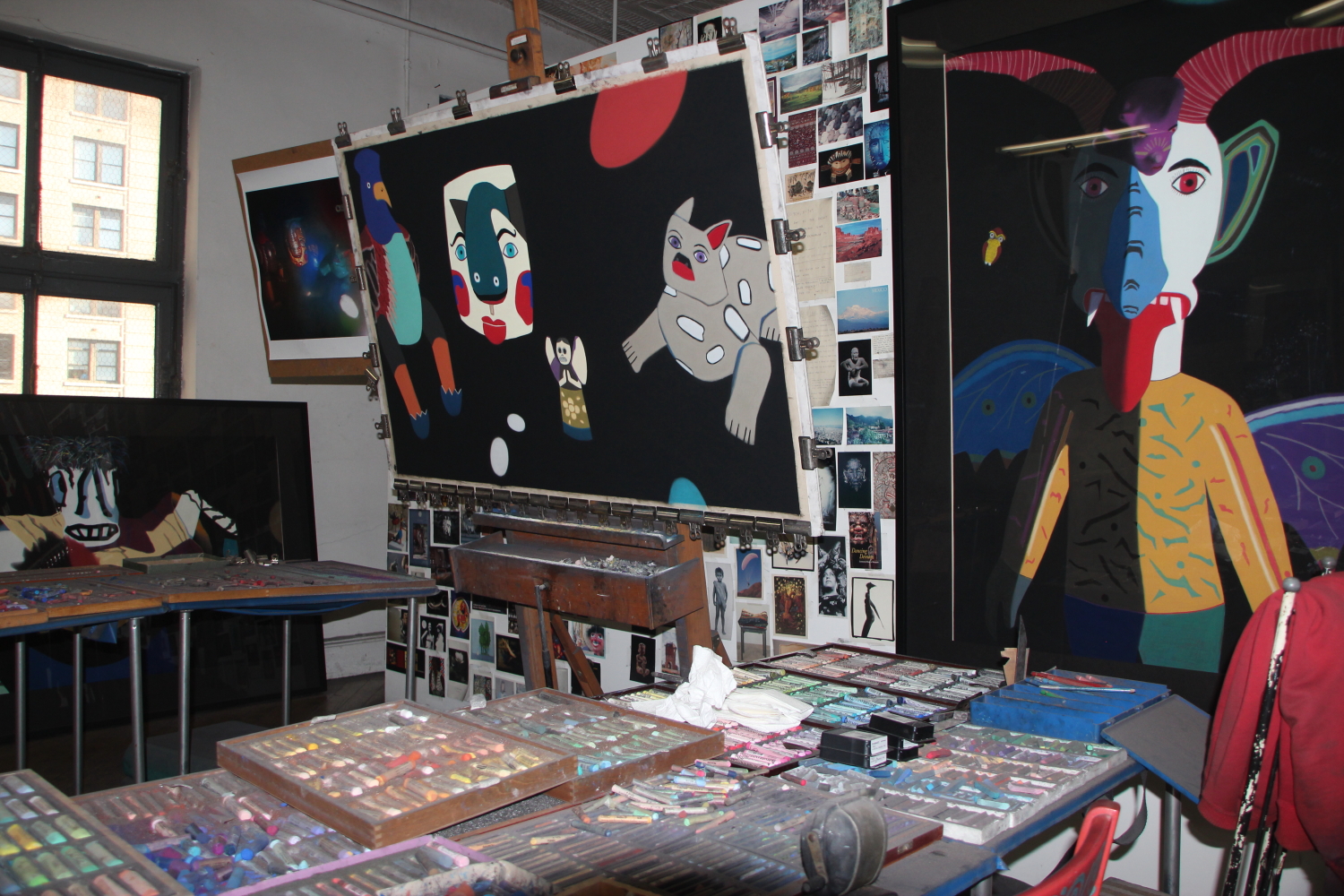
Barbara’s studio
A: Once I had achieved a high degree of technical facility with soft pastel, there was not much more to be gained from copying reality. Cameras do an excellent job of that so what would be the point?
Ultimately, all art lies in following an experience through to the end. Art is in the choices one makes. A visual artist’s private decisions about what to include and what to leave out become her unique inimitable style. Years ago I made a conscious decision to abandon photorealism. Since then I have been on a journey to work more from imagination and direct experience and less from physical reality.
It’s funny. I have always worked from photographs. Because I have a strong work ethic and substantial technical skill, I often feel like a slacker if I do not put in all the details that I see in the reference photo. That’s why the journey has been so slow, I think, as I convince myself it’s really ok to omit more and more details.
Comments are welcome!
Pearls from artists* # 76
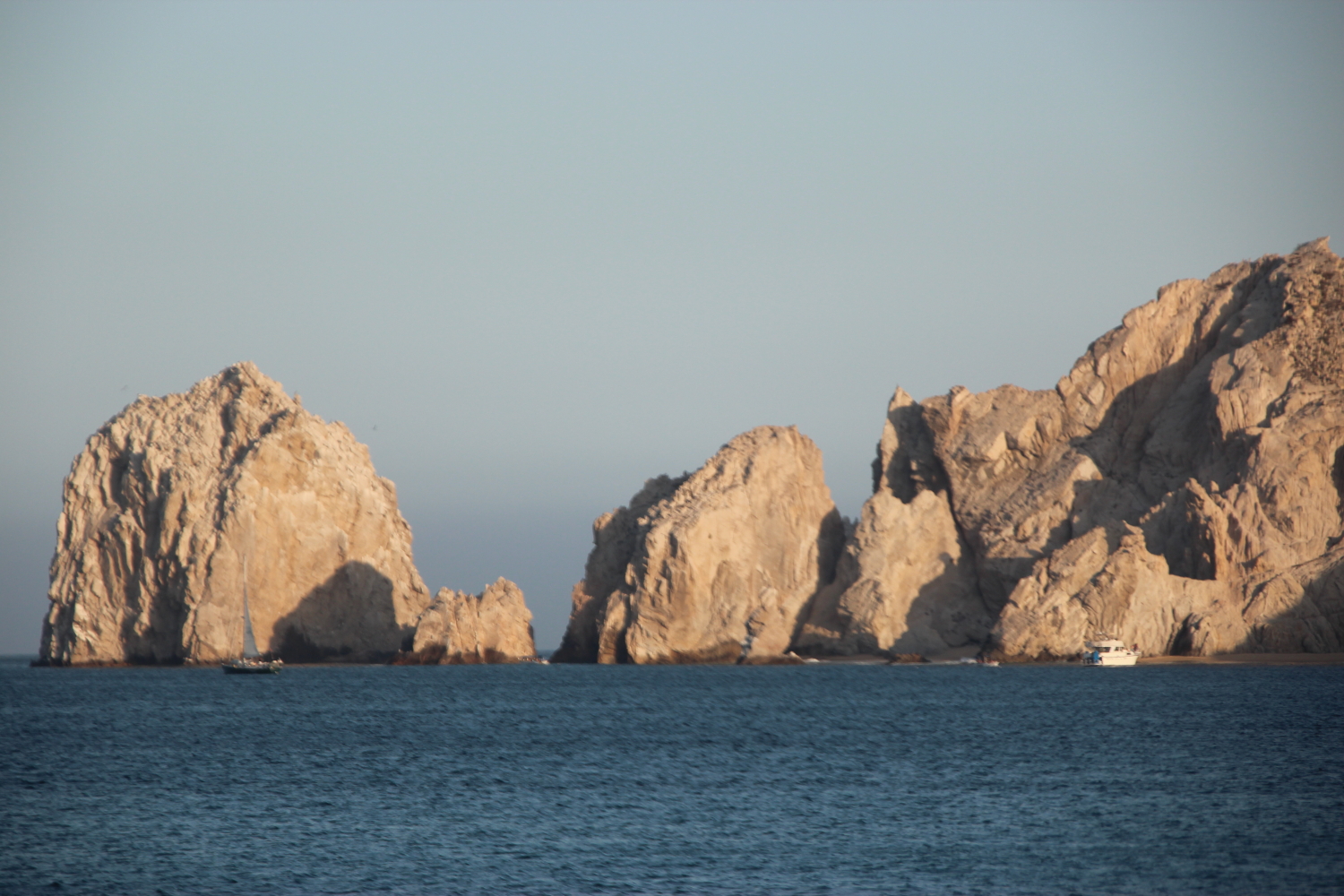
Cabo San Lucas, Mexico
* an ongoing series of quotations – mostly from artists, to artists – that offers wisdom, inspiration, and advice for the sometimes lonely road we are on.
What stops us in our tracks? I am rarely stopped by something or someone I can instantly know. In fact, I have always been attracted to the challenge of getting to know what I cannot instantly categorize or dismiss, whether an actor’s presence, a painting, a piece of music, or a personal relationship. It is the journey towards the object of attraction that interests me. We stand in relation to one another. We long for the relationships that will change our vistas. Attraction is an invitation to an evanescent journey, to a new way of experiencing life or perceiving reality.
An authentic work of art embodies intense energy. It demands response. You can either avoid it, shut it out, or meet it and tussle. It contains attractive and complicated energy fields and a logic all its own. It does not create desire or movement in the receiver, rather it engenders what James Joyce labeled ‘aesthetic arrest.’ You are stopped in your tracks. You cannot easily walk by it and go on with your life. You find yourself in relation to something that you cannot readily dismiss.
Anne Bogart in A Director Prepares: Seven Essays on Art and Theater
Comments are welcome!
Q: In light of the realities you discussed last week (see blog post of Aug. 24), what keeps you motivated to make art?

A favorite book
A: In essence it’s that I have always worked much harder for love than for money. I absolutely love my work, my creative process, and my chosen life. I have experienced much tragedy – no doubt there is more to come – but through it all, my journey as an artist is a continual adventure that gives me the ultimate freedom to spend my time on this earth as I want. In my work I make the rules, set my own tasks, and resolve them on my own timetable. What could be better than that?
Furthermore, I know that I have a gift and with that comes a profound responsibility, an obligation to develop and use it to the best of my ability, regardless of what it may cost. And when I say “cost,” I do not mean only money. Art is a calling and all self-respecting artists do whatever is necessary to use and express our gifts.
In “The Gift” Lewis Hyde says, “A gift is a thing we do not get by our own efforts. We cannot buy it, we cannot acquire it through an act of will. It is bestowed upon us. Thus we rightly speak of “talent” as a “gift” for although a talent can be perfected through an act of will, no effort in the world can cause its initial appearance. Mozart, composing on the harpsichord at the age of four, had a gift.”
Comments are welcome!
Q: Would you speak about the practical realities – time and expenses – involved in making your pastel-on-sandpaper paintings? What might people be surprised to learn about this aspect of art-making?
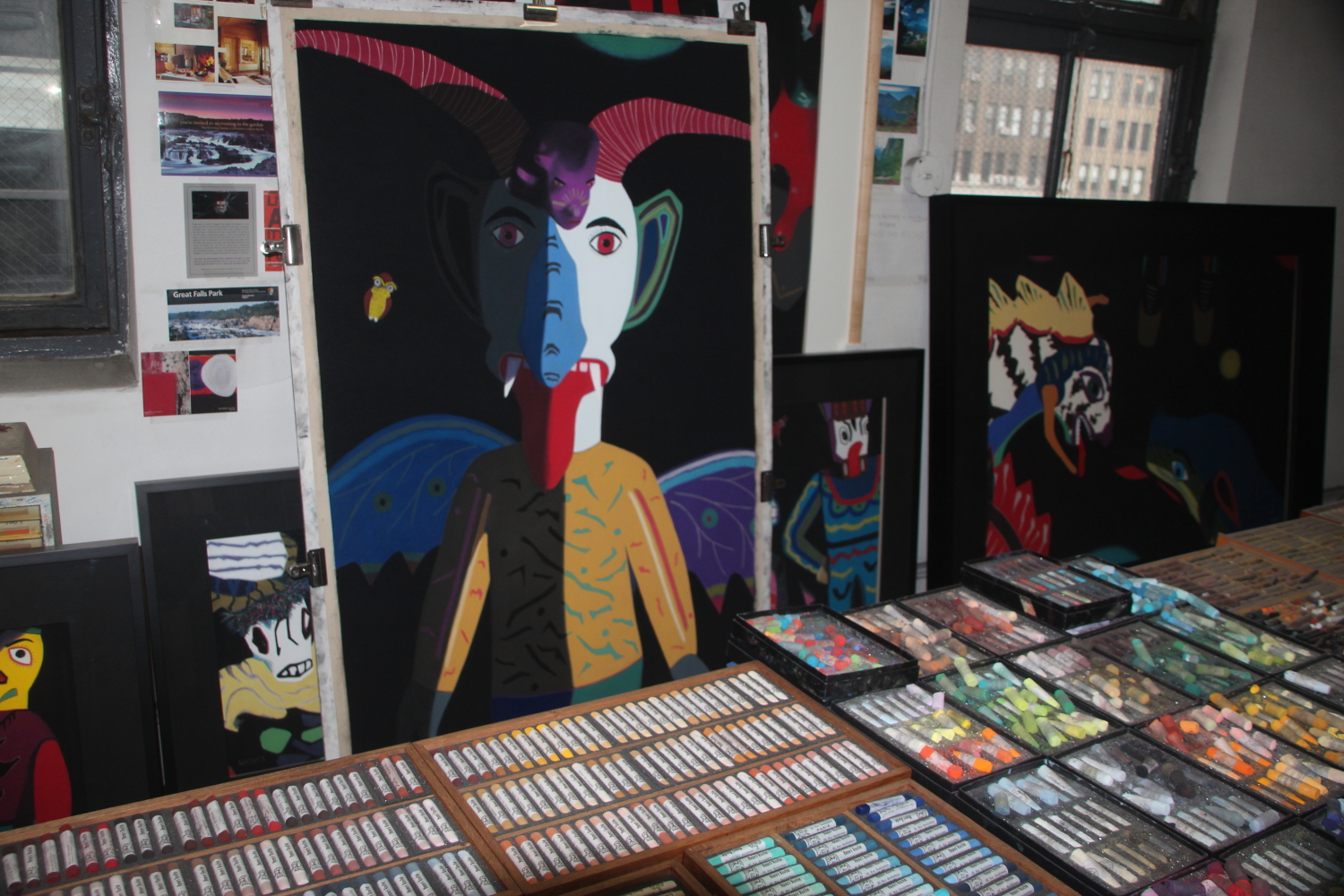
Studio
A: I have often said that this work is labor-intensive. In a good year I can complete five or six large (38″ x 58″) pastel paintings. In 2013 I am on track to make four, or, on average, one completed painting every three months. I try to spend between thirty-five and forty hours a week in the studio. Of course, I don’t work continuously all day long. I work for awhile, step back, look, make changes and additions, think, make more changes, step back, etc. Still, hundreds of hours go into making each piece in the “Black Paintings” series, if we count only the actual execution. There is also much thinking and preparation – there is no way to measure this – that happen before I ever get to stand before an empty piece of sandpaper and begin.
As far as current expenses, they are upwards of $12,000 per painting. Here is a partial breakdown:
$4500 New York studio, rent and utilities ($1350/month) for three months
$2500 Supplies, including frames (between $1500 – $1700), photographs, pastels (pro-rated), paper
$2000 Foreign travel to find the cultural objects, masks, etc. depicted in my work (approximate, pro-rated)
$3000 Business expenses, such as computer-related expenses, website, marketing, advertising, etc.
This list leaves out many items, most notably compensation for my time, shipping and exhibition expenses, costs of training (i.e. ongoing photography classes), photography equipment, etc. Given my overhead, the paintings are always priced at the bare minimum that will allow me to continue making art.
I wonder: ARE people surprised by these numbers? Anyone who has ever tried it knows that art is a tough road. Long ago I stopped thinking about the cost and began doing whatever is necessary to make the best paintings. The quality of the work and my evolution as an artist are paramount now. This is my life’s work, after all.
Comments are welcome!
Pearls from artists* # 54
Pier 40, NYC
* an ongoing series of quotations – mostly from artists, to artists – that offers wisdom, inspiration, and advice for the sometimes lonely road we are on.
In the cemetery all the vultures began to circle, and the sky filled with birds. It was then that I began my series of birds – many of my bird photos came from that moment. All this is to say that in life everything is connected: your pain and your imagination, which perhaps can help you forget reality. It’s a way of showing how you connect what you live with what you dream, and what you dream with what you do, and this is what remains on paper…
Graciela Iturbide in Eyes to Fly With
Comments are welcome!


 barbararachkoscoloreddust.com
Q: What is the reality of the art world today? Do people experience it enough?
Aug 2
Posted by barbararachkoscoloreddust
West 29th Street studio
A: I cannot comment on the art world today or the experience of other people. I can only speak for myself. I am completely devoted to my work; my entire life revolves around art. When I’m not in my studio creating, I am reading about art, thinking about it, gaining inspiration from other artists and from artistic travel, working out new ideas, going to museum and gallery exhibitions, trying to understand the business side of things, etc. Art is a calling and I personally experience it enough as my work continues to evolve!
Comments are welcome!
Share this:
Posted in 2014, An Artist's Life, Art in general, Black Paintings, Creative Process, Inspiration, New York, NY, Pastel Painting, Photography, Studio, Working methods
2 Comments
Tags: art, art world, artistic, business, calling, comment, completely, continues, creating, devoted, enough, evolve, Exhibitions, experience, gaining, gallery, going, grow, ideas, inspiration, life, museum, people, personally., reading, reality, revolves, speak, Studio, thinking, today, travel, trying, understand, West 29th Street, work, working