Blog Archives
Q: What’s the most unusual place you have exhibited your art? Was it worth it?
A: In 2004 I exhibited in a group show that was hosted as a fund raiser for Breast Cancer Awareness Month. Artists who had had breast cancer were invited to present our work. The show was titled, “Art of Survival,” and was held in a breast surgeon’s office in West Long Branch, NJ. I had absolutely no expectations of selling anything and reluctantly participated, thinking, “More people are likely to see my work in this show than would see it in my studio during the same period.” Who could have foreseen it, but I sold a $15,000 painting to the surgeon who had organized the exhibition!
Sadly, several years later, the curator of the exhibition informed me that Beth, the breast cancer surgeon, had died from the same disease.
Comments are welcome!
Pearls from artists* # 624

Machu Picchu (Peru), June 2016
*an ongoing series of quotations – mostly from artists, to artists – that offers wisdom, inspiration, and advice for the sometimes lonely road we are on.
If we were speaking from the point of view of the historian, and if we desired to know as concretely as possible how those peoples of the past or present conceived of their world, we should have to turn to their philosophy to find how they thought about their world, and to their sciences to analyze the atomic factors that contributed to those thoughts, and to their applied arts for the understanding of how this notion appeared when necessarily vulgarized to the common denominator of intelligence. But we would have to turn to their art to understand how they “felt about their world,” to know how their notions of reality found expression in their sensual perception of the world. And we know, of course, how those expressions can differ by simply examining Christian art, which consciously discarded the reality of its predecessor, Greek Hellenistic art.
Mark Rothko in The Artist’s Reality: Philosophies of Art
Comments are welcome!
Pearls from artists* # 605

*an ongoing series of quotations – mostly from artists, to artists – that offers wisdom, inspiration, and advice for the sometimes lonely road we are on.
At first the concept of the unconscious was limited to denoting the state of repressed or forgotten contents. Even with Freud, who makes the unconscious – at least metaphorically – take the stage as the acting subject, it is really nothing but the gathering place of forgotten and repressed contents, and has a functional significance thanks only to these. For Freud, accordingly, the unconscious is of an exclusively personal nature, although he was aware of its archaic and mythological thought forms.
A more or less superficial layer of the unconscious is undoubtedly personal. I call it the personal unconscious. But this personal unconscious rests upon a deeper layer, which does not derive from personal experience and is not a personal acquisition but is inborn. This deeper layer I call the collective unconscious. I have chosen the term “collective” because this part of the unconscious is not individual but universal; in contrast to the personal psyche, it has contents and modes of behavior that are more or less the same everywhere and in all individuals. It is, in other words, identical in all men and thus constitutes a common psychic substrate of a suprapersonal nature which is present in every one of us.
Carl Jung in The Archetypes and the Collective Unconscious, translated by RFC Hull
Comments are welcome!
Pearls from artists* # 589

Barbara’s studio… where plenty of mistakes happen!
*an ongoing series of quotations – mostly from artists, to artists – that offers wisdom, inspiration, and advice for the sometimes lonely road we are on.
In school, in the workplace, in learning an art or sport, we are taught to fear, hide or avoid mistakes. But mistakes are of incalculable value to us. There is first the value of mistakes as the raw material of learning. If we don’t make mistakes, we are unlikely to make anything at all. Tom Watson, for many years the head of IBM, said “Good judgment comes from experience. Experience cones from bad judgment.” But more important, mistakes and accidents can be the irritating grains that become pearls; they present us with unforeseen opportunities, they are fresh sources of inspiration in and of themselves. We come to regard our obstacles as ornaments, as opportunities to be exploited and explored.
Seeing and using the power of mistakes does not mean that anything goes. Practice is rooted in self-correction and refinement, working toward clearer and more reliable technique. But when a mistake occurs, we can treat it either as an invaluable piece of data about our technique or as a grain of sand around which we can make a pearl.
Stephen Nachmanovitch in Free Play: Improvisation in Life and Art
Comments are welcome!
Pearls from artists* # 579

New York, NY
*an ongoing series of quotations – mostly from artists, to artists – that offers wisdom, inspiration, and advice for the sometimes lonely road we are on.
An empirical fact about our lives is that we do not and cannot know what will happen a day or a moment in advance. The unexpected awaits us at every turn and every breath. The future is a vast perpetually regenerated mystery and the more we live and know, the greater the mystery. When we drop the blinders of our preconceptions, we are virtually propelled by every circumstance into the present time and the present mind: the moment, the whole moment, and nothing but the moment. This is a state of mind taught and strengthened by improvisation, a state of mind in which the here and now is not some trendy idea but a matter of life and death, upon which we can learn to reliably depend. We can depend on the world being a perpetual surprise in general motion and a perpetual invitation to create.
Stephen Nachmanovitch in Free Play: Improvisation in Life and Art
Comments are welcome!
Pearls from artists* # 572

*an ongoing series of quotations – mostly from artists, to artists – that offers wisdom, inspiration, and advice for the sometimes lonely road we are on.
The use of color to paint the Chinchorro mummies is interesting. According to anthropologist Victor Turner (1970), colors are experiences of social relationships. The use of particular colors in prehistory, then, has meaning even if today we cannot comprehend these meanings. Turner said that white, red, and black are the earliest colors produced by humans and they “provide a kind of primordial classification of reality” (Turner, 1970:90). This color trilogy is associated with reproduction, life, and death. Obviously, in the case of Chinchorros, black and red colors predominated. Black is equated with darkness, like the night, invisible yet present. Black is what is hidden, it is a mystical transition (Turner, 1970:109, 89-73). Black represents death, but not the end of a cycle, not an annihilating, rather a change of status and existence (Turner, 1970:71-72). Red on the other hand is equal to membership, change, blood, and social place (Turner, 1970:90). Red can be associated with life, here and in the afterworld.
The use of colors as symbols is rather universal, but the meaning of each color varies from culture to culture. In western societies black may be worn to symbolize mourning, but on other occasions it signifies relevance. The Yahgan Indians in South America used body painting with intricate patterns of black, white, and red to show their sadness and grief when someone died (Gusinde, 1937). Black was the color to symbolize mourning among the Incas (Montez, 1929:222; Zuidema, 1992:23).
Bernardo T. Arrizabalaga in Beyond Death: The Chinchorro Mummies of Ancient Chile
Comments are welcome!
Pearls from artists* #571
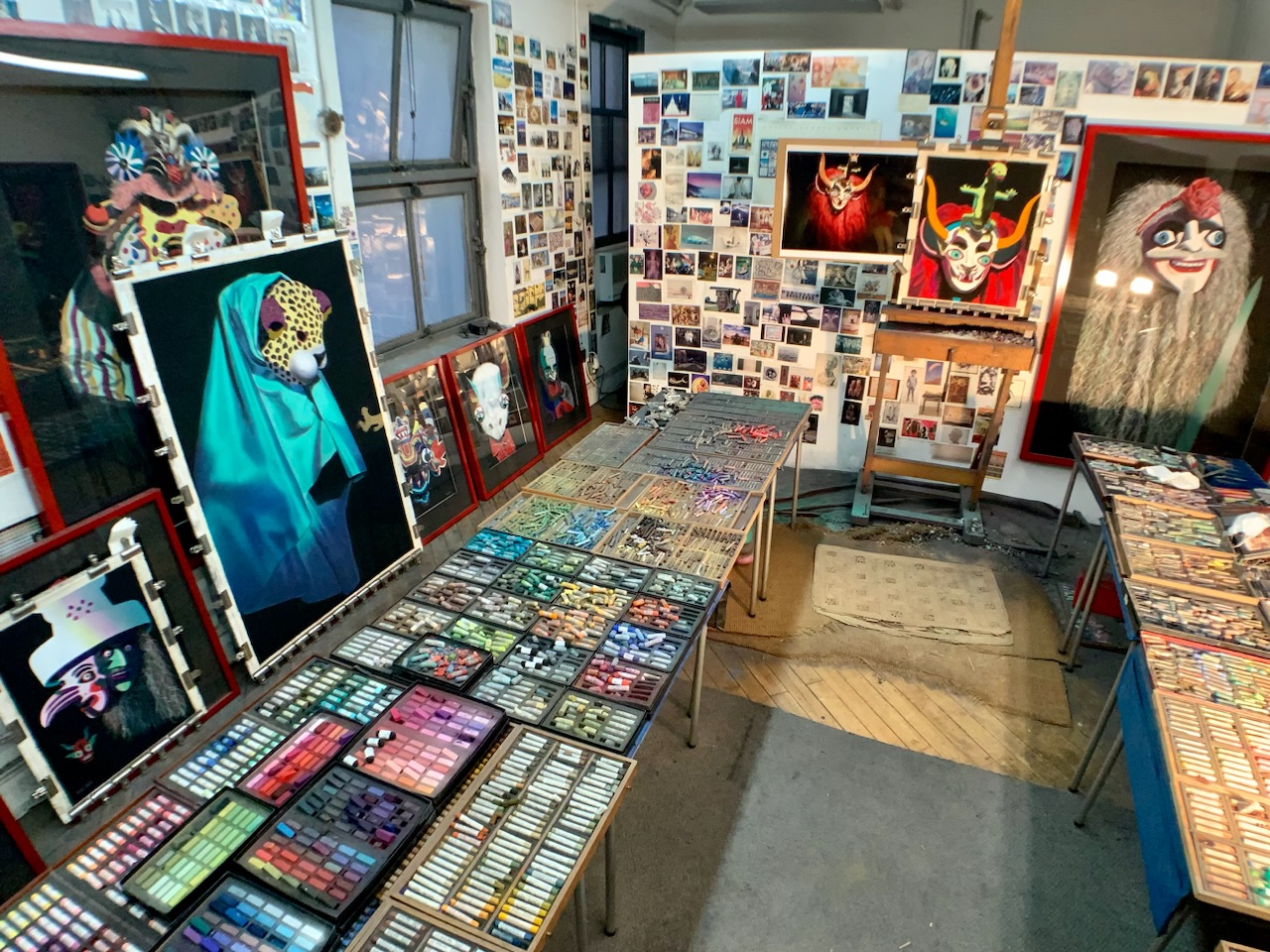
The Studio
*an ongoing series of quotations – mostly from artists, to artists – that offers wisdom, inspiration, and advice for the sometimes lonely road we are on.
To put it simply, but accurately, artists are often lost to the world because of their obsessions with their art. They may be just as lost as they prepare to work or incubate a new idea as in those feverish days when they make their final cuts on a film or race toward a publishing deadline. They may obsess about artistic questions and feel bursts of creative energy day or night, alone or in the company of others, in the middle of the work week or on vacation in the Bahamas.
Lost in time and space, the artist may feel more connected to Picasso, Emily Dickinson, Ingmar Bergman, Gertrude Stein, Handel, or Tennessee Williams than to the people in his immediate world. The living past holds extraordinary meaning for him. He travels elsewhere, removing his spirit and attention from the present. He may reside, as he works on his novel, in the childhood of a character, walking the garden paths and living the household dramas there. He may come upon a Rembrandt drawing and find himself wrenched, not to any particular place or time, but just elsewhere, as he experiences the greatness of his traditions, measures himself anew, and dreams again of his future.
Eric Maisel in A Life in the Arts: Practical Guidance and Inspiration for Creative and Performing Artists
Comments are welcome!
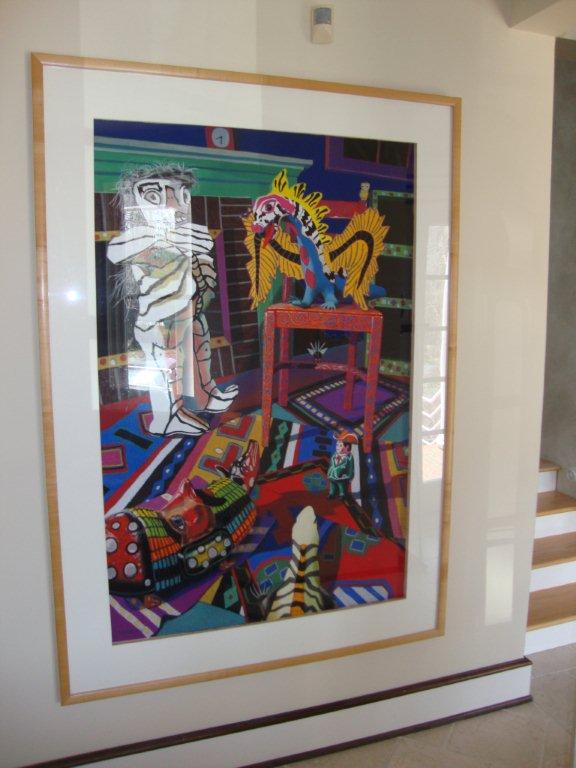
Q: The first pastel painting you see every morning when you arrive at your studio is “Myth Meets Dream.” It must have special meaning. Would you elaborate? (Question suggested by Marlissa Gardner via Facebook)

A: “Myth Meets Dream,” an early pastel painting from the “Domestic Threats” series, is one I have never wanted to sell. It marks the first time I included Mexican folk art figures in my work. In 1992 as a Christmas present, my future sister-in-law sent the two Oaxacan painted wooden figures you see depicted above – the blue winged creature and the red, white, and black figure behind it. The other three figures in this painting are hand-puppets.
Previously, I had been creating elaborate staged photographs in my Alexandria house using stuffed animals and hand-puppets. (The latter were made by a company called “Folk Tails”). I used the photos as reference material for pastel paintings. In other words, rather than work exclusively from life, I mostly looked at these photos while I made the painting. Although I have simplified my process since those early days, I still create pastel paintings using reference photographs.
In “Myth Meets Dream” you can see both puppets and my then new Oaxacan folk art figures. This pastel painting marks an important transition in subject matter and was the start of decades-worth of foreign travel, study, adventure, hard work, and yes, fun. It’s true that “Myth Meets Dream” hangs in my studio and is the first thing I see every morning. It brings back so many precious memories.
Every painting has a story!
If you’re interested to learn more, please see https://barbararachko.art/en/art-market
Comments are welcome!
Pearls from artists* # 550

In the studio
*an ongoing series of quotations – mostly from artists, to artists – that offers wisdom, inspiration, and advice for the sometimes lonely road we are on.
Be more than ready. Be present in your discipline. Remember your gift. Be grateful for your gift and treat it like a gift. Cherish it, take care of it, and pass it on. Use your time to bathe yourself in that gift. Move your hand across the canvas. Go to museums. Make this into an obsession.
… what you are will show, ultimately. Start now, every day, becoming in your actions, your regular actions, what you would like to become in the bigger scheme of things.
Anna Deveare Smith in Letters to a Young Artist: Straight Up Advice on Making a Life in the Arts – For Actors, Performers, Writers, and Artists of Every Kind
Comments are welcome!
Pearls from artists* # 532
*an ongoing series of quotations – mostly from artists, to artists – that offers wisdom, inspiration, and advice for the sometimes lonely road we are on.
Far from offering an escape from the world, the arts present one of the most difficult and hard-fought ways to enter into the life of our time or any other time. What the artist must first accept is the authority of an art form, the immersion in what others have done and achieved. Once the artist has begun to take all that in – it’s a process that never really ends – there comes the even greater challenge of asserting one’s freedom. It’s the limits imposed by a vocation that makes it possible to turn away from the pressures of the moment and think and feel freely – and sometimes, give the most private emotions an extraordinary public hearing. If art is the ordering of disorderly experience, and I don’t know how else to describe it, then the artist must be true both to the order and to the disorder. These are the trials of the artist and the artistic vocation. They shape the experience of anybody who reads a novel or looks at a painting or listens to a piece of music.
Jed Perl in Authority and Freedom: A Defense of the Arts
Comments are welcome!


 barbararachkoscoloreddust.com