Blog Archives
Pearls from artists* # 164
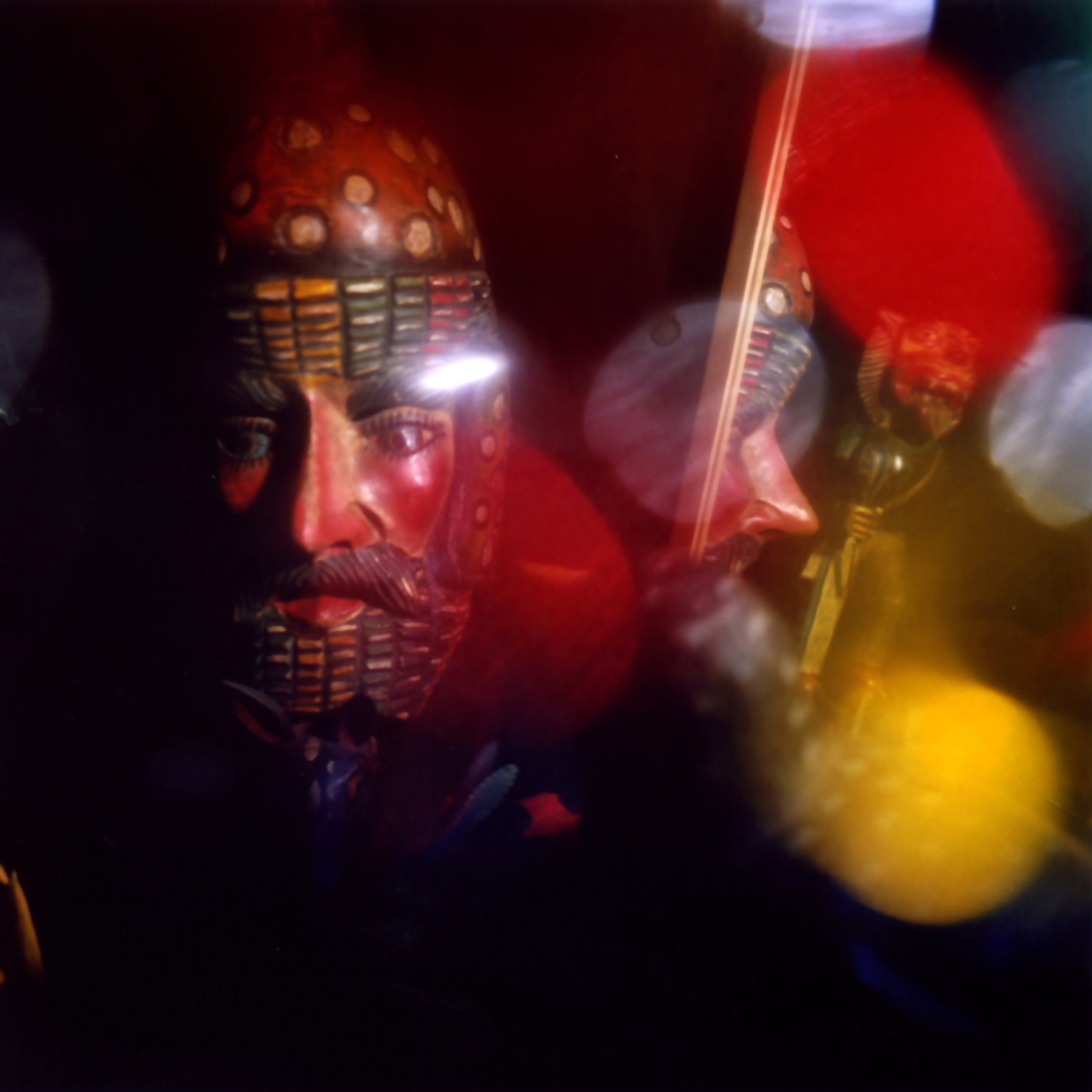
Untitled chromogenic print, 24″ x 24,” edition of 5
* an ongoing series of quotations – mostly from artists, to artists – that offers wisdom, inspiration, and advice for the sometimes lonely road we are on.
The Eastern and Western classics are full of gods, saints, and heroes, all striving against life’s odds and overcoming them with perseverance, courage, energy and hope as well as help from some sort of divine energy. Unlike the gods, the saints, gurus, and heroes are humanized in creative works. Otherwise, we would find it difficult to accept them, relate to them or look up to them for inspiration and courage. It is the humanization of the subject that makes the supernatural sometimes feel real. And sometimes makes the impossible seem reachable and achievable. The classic writings all contain humanized heroes, saints and gods. The characters in these books are so humanized that the courage and inspiration we get from their endurance in overcoming life’s challenges will keep on inspiring readers forever. Because of this we can aspire to their accomplishments. If we too are able to create meaningful works providing timeless inspiration to help others, our work will live on.
Samuel Odoquei in Origin of Inspiration: Seven Short Essays for Creative People
Comments are welcome!
Q: How do you decide how much realism and how much imagination to put into a pastel painting?
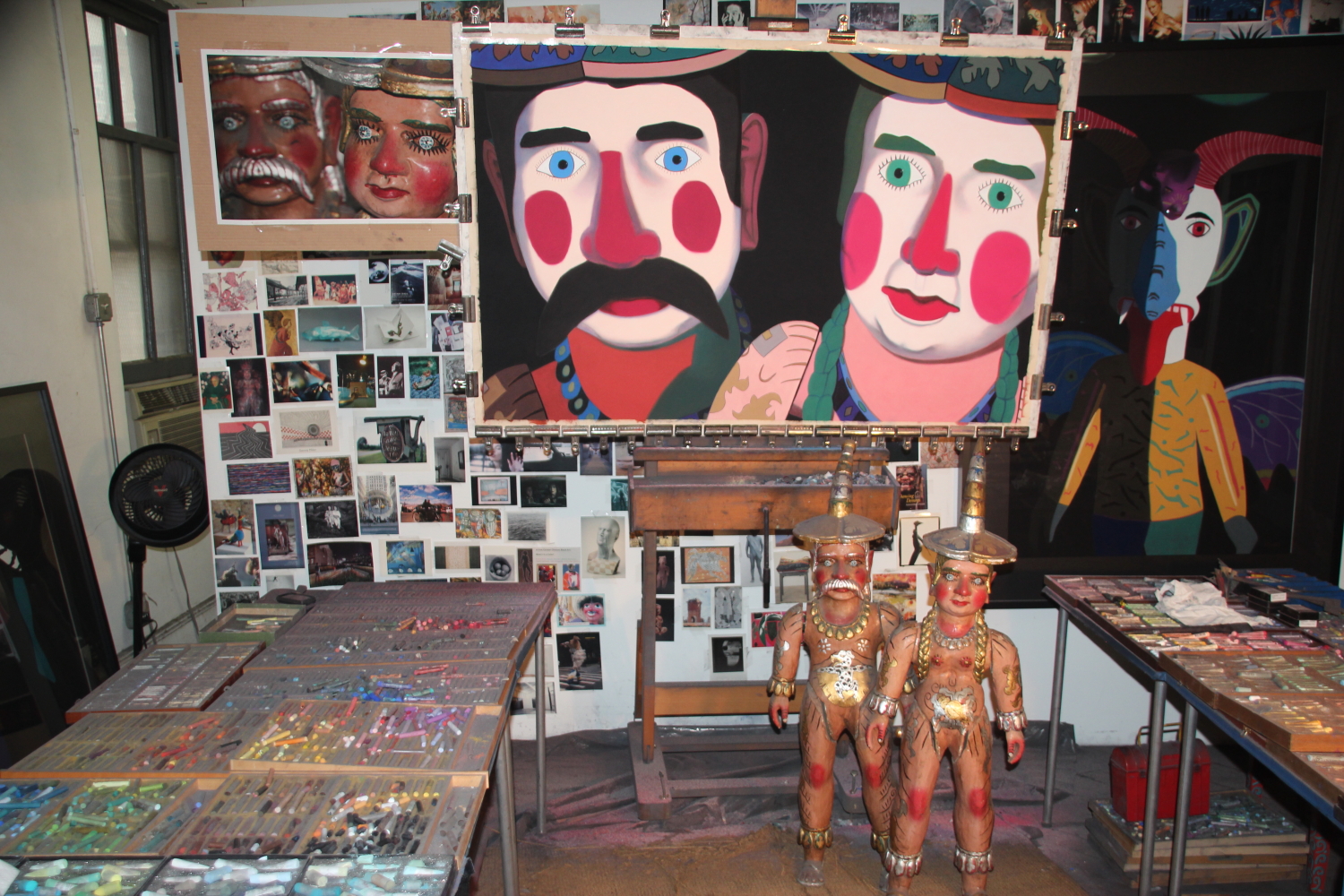
Models, reference photograph, and pastel painting in progress
A: I wouldn’t say “decide” is the right word because creating a painting is not strictly the result of conscious decisions. I think of my reference photograph, my preliminary sketch, and the actual folk art objects I depict as starting points. Over the months that it takes to make a pastel painting, the resulting interpretive development pushes the painting far beyond this source material. When all goes well, the original material disappears and characters that belong to the painting and nowhere else emerge.
It is a mysterious process that I am still struggling to understand. This is the best way I can describe what it feels like from the inside, as the maker.
Comments are welcome!
Q: What’s on the easel today?
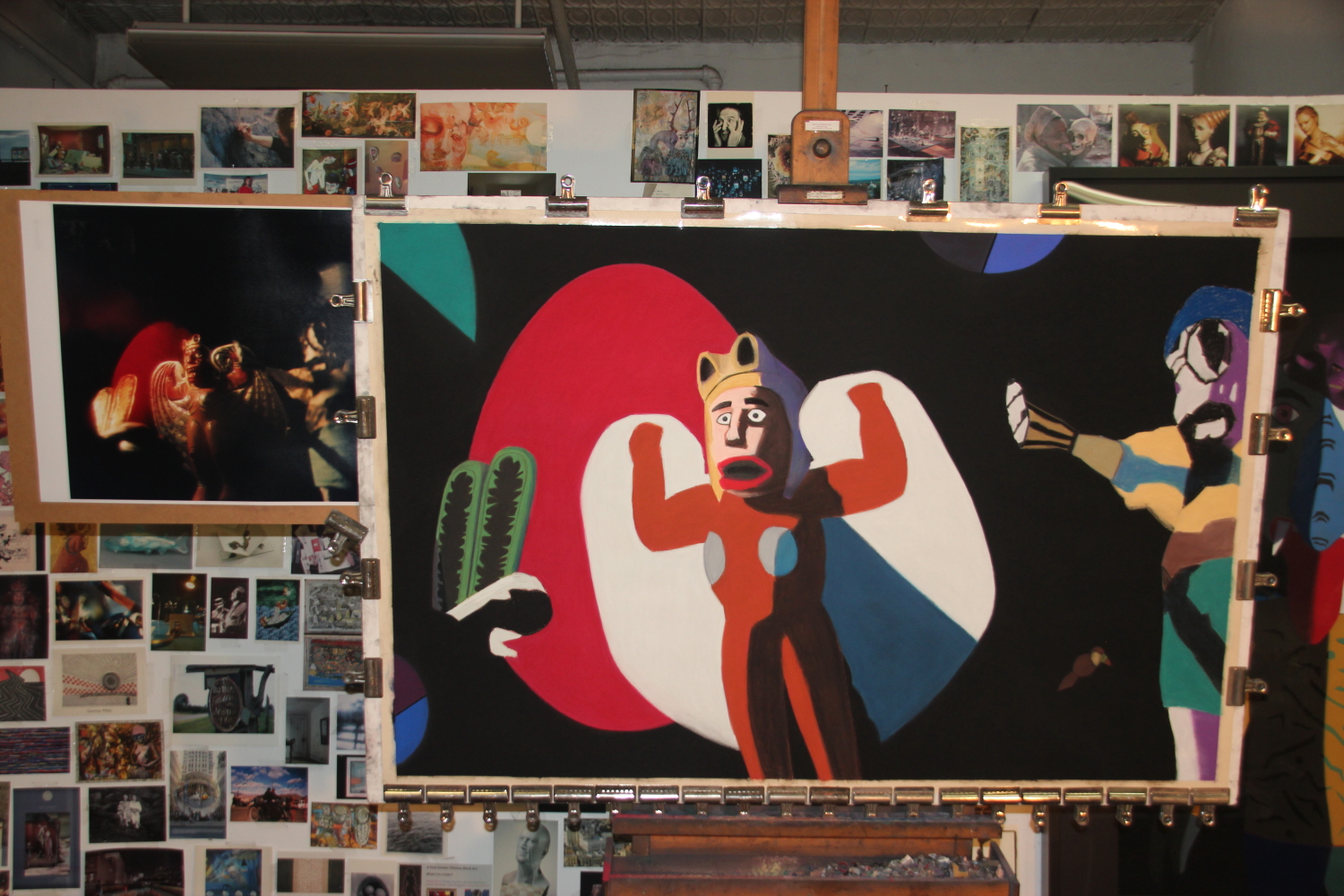
Work in pogress
A: I am working on a 38″ x 58″ pastel painting. Rather than create and photograph a new setup each time, I sometimes search through older photographs to find ones that might spark a compelling painting. Photos that I haven’t seen in a while often have new lessons to teach. The one clipped to my easel above is from 2009.
Comments are welcome!
Pearls from artists* # 148
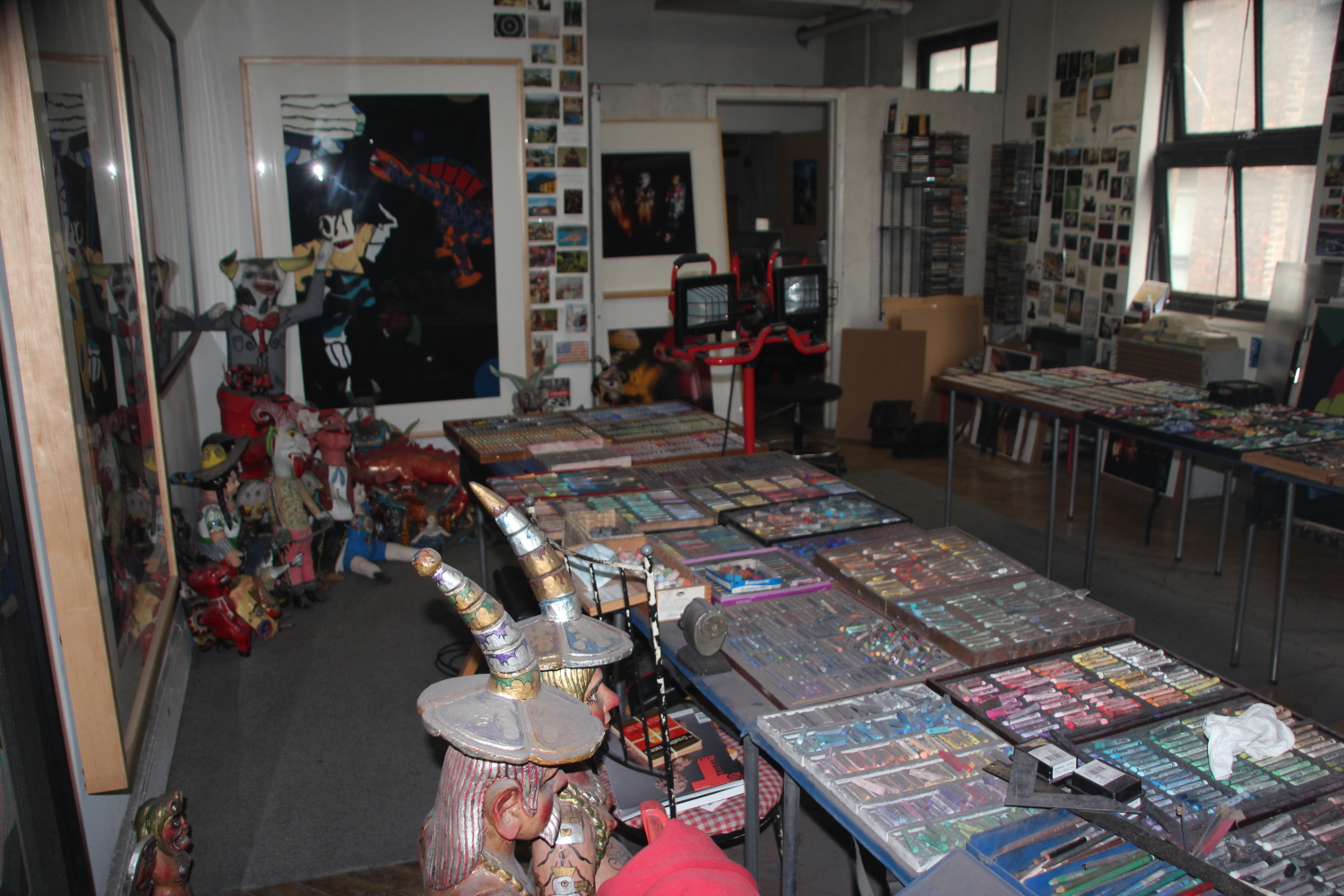
Barbara’s studio
* an ongoing series of quotations – mostly from artists, to artists – that offers wisdom, inspiration, and advice for the sometimes lonely road we are on.
I want Bob Iger, the head of Disney, to invest in my ideas. In fact … one of my ideas is … I love Walt Disney … I feel Disney should have an art fund that completely supports all of the arts. And I feel that there should be a responsibility, recruiters, constantly looking for new thinkers and connecting them directly to companies that already work. Why does the person who has the most genius idea or cultural understanding or can create the best art have to figure out how to become a businessman in order to become successful at expressing himself? I think it’s important for anyone that’s in power to empower.
Kanye West in Choice Quotes from Kanye’s Address at the School of the Art Institute of Chicago, in Hyperallergic, May 12, 2015
Comments are welcome!
Q: How do you know when a series has ended?

“A Promise, Meant to be Broken,” soft pastel on sandpaper, 58″ x 38″
A: I suppose it’s when there is nothing left to say within a particular body of work. The urgency to add something I haven’t tried vanishes. Usually I can’t even think of anything I haven’t tried.
I knew with certainty that the “Domestic Threats” series was finished while “A Promise Meant to be Broken” was still on my easel. It’s no accident that I included a self-portrait. This painting was my way of saying good-bye to an important body of work – literally turning my back on it – and summing up where the work had taken me.
For artists each series is a creative journey with a beginning, a middle, and an end. At a certain point it’s over. Then you build on what you’ve accomplished and move on to create something new. The connection between new work and old may not always be obvious, but one thing is certain: all the previous work laid the groundwork for what you make today.
Comments are welcome!
Pearls from artists* # 131
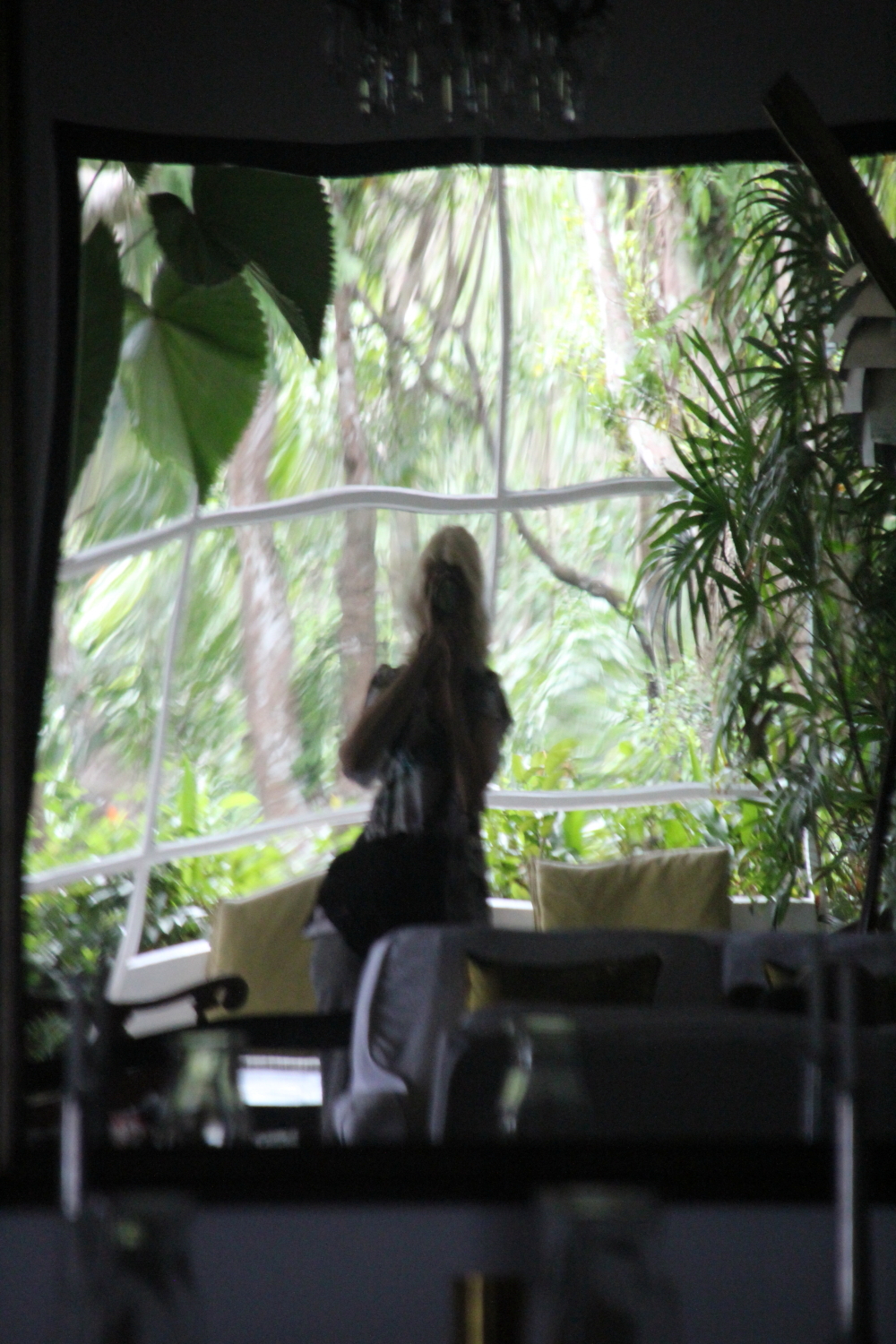
Self-portrait at an architect’s estate in Sri Lanka
* an ongoing series of quotations – mostly from artists, to artists – that offers wisdom, inspiration, and advice for the sometimes lonely road we are on.
Sister Corita
Immaculate Heart College Art Department Rules
Rule 1: Find a place you trust, and then try trusting it for a while.
Rule 2: General duties of a student: pull everything out of your teacher. Pull everything out of your fellow students.
Rule 3: General duties of a teacher: Pull everything out of your students.
Rule 4: Consider everything an experiment.
Rule 5: Be self-disciplined. This means finding someone wise or smart and choosing to follow them. To be disciplined is to follow in a good way. To be self-disciplined is to follow in a better way.
Rule 6: Nothing is a mistake. There’s no win and no fail. There’s only make.
Rule 7: The only rule is work. If you work it will lead to something. It’s the people who do all of the work all of the time who eventually catch on to things.
Rule 8: Don’t try to create and analyze at the same time. They’re different processes.
Rule 9: Be happy whenever you can manage it. Enjoy yourself. It’s lighter than you think.
Rule 10: “We’re breaking all the rules. Even our own rules. And how do we do that? By leaving plenty of room for X quantities.” John Cage
Helpful Hints: Always be around. Come or go to everything. Always go to classes. Read anything you can get your hands on. Look at movies carefully, often. Save everything – it might come in handy later.
There should be new rules next week.
Quoted in The Art Life: On Creativity and Career by Stuart Horodner
Comments are welcome!
Q: Why don’t you make political art?
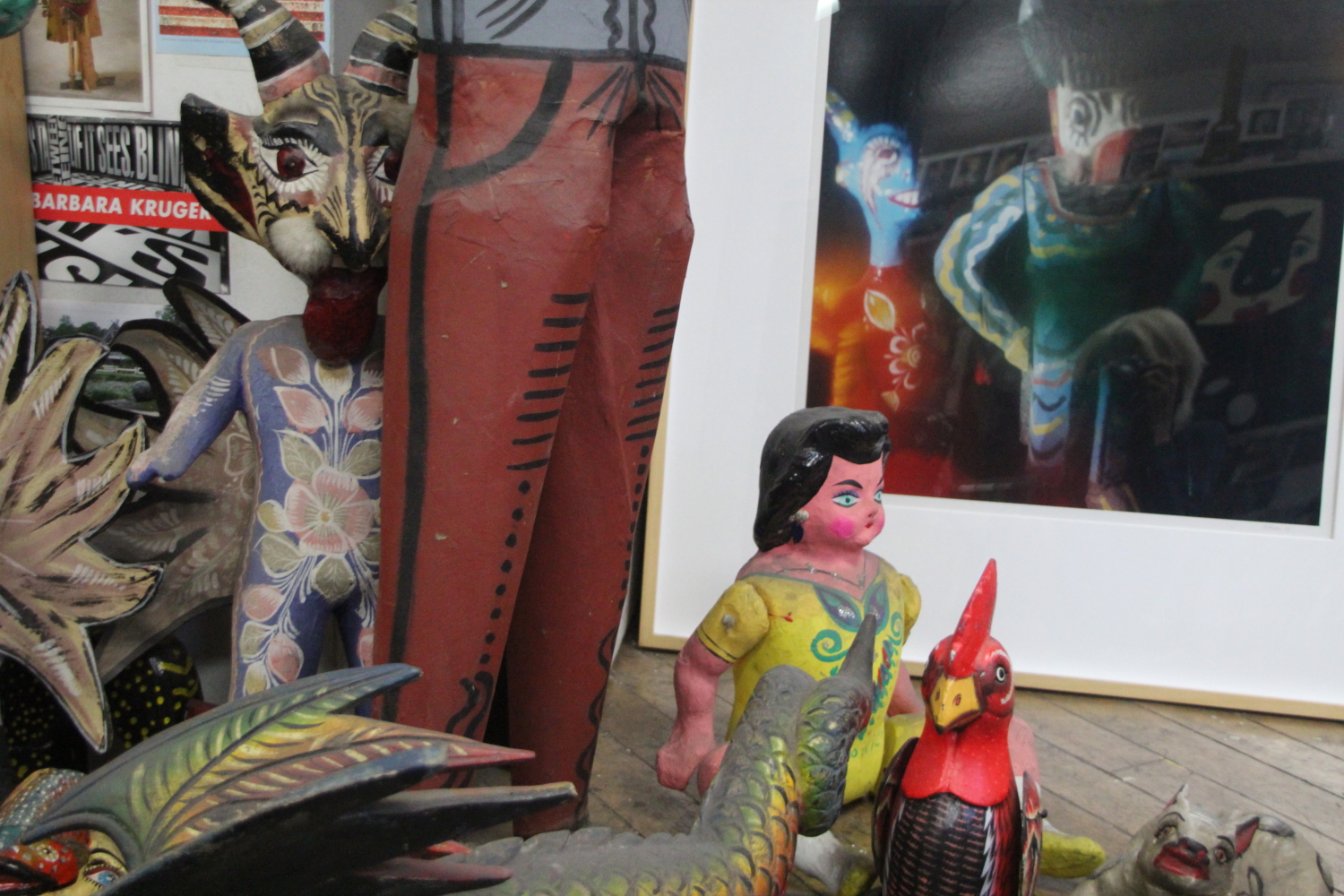
Barbara’s studio
A: I have little interest in dealing with political events in my work because these events come and go. They have a short shelf life. Fine art based on current events quickly loses its context and becomes outdated and irrelevant.
I prefer art that is timeless. My intention is to create personal work about deeper psychological issues and the human condition. Done well, personal work is more likely to speak to and stay with an audience long after the news cycle has moved on.
Comments are welcome!
Q: Can you talk a little bit about your process? What happens before you even begin a pastel painting?

Barbara in Bali (far right)
A: My process is extremely slow and labor-intensive.
First, there is foreign travel – often to Mexico, Guatemala or someplace in Asia – to find the cultural objects – masks, carved wooden animals, paper mâché figures, and toys – that are my subject matter. I search the local markets, bazaars, and mask shops for these folk art objects. I look for things that are old, that look like they have a history, and were probably used in religious festivals of some kind. Typically, they are colorful, one-of-a- kind objects that have lots of inherent personality. How they enter my life and how I get them back to my New York studio is an important part of my art-making practice.
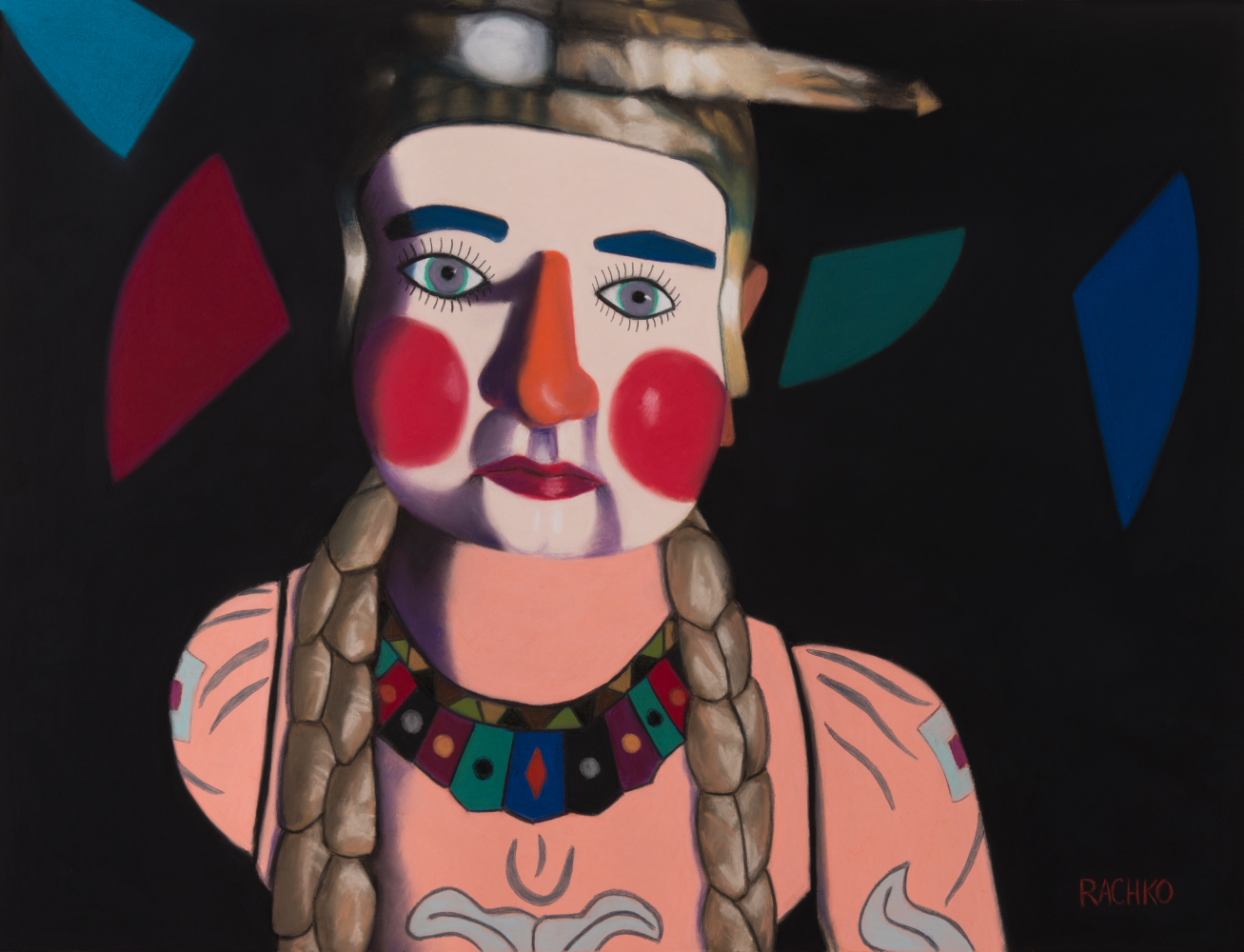
My working methods have changed dramatically over the nearly thirty years that I have been an artist. My current process is a much simplified version of how I used to work. As I pared down my imagery in the current series, “Black Paintings,” my creative process quite naturally pared down, too.
One constant is that I have always worked in series with each pastel painting leading quite naturally to the next. Another is that I always set up a scene, plan exactly how to light and photograph it, and work with a 20″ x 24″ photograph as the primary reference material.
In the setups I look for eye-catching compositions and interesting colors, patterns, and shadows. Sometimes I make up a story about the interaction that is occurring between the “actors,” as I call them.
In the “Domestic Threats” series I photographed the scene with a 4″ x 5″ Toyo Omega view camera. In my “Gods and Monsters” series I shot rolls of 220 film using a Mamiya 6. I still like to use an old analog camera for fine art work, although I have been rethinking this practice.
Nowadays the first step is to decide which photo I want to make into a painting (currently I have a backlog of photographs to choose from) and to order a 19 1/2″ x 19 1/2″ image (my Mamiya 6 shoots square images) printed on 20″ x 24″ paper. They recently closed, but I used to have the prints made at Manhattan Photo on West 20th Street in New York. Now I go to Duggal. Typically I have in mind the next two or three paintings that I want to create.
Once I have the reference photograph in hand, I make a preliminary tonal charcoal sketch on a piece of white drawing paper. The sketch helps me think about how to proceed and points out potential problem areas ahead.
Only then am I ready to start actually making the painting.
Comments are welcome!


 barbararachkoscoloreddust.com
Q: Another interesting series of yours that has impressed me is your recent “Black Paintings.” The pieces in this series are darker than the ones in “Domestic Threats.” You create an effective mix between the dark background and the few bright tones, which establish such a synergy rather than a contrast, and all the dark creates a prelude to light. It seems to reveal such a struggle, a deep tension, and intense emotions. Any comments on your choice of palette and how it has changed over time?
Dec 6
Posted by barbararachkoscoloreddust
West 29th Street studio
A: That is a great question!
You are correct that my palette has darkened. It’s partly from having lived in New York for so long. This is a generally dark city. We famously dress in black and the city in winter is mainly greys and browns.
Also, the “Black Paintings” are definitely post-9/11 work. My husband, Bryan, was tragically killed onboard the plane that crashed into the Pentagon. Losing Bryan was the biggest shock I ever have had to endure, made even harder because it came just 87 days after we had married. We had been together for 14 ½ years and in September 2001 were happier than we had ever been. He was killed so horribly and so senselessly. Post 9/11 was an extremely difficult, dark, and lonely time.
In the summer of 2002 I resumed making art, continuing to make “Domestic Threats” paintings. That series ran its course and ended in 2007. Around then I was feeling happier and had come to better terms with losing Bryan (it’s something I will never get over but dealing with loss does get easier with time). When I created the first “Black Paintings” I consciously viewed the background as literally, the very dark place that I was emerging from, exactly like the figures emerging in these paintings. The figures themselves are wildly colorful and full of life, so to speak, but that black background is always there.
Comments are welcome!
Share this:
Posted in 2014, An Artist's Life, Art in general, Art Works in Progress, Black Paintings, Creative Process, Domestic Threats, Inspiration, Painting in General, Pastel Painting, Photography, Studio, Working methods
Comments Off on Q: Another interesting series of yours that has impressed me is your recent “Black Paintings.” The pieces in this series are darker than the ones in “Domestic Threats.” You create an effective mix between the dark background and the few bright tones, which establish such a synergy rather than a contrast, and all the dark creates a prelude to light. It seems to reveal such a struggle, a deep tension, and intense emotions. Any comments on your choice of palette and how it has changed over time?
Tags: after, always, another, around, art, background, better, between, biggest, black, Black Paintings, bright, browns, Bryan, changed, choice, city, colorful, comments, consciously, continuing, contrast, correct, course, crashed, create, dark, dealing, deep, difficult, Domestic Threats, dress, easier, effective, emerging, emotions, ended, endure, establish, exactly, extremely, famously, feeling, figures, first, full, generally, great, greys, happier, harder, horribly, however, husband, impressed, intense, interesting, killed, life, light, literally, lived, lonely, losing, loss, mainly, making, married, mix, New York, onboard, paintings, palette, partly, Pentagon, pieces, plane, post-9/11, prelude, question, rather, recent, resumed, reveal, senselessly, September, series, shock, something, speak, struggle, summer, synergy, tension, terms, themselves, time, together, tones, tragically, viewed, wildly, winter, work