Blog Archives
Pearls from artists* # 483

*an ongoing series of quotations – mostly from artists, to artists – that offers wisdom, inspiration, and advice for the sometimes lonely road we are on.
The editor has a unique relationship with the actors. I never try to go on to the set to see the actors out of costume or out of character – and also just not to see the set. I only want to see what there is on screen. Ultimately, that’s all the audience is ever going to see. Everyone else working on the film at that stage is party to everything going on around the filmed scene: how cold it was when that scene was shot; who was mad at whom; who is in love with whom; how quickly something was done; what was standing just to the left of the frame. An editor particularly has to be careful that those things don’t exert a hidden influence on the way the film is constructed, can (and should in my view) remain ignorant of all that stuff – in order to find value where others might not see value, and on the other hand, to diminish the value of certain things that other people see as too important. It’s one o the crucial functions of the editor. To take, as far as it is possible, the view of the audience, who is seeing the film without any knowledge of all the things that went into its construction.
On Editing Actors, by Walter Murch in The Conversations: Walter Murch and the Art of Editing Film, by Michael Ondaatje
Comments are welcome!
Pearls from artists* # 481
*an ongoing series of quotations – mostly from artists, to artists – that offers wisdom, inspiration, and advice for the sometimes lonely road we are on.
Artists, because they spend such prolonged periods in isolation, frequently fall behind the times. They may gain great self-knowledge, spiritual insight, and understanding of their media as they work in private, but at the price of a lack of vital knowledge of the world around them.
Because solitude provides artists with a safe haven, fits their personality, and offers them a kind of communal contact with other human beings through their work, it can also serve as a breeding ground for stagnation. Without ever realizing it, artists can grow flacid in isolation and begin to experience their solitude as deadening. The studio can become too easy and unchallenging a place.
The world outside the studio offers unmatched opportunities for growth and for the expression of authentic and courageous behavior. Artists often miss these opportunities and, remaining relatively untested, handle themselves poorly when they do venture out.
Eric Maisel in A Life in the Arts: Practical Guidance and Inspiration for Creative and Performing Artists
Comments are welcome!
Pearls from artists* 457
*an ongoing series of quotations – mostly from artists, to artists – that offers wisdom, inspiration, and advice for the sometimes lonely road we are on.
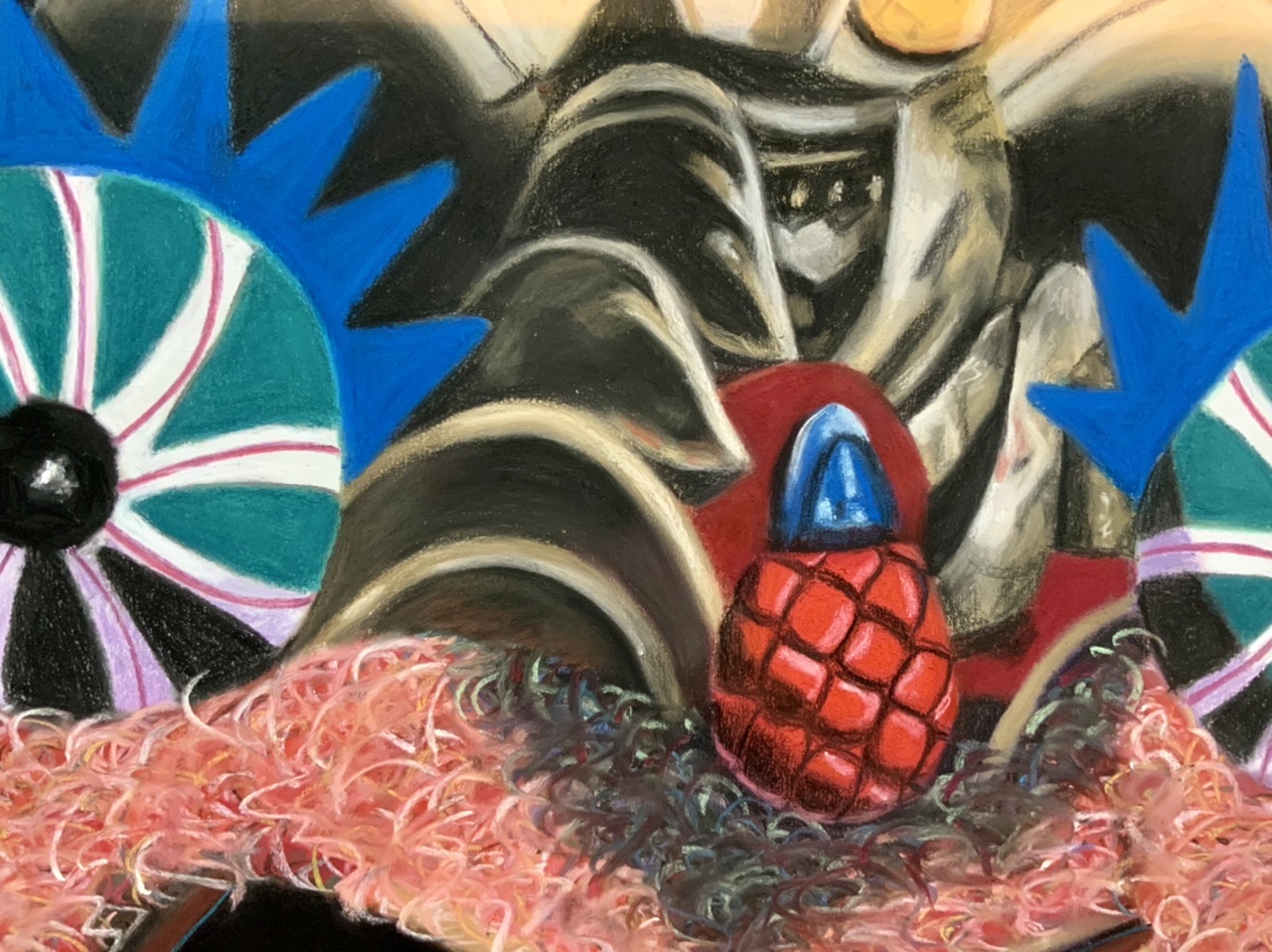
In Italy on the Prixe de Rome, he [Phillip Guston] traveled, studied Piero and Tiepolo and drew everywhere. His marks bunched up in quavering confederations and eventually left their subject matter behind. The trouble with figurative art, he concluded, was that it “vanishes into recognition.” Remove the recognizable and you can begin to see the push and pull of impulse, recanting, and reconfiguration that constitute painting and, by extension, life itself.
Susan Tallman in Philip Guston’s Discomfort Zone, The New York Review of Books, January 14, 2021
Comments are welcome!
Q: What’s the best piece of advice you’ve been given?
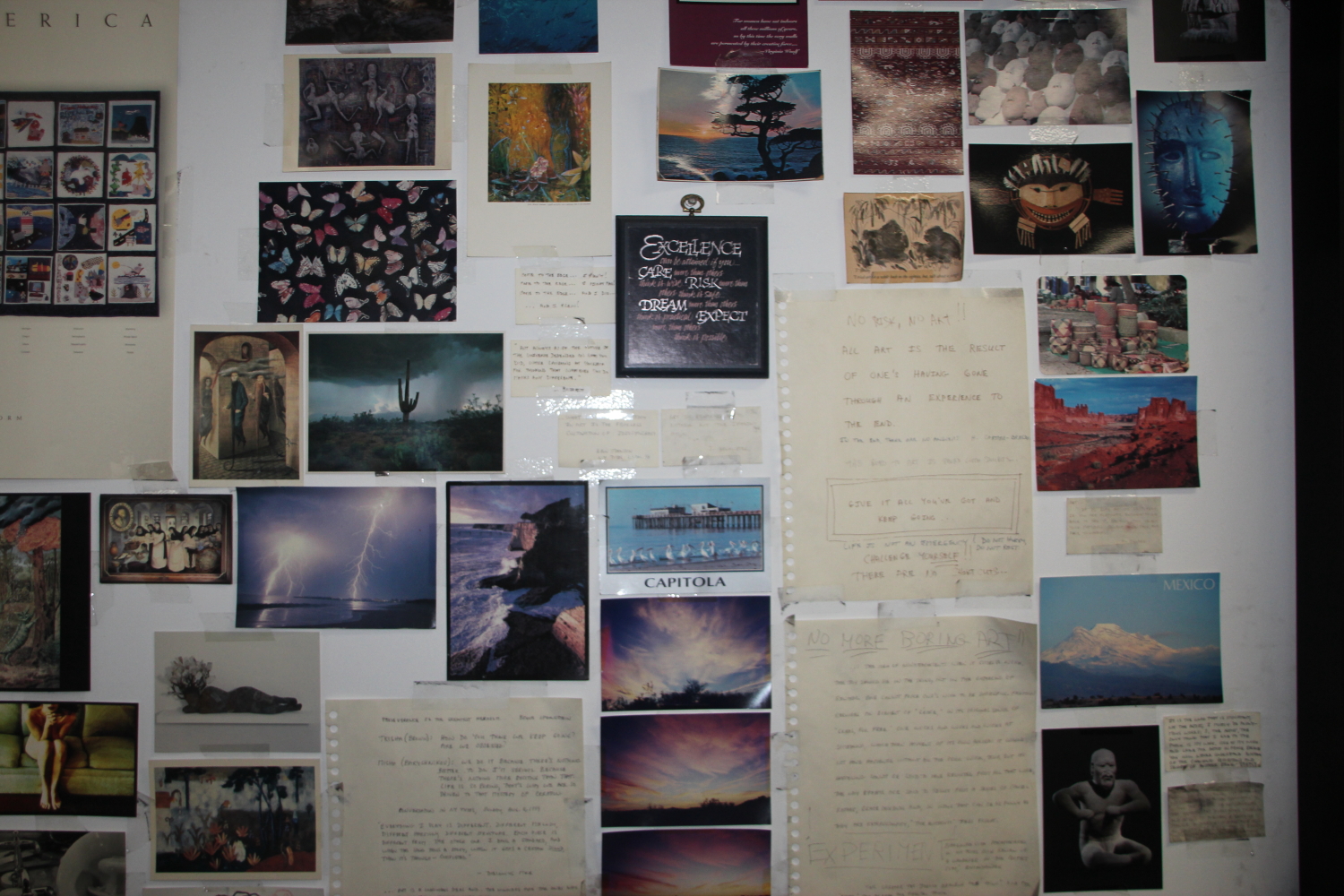
A wall in Barbara’s studio
A: When I left the active duty Navy in 1989, my co-workers threw a farewell party. One of the parting gifts I received was a small plaque from a young enlisted woman whom I had supervised. The words on the plaque deeply resonated with me, since I was about to make a significant, risky, and scary career change. It was the perfect gift for someone facing the uncertainty of an art career.
Many years later Tina’s plaque is still a proud possession of mine. It is hanging on the wall behind my easel, to be read every day as I work. It says:
“Excellence can be attained if you…
Care more than others think is wise…
Risk more than others think is safe…
Dream more than others think is practical…
Expect more than others think is possible.”
Comments are welcome!

Q: Would you speak about the creative process that resulted in your 1994 pastel painting, “Amok”?

A: Behind me in the photo above is one of my circa 1994 50” x 40” c-prints, signed by both Bryan, my late husband, and me. The photo was my reference for a pastel painting titled, “Amok” (right, above).
I staged these photos in our Alexandria house (staged photography was popular then), refined the composition over days or weeks, and lit the scene using two tungsten studio lights. I was careful to accentuate the shadows, doing what I could to light everything as though it were a film noir set. (Film noir is still a favorite movie genre of mine).
In those days I knew nothing about photography so I considered these photos collaborations, since Bryan clicked the shutter. (He typically shot two pieces of film using his old Toyo Omega 4 x 5 view camera with a rented wide angle lens). Bryan was reluctant to take any credit- insisting that the idea, concept, etc. were mine – but I persuaded him to also sign the photos. (How I wish he were still around to fill in forgotten details about our collaboration).People enjoyed and often asked to purchase the reference photos so I sometimes had them enlarged and sold them. The dragon in the foreground is significant because it was my first purchase in Oaxaca during our initial trip to Mexico.
If anyone is interested, please remind me to tell the (long) story about how I got it home on the plane!
Comments are welcome!
Pearls from artists* # 431

New York Harbor
* an ongoing series of quotations – mostly from artists, to artists – that offers wisdom, inspiration, and advice for the sometimes lonely road we are on.
Writer Stanley Elkin suggested that all books retell the Old Testament story of Job. Similarly one feels that behind most music there is a struggle with pain. By the time we are adults, the songs we know by heart are often those that acknowledge grief or celebrate release, and the performers we respect are the ones who sing from need – people like Etta James, of whom it was said that she “always hit the notes with the right amount of hurt and hope.”
A photographer’s subject is his or her score, the given notes on a page. The way the photographer hits these notes – shows the subject – determines whether we will be newly reconciled with it.
Robert Adams in Art Can Help
Comments are welcome!
Pearls from artists* # 384
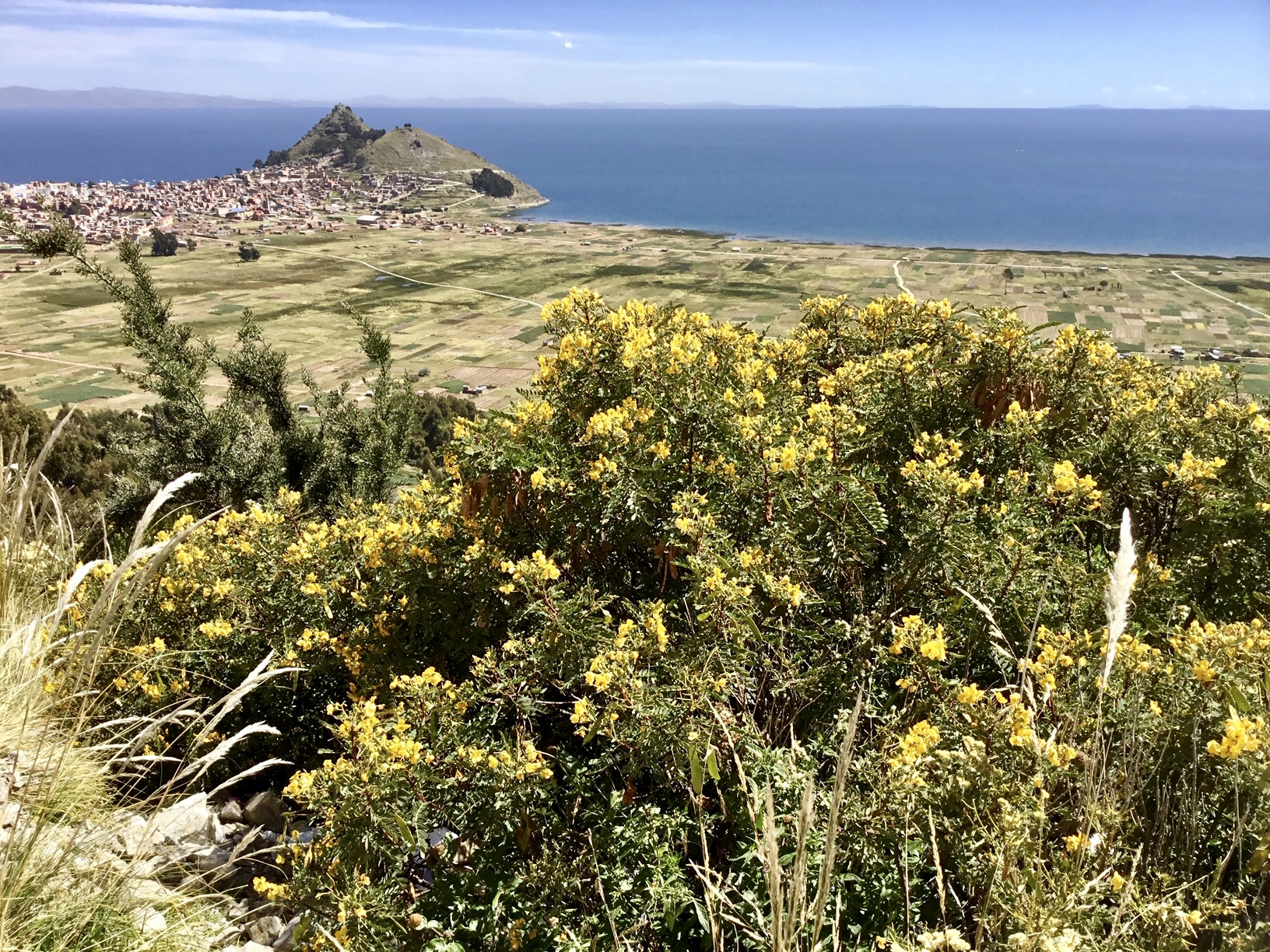
Overlooking Copacabana, Bolivia and Lake Titicaca
* an ongoing series of quotations – mostly from artists, to artists – that offers wisdom, inspiration, and advice for the sometimes lonely road we are on.
Carnival in Oruro [Bolivia] is a glorious spectacle. It’s flash, pomp and brilliance can be enjoyed without understanding its long history and intricate mythologies. Still, the onlooker is left with a thousand questions that are not so easily answered. Behind the glitter of Carnival lie the history, the timeless myths and the distinct traditions of this mining community.
According to the Spanish writer Jean Laude, “The function of the mask is to reaffirm, at regular intervals, the truth and presence of myths in everyday life.” This suggests that masks should be studied in context, noting their association with the individual dancer and the history, myths and traditions of the community that produces them. The mask has to be animated within its ritual, comic or social role.
A first step in appreciating the masks is to understand something of the land and people that crafted them. Oruro is a mining city on the open Altiplano at 3,700 meters (12,144 ft.) above sea level. The sky appears a rarified blue, it is intensely cold and a constant wind lifts dust to the eyes. During the year no more than 125,000 people live in the city. Suddenly in the weeks of Carnival, the population doubles or triples.
Three languages, Quechua, Aymara, and Spanish are spoken in Oruro. Their use reflects an ancient pattern of conquest in the history of this land. It is said that the Urus, whose language is now almost lost, were the first inhabitants. In time they were dominated by the Aymara tribes. Later, Quechua was introduced as the Inca advanced their empire from Cuzco. Ultimately the Spanish arrived and founded the present city in 1601 to exploit rich mineral deposits found in the seven hills.
Today, descendants of the Urus live near Oruro around the shore of Lake Poopo. Elements of their distinctive culture remain but they have no wealth in comparison with the more dominant Aymara and Quechua who surround them. A further change came in the recent past because Oruro has acted as a magnet, attracting many people from the countryside to work in the mines.
On one side were the Urus, ancient owners of all the land which now only carries their name (Uro Uro = Oruro). On the other side were the miners, many of whom were Quechua and Aymara migrants. In the middle is “Carnival.”
El Carnaval de Oruro by Manuel Vargas in Mascaras de los Andes Bolivianos, Editorial Quipus and Banco Mercantil
Comments are welcome!
Q: Why do you make art?

“Why Do I Make Art” by Ursula von Rydingsvard
A: Last spring I viewed Ursula von Rydingsvard’s exhibition at the National Museum of Women in the Arts. One thing that stayed with me is her wall text, “Why Do I Make Art by Ursula von Rydingsvard” in which she listed a few dozen benefits that art-making has brought to her life.
I want to share some of my own personal reasons here, in no particular order. My list keeps changing, but these are true at least for today.
1. Because I love the entire years-long creative process – from foreign travel whereby I discover new source material, to deciding what I will make, to the months spent in the studio realizing my ideas, to packing up my newest pastel painting and bringing it to my Virginia framer’s shop, to seeing the framed piece hanging on a collector’s wall, to staying in touch with collectors over the years and learning how their relationship to the work changes.
2. Because I love walking into my studio in the morning and seeing all of that color! No matter what mood I am in, my spirit is immediately uplifted.
3. Because my studio is my favorite place to be… in the entire world. I’d say that it is my most precious creation. It’s taken more than twenty-two years to get it this way. I hope I never have to move!
4. Because I get to listen to my favorite music all day or to Public Radio stations.
5. Because when I am working in the studio, if I want, I can tune out the world and all of it’s urgent problems. The same goes for whatever personal problems I am experiencing.
6. Because I am devoted to my medium. How I use pastel continually evolves. It’s exciting to keep learning about its properties and to see what new techniques will develop.
7. Because I have been given certain gifts and abilities and that entails a sacred obligation to USE them. I could not live with myself were I to do otherwise.
8. Because art-making gives meaning and purpose to my life. I never wake up in the morning wondering, how should I spend the day? I have important work to do and a place to do it. I know this is how I am supposed to be spending my time on earth.
9. Because I have an enviable commute. To get to my studio it’s a thirty-minute walk, often on the High Line early in the morning before throngs of tourists have arrived.
10. Because life as an artist is never easy. It’s a continual challenge to keep forging ahead, but the effort is also never boring.
11. Because each day in the studio is different from all the rest.
12. Because I love the physicality of it. I stand all day. I’m always moving and staying fit.
13. Because I have always been a thinker more than a talker. I enjoy and crave solitude. I am often reminded of the expression, “She who travels the farthest, travels alone.” In my work I travel anywhere.
14. Because spending so much solitary time helps me understand what I think and feel and to reflect on the twists and turns of my unexpected and fascinating life.
15. Because I learn about the world. I read and do research that gets incorporated into the work.
16. Because I get to make all the rules. I set the challenges and the goals, then decide what is succeeding and what isn’t. It is working life at its most free.
17. Because I enjoy figuring things out for myself instead of being told what to do or how to think.
18. Because despite enormous obstacles, I am still able to do it. Art-making has been the focus of my life for thirty-three years – I was a late bloomer – and I intend to continue as long as possible.
19. Because I have been through tremendous tragedy and deserve to spend the rest of my life doing exactly what I love. The art world has not caught up yet, but so be it. This is my passion and my life’s work and nothing will change that.
20. Because thanks to the internet and via social media, my work can be seen in places I have never been to and probably will never go.
21. Because I would like to be remembered. The idea of leaving art behind for future generations to appreciate and enjoy is appealing.
Comments are welcome!
Q: I especially enjoy your “Black Paintings” series. You mention being influenced by the story of how Miles Davis developed cool jazz, making this work uniquely American all around. How did you use jazz history in this series?

“Between,” soft pastel on sandpaper, 20″ x 26″
A: In 2007 I finished the Domestic Threats series and was blocked, certain that a strong body of work was behind me. But what would come next?
The idea for the Black Paintings began when I attended a jazz history course at Lincoln Center and learned how Miles Davis developed cool jazz from bebop. In bebop the notes were played hard and fast as musicians showcased their musical virtuosity. Cool jazz was a much more relaxed style with fewer notes being played. In other words, the music was pared down to its essentials. Similarly, the Black Paintings evolved from dense, intricate compositions into paintings that depicted only the essential elements. As the series evolved, what was left out became more important, resulting in more demands being placed on the viewer.
Eventually, after much reflection, I had an epiphany and my painful creative block ended. “Between,” with drastically simplified imagery, was the first in a new series called Black Paintings. I like to think this series includes work that is richer and more profound than the previous Domestic Threats.
Comments are welcome!
Pearls from artists* # 366

Studio entrance
* an ongoing series of quotations – mostly from artists, to artists – that offers wisdom, inspiration, and advice for the sometimes lonely road we are on.
For some artists the studio becomes like a temple, a place that becomes invested with a sacred energy. I was looking at a book recently called Artist at Work. It featured the studios of several well-known American artists. In almost every case the space reminded me of a chapel in a cathedral. The physical, emotional, and even spiritual elevation the space created contributed to the work.
This is the home turf of your creative space. A space that stays undisturbed from the rest of daily forces. It stays open for your arrival. When you walk in you acquire a heightened readiness to begin. Your dining room table that must be cleared off for the evening meal will require more energy from you each time you begin. but a studio collects energy and focuses it, ready for your return. That space may be your garden, the view behind the house, or a desk in a bedroom that is reserved for your creative work. But it will help to secure it. It is your temple, the place where you focus your energies to express yourself. Your creative home base.
Ian Roberts in Creative Authenticity: 16 Principles to Clarify and Deepen Your Artistic Vision
Comments are welcome!


 barbararachkoscoloreddust.com