Blog Archives
Q: What would you be if you were not an artist?

The studio with pastel paintings in progress!
A: I honestly have no idea, but whatever it might be, there is a good chance that I’d be bored! In my younger days boredom was a strong motivator. I left the active duty Navy out of boredom. I couldn’t bear not being intellectually challenged (most of my jobs consisted of paper-pushing), not using my flying skills (at 27 I was a licensed commercial pilot and Boeing 727 flight engineer), and not developing my artistic talent. In what surely must be a first, by spending a lot of time and money training me for jobs I hated, the Navy turned me into a hard-working artist! And once I left the Navy there was no plan B. There was no time to waste. It was “full speed ahead.”
Art is a calling. You do not need to be told this if you are among those who are called. It’s all about “the work,” that all-consuming focus of an artist’s life. If a particular activity doesn’t make you a better artist, you avoid it. You work hard to nourish and protect your gifts. As artists we invent our own tasks, learn whatever we need in order to progress, and complete projects in our own time. It is life lived at its freest.
My art-making has led me to fascinating places: Mexico, Guatemala, Brazil, Chile, Easter island, Argentina, Uruguay, France, England, Italy, Bali, Java, India, Bhutan, and more; and to in-depth studies of intriguing subjects: drawing, color, composition, art and art history, the art business, film and film history, photography, mythology, literature, music, jazz history, and archaeology, particularly that of ancient Mesoamerica (the Olmec, Zapotec, Mixtec, Aztec, Maya, etc.). And this rich mixture continually grows! For anyone wanting to spend their time on earth learning and meeting new challenges, there is no better life than that of an artist.
I SO agree with this exchange that I read years ago between between Trisha Brown and Mikhail Baryshnikov in the New York Times. I wrote it on a piece of paper and taped it to my studio wall:
Trisha: How do you think we keep going? Are we obsessed?
Mikhail: We do it because there’s nothing better. I’m serious. Because there is nothing more exciting than that. Life is so boring, that’s why we are driven to the mystery of creation.
Comments are welcome.
Q: When did you begin drawing and painting? (Question from “Cultured Focus Magazine”)

A: This is a long story because my path to becoming a professional artist has been unusually circuitous.
I grew up in a blue collar family in suburban New Jersey. My parents were both first-generation Americans and no one in my family had gone to college. I was a smart kid, who showed some artistic talent in kindergarten and earlier. At the age of 6, my sister, my cousin, and I enrolled in Saturday morning painting classes at the studio of a local artist. I continued the classes for about 8 years and became a fairly adept oil painter.
At the age of 15 my father decided that art was not a serious pursuit – he called it a hobby, not a profession – and abruptly stopped paying for my Saturday morning lessons. Unfortunately, there were no artists or suitable role models in my family. So with neither financial nor moral support to pursue art, I turned my attention to very different interests.
Cut to ten years later. When I was 25, I earned my private pilot’s license and spent the next two years amassing other flying licenses and ratings, culminating in a Boeing-727 flight engineer’s certificate.
At 29, I joined the Navy. By then I was an accomplished civilian pilot with thousands of flight hours so I expected to fly jets. However, in the early 1980s women were not allowed in combat. There were very few women Navy pilots and those few were restricted to training male pilots. There were no women pilots landing on aircraft carriers.
In the mid-1980s I was in my early 30s, a lieutenant on active duty in the Navy, working a soul-crushing job as a computer analyst on the midnight shift in a Pentagon basement. It was literally and figuratively the lowest point of my life. I was completely bored and miserable.
Remembering the joyful Saturdays of my youth when I had taken art classes with a local New Jersey painter, I enrolled in a drawing class at the Art League School in Alexandria, Virginia. Initially I wasn’t very good, but it was wonderful to be around other women and a world away from the mentality of the Pentagon. I was having fun again! I enrolled in more classes and became a very motivated full-time art student who worked nights at the Pentagon. As I studied and improved my skills, I quickly discovered my preferred medium – soft pastel on sandpaper.
Although I knew I had found my calling, for more than a year I agonized over whether or not to leave the financial security of a Navy paycheck. Finally I did make up my mind and resigned my commission, effective on September 30, 1989. With Bryan’s (my then boyfriend’s) support, I left the Navy to devote my time to making art.
I’m probably one of the few people who can name THE day I became a professional artist! That day was October 1, 1989. Fortunately, I have never needed another job. I remained in the Navy Reserve for the next 14 years, working primarily at the Pentagon for two days each month and two weeks each year. I commuted by train to Washington, DC after I moved to Manhattan in 1997. Finally on November 1, 2003, I officially retired as a Navy Commander.
Life as a self-employed professional artist is endlessly varied, fulfilling, and interesting. I have never regretted my decision to pursue art full-time.
Comments are welcome!
Pearls from artists* # 602
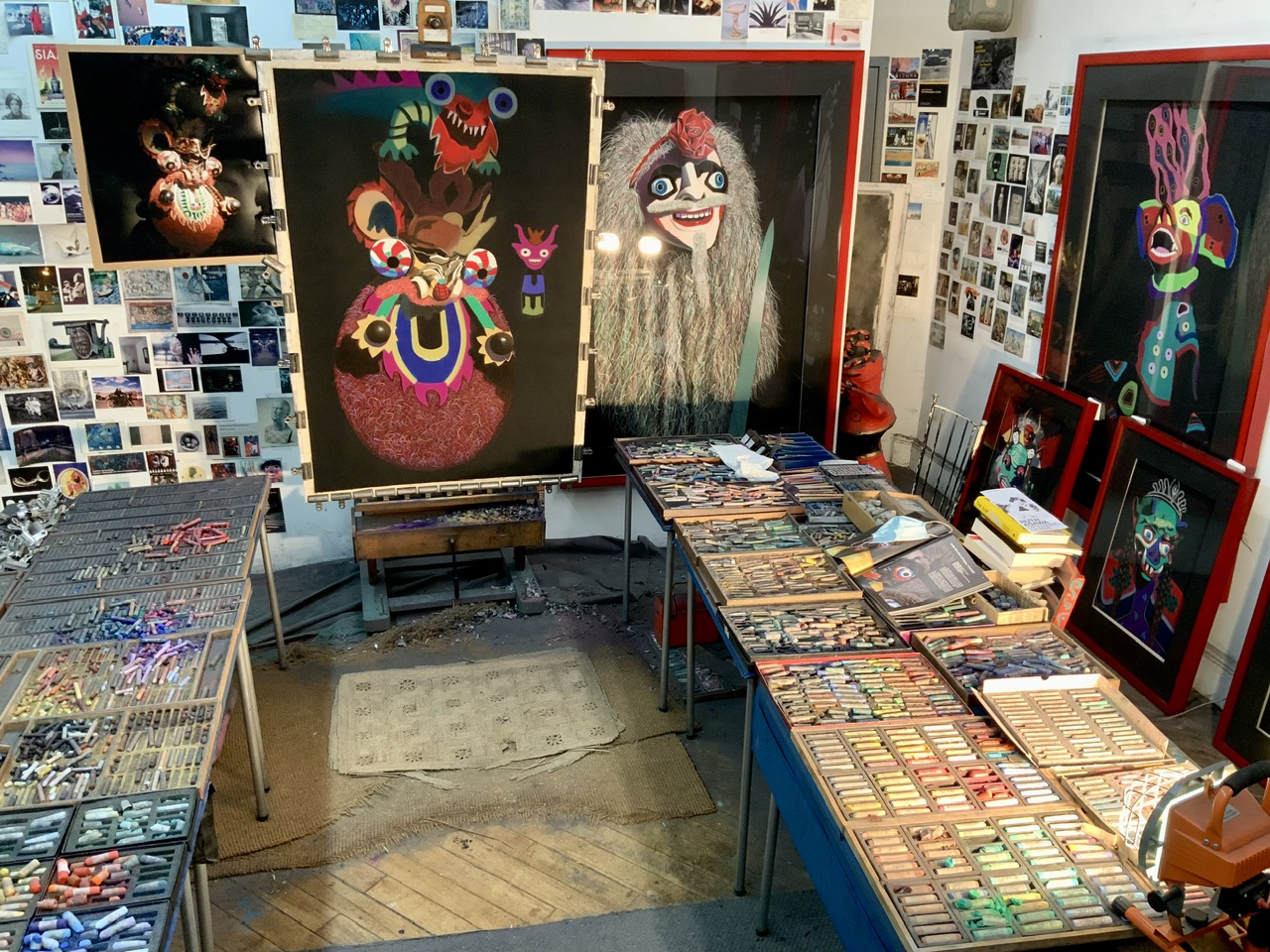
Barbara’s Studio
*an ongoing series of quotations – mostly from artists, to artists – that offers wisdom, inspiration, and advice for the sometimes lonely road we are on.
Anyone who studies an instrument, sport, or other art form must deal with practice, experiment, and training. We learn only by doing. There is a gigantic difference between the projects we imagine doing or plan to do and the ones we actually do. It is like the difference between a fantasied romance and one in which we really encounter another human being with all his or her complexities. Everyone knows this, yet we are inevitably taken aback by the effort and patience needed in the realization. A person may have great creative proclivities, glorious inspirations, and exalted feelings, but there is no creativity unless creations actually come into existence.
Stephen Nachmanovitch in Free Play: Improvisation in Art and Life
Comments are welcome!

Pearls from artists* # 591
*an ongoing series of quotations – mostly from artists, to artists – that offers wisdom, inspiration, and advice for the sometimes lonely road we are on.
Like lîla, or divine creativity, art is a gift, coming from a place of joy, self-discovery, inner knowing. Play, intrinsically rewarding, doesn’t cost anything. As soon as you put a price on it, it becomes, to some extent, not play. Somewhere, therefore, we each have to map out for ourselves the tricky questions of money and the artist. This is a difficult issue because artists have to eat, equip themselves, and subsidize years of professional training. Yet the marketplace shifts our art at least to some degree out of the state of free play, and may in some cases contaminate it totally. Professional athletes face the same issues. Certainly they play to a great extent for love of their sport, but issues of money, prestige, and fame introduce a lot of non play as well.
Stephen Nachmanovitch in Free Play: Improvisation in Life and Art
Comments are welcome!
Pearls from artists* # 581

With recent “Bolivianos”
*an ongoing series of quotations – mostly from artists, to artists – that offers wisdom, inspiration, and advice for the sometimes lonely road we are on.
The essence of style is this: We have something in us, about us; it can be called many things, but for now let’s call it our original nature. We are born with our original nature, but on top of that, as we grow up, we accommodate to the patterns and habits of our culture, family, physical environment, and the daily business of the life we have taken on. What we are taught solidifies as “reality.” Our persona, the mask we show the world, develops out of our experience and training, step by step from infancy to adulthood. We construct our world through the actions of perception, learning, and expectation. We construct our “self” through the same actions of perception, learning, and expectation. World and self interlock and match each other, step by step and shape by shape. If the two constructions, self and world, mesh, we grow from child to adult becoming “normally adjusted individuals.” If they do not mesh so well, we may experience feelings of inner division, loneliness, or alienation.
If we should happen to become artists, our work takes on, to a certain extent, the style of the time: the clothing in which we are dressed by our generation, our country and language, our surroundings, the people who have influenced us.
But somehow, even when we are grown up and “adjusted,” everything we do and are – our handwriting, the vibrato of our voice, the way we handle the bow or breathe into the instrument, our way of using language, the look in our eyes, the pattern of whirling fingerprints on our hand – all these things are symptomatic of our original nature. They all show the imprint of our own deeper style or character.
Stephen Nachmanovitch in Free Play: Improvisation in Life and Art
Comments are welcome!
Pearls from artists* # 549
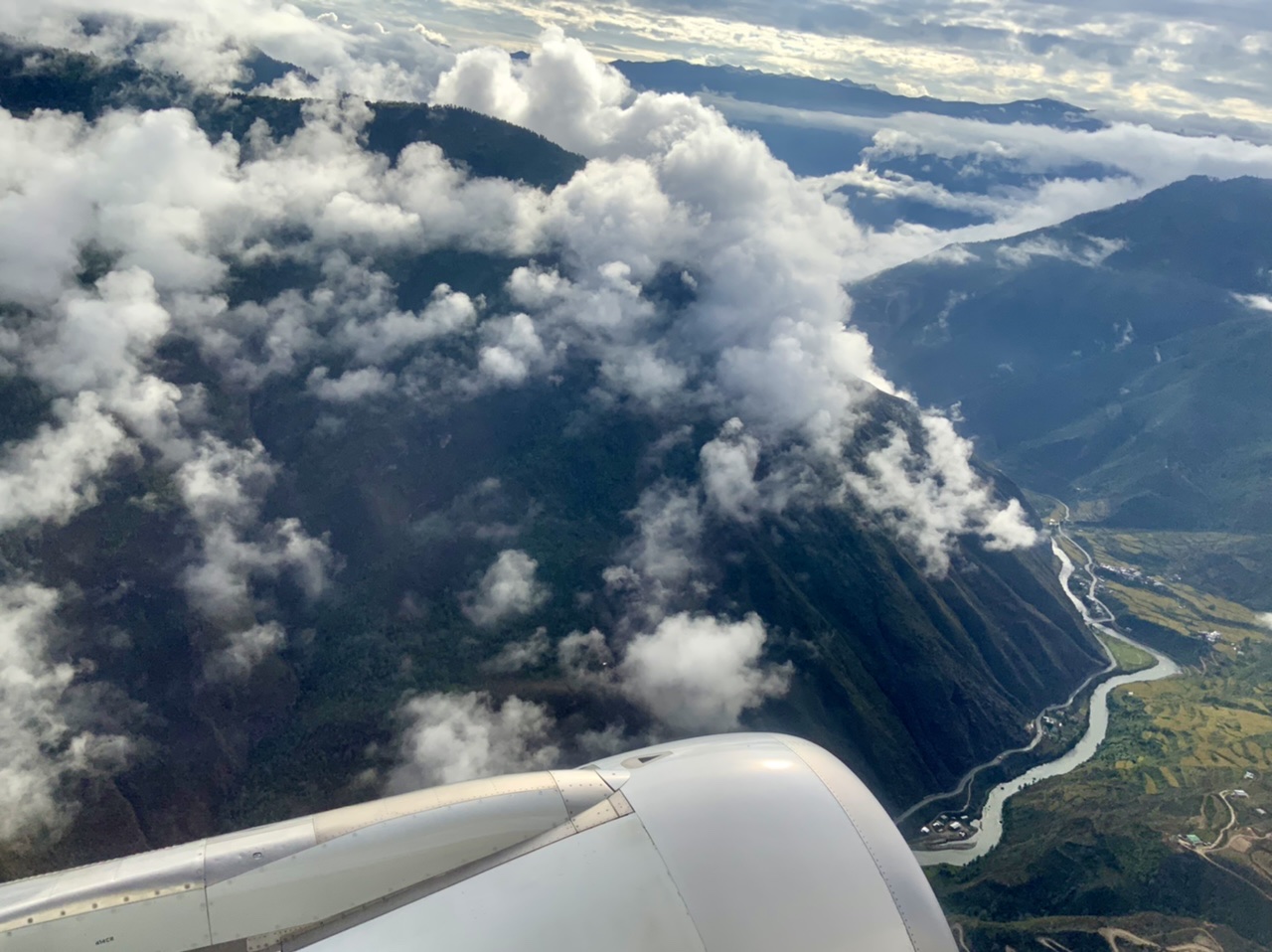
Departing from Paro Airport in Bhutan
*an ongoing series of quotations – mostly from artists, to artists – that offers wisdom, inspiration, and advice for the sometimes lonely road we are on.
… a lot of times you take a trip halfway around the world. You think the trip is for one thing… and you came away with something else. You change in a way you did not expect. These are the lessons that come well after school, college, training, apprenticeships. These lessons are not full courses; they are two sentences long. I felt I had gotten a degree in two minutes.
Anna Deavere Smith in Letters to a Young Artist: Straight-up Advice on Making a Life in the Arts – For Actors, Performers, Writers, and Artists of Every Kind
Comments are welcome!
Q: What about the importance of vision in your training in the Navy has helped you be able to see what you want to create in your art? (Question from “Arte Realizzata”)

A: I continue to reflect on what my experiences as a Naval officer contributed to my present career. Certainly, I learned attention to detail, time management, organization, and discipline, which have all served me well. I keep regular studio hours (currently 10:00 – 4:00 on Monday, Tuesday, Thursday, Friday, and Saturday) which I understand is rare among artists.
Prior to joining the Navy, I had financed my own flight training to become a commercial pilot and Boeing-727 Flight Engineer. However, my Naval career consisted entirely of monotonous paper-work jobs that were not the least bit intellectually challenging. Finding myself stuck in jobs that reflected neither my skills nor my interests, I made a major life change. When I left active duty at the Pentagon I resolved, “I have just resigned from the most boring job. I am going to do my best to never make BORING art!” Other than this, I an hard-pressed to pinpoint anything the Navy contributed to my art career.
Comments are welcome!
Q: How do you think about risk? What role has taking risks played in your life/career? (Question from Emma Jacobs, VoyageMIA.com)

A: My journey to becoming a visual artist was circuitous, to say the least. Risk-taking gave me the life and career I enjoy now.
The biggest – and scariest – risk I’ve ever taken was deciding to leave my active duty Naval career to pursue art full-time. The second most significant risk was moving to New York City in 1997. I have never regretted doing either one.
When I was 25, and a civilian, I earned my private pilot’s license and spent the next two years amassing other flying licenses and ratings, culminating in a Boeing-727 flight engineer’s certificate. Two years later I joined the Navy.
As an accomplished civilian pilot with thousands of flight hours, I had expected to fly jets in the Navy. However, women were barred from combat in those days (the 1980s) so there were very few women Navy pilots. There were no female pilots on aircraft carriers and no female Blue Angels. Women were restricted to training male pilots for combat jobs and priority was given to Naval Academy graduates. My BA was from a different university.
In the mid-1980s I was in my early 30s and a Lieutenant on active duty in the Navy. I worked a soul-crushing job as a computer analyst on the midnight shift in a Pentagon sub-basement. It was literally and figuratively the lowest point of my life. I hated my job! Not only was it boring, I was not using my hard-won flying skills. In short I was miserable – miserable and trapped because a Naval officer cannot just resign with two weeks notice.
Remembering the joyful Saturdays of my youth when I had taken art classes with a local New Jersey painter, I enrolled in a drawing class at the Art League School in Alexandria, Virginia. Initially I wasn’t very good, but it was wonderful to be around other women and a world away from the “warrior mentality” of my mostly male Pentagon co-workers. Plus, I was having fun!
Soon I enrolled in more classes and became a very motivated full-time art student who worked nights at the Pentagon. As I studied and improved my skills, I discovered my preferred medium – soft pastel on sandpaper.
Although I was certain I had found my life’s calling as a fine artist, I had grown used to a regular paycheck and the many benefits of being a Navy Lieutenant. For more than a year I agonized over whether or not to leave the Navy and lose my financial security. I’d be taking a huge risk: could I ever support myself as an artist? Was I making the dumbest mistake of my life?
Eventually, I decided I HAD TO take a leap. I simply adored making art – it challenged me to use all of my skills and talents – while I was unhappy, bored, and unfulfilled working at the Pentagon.
But once my mind was finally made up, I still could not leave. Due to geopolitical circumstances, there was a significant delay. The Navy was experiencing a manpower shortage and Congress had enacted a stop-loss order, which prevented officers from resigning for one year. I submitted my resignation effective exactly one year later: on September 30, 1989. Being stuck in a job I no longer wanted nor had the slightest interest in, was truly the longest year of my life!
Unlike most people, I can pinpoint exactly when I became an artist. I designate October 1, 1989 as the day I became a professional artist! I have never regretted my decision and I never again needed, nor had, a day job.
However, I must mention that I remained as a part-time Naval Reservist for the next 14 years, working primarily at the Pentagon for two days every month and two weeks each year. The rest of the time was my own to pursue my art career. After I moved to Manhattan in 1997, I commuted by train to Washington, DC to work for the Navy.
Finally on November 1, 2003, I officially retired as a Navy Commander. Now, I daresay, I am the rare fine artist who can point to a Navy pension as a source of income.
I love my life as an accomplished New York fine artist! With the help of two social media assistants, I work hard to make and promote the art I create. My pastel paintings and my pastel skills continue to evolve and grow, gaining wider recognition and a larger audience along the way.
In addition to making art, I have been a blogger since 2012. The audience for my blog, https://barbararachkoscoloreddust.com/ increases by 1,000 – 2,000 new subscribers each month. Today I have more than 72,000 readers!
Comments are welcome!
Q; What was the spark that got you started? (Question from Barbara Smith via Facebook)
A: If I had to select one factor, I would say, profound unhappiness with my professional life. In 1986 I was a 33-year-old Navy Lieutenant working as a computer analyst at the Pentagon. I hated my job, was utterly miserable, and moreover, I was trapped because unlike many jobs, it’s not possible to resign a Naval commission with two weeks notice.
My bachelor’s degree had been in psychology. When I was in my 20s and before I joined the Navy, I had spent two years and my own money training to become a licensed commercial pilot and Boeing-727 Flight Engineer. I had planned to become an airline pilot, but due to bad timing (airlines were not hiring pilots when I was looking for a job), that did not come to pass.
So there I was with absolutely no interest, nor any training in computers, working for the Joint Chiefs of Staff, and completely bored. I knew I must have taken a wrong turn somewhere and resolved to make a significant change. Searching around, I discovered a local art school, the Art League School in Alexandria, VA, and began taking drawing classes.
One drawing class lead to more. Within a couple of years, due to being highly motivated to change my life, my technical skills rapidly improved. Even then, I believe, it was obvious to anyone who knew me that I had found my calling. I resigned my active duty Naval commission and have been a fulltime professional artist since October 1989. (Note: For fourteen more years I remained in the Naval Reserve working, mostly at the Pentagon, one weekend a month and two weeks each year, and retired as a Navy Commander in 2003).
Life as a self-employed professional artist is endlessly varied, fulfilling, and interesting. I have never once regretted my decision to pursue art fulltime!
Comments are welcome!
Q: Did your military experience become a building block on which you formed your artistic ideas?
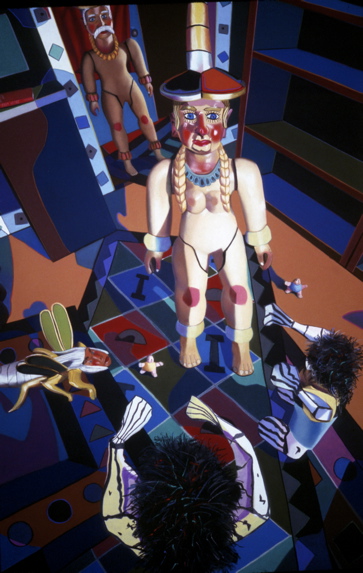
“Answering the Call,” 58″ x 38,” soft pastel on sandpaper, 2000
A: In my younger days boredom was a strong motivator. I left the active duty Navy out of boredom. I couldn’t bear not being intellectually challenged (most of my jobs consisted of paper-pushing), not using my flying skills, and not developing my artistic talent. In what must be a first, by spending a lot of time and money training me for jobs I hated, the Navy turned me into a hard-working, devoted, and disciplined artist! Once I left the Navy there was no plan B. It was “full speed ahead” to become an accomplished artist.
Comments are welcome!


 barbararachkoscoloreddust.com