Blog Archives
Pearls from artists* # 695
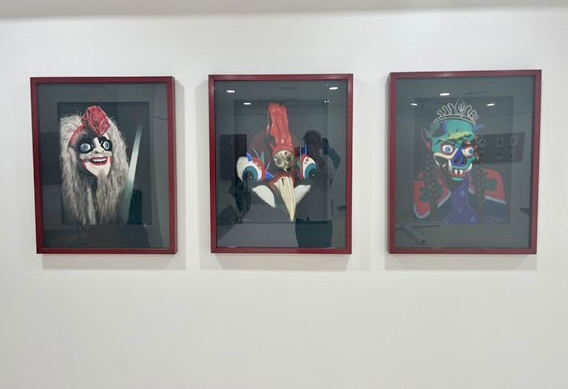
Barbara’s paintings on exhibit in Mumbai, India!
*an ongoing series of quotations – mostly from artists, to artists – that offers wisdom, inspiration, and advice for the sometimes lonely road we are on.
Artists are known to feel intense highs and lows. Being a channel for such copious amounts of emotion is overwhelming. The input we absorb and the output we emit can feel as though it might annihilate us, as if our hearts might explode with joy, or be crushed with sorrow. We were all handed a special gift at birth, a fire to be tended. It flares and wanes over the course of our existence. We spend our livings trying to keep it burning and fed, without allowing it to consume us.
Kate Kretz in Art From Your Core: A Holistic Guide to Visual Voice
Comments are welcome!
Pearls from artists* # 664

*an ongoing series of quotations – mostly from artists, to artists – that offers wisdom, inspiration, and advice for the sometimes lonely road we are on.
Throughout history, geniuses have attributed their breakthroughs to the time they spent alone, deep in thought. Frank Kafka assures us,
‘You need not leave your room. Remain sitting at your table and listen. You need not even listen, simply wait. You need not even wait, just learn to become quiet, and still, and solitary. The world will freely offer itself to you to be unmasked. It has no choice; it will roll in ecstasy at your feet.’
Artists have a special relationship with the passing hours. Our work is tangible evidence of how we mark and give value to time. We have a finite, unknown number of hours on Earth, so we will only leave behind so many pieces. Our artistic legacy is literally tied to our ability to steal time and maintain silence.
And yet, we exist in a time and place with a tremendous aversion to peace. We must fight both ourselves and others to acquire it. No one asked us if this is the kind of environment we want to inhabit. Corporations inundate every square inch of space with uninvited visual and auditory interference, designed to light up the addiction pleasure centers in our brains. Our ancestors would have found this environment assaulting and maddening. It is certainly causing damage to our mental health, happiness, and creativity. But, it is so ubiquitous that there is pressure to simply accept the anxiety-producing ‘new normal’: we have collectively surrendered our brain space to the colonization.
Kate Kretz in Art From Your Core: A Holistic Guide to Visual Voice
Comments are welcome!
Pearls from artists* # 590

Barbara’s Studio: when you fall in love with pastel!
*an ongoing series of quotations – mostly from artists, to artists – that offers wisdom, inspiration, and advice for the sometimes lonely road we are on.
We see again and again in the lives of special artists a profound youthful infatuation with their medium, with everything and anything connected with it – the good, the bad, the indifferent. If books have mesmerized them, they will read everything; if painting, they will frequent every gallery, running to every visiting show. They may have no idea that they are about to devote their life to that medium; they simply fell in love. The actor Len Cariou said:
“I didn’t have any thoughts about being an actor. I always was an actor. I’d go to films every Saturday. I had an insatiable appetite for films. You could see four films and a serial for half a buck. In 1959 when I read an ad in the local paper, ‘Young actors wanted for summer stock,’ all of a sudden I knew; there was a crunch in my head.”
… The artist is transported by his medium, is delighted and astonished. That his medium is able to speak to him in this way is almost a proof of the existence of god, or at least a special affirmation in the realm of the spirit.
Eric Maisel in A Life in the Arts: Practical Guidance and Inspiration for Creative and Performing Artists
Comments are welcome!
Q: When you’re not creating art what’s your next favorite creative activity?

Hudson Yards, NYC iPad Photo
A: I love taking photographs with my iPad Pro! It has a 12.9″ screen so I can see every detail of the image. It is equivalent to using an 8 x 10 view camera with the advantages of being relatively lightweight and portable; does not require a tripod, a hood, or other special equipment like individual film holders; and the image appears right side up on the screen. It’s a perfect camera!
I have owned and used many film and digital cameras, but my iPad Pro has been my favorite for several years now. It’s great for my specific needs. I take it all over the world!
Comments are welcome!
Pearls from artists* # 580
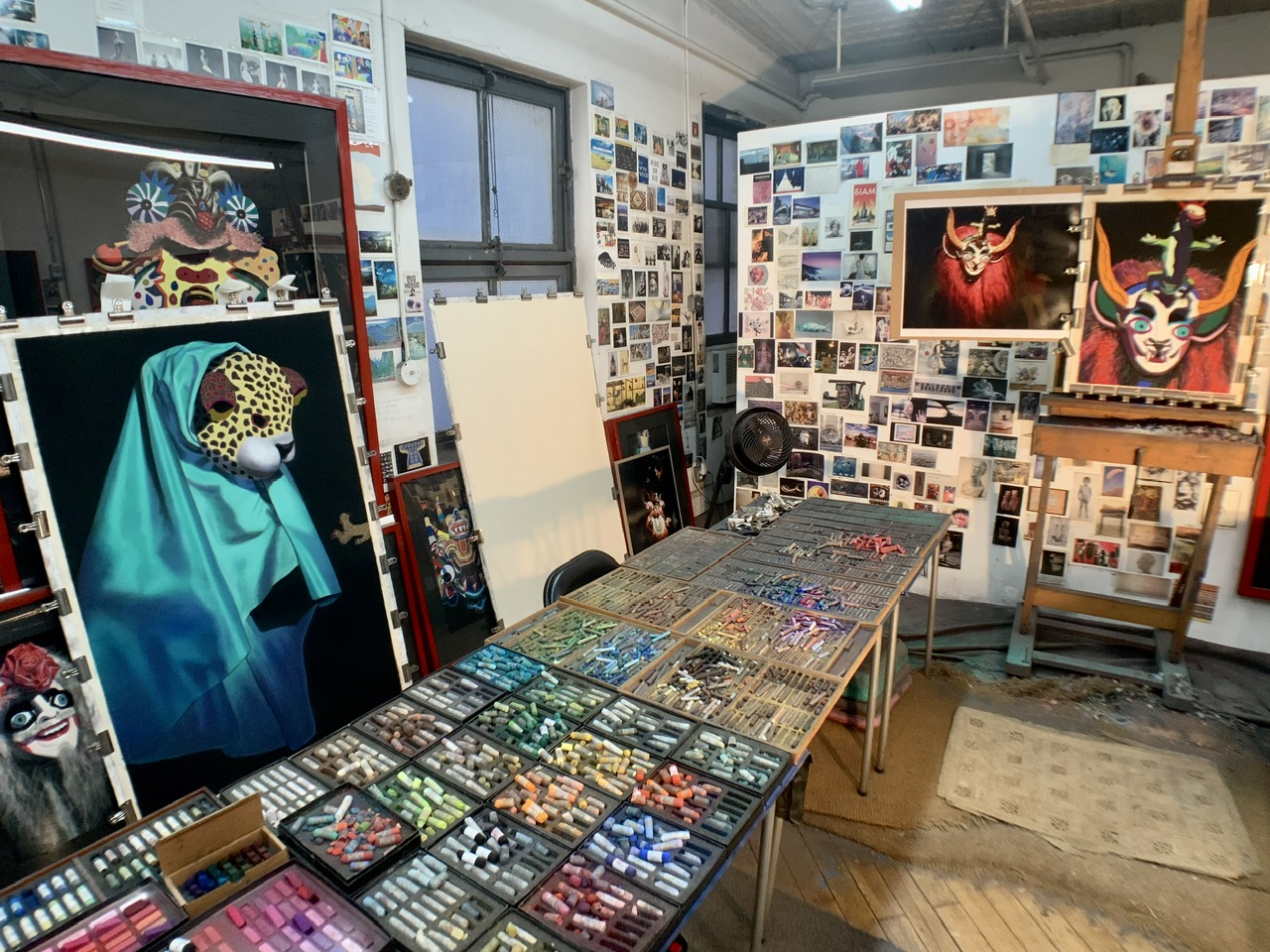
Barbara’s Studio
*an ongoing series of quotations – mostly from artists, to artists – that offers wisdom, inspiration, and advice for the sometimes lonely road we are on.
Love is the spirit that motivates the artist’s journey. The love may be sublime, raw, obsessive, passionate, awful, or thrilling, but whatever its quality, it’s a powerful motive in the artist’s life. The actor Derek Jacobi distinguished this special deeply rooted drive from mere desire in the following way:
You have to have an absolute obsession and compulsion to act, not just desire; it’s just not enough to have talent and want to express it, it’s not enough. It’s got to be more deeply rooted, more abrasive. The fire in the belly has got to be there. If there’s no fire, you can’t do it.
What is it that the artist loves? It is first and foremost the sheer power of whatever medium has attracted him. This is why he’s an artist and not a botanist or an archeologist: an art form has gotten under his skin. It may be the power of the book that gripped him, the power of dance, the power of music, the power of the image, or the power of the play.
Eric Maisel in A Life in the Arts: Practical Guidance and Inspiration for Creative and Performing Artists
Comments are welcome!
Pearls from artists* # 577

In the Studio
*an ongoing series of quotations – mostly from artists, to artists – that offers wisdom, inspiration, and advice for the sometimes lonely road we are on.
What is the popular conception of the artist? Gather a thousand descriptions and the resulting composite is the portrait of a moron: he is held to be childish, irresponsible, and ignorant or stupid in everyday affairs.
The picture does not necessarily involve censure or unkindness. These definitions are attributed to the artist’s preoccupation with his particular kind of fantasy and to the unworldly nature of the fantastic itself. The bantering tolerance granted to the absentminded professor is extended to the artist. Biographers contrast the artless news of his judgments with the high attainment of his art, and while his naïveté or rascality are gossiped about, they are viewed as signs of Simplicity and Inspiration, which are the Handmaidens of Art. And if the artist is inarticulate and lacking in the usual repositories of fact and information, how fortunate, it is said, that nature has contrived to divert him from all worldly distractions so he may be single-minded in regards to his special office.
Mark Rothko in The Artist’s Reality: Philosophies of Art, edited and with an introduction by Christopher Rothko
Comments are welcome!
Q: The first pastel painting you see every morning when you arrive at your studio is “Myth Meets Dream.” It must have special meaning. Would you elaborate? (Question suggested by Marlissa Gardner via Facebook)

A: “Myth Meets Dream,” an early pastel painting from the “Domestic Threats” series, is one I have never wanted to sell. It marks the first time I included Mexican folk art figures in my work. In 1992 as a Christmas present, my future sister-in-law sent the two Oaxacan painted wooden figures you see depicted above – the blue winged creature and the red, white, and black figure behind it. The other three figures in this painting are hand-puppets.
Previously, I had been creating elaborate staged photographs in my Alexandria house using stuffed animals and hand-puppets. (The latter were made by a company called “Folk Tails”). I used the photos as reference material for pastel paintings. In other words, rather than work exclusively from life, I mostly looked at these photos while I made the painting. Although I have simplified my process since those early days, I still create pastel paintings using reference photographs.
In “Myth Meets Dream” you can see both puppets and my then new Oaxacan folk art figures. This pastel painting marks an important transition in subject matter and was the start of decades-worth of foreign travel, study, adventure, hard work, and yes, fun. It’s true that “Myth Meets Dream” hangs in my studio and is the first thing I see every morning. It brings back so many precious memories.
Every painting has a story!
If you’re interested to learn more, please see https://barbararachko.art/en/art-market
Comments are welcome!
Pearls from artists* # 570
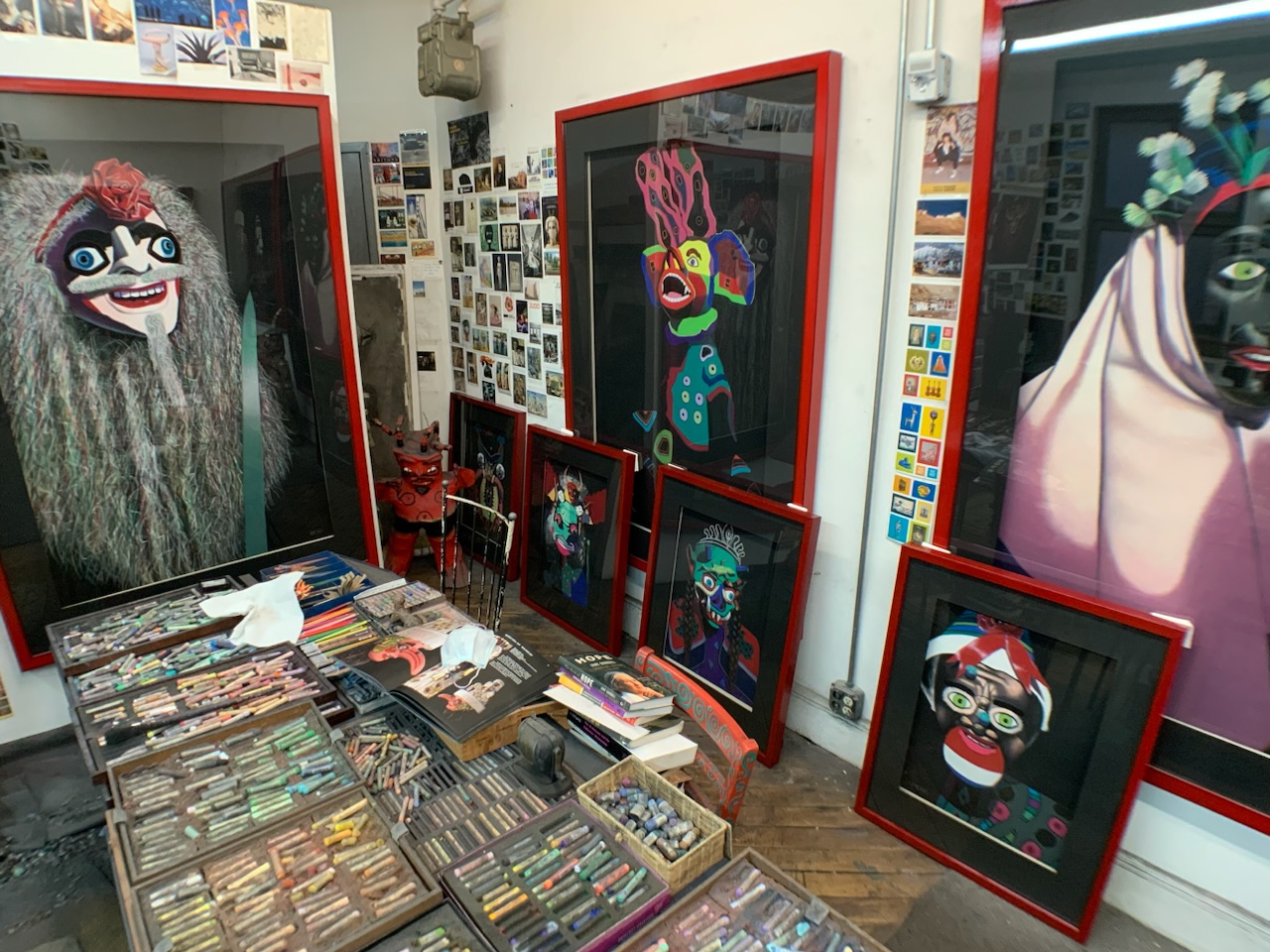
Barbara’s Studio
*an ongoing series of quotations – mostly from artists, to artists – that offers wisdom, inspiration, and advice for the sometimes lonely road we are on.
One of the main differences between the young girl who drew a line in chalk from the Metropolitan Museum all the way to her home on Park Avenue and the young woman who drew lines on canvas and paper twenty years later was that the latter understood the willfulness that drove the child. She was facing “the monster,” the consuming need to create, which was beyond her control but no longer beyond her comprehension. Helen [Frankenthaler] had long understood that her gift set her apart, and that it would be nearly impossible to describe how and why without sounding arrogant or cruel. “It’s saying I’m different, I’m special, consider me differently,” she explained years later. “And it’s also on the other side, a recognition that one is lonely, that one is not run of the mill, that the values are different, and yet we all go into the same supermarkets… and we are all moved one way or another by children and seasons, and dreams. So that art separates you…”
The separation she described was not merely the result of what one did, whether it be painting or sculpting or writing poetry. Helen said the distance between an artist and society was due to a quality both intangible and intrinsic, a “spiritual” or “magical” aspect that nonartists did not always understand and were sometimes frightened by. “They want you to behave a certain way. They want you to explain what you do and why you do it. Or they want you removed, either put on a pedestal or victimized. They can’t handle it.” Helen concluded that existing outside so-called normal life was simply the price an artist paid to create.
Mary Gabriel in Ninth Street Women
Comments are welcome!
Q: Many of the world’s cultures have a mask tradition. Is there something special about Bolivian masks that first attracted you to them?

Bolivian Carnival Mask
A: My subject matter emerges directly from my travels. I visited Bolivia in 2017. What I especially liked then – and now – about Bolivian Carnival masks, is that they include additional textures – feathers, fur, costume jewelry, sequins, fabric, etc. that add to their physical presence. Masks from most of the other countries I’ve visited tend to be made of wood and/or paper mache and nothing else. In my view such masks are not as dramatic nor do they offer much expressive potential. They feel dead. They lack a certain “soulfulness.”
Furthermore, textures are challenging to render in soft pastel. For more than three decades I have been striving to improve my pastel techniques. By now I have a vast repertoire from which to select. As was true in my earlier series, with “Bolivianos” an important personal goal is to keep adding to the repertoire.
It takes months to create a pastel painting, which means I need masks that will hold my attention every day over the course of three or four months. I never want to be bored in the studio. If I am bored while making the work, those feelings will be directly transferred and I will make a boring pastel painting, something I hope never to do! The masks need to have a really strong ‘presence.’ Then as I slowly make a pastel painting, one that is exciting to work on from start to finish, I can transform my subject into something surprising and powerful that has never existed before!
Comments are welcome!
Pearls from artists* # 558
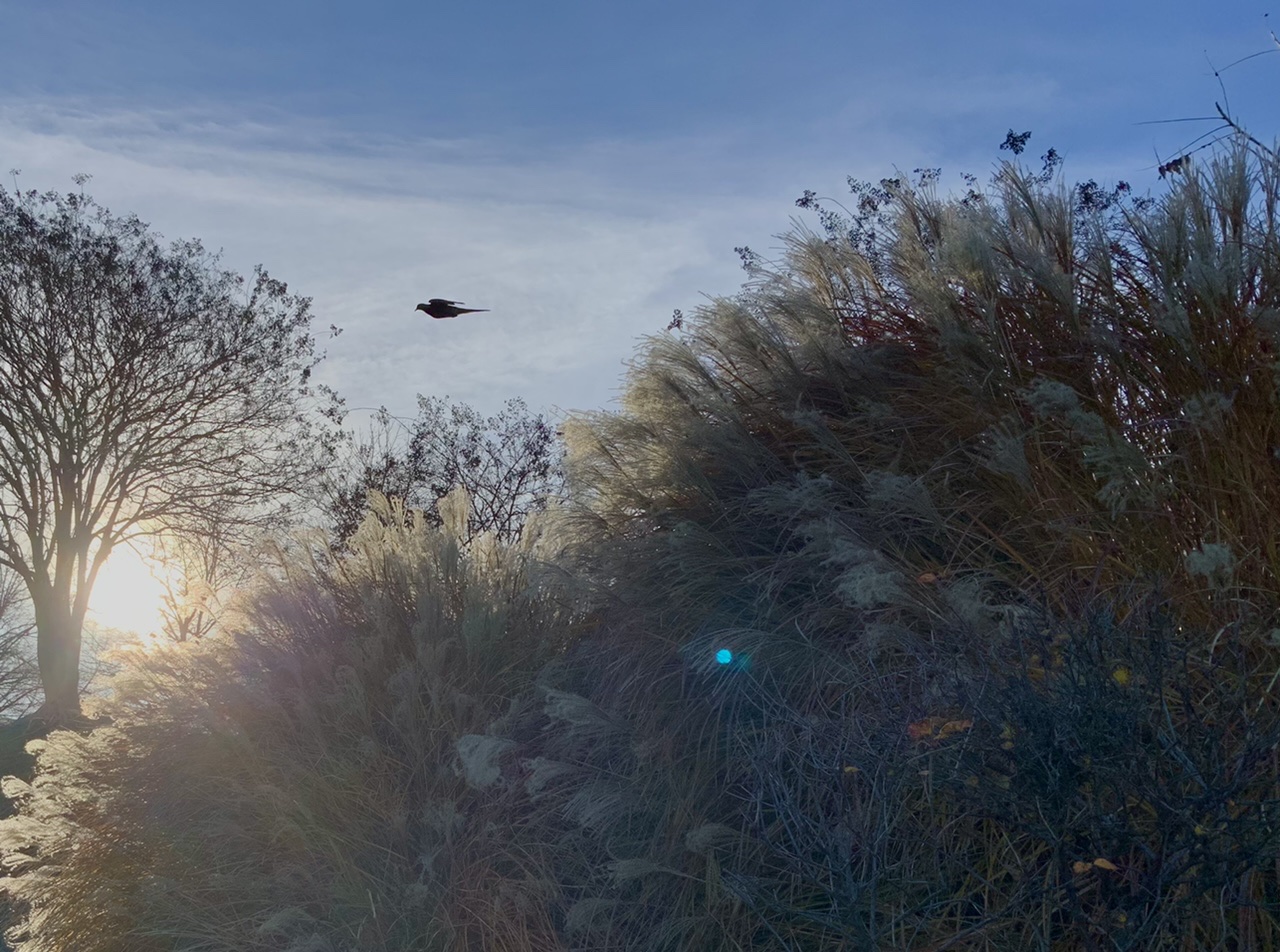
Alexandria, VA
*an ongoing series of quotations – mostly from artists, to artists – that offers wisdom, inspiration, and advice for the sometimes lonely road we are on.
One of the main differences between the young girl who drew a line in chalk from the Metropolitan Museum all the way to her home on Park Avenue and the young woman who drew lines on canvas and paper twenty years later was that the latter understood the willfulness that drove the child. She was facing “the monster,” the consuming need to create, which was beyond her control but no longer beyond her comprehension. Helen [Frankenthaler] had long understood that her gift set her apart, and that it would be nearly impossible to describe how and why without sounding arrogant or cruel. “It’s saying I’m different, I’m special, consider me differently,” she explained years later. “And it’s also on the other side, a recognition that one is lonely, that one is not run of the mill, that the values are different, and yet we all go into the same supermarkets… and we all are moved one way or the other by children and seasons, and dreams. So the art separates you.”
The separation she described was not merely the result of what one did, whether it be painting or sculpting or writing poetry. Helen said the distance between an artist and society was due to a quality both tangible and intangible and intrinsic, a “spiritual” or “magical” aspect that nonartists did not always understand and were sometimes frightened by. “They want you to behave a certain way. They want you to explain what you do and why you do it. Or they want you removed, either put on a pedestal or victimized. They can’t handle it.” Helen concluded that existing outside so-called normal life was simply the price an artist paid to create.
Mary Gabriel in Ninth Street Women
Comments are welcome!


 barbararachkoscoloreddust.com