Blog Archives
Pearls from artists* # 632

*an ongoing series of quotations – mostly from artists, to artists – that offers wisdom, inspiration, and advice for the sometimes lonely road we are on.
”The mind once stretched by a new idea, never returns to its original dimensions.” – Ralph Waldo Emerson ((1803 – 1882)
Ralph Waldo Emerson was more prescient than he can ever have realized. It was not until the 1960s that neuroscientist Marian Diamond discovered that exposure to enriched environments increased brain matter, specifically in the brain’s outer cortex. Prior to her landmark research, scientists believed that the brain remained static until it started to decline in older age. Diamond was the first to observe the brain’s neuroplasticity, yet her findings were disputed and rejected for many years. Today she is considered one of the founders of modern neuroscience.
Museums are the ultimate enriched environments, or super-enriched spaces, that are good for body, mind, and soul. Museums are dedicated to arousing our curiosity; engaging us in discovery and learning; and evoking our reflection, wonder, and awe. Artists (and Emerson) have known intuitively what scientists are now proving with rigorous research: aesthetic experiences affect us in extraordinary ways. In short, our brains are wired for art.
The Museum and the Mind by Susan Magsamen in Museum, May/June 2024
Comments are welcome!
Q: Would you talk about your early art exhibitions? (Question from “Culture Focus Magazine”)

Review of my first exhibition at Brewster Arts, New York City!
A: Certainly! My very first group exhibition was in a juried show in the late 1980s at the Art League Gallery in Alexandria, VA. This was a gallery that offered monthly juried shows for members. I applied regularly, had work accepted many times, and frequently won first prize for my pastel paintings.
Early exhibitions at the Art League were followed by group and solo exhibitions at nonprofit and university spaces in Virginia, Washington, D.C., Maryland, North Carolina, Pennsylvania, Ohio, Rhode Island, Connecticut, Massachusetts, New Jersey, and New York; more or less up and down the mid-Atlantic states and the northeast, which were all places I could drive my truck to hand-deliver fragile pastel paintings.
My very first solo exhibition at a commercial gallery was at 479 Gallery in SoHo (New York City) in July 1996. In 1995 I had submitted work to a juried group show and was awarded first prize, which was a solo exhibition at 479 the following year.
My exhibition with 479 Gallery was quickly followed by representation at a prestigious New York gallery, Brewster Arts Ltd., which specialized in Latin American masters such as Frida Kahlo, Leonora Carrington, Diego Rivera, Rufino Tamayo, and many others. I was awarded my first two-person exhibition there in October 1996 and got to meet fellow gallery artist Leonora Carrington when she came to the opening. I could hardly believe my good fortune at gaining representation at such a revered and elegant gallery!
Comments are welcome!
Pearls from artists* # 539
*an ongoing series of quotations – mostly from artists, to artists – that offers wisdom, inspiration, and advice for the sometimes lonely road we are on.
It is important to consider, when cities like New York continue a process of gentrification that make them unlivable for most artists and intellectuals, that the community Schloss describes was to some extent brought into being by a number of radically different circumstances: first, immigration – in some cases, such as de Kooning, illegal, and in others, such as Schloss, forced by war and politics – and second, the existence in post-Great Depression New York of cheap rents for run-down spaces that no one other than artists would consider or would be able to make not just livable but eventually fashionable.
Mira Schor in The Loft Generation: From the de Koonings to Twombly, Portraits and Sketches 1942-2011 edited by Mary Venturini
Comments are welcome!
Pearls from artists* # 527
*an ongoing series of quotations – mostly from artists, to artists – that offers wisdom, inspiration, and advice for the sometimes lonely road we are on.
Vocation was originally a religious term. The word comes from the Latin vocatio, which means a summons, a call. To be a priest, a monk, or a nun is to accept a calling – a vocation. The sense of an imperative – of an activity that’s a necessity, an inevitability – remains very much part of the meaning of the word today. A creative vocation isn’t a job. It’s a calling, even if for most modern artists the summons is an inner necessity, not the call of some divine figure or force. Even an artist as determinedly secular as Picasso saw echoes of religious vocation in his experience as an artist. When his mistress Francoise Gilot, wondering at his concentration and stamina, asked him if when he was painting “it didn’t tire him to stand so long in one spot,” this was his response: “No. That’s why painters live so long. While I work, I leave my body outside the door, the way Moslems take off their shoes before entering the mosque.” For creative spirits the studio or stage – or wherever they do their work – is a place apart. They may recoil from describing this as a sacred space, but there’s no question that these spaces have a special significance.
Jed Perl in Authority and Freedom: A Defense of the Arts
Comments are welcome!
Q: What was the first review you ever received and how did you get it?
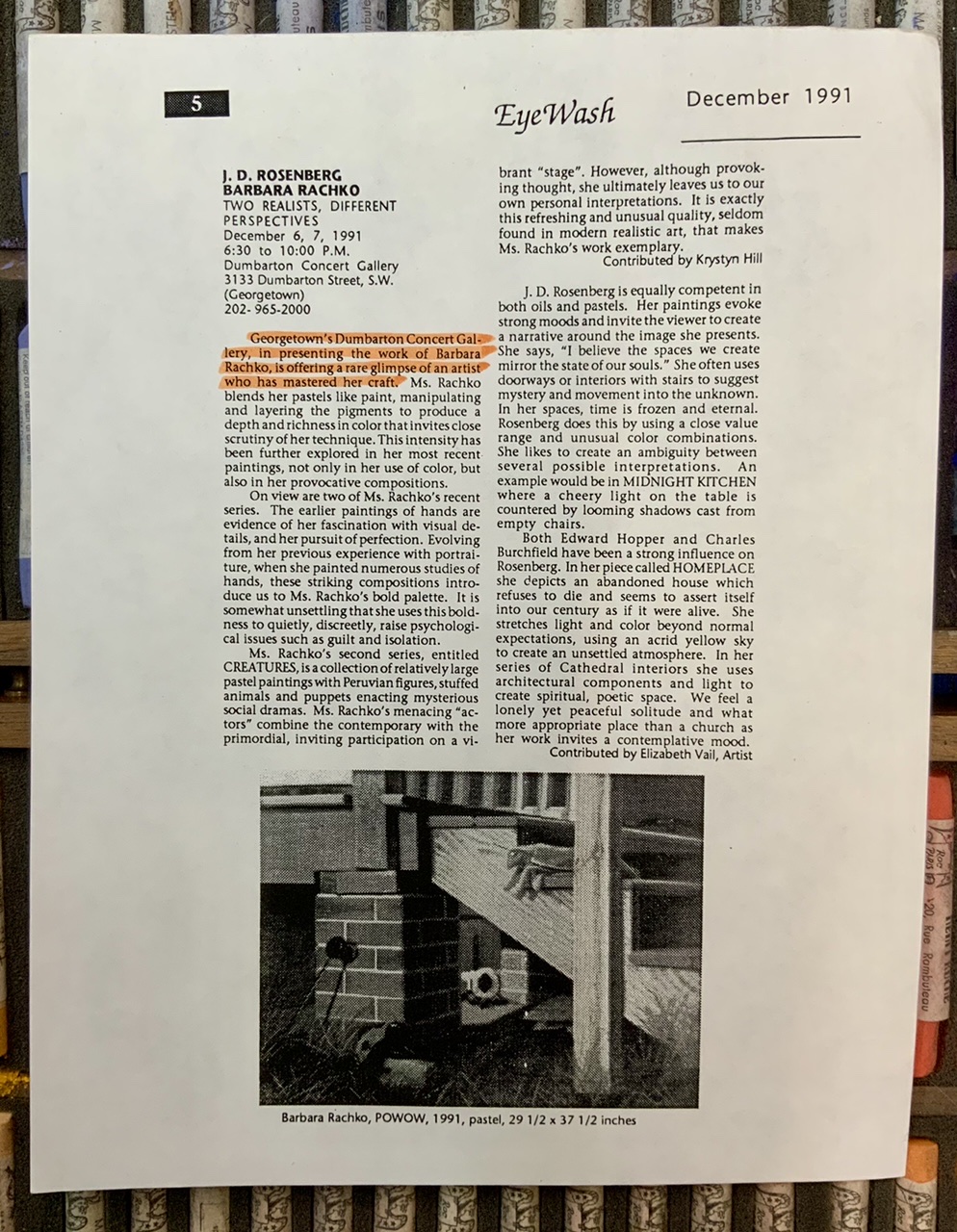
A: In 1991 I was in my late thirties and had resigned my active duty Naval commission two years before. I had been an artist for five years. I was anxious to get my pastel paintings exhibited, seen by an audience, and collected! As I worked hard to build my resume, I hustled to exhibit in all sorts of spaces that were not galleries: restaurants, hospitals, real estate offices, law offices, theaters, doctors’ offices, and more. The goal was to just get the work out of my home studio.
In December 1991 I presented a solo exhibition at Dumbarton Church in Georgetown (Washington, DC). For years Bryan had volunteered to set up chairs, a Steinway piano, and other miscellaneous equipment for their classical music concert series. The church’s downstairs space was used to showcase artists’ work. So I applied for a solo exhibition, was accepted, and got my first review in a local Washington, DC newspaper called “Eye Wash!”
Moral: artists have to work extremely hard for every little thing that comes our way!
Comments are welcome!
Pearls from artists* # 473

*an ongoing series of quotations – mostly from artists, to artists – that offers wisdom, inspiration, and advice for the sometimes lonely road we are on.
… slow art arose in the later eighteenth century when two massive cultural changes converged, changes that have grown more acute ever since. First: acceleration, as capitalism and advances in technology quickened the pace of everyday life in unprecedented ways. It’s no coincidence that Harmut Rosa links the origin of modernity to the quickening movement of money, vehicles, and communication. The pressures of acceleration created the need for psychological breathers or timeouts. But second, and simultaneously: Western society grew more and more secularized. As a result, occasions to slow one’s tempo became harder to access – like devotional practices requiring viewers to focus intensely on single works over long periods of time. Hence an increased need met decreased opportunities to address that need. Slow art came to supplement older sacred practices by creating social spaces for getting off the train. In sum, as culture sped up and sacred aesthetic practices waned, slow art came to satisfy our need for downtime by producing works that require sustained attention in order to experience them.
Arden Reed in Slow Art: The Experience of Looking, Sacred Images to James Turrell
Comments are welcome!
Pearls from artists* # 205
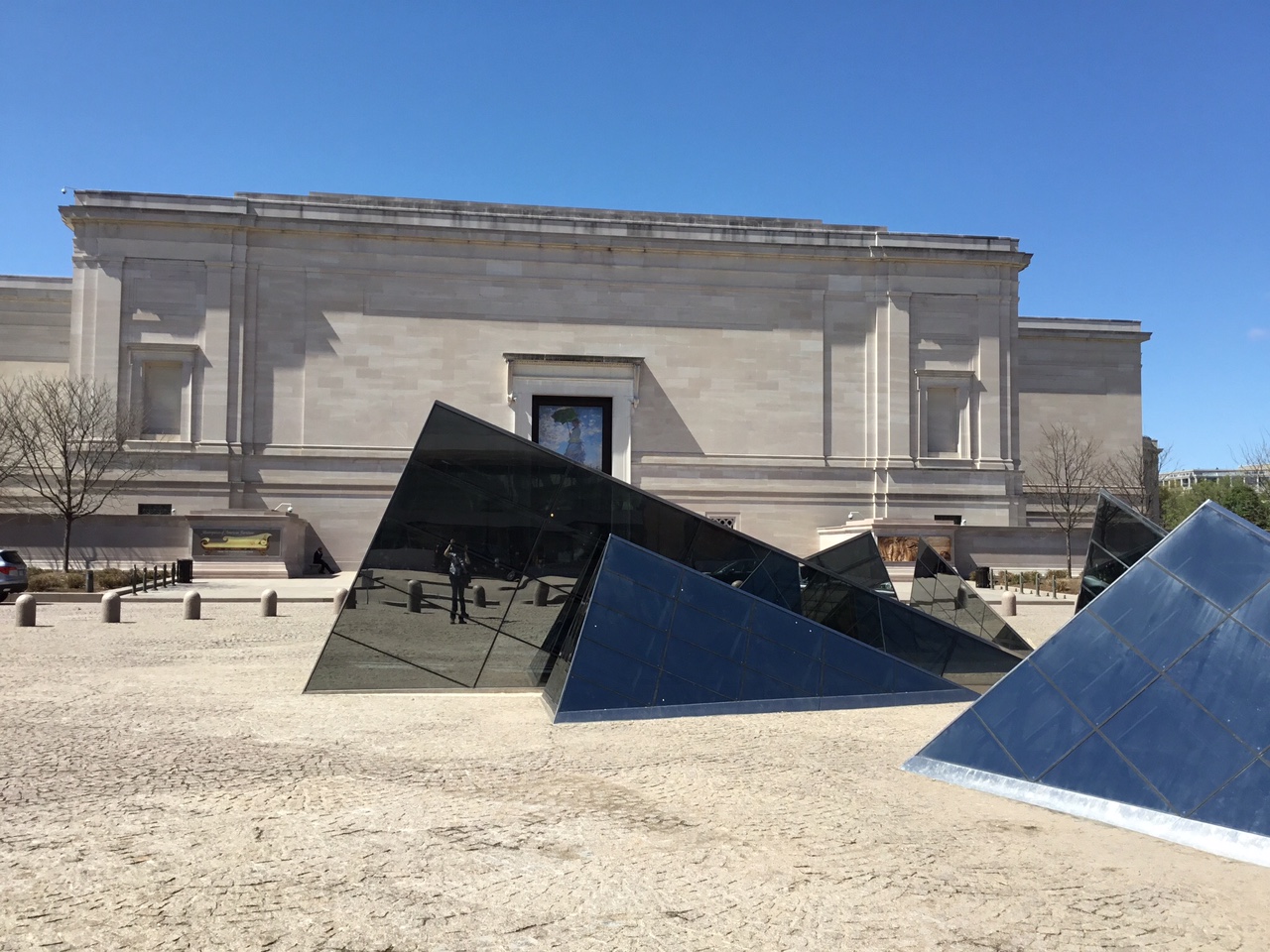
National Gallery of Art with self-portrait
* an ongoing series of quotations – mostly from artists, to artists – that offers wisdom, inspiration, and advice for the sometimes lonely road we are on.
Museums empower people when they are patrons for artists and thinkers; when they amplify civic discourse, accelerate cultural change and contribute to cultural intelligence among the great diversity of city dwellers, visitors, policy makers and leaders… Museums present beautiful, accessible and meaningful spaces in which communities and individuals can meet, exchange ideas and solve problems.
David J. Skorton, Director of the Smithsonian Institution in “What Do We Value?” Museum, May/June 2016
Comments are welcome!
Pearls from artists* # 202

Soft pastels
* an ongoing series of quotations – mostly from artists, to artists – that offers wisdom, inspiration, and advice for the sometimes lonely road we are on.
When you’re working on something, you always wonder, “Can I get away with this? Is it working?” It’s the space between that I’ve been interested in for a long time. I think that when I started to make, say, a triptych that came from an observation of a little Picasso drawing, the spaces in between became as important as the three actual pieces. It’s especially true of the Wallpaper piece. But most of the changes in my own work really evolve from one piece to the next: from looking at my own work, the works of others, and things in my studio. It happens when you see something that you didn’t see previously, like those scraps of clay that became the wall pieces. It’s similar to the space that I’ve explored for years and years between artist and craftsperson, which is both interesting and challenging, and I don’t think that one thing is inferior to the other. Each has a different goal, a different function. Its my responsibility how nd where my work is viewed in different contexts.
In Conversation: Betty Woodman with Phong Bui, The Brooklyn Rail, April 2016
Comments are welcome!
Q: Would you talk about how the Judas figures you depict in your pastel paintings function in Mexico?
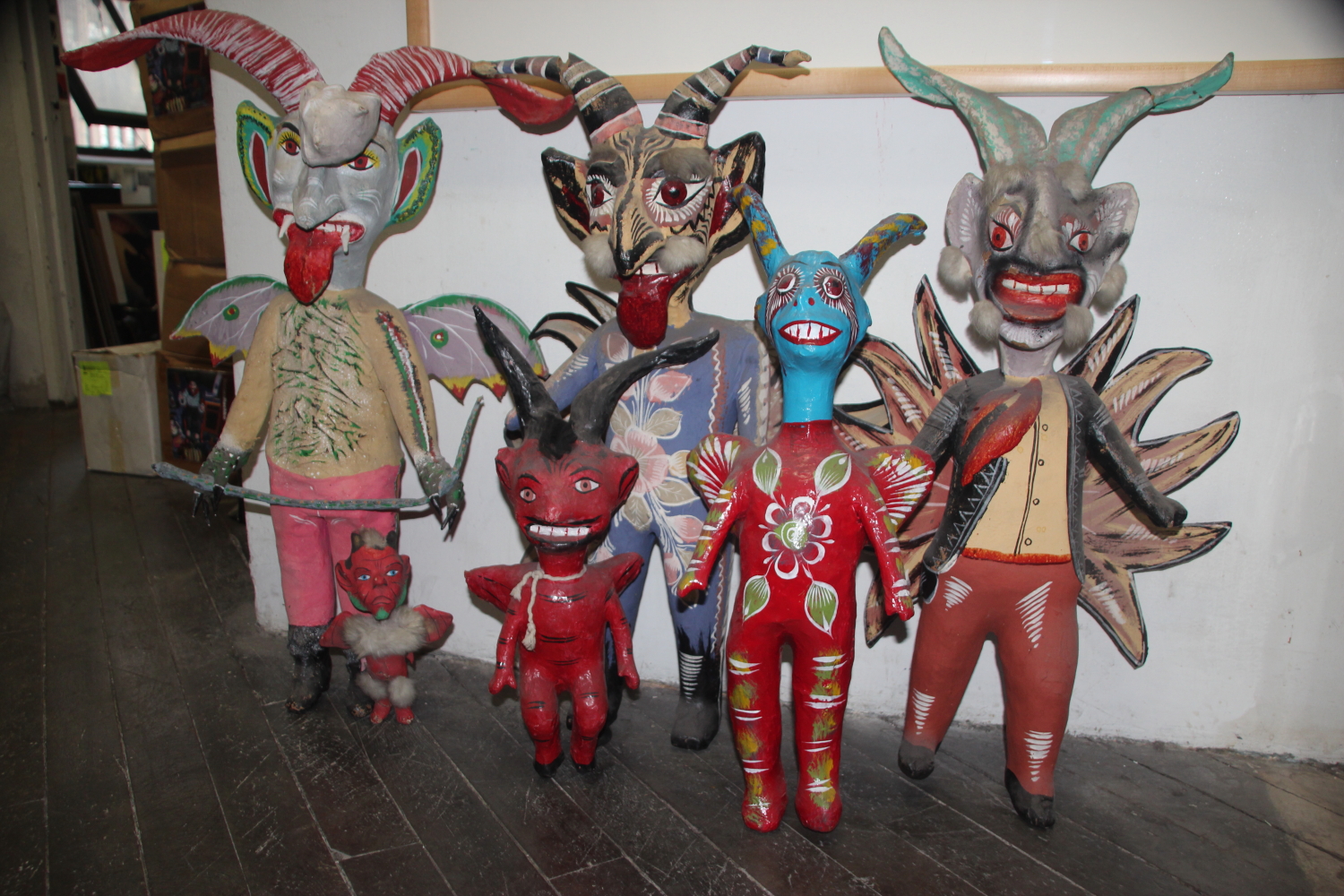
Some Judases
A: Here’s a good explanation from a website called “Mexican Folk Art Guide”:
“La quema de Judas or the Judas burning in Mexico is a celebration held on Sabado de Gloria (Holy Saturday). Papier mache figures symbolizing Judas Iscariot stuffed with fireworks are exploded in local plazas in front of cheerful spectators.
The Judases exploded in public spaces can measure up to 5 meters, while 30 cm ones can be found with a firework in their back to explode at home.
In Mexico la quema de Judas dates from the beginning of the Spanish colony when the Judas effigies were made with hay and rags and burned. Later as paper became available and the fireworks techniques arrived, thanks to the Spanish commerce route from the Philippines, the Judases were made out of cardboard, stuffed with fireworks, and exploded.
After the Independence War the celebration lost its religious character and became a secular activity. The Judas effigies were stuffed with candies, bread, and cigarettes to attract the crowds into the business [establishment] that sponsored the Judas.
Judas was then depicted as a devil and identified with a corrupt official, or any character that would harm people. In 1849 a new law stipulated that it was forbidden to relate a Judas effigy with any person by putting a name on it or dressing it in a certain way to be identified with a particular person.”
This is why whenever I bring home a Judas figure from Mexico, I feel like I have rescued it from a fire-y death!
Comments are welcome!
Pearls from artists* # 124
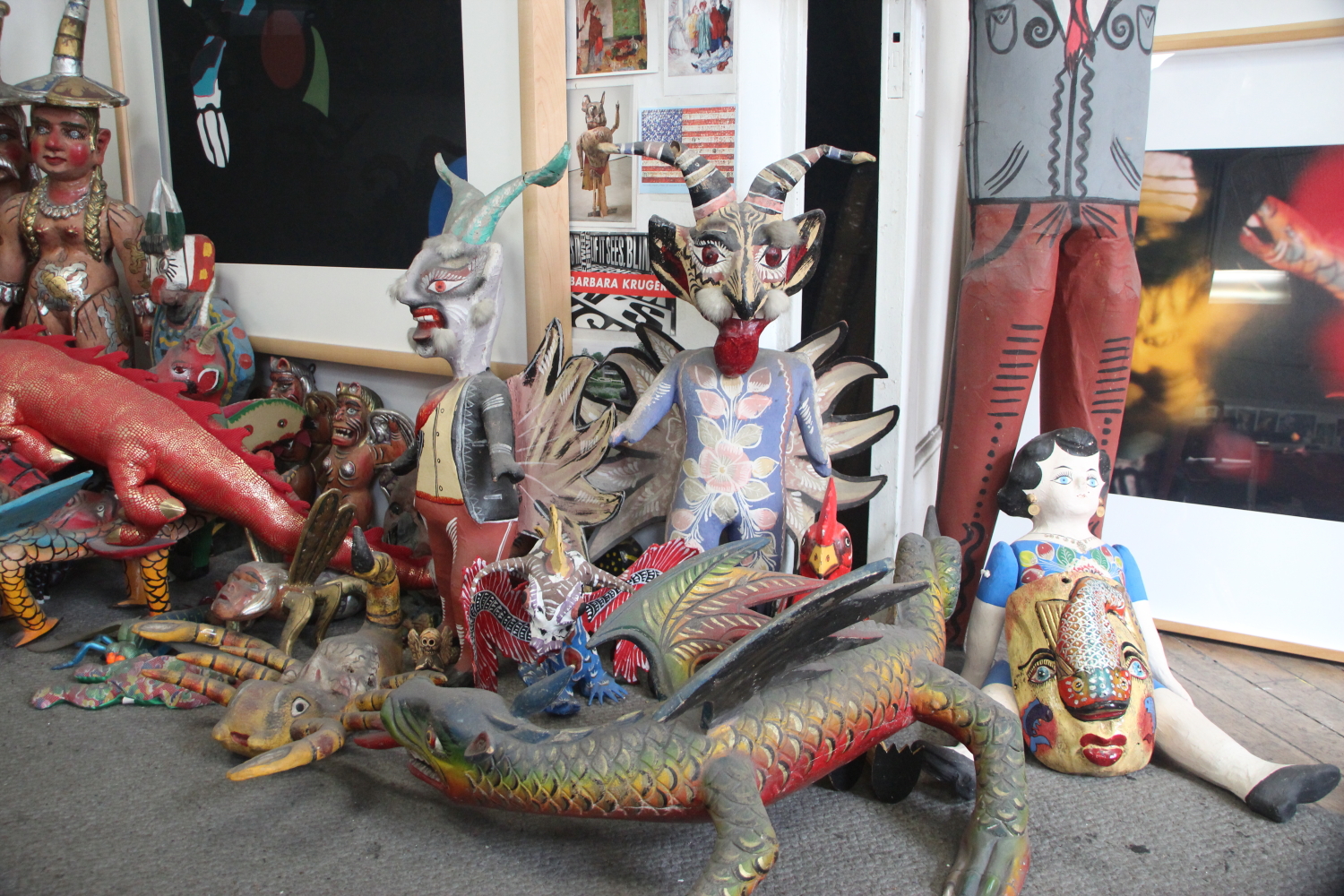
Barbara’s studio
* an ongoing series of quotations – mostly from artists, to artists – that offers wisdom, inspiration, and advice for the sometimes lonely road we are on.
You give yourself a creative life – pursuing those questions and aesthetic conditions that mean the most to you. What are you interested in? Landscape and gender and nuclear power are each worthy subjects and there are plenty more. Do you aspire to exhibit in museums or public spaces or virtual realms? Your job is to figure out how to best engage these distinct contexts. Your studio may be a large industrial space or a second bedroom or the kitchen table, where you can work days or nights while wearing your favorite sweatpants and drinking tea as music blasts or silence is maintained. You might produce five or fifty objects a year, using bronze or oil paint or folded paper, and these can be large or tiny, made to last for centuries or a few weeks. Maybe you’ve been a printmaker for several years and all of a sudden you decide to make videos. OK. You might be influenced by Pop Art or Minimalism or Feminism or Fluxus. How are you using these various histories to your advantage? Does Edward Hopper or Gordon Matta-Clark or Agnes Martin or David Hammons inspire you? If not, who does? Try to understand the reasons for your choices, and if you feel the need to shift gears, indulge that impulse. Grant yourself the permission to acquire new skills, travel to biennials, buy a new computer, start a reading group. Risk not knowing what will happen when you do.
Stephen Horodner in THE ART LIFE: On Creativity and Career
Comments are welcome!


 barbararachkoscoloreddust.com