Blog Archives
Pearls from artists* # 661

*an ongoing series of quotations – mostly from artists, to artists – that offers wisdom, inspiration, and advice for the sometimes lonely road we are on.
Curiosity and wonder are essential to the art life. Curiosity drives us to look beneath the rocks that others pass by. Wonder helps us recognize the infinite potential of what we find there, so we might spin it into something remarkable. The concepts and visuals that attract me will likely not grab you, but therein lies the beauty. Your job is to keep excavating the things that intrigue you, feeding your head with new ideas. The objective is to build a singular mental stockpile of elements that make up your visual voice. Your brain then makes connections that others would never make because they have assembled a vastly different stockpile of ideas, images, experiences, concepts, beliefs, and concerns.
Kate Kretz in Art From Your Core: A Holistic Guide to Visual Voice
Comments are welcome!
Pearls from artists* # 648

“Apparition,” soft pastel on sandpaper, 58” x 38”
*an ongoing series of quotations – mostly from artists, to artists – that offers wisdom, inspiration, and advice for the sometimes lonely road we are on.
I prefer to speak in terms of the artist’s voice. Voice is deeper, manifested from the very core of your being. It is a synthesis of the experiences, intellectual concepts, and aesthetic interests you possess, executed in your distinctive way, in the formal, emotional, and intellectual language of your chosen medium. When successful, the realization of your voice follows a gestalt principle. The combination of your ideas and the work’s physical embodiment is greater than the sum of its parts and distinguishes your outcome from everyone else’s. If we wrote down a single concept and handed it to a dozen artists, we would get very different responses from each of them, and some works would be a stronger synthesis of ideas and execution. As Frank Stella once said, “There are no good ideas for paintings, there are only good paintings… the painting IS the idea (Saltz, 2020:42).”
The art that we recognize as having singular, identifying features, those formal aspects that allow us to immediately see a work as ‘a David Wojnarowicz’ or ‘a Julie Mehretu,’ were not the product of a singular flash of brilliance. These qualities evolved as part of a sustained, life-long, ever-deepening investigation to articulate their specific and singular vision. Our voice comes from tapping into the depths of our own consciousness, then distilling the most powerful aspects of that awareness. Voice also expands and deepens over time. It evolves along with the artist.
Kate Kretz in Art From Your Core: A Holistic Guide to Visual Voice
Comments are welcome!
Pearls from artists* # 632

*an ongoing series of quotations – mostly from artists, to artists – that offers wisdom, inspiration, and advice for the sometimes lonely road we are on.
”The mind once stretched by a new idea, never returns to its original dimensions.” – Ralph Waldo Emerson ((1803 – 1882)
Ralph Waldo Emerson was more prescient than he can ever have realized. It was not until the 1960s that neuroscientist Marian Diamond discovered that exposure to enriched environments increased brain matter, specifically in the brain’s outer cortex. Prior to her landmark research, scientists believed that the brain remained static until it started to decline in older age. Diamond was the first to observe the brain’s neuroplasticity, yet her findings were disputed and rejected for many years. Today she is considered one of the founders of modern neuroscience.
Museums are the ultimate enriched environments, or super-enriched spaces, that are good for body, mind, and soul. Museums are dedicated to arousing our curiosity; engaging us in discovery and learning; and evoking our reflection, wonder, and awe. Artists (and Emerson) have known intuitively what scientists are now proving with rigorous research: aesthetic experiences affect us in extraordinary ways. In short, our brains are wired for art.
The Museum and the Mind by Susan Magsamen in Museum, May/June 2024
Comments are welcome!
Pearls from artists* # 629

Barbara’s Studio
*an ongoing series of quotations – mostly from artists, to artists – that offers wisdom, inspiration, and advice for the sometimes lonely road we are on.
I kept coming back to [Ellen] Dissanayake. She’s for banning the word art altogether on the grounds it’s uselessly vague, and argues we shouldn’t treat art as a thing but as a behavior. Art, she claims, occurs anytime we take ordinary things and transform them into extraordinary experiences through a process she calls “making special.” Making special happens when words turn into poetry, flesh gets painted for a shaman’s ceremony, a B-flat meets a middle G to form the tune in a Peking opera. I liked her definition, which seemed less arbitrary than others I’d read and didn’t turn up its nose at blockbuster movies or Super Bowl halftime shows – which Dissanayake calls “the arts of our time.” As she sees it, art results from several key “operations” … Artists repeat… formalize… exaggerate… elaborate… and manipulate expectation… Break dancing, leading a tea ceremony, designing Grand Theft Auto – to Dissanayake, it’s art, art, and more art.
Bianca Bosker in Get the Picture: A Mind-Bending Journey Among the Inspired Artists and Obsessive Art Fiends Who Taught Me How to See
Comments are welcome!
Pearls from artists* # 573

In the studio
*an ongoing series of quotations – mostly from artists, to artists – that offers wisdom, inspiration, and advice for the sometimes lonely road we are on.
The literature on creativity is full of tales of breakthrough experiences. These moments come when you let go of some impediment or fear, and boom – in whooshes the muse. You feel clarity, power, freedom, as something unforeseen jumps out at you. The literature of Zen… abounds with accounts of kensho and satori – moments of illumination and moments of total change of heart. There come points in your life when you simply kick the door open. But there is no ultimate breakthrough; what we find in the development of a creative life is an open-ended series of provisional breakthroughs. In this journey there is no endpoint because it is the journey into the soul.
Stephen Nachmanovitch in Free Play: Improvisation in Life and Art
Comments are welcome!
Pearls from artists* # 572

*an ongoing series of quotations – mostly from artists, to artists – that offers wisdom, inspiration, and advice for the sometimes lonely road we are on.
The use of color to paint the Chinchorro mummies is interesting. According to anthropologist Victor Turner (1970), colors are experiences of social relationships. The use of particular colors in prehistory, then, has meaning even if today we cannot comprehend these meanings. Turner said that white, red, and black are the earliest colors produced by humans and they “provide a kind of primordial classification of reality” (Turner, 1970:90). This color trilogy is associated with reproduction, life, and death. Obviously, in the case of Chinchorros, black and red colors predominated. Black is equated with darkness, like the night, invisible yet present. Black is what is hidden, it is a mystical transition (Turner, 1970:109, 89-73). Black represents death, but not the end of a cycle, not an annihilating, rather a change of status and existence (Turner, 1970:71-72). Red on the other hand is equal to membership, change, blood, and social place (Turner, 1970:90). Red can be associated with life, here and in the afterworld.
The use of colors as symbols is rather universal, but the meaning of each color varies from culture to culture. In western societies black may be worn to symbolize mourning, but on other occasions it signifies relevance. The Yahgan Indians in South America used body painting with intricate patterns of black, white, and red to show their sadness and grief when someone died (Gusinde, 1937). Black was the color to symbolize mourning among the Incas (Montez, 1929:222; Zuidema, 1992:23).
Bernardo T. Arrizabalaga in Beyond Death: The Chinchorro Mummies of Ancient Chile
Comments are welcome!
Pearls from artists* #571
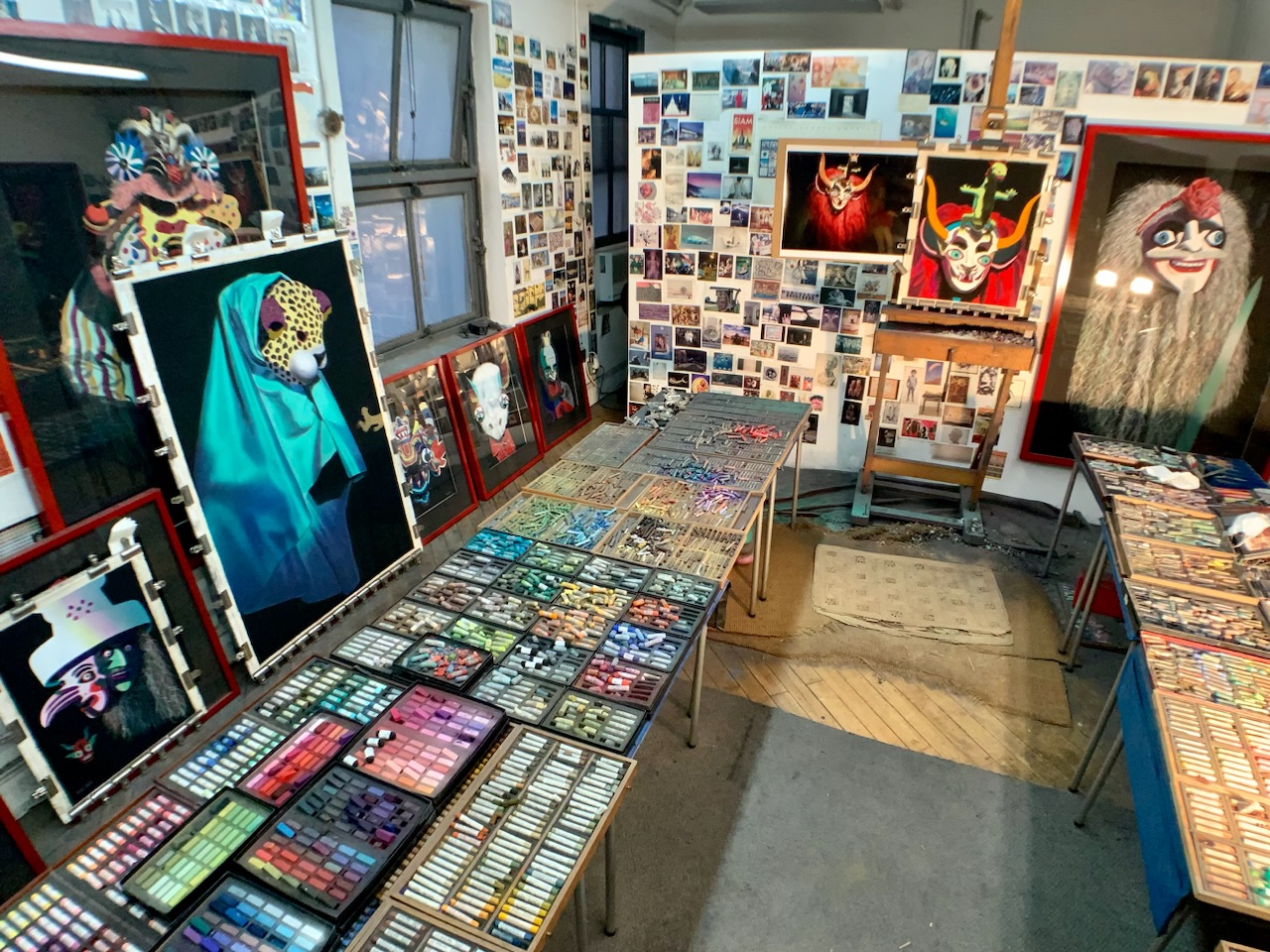
The Studio
*an ongoing series of quotations – mostly from artists, to artists – that offers wisdom, inspiration, and advice for the sometimes lonely road we are on.
To put it simply, but accurately, artists are often lost to the world because of their obsessions with their art. They may be just as lost as they prepare to work or incubate a new idea as in those feverish days when they make their final cuts on a film or race toward a publishing deadline. They may obsess about artistic questions and feel bursts of creative energy day or night, alone or in the company of others, in the middle of the work week or on vacation in the Bahamas.
Lost in time and space, the artist may feel more connected to Picasso, Emily Dickinson, Ingmar Bergman, Gertrude Stein, Handel, or Tennessee Williams than to the people in his immediate world. The living past holds extraordinary meaning for him. He travels elsewhere, removing his spirit and attention from the present. He may reside, as he works on his novel, in the childhood of a character, walking the garden paths and living the household dramas there. He may come upon a Rembrandt drawing and find himself wrenched, not to any particular place or time, but just elsewhere, as he experiences the greatness of his traditions, measures himself anew, and dreams again of his future.
Eric Maisel in A Life in the Arts: Practical Guidance and Inspiration for Creative and Performing Artists
Comments are welcome!
Q: What about the importance of vision in your training in the Navy has helped you be able to see what you want to create in your art? (Question from “Arte Realizzata”)

A: I continue to reflect on what my experiences as a Naval officer contributed to my present career. Certainly, I learned attention to detail, time management, organization, and discipline, which have all served me well. I keep regular studio hours (currently 10:00 – 4:00 on Monday, Tuesday, Thursday, Friday, and Saturday) which I understand is rare among artists.
Prior to joining the Navy, I had financed my own flight training to become a commercial pilot and Boeing-727 Flight Engineer. However, my Naval career consisted entirely of monotonous paper-work jobs that were not the least bit intellectually challenging. Finding myself stuck in jobs that reflected neither my skills nor my interests, I made a major life change. When I left active duty at the Pentagon I resolved, “I have just resigned from the most boring job. I am going to do my best to never make BORING art!” Other than this, I an hard-pressed to pinpoint anything the Navy contributed to my art career.
Comments are welcome!
Pearls from artists* # 478

*an ongoing series of quotations – mostly from artists, to artists – that offers wisdom, inspiration, and advice for the sometimes lonely road we are on.
Artists, because of the demands of their personality, their sense of personal mission, and their need to create or perform, are driven people. Mixed with the love of work can be a terrible pressure to work. For many artists, and especially for the most productive ones, the line between love and obsession and between love and compulsion blurs or disappears entirely. Are such artists free or are they slaves to their work?
In The Artist and Society the psychiatrist Lawrence Hatterer said of such an artist:
His most recognizable trait is his recurring daily preoccupation with translating artistic activity into accomplishment. The consuming intensity of this artistic pursuit brooks no interference or obstacles. His absorption with the creative act is such that he experiences continually what the average artist feels only infrequently when he reaches unusual levels of creative energy with accompanying output. He appears to be incapable of willful nonproductivity.
This is Picasso working for 72 hours straight. This is van Gogh turning out 200 finished paintings during his 444 days in Arles. The artist who is “incapable of willful nonproductivity” is a workaholic for whom little in life, apart from his artistic productivity and accomplishment, may have any meaning.
Eric Maisel in A Life in the Arts: Practical Guidance and Inspiration for Creative and Performing Artists
Comments are welcome!
Pearls from artists* # 439

New York Harbor
* an ongoing series of quotations – mostly from artists, to artists – that offers wisdom, inspiration, and advice for the sometimes lonely road we are on.
Art is a way of preserving experiences, of which there are many transient and beautiful examples, and that we need help containing. There is an analogy to be made with the task of carrying water and the tool that helps us do it. Imagine being out in a park on a blustery April day. We look up at the clouds and feel moved by their beauty and grace. They feel delightfully separate from the day-to-day bustle of our lives. We give our minds to the clouds, and for a time we are relieved of our preoccupations and placed in a wider context that stills the incessant complaints of our egos. John Constable’s cloud studies invite us to concentrate, much more than we would normally, on the distinctive textures and shapes of individual clouds, to look at their variations in colour and at the way they mass together. Art edits down complexity and helps us to focus, albeit briefly, on the most meaningful aspects. In making his cloud studies, Constable didn’t expect us to become deeply concerned with meteorology. The precise nature of a cumulonimbus is not the issue. Rather, he wished to intensify the emotional meaning of the soundless drama that unfolds daily above our heads, making it more readily available to us and encouraging us to afford it the central position it deserves.
Alain de Botton and John Armstrong in Art as Therapy
Comments are welcome!


 barbararachkoscoloreddust.com