Blog Archives
Pearls from artists* # 486

Walter Murch: Somebody once asked WH Auden, is it true that you can write only what you know?” And he said, “Yes it is. But you don’t know what you know until you write it.” Writing is a process of discovery of what you really do know. You can’t limit yourself in advance to what you know, because you don’t know everything you know.
The Conversations: Walter Murch and the Art of Editing Film by Michael Ondaatje
Comments are welcome!
Pearls from artists* # 483

*an ongoing series of quotations – mostly from artists, to artists – that offers wisdom, inspiration, and advice for the sometimes lonely road we are on.
The editor has a unique relationship with the actors. I never try to go on to the set to see the actors out of costume or out of character – and also just not to see the set. I only want to see what there is on screen. Ultimately, that’s all the audience is ever going to see. Everyone else working on the film at that stage is party to everything going on around the filmed scene: how cold it was when that scene was shot; who was mad at whom; who is in love with whom; how quickly something was done; what was standing just to the left of the frame. An editor particularly has to be careful that those things don’t exert a hidden influence on the way the film is constructed, can (and should in my view) remain ignorant of all that stuff – in order to find value where others might not see value, and on the other hand, to diminish the value of certain things that other people see as too important. It’s one o the crucial functions of the editor. To take, as far as it is possible, the view of the audience, who is seeing the film without any knowledge of all the things that went into its construction.
On Editing Actors, by Walter Murch in The Conversations: Walter Murch and the Art of Editing Film, by Michael Ondaatje
Comments are welcome!
Q: What country’s artistic style influenced you the most over the years? (Question from Arte Realizzata)

A: Undoubtedly, I would have to say Mexico. As a Christmas present in 1991 my future sister-in-law sent two brightly painted wooden animal figures from Oaxaca, Mexico. One was a blue polka-dotted winged horse. The other was a red, white, and black bear-like figure.
I was enthralled with this gift and the timing was fortuitous because I had been searching for new subject matter to paint. Soon I started asking artist-friends about Oaxaca and learned that it was an important art hub. At least two well-known Mexican painters, Rufino Tamayo and Francisco Toledo, had gotten their start there , as had master photographer Manual Alvarez Bravo. There was a “Oaxacan School of Painting” (‘school’ meaning a style, not an actual building) and Alvarez Bravo had established a photography school there (the building/institution kind). I began reading everything I could find. At the time I had only been to Mexico very briefly, in 1975, having made a road trip to Ensenada with my cousin and best friend from college. The following autumn my then-boyfriend, Bryan, and I planned a two-week trip to visit Mexico. We timed it to see Day of the Dead celebrations in Oaxaca. (In my reading I had become fascinated with this festival). We spent one week in Oaxaca followed by one week in Mexico City. My interest in collecting Mexican folk art was off and running!
Comments are welcome!
Pearls from artists* # 475

*an ongoing series of quotations – mostly from artists, to artists – that offers wisdom, inspiration, and advice for the sometimes lonely road we are on.
In order to warm the artist’s heart, it’s necessary to assert that he is doing good work. Random or wrong-headed praise won’t do the trick, but will only exacerbate the artist’s feeling that he is unseen and misunderstood.
Even wrong-headed praise is the exception rather than the rule in the artist’s search for recognition. More often than not your recognition will consist of criticism, not praise. You may be criticized for not attempting work you have no desire to attempt, for pandering to mass taste, for working too exotically or too narrowly… You may be attacked in a mixed review that purports to praise you. In short, you may be criticized for everything and anything under the sun.
Can you escape this criticism as you struggle for recognition? No. The journalist Elbert Hubbard said, “To escape criticism, do nothing, say nothing, be nothing.” … you can’t escape criticism, you can’t tame your critics.
Eric Maisel in A Life in the Arts: Practical Guidance and Inspiration for Creative and performing Artists
Comments are welcome!
Pearls from artists* # 472
*an ongoing series of quotations – mostly from artists, to artists – that offers wisdom, inspiration, and advice for the sometimes lonely road we are on.
A remark by Kurt Anderson suggests how the Internet discourages patient gazing: “Waiting a while to get everything you want… was a definition of maturity. Demanding satisfaction right this instant, on the other hand, is a defining behavior of seven-year-olds. The powerful appeal of the Web is not just the ‘community’ it enables but its instantane-ity… as a result… delayed gratification itself came to seem quaint and unnecessary.” A survey commissioned by the Visitor Studies Association reveals the impact of impatience. On average, the survey found, Americans spend between six and ten seconds looking at individual works in museums. (Is it just a coincidence that six to ten seconds is also the average time browsers perch on any given Web page?) Yet how many hours a day do we spend absorbed by one or another electronic screen? For the Los Angeles artist Ed Ruscha (born 1937) brief encounters won’t suffice. When somebody asked, “How can you tell good art from bad?” Ruscha replied, “With a bad work you immediately say, ‘Wow!’ But afterwards, you think, ‘Hum? Maybe not.’ With a good work, the opposite happens.” Time is lodged at the heart of Ruscha’s formula, as the artwork becomes part of our temporal experience. In order to know what is good, we need to take a breather. Even to know what is bad, we need to pause.
Arden Reed in Slow Art: The Experience of Looking, Sacred Images to James Turrell
Comments are welcome!
Q: How did your ebook “From Pilot to Painter” come to be? (Question from “Arte Realizzata”)
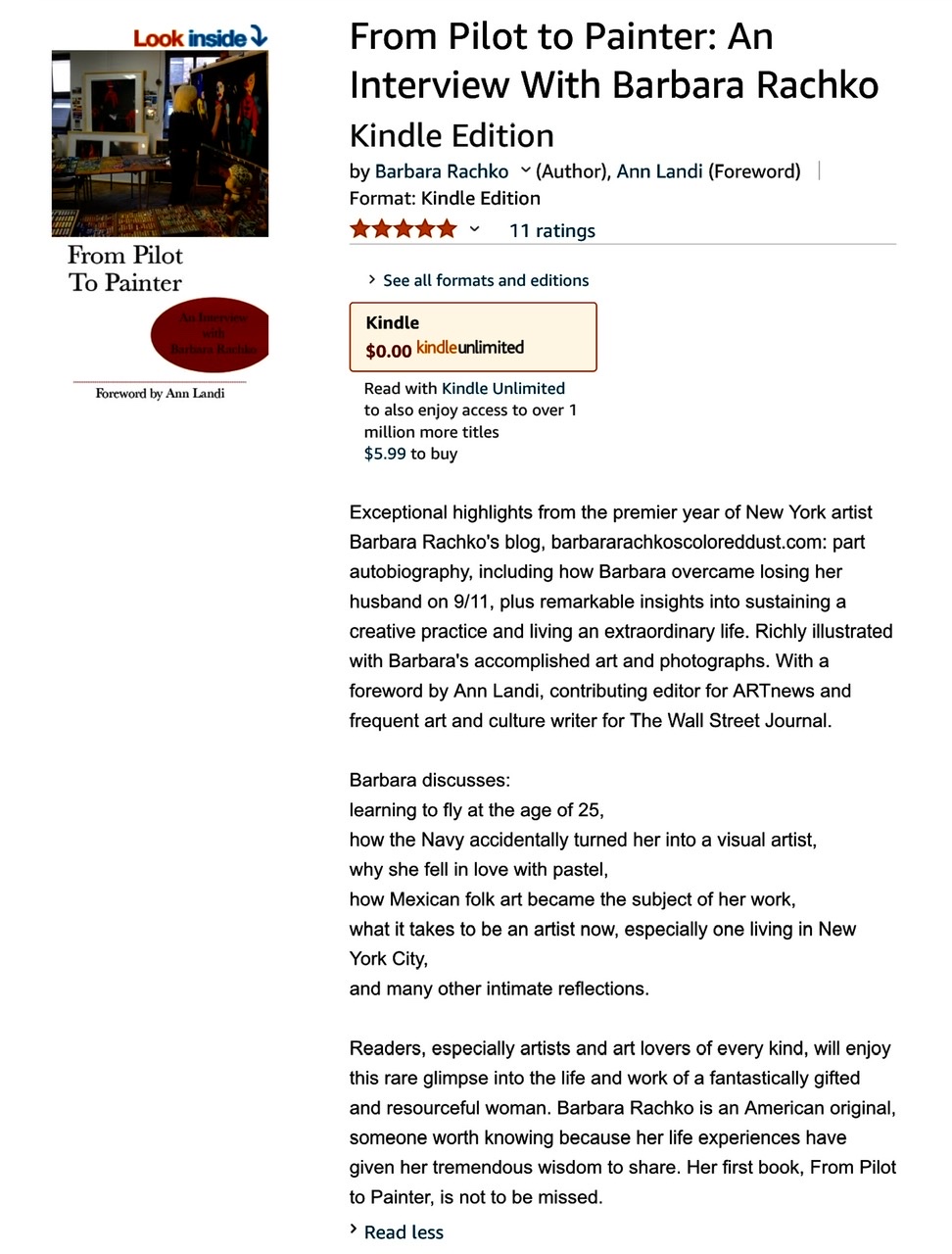
A: It was my longtime assistant, Barbra Drizin’s, idea and more than I’d care to admit, I was resistant. I said, “I am much too busy to write an ebook!” Barbra went on to explain that we could start with material I had already written for my blog, expand on it, add reproductions of my pastel paintings, etc. With her persuasion, I agreed! Barbra made the initial selections and together we added and revised text, organized the material, and worked out countless details. I asked my friend, Ann Landi, to write a foreword and Barbra found an editor to put everything into Amazon’s ebook format.
Now I am extremely pleased that my ebook FROM PILOT TO PAINTER is available not only on Amazon, but also on iTunes. It is based on my blog and is part memoir, including the loss of my husband on 9/11, insights into my creative practice, and intimate reflections on what it’s like to be an artist living in New York City. The ebook includes material not found on the blog, plus 25+ reproductions of my vibrant pastel-on-sandpaper paintings, a Foreword by Ann Landi, the founder of Vasari21.com and longtime critic for ARTnews, and more.
Comments are welcome!
Pearls from artists* # 470
*an ongoing series of quotations – mostly from artists, to artists – that offers wisdom, inspiration, and advice for the sometimes lonely road we are on.
Find something that is really meaningful to you – that’s the most important thing at the end of the day. Even if everything goes well, there are still those moments when you see through it all. Once you see through the fame, money, and social life and ask yourself, “What is this all about? What does it mean to me?,” it’s great if you can see your work clearly and what you see is important to you.
That same thing goes on the other side. When you wonder why you go through all this hell and you’re struggling, at least you see that you really enjoy what you do, you are fulfilled by what you make, and you believe in it.
Charles Long, artist, Mount Baldy, CA, in Art/Work: Everything You Need to Know (And Do) As You Pursue Your Art Career by Heather Darcy Bhandari and Jonathan Melber
Comments are welcome!
Pearls from artists* # 469

*an ongoing series of quotations – mostly from artists, to artists – that offers wisdom, inspiration, and advice for the sometimes lonely road we are on.
I feel artists are at the cutting edge of everything created by humans in our society. I would love for artists, young and old, to remember that for the Art World to exist, the first thing that is necessary is art. No gallerist, museum director, preparatory, or museum guard would have a job without an artwork having been created.
Without remembering this, artists can lose sight of their power and worth. We begin to believe that the Art World came first and that we need to change, appropriate, adjust, or edit ourselves and our work to fit into this world. This does not need to happen, and should not happen.
Stephanie Diamond, artist, New York, NY, in Art/Work: Everything You Need to Know (And Do) As You Pursue Your Art Career by Heather Darcy Bhandari and Jonathan Melber
Comments are welcome!
Pearls from artists* # 466

*an ongoing series of quotations – mostly from artists, to artists – that offers wisdom, inspiration, and advice for the sometimes lonely road we are on.
Within the initial artistic response to something is a core idea or feeling and most of our work comes from stripping away everything that is extraneous to it. To translate that vision means “to get across” the idea or feeling. How cleanly can that idea be isolated and honed, how much can be stripped away? Everything superfluous and tangential needs to be eliminated. Otherwise the idea may get buried and our intention deflected. And the viewer’s will also. The problem is seldom that an idea is too simple. Power comes from something deeply felt and simply stated. “Nothing astonishes men so much as common sense and plain dealing. All great actions have been simple, and all great pictures are.” (Quote from Ken Weber, The Eye of the Spirit, Shambala, 1998, p. 136).
Ian Roberts in Creative Authenticity: 16 Principles to Clarify and Deepen Your Artistic Vision
Comments are welcome!
Pearls from artists* # 460
*an ongoing series of quotations – mostly from artists, to artists – that offers wisdom, inspiration, and advice for the sometimes lonely road we are on.
Precious realm of painting! That silent power that speaks at first only to the eyes and then seizes and captivates every faculty of the soul! Here is your real spirit; here is your own true beauty, beautiful painting, so much insulted, so much misunderstood and delivered up to fools who exploit you. But there are still hearts ready to welcome you devoutly, souls who will no more be satisfied with mere phrases than with inventions and clever artifices. You have only to be seen in your masculine and simple vigor to give pleasure that is pure and absolute. I confess that I have worked logically, I, who have no love for logical painting. I see now that my turbulent mind needs activity, that it must break out and try a hundred different ways before reaching the goal towards which I am always straining. There is an old leaven working in me, some black depth that must be appeased. Unless I am writhing like a serpent in the coils of a pythoness I am cold. I must recognize this and accept it, and to do so is the greatest happiness. Everything good that I have ever done has come about in this way. No more ‘Don Quixotes’ and such unworthy things!
The Journal of Eugene Delacroix edited by Hubert Wellington
Comments are welcome!


 barbararachkoscoloreddust.com