Blog Archives
Q: You started the Bolivianos series in 2017. It has been 8 years since you created The Champ. This endeavor of focussing on a series for almost a decade’s timeline shows that you embody stability as against many artists who tend to hop on to the next inspiration they find. How has discipline, stability, focus and punctuality defined your works apart from being inspired by Bolivian culture for the series Bolivianos? (Question from Vedica Art Studios and Gallery)
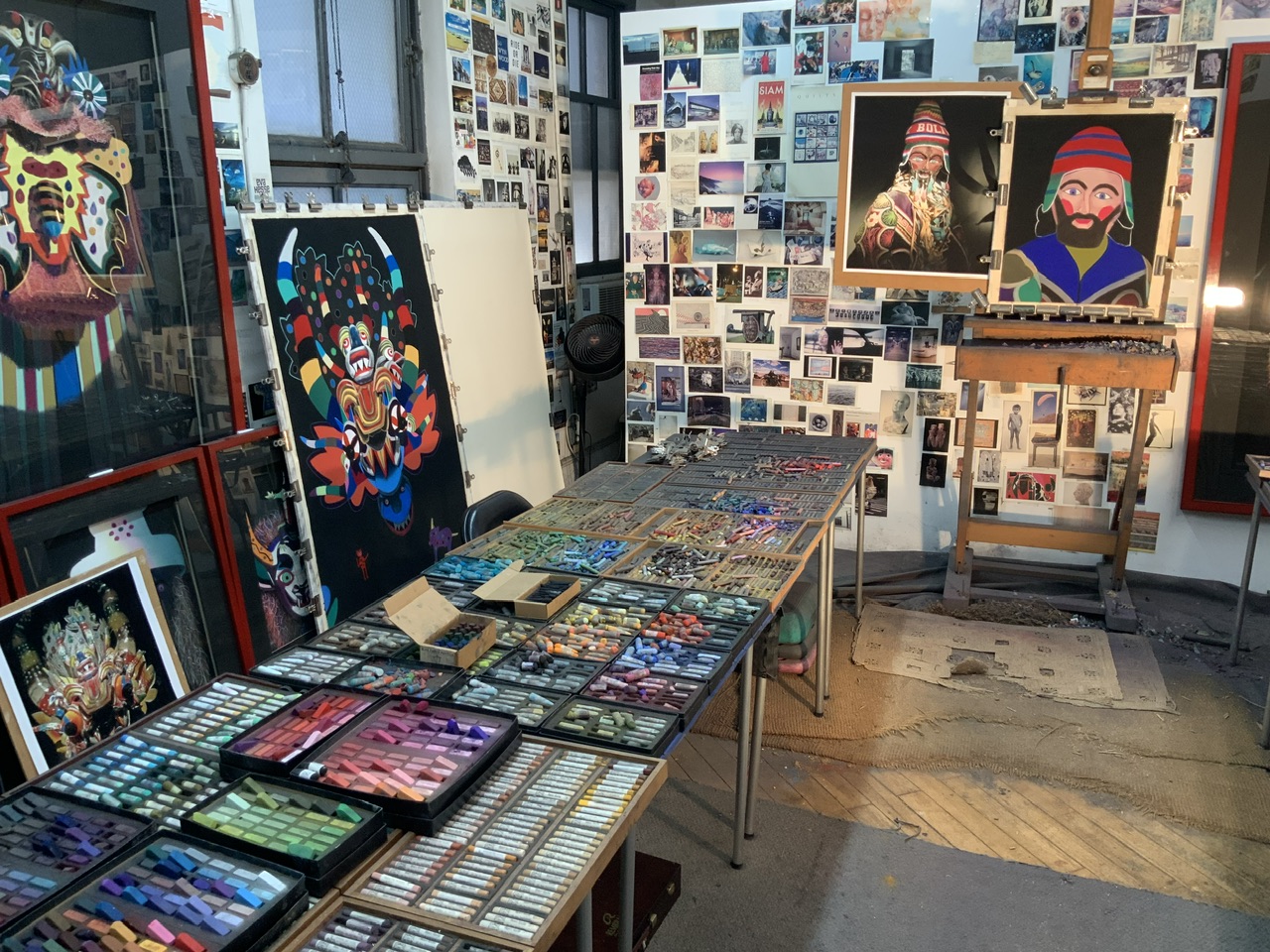
A: My first series, Domestic Threats, lasted fifteen years, and my second, Black Paintings, lasted ten. Stability and related qualities are likely natural parts of my personality, reinforced by my previous professional life. My prior careers as a Navy Commander, commercial pilot, and Boeing-727 Flight Engineer undoubtedly helped develop discipline, stability, focus, and punctuality. Details matter deeply to me; as a Naval Officer for twenty-one years, “attention to detail” was paramount. From my earliest days as an artist, I have been meticulous and dedicated to inventing new techniques and refining the craft of soft pastel.
I dislike wasting precious time. As a goal-oriented person, I continually strive to accomplish as much as possible. These qualities were influenced by my Navy career and further deepened by the tragic loss of my husband onboard the plane that crashed into the Pentagon on 9/11. I understand firsthand that life can change in an instant. Whenever I finish one task, I immediately look around and ask, “OK, what’s next?” I devote my studio time to pushing myself and pastel to new technical heights. There’s always more to accomplish as an artist!
Comments are welcome!
Q: Would you please share your current bio?

A: Here it is.
Barbara Rachko, born in 1953 in Paterson, New Jersey, is a contemporary painter based in New York City, renowned for her large pastel-on-sandpaper paintings inspired by Bolivian Carnival masks. With nearly 40 years dedicated to revolutionizing pastel as a fine art medium, Rachko’s influential blog, Barbara Rachko’s Colored Dust, has garnered over 229,000 subscribers. She is the subject of the acclaimed documentary “Barbara Rachko: True Grit,” available on YouTube, and her ebook “From Pilot to Painter” captures her inspiring journey from a former pilot to an accomplished artist.
Rachko’s work explores the vibrant cultural heritage of Bolivian Carnival masks, and Mexican and Guatemalan folk art. Her meticulous attention to detail is showcased in notable series such as Bolivianos, Black Paintings, and Domestic Threats. In 2023, she was featured in a documentary that premiered at the Newport Beach Film Festival, earning the Audience Award and Best in Category Award, further cementing her impact on contemporary art.
Her solo exhibitions include the Joy Pratt Markham Gallery at Walton Arts Center (AR), Louise Jones Brown Gallery at Duke University (NC), Olin Gallery (VA), and La MaMa La Galleria (NY). She trained in photography at the International Center of Photography in New York and studied drawing and pastel techniques at the Art League School in Alexandria, VA. Her works are held in private collections worldwide and have been showcased at prestigious art fairs, including Art Basel Miami, Moon Art Fair in Hamburg, and Art Busan in Korea, affirming her global influence in pastel painting.
Comments are welcome!
Q: Did you formally study art? (Question from “Cultured Focus Magazine”)

A: My bachelor’s degree in Psychology is from the University of Vermont. I did not formally study art, unless you want to count the several years-worth of drawing and painting classes I took at the Art League School in Alexandria, VA. I never went to art school so do not have a bachelor’s or master’s degree in art.
Much later, in the early 2000s, I was compelled to study photography at the International Center of Photography in New York. This is a rather long story.
On September 11, 2001, my husband Bryan Jack, a high-ranking federal government employee, a brilliant economist and a budget analyst at the Pentagon, was on his way to present his monthly guest lecture in economics at the Naval Postgraduate College in Monterey, CA. He was a passenger on the plane that departed from Dulles Airport and was high-jacked and crashed into the Pentagon.
Losing Bryan on 9/11 was the biggest shock of my life, devastating in every way imaginable. We were soulmates and newly married. I have lived with his loss every single day for more than twenty years now. Life has never been the same.
In the summer of 2002 I was beginning to feel ready to get back to work. Learning about photography and cameras became essential avenues to my well-being.
My first challenge was learning how to use Bryan’s 4 x 5 view camera. Bryan had always taken the 4 x 5 negatives from which I derived the reference photos that were essential tools for making pastel paintings. I enrolled in a one-week view camera workshop at the International Center of Photography in New York. Surprisingly, it was very easy. I had derived substantial technical knowledge just from watching Bryan for many years.
After the view camera workshop, I decided to throw myself into learning this new medium, beginning with Photography I. I spent the next few years taking many classes at ICP and learning as much as I could. Eventually, I learned how to use Bryan’s extensive collection of film cameras, to properly light the setups that served as subject material for my “Domestic Threats” pastel paintings, and to make my own large chromogenic prints in a darkroom.
Then in October 2009 I was invited to present a solo photography exhibition at a gallery in New York. Continuing to make art after Bryan’s death had seemed like such an impossibility. I remember thinking how proud he would have been to know I became a good photographer.
Comments are welcome!
Q: Would you speak about someone who made a difference in your professional life?
A: The first person who comes to mind is my favorite aunt, Teddie. In 1997 she was headed to northern California to attend a three-year-plus silent Tibetan Buddhist retreat at her teacher’s center. Teddie offered me her West 13th Street 6th-floor walkup apartment to live in while she was away. At the time I was based in Alexandria, VA and had just had my first solo exhibition at an important West 57th Street gallery, Brewster Fine Arts. I was becoming increasingly frustrated with the limited Washington, DC art scene, had outgrown everything it had to offer, and felt New York pulling me towards new and exciting professional adventures.
Teddie, recognizing my talent and ambition, made it possible for me to afford to move to New York. She had practiced Tibetan Buddhism for 35 years and was soon to become a Buddhist lama. She had an extraordinary mind and thought deeply about life. We used to talk for hours. Teddie was 7 years older and seemed more like a sister than an aunt. Indeed, she was my first soul mate. (I have been extremely fortunate to have had two such relationships in my life. The other was my late husband, Bryan).
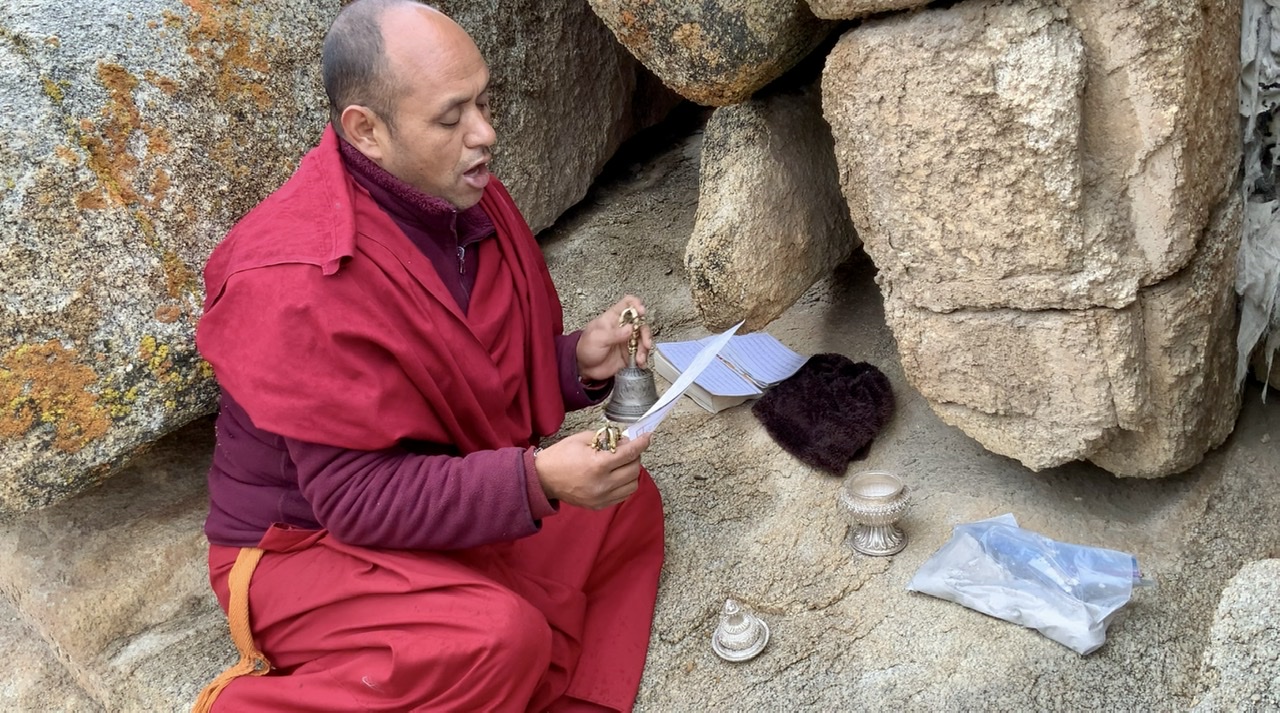
Unfortunately, dear Aunt Teddie died at the age of 67 of breast cancer. Recently, on September 25 I honored her life in a short ceremony on a mountain cliff in Leh, Ladakh (India). A Tibetan Buddhist monk recited prayers as he placed her ashes among the rocks.
Comments are welcome!

Q: I especially enjoy your “Black Paintings” series. You mention being influenced by the story of how Miles Davis developed cool jazz, making this work uniquely American all around. How did you use jazz history in this series?

“Between,” soft pastel on sandpaper, 20″ x 26″
A: In 2007 I finished the Domestic Threats series and was blocked, certain that a strong body of work was behind me. But what would come next?
The idea for the Black Paintings began when I attended a jazz history course at Lincoln Center and learned how Miles Davis developed cool jazz from bebop. In bebop the notes were played hard and fast as musicians showcased their musical virtuosity. Cool jazz was a much more relaxed style with fewer notes being played. In other words, the music was pared down to its essentials. Similarly, the Black Paintings evolved from dense, intricate compositions into paintings that depicted only the essential elements. As the series evolved, what was left out became more important, resulting in more demands being placed on the viewer.
Eventually, after much reflection, I had an epiphany and my painful creative block ended. “Between,” with drastically simplified imagery, was the first in a new series called Black Paintings. I like to think this series includes work that is richer and more profound than the previous Domestic Threats.
Comments are welcome!
Q: Can you tell us about the different series of work you have created and what they embody?
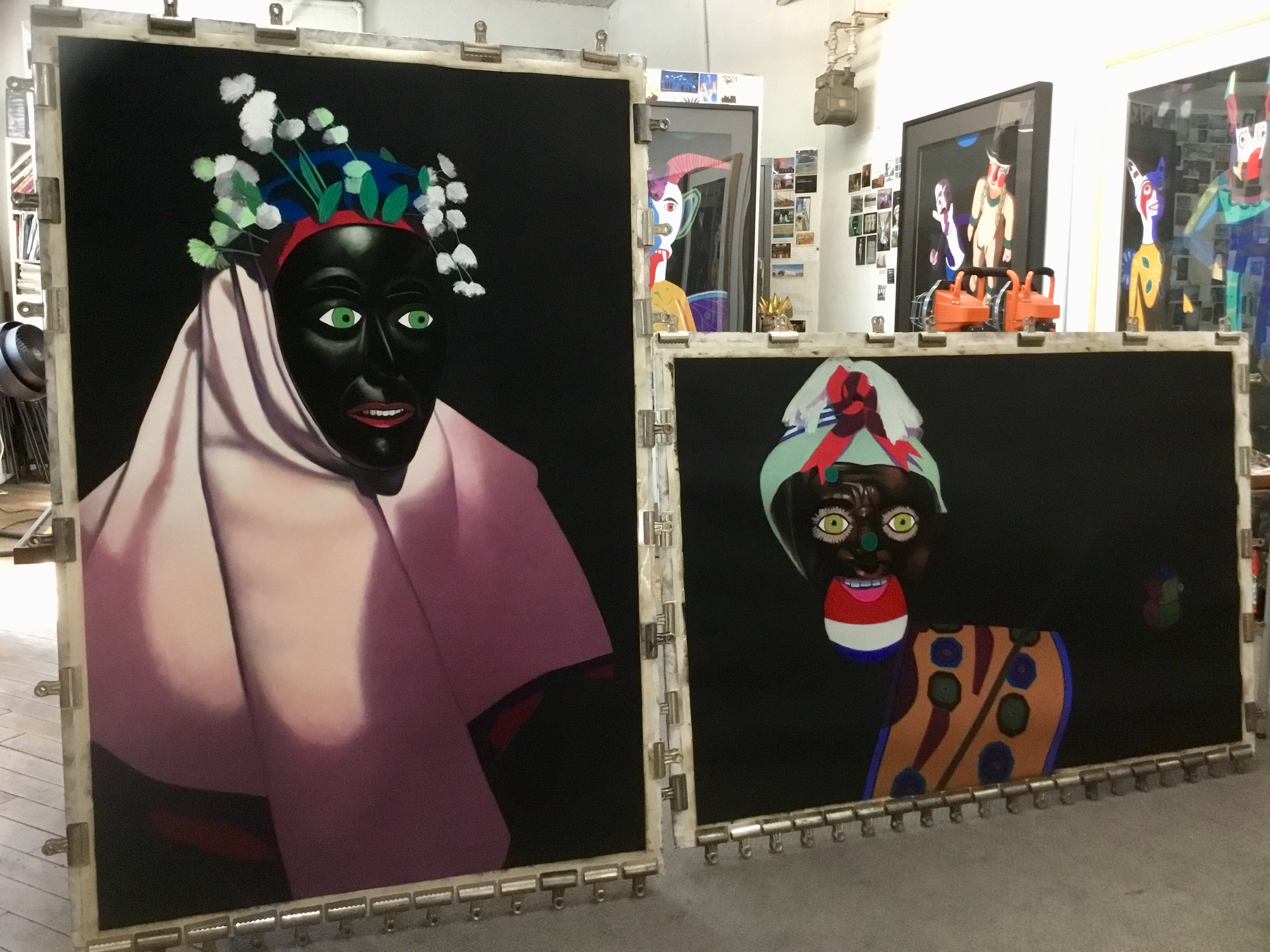
Barbara’s studio with work in progress
A: The Black Paintings series of pastel-on-sandpaper paintings grew directly from an earlier series, Domestic Threats. While both use cultural objects as surrogates for human beings acting in mysterious, highly-charged narratives, in the Black Paintings I replaced all background details of my actual setup (furniture, rugs, etc.) with lush black pastel. In this work the ‘actors’ are front and center.
While traveling in Bolivia two years ago, I visited a mask exhibition at the National Museum of Ethnography and Folklore in La Paz. The masks were presented against black walls, spot-lit, and looked eerily like 3D versions of my Black Paintings. I immediately knew I had stumbled upon a gift. So far I have completed nine pastel paintings in the Bolivianos series. One is awaiting finishing touches, one is in progress now, and I am planning the next one.
All of my pastel paintings are an example of a style called “contemporary conceptual realism” in which things are not quite as innocent as they seem. In this sense each painting is a kind of Trojan horse. There is plenty of backstory to my images, although I usually prefer not to over-explain them. Some mystery must always remain in art.
The world I depict is that of the imagination and this realm owes little debt to the natural world. I recently gave an art talk where I was reminded how fascinating it is to learn how others respond to my work. As New York art critic Gerrit Henry once remarked, “What we bring to a Rachko… we get back, bountifully.”
Comments are welcome!
Q: During one of the most gripping times of your life, you were personally affected by the 9/11 attack on our country. Your husband was killed on the plane that crashed into the Pentagon. Would you mind telling us about it and how it has shaped your work?
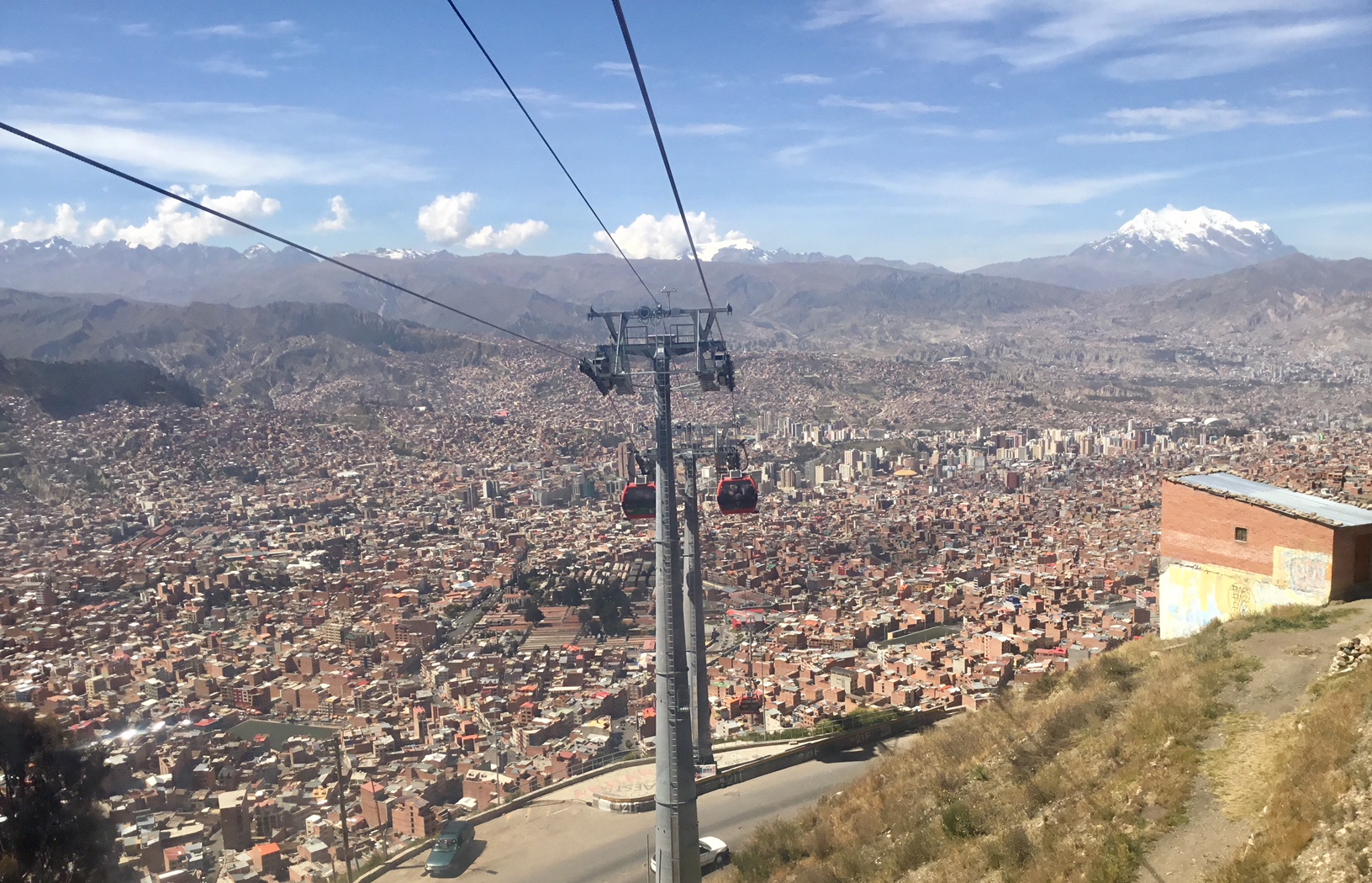
‘Mi Teleferico’ line, La Paz, Bolivia
A: In the summer of 2002 I was ready to – I HAD to – get back to work in my studio. I knew exactly what I must do. More than ever before, learning and painting would become the avenues to my well-being.
Because I use reference photos for my pastel paintings, the first challenge was to learn how to use Bryan’s 4 x 5 view camera. At that time I was not a photographer. Bryan had always taken reference photos for me.
In July 2002 I enrolled in a view camera workshop at New York’s International Center of Photography. Much to my surprise I had already absorbed quite a lot from watching Bryan. After the initial workshop, I continued more formal studies of photography for several years. In 2009, I am proud to say, I was invited to present a solo photography exhibition at a New York gallery!
In 2003 I resumed making my Domestic Threats series of pastel paintings, something that had seemed impossible after Bryan’s death. The first large pastel painting that I created using a reference photograph taken by me confirmed that my life’s work could continue. The title of that painting, “She Embraced It and Grew Stronger,” was autobiographical. “She” is me, and “it” meant continuing on without Bryan and living life for both of us.
Having had a long successful run, the Domestic Threats series finally ended in early 2007. Around that time I was feeling happier and had come to better terms with losing Bryan. While this is a tragedy I will never truly be at peace with, dealing with the loss became easier with time.
Then in 2007 I suddenly became blocked and did not know where to take my work next. I had never experienced creative block and especially for a full-time professional artist, this was a painful time. Still, I continued to go to the studio every day and eventually, thanks to a confluence of favorable circumstances, the block ended.
My next pastel painting series was called Black Paintings. I viewed the black background as literally, the very dark place that I was emerging from, exactly like the figures emerging in these paintings. The figures themselves were wildly colorful and full of life, but that black background – one critic has dubbed it my “blackground” – is always there.
Still the work continues to evolve. In 2017 I began my third pastel painting series called Bolivianos, based on a mask exhibition encountered in La Paz at the The National Museum of Ethnography and Folklore. Many people have proclaimed this to be my most bold, daring, and exciting pastel painting series yet. And I think they may be right! Continuing on the journey I began 30+ years ago, I am looking forward to creating many new, striking pastel paintings!
Comments are welcome!
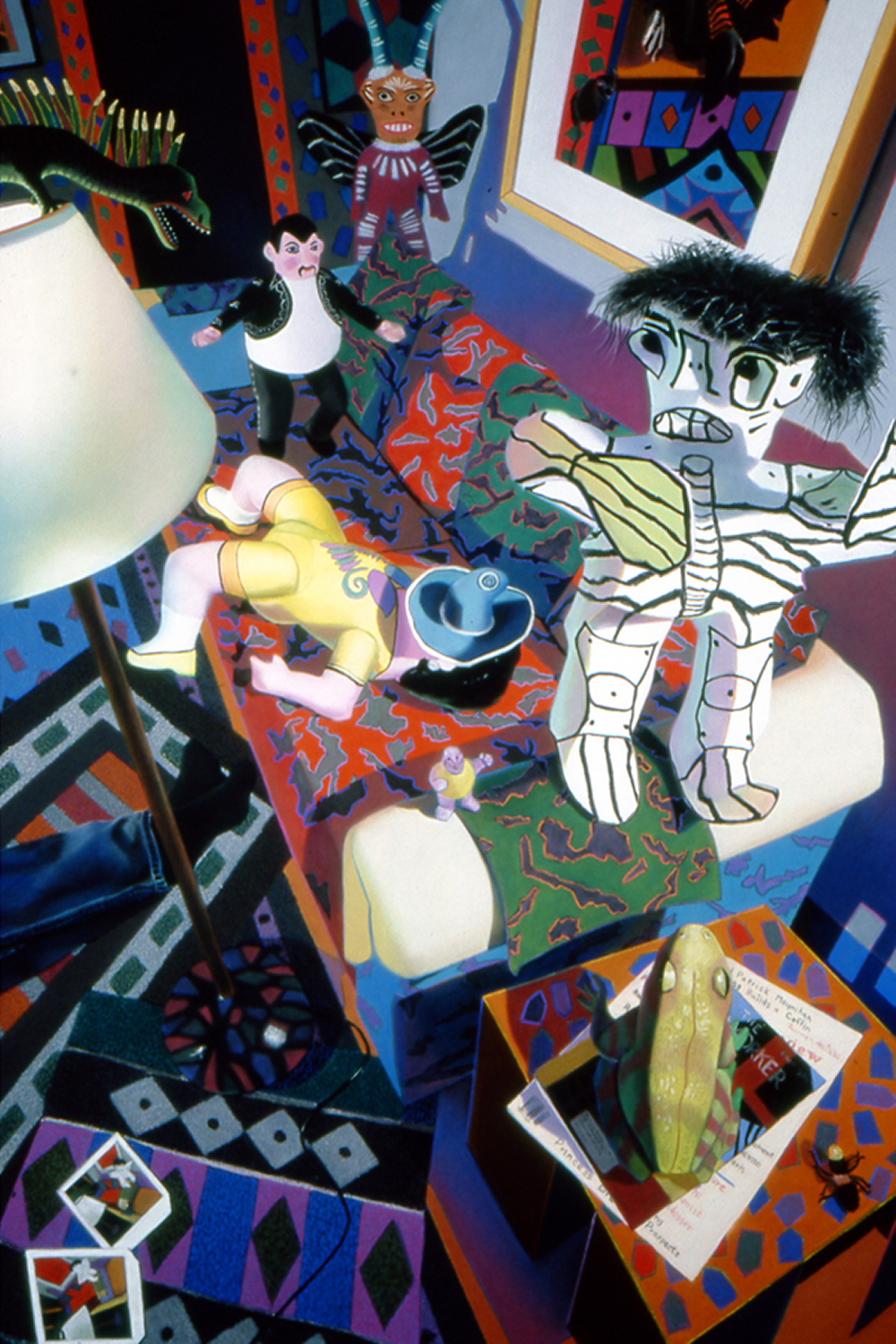
Q: What was the first folk art figure you brought back from Mexico?
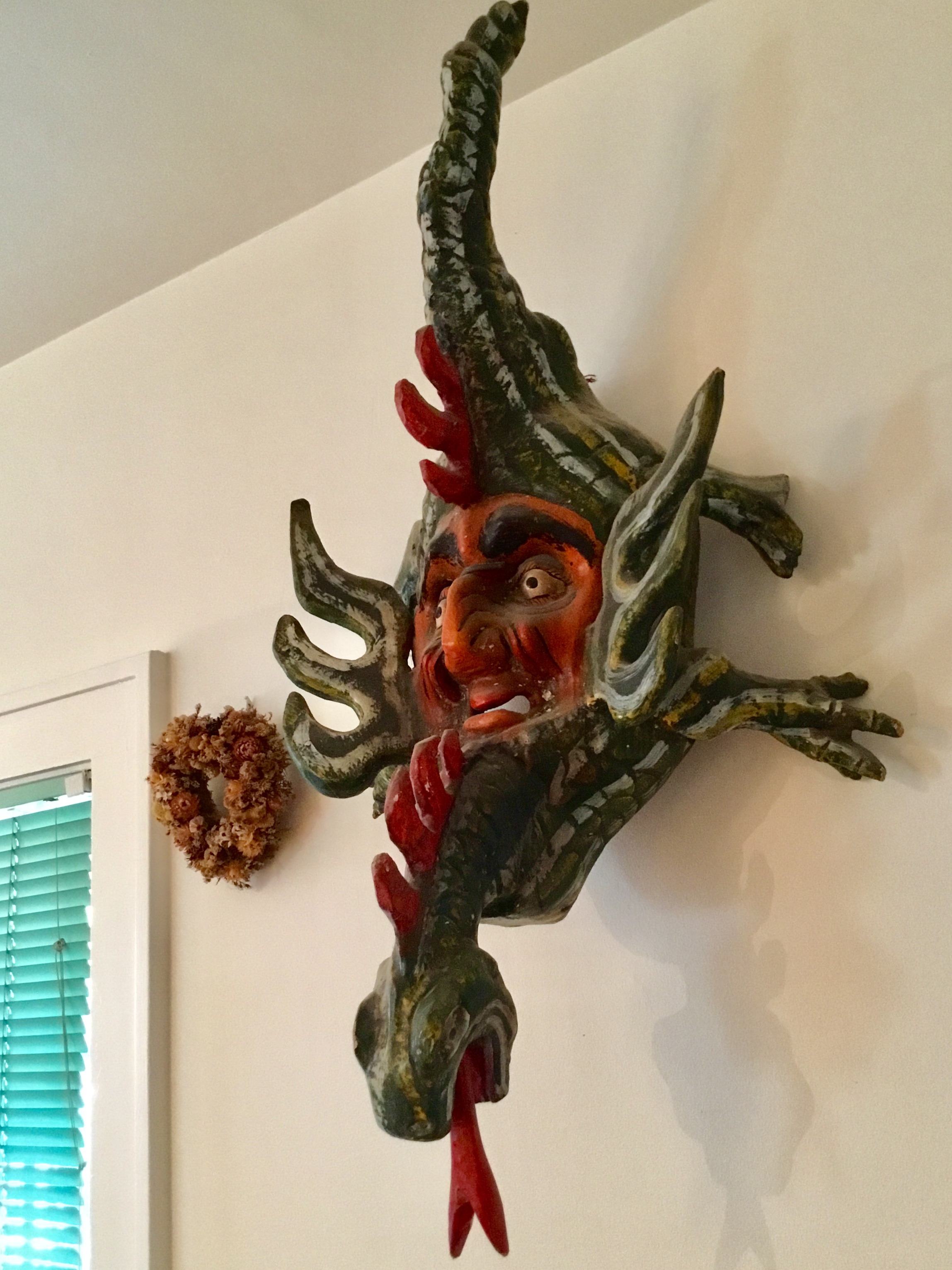
Mask from Oaxaca
A: In Oaxaca I bought a large carved wooden dragon mask with a Conquistador’s face carved and painted on its back. My intent was to depict the dragon in a subsequent “Domestic Threats” painting (the series I was working on at the time). The dragon still hangs in my living room in Alexandria, VA.
This first trip in 1992 was a revelation and marked the start of my on-going love of Mexico: its people, landscapes, ancient cultures, archaeology, history, art, cuisine, etc. There would be many subsequent trips to Mexico to learn as much as I can about this endlessly interesting cradle of civilization.
Comments are welcome!


 barbararachkoscoloreddust.com