Blog Archives
Q: Do you use a sketchbook?
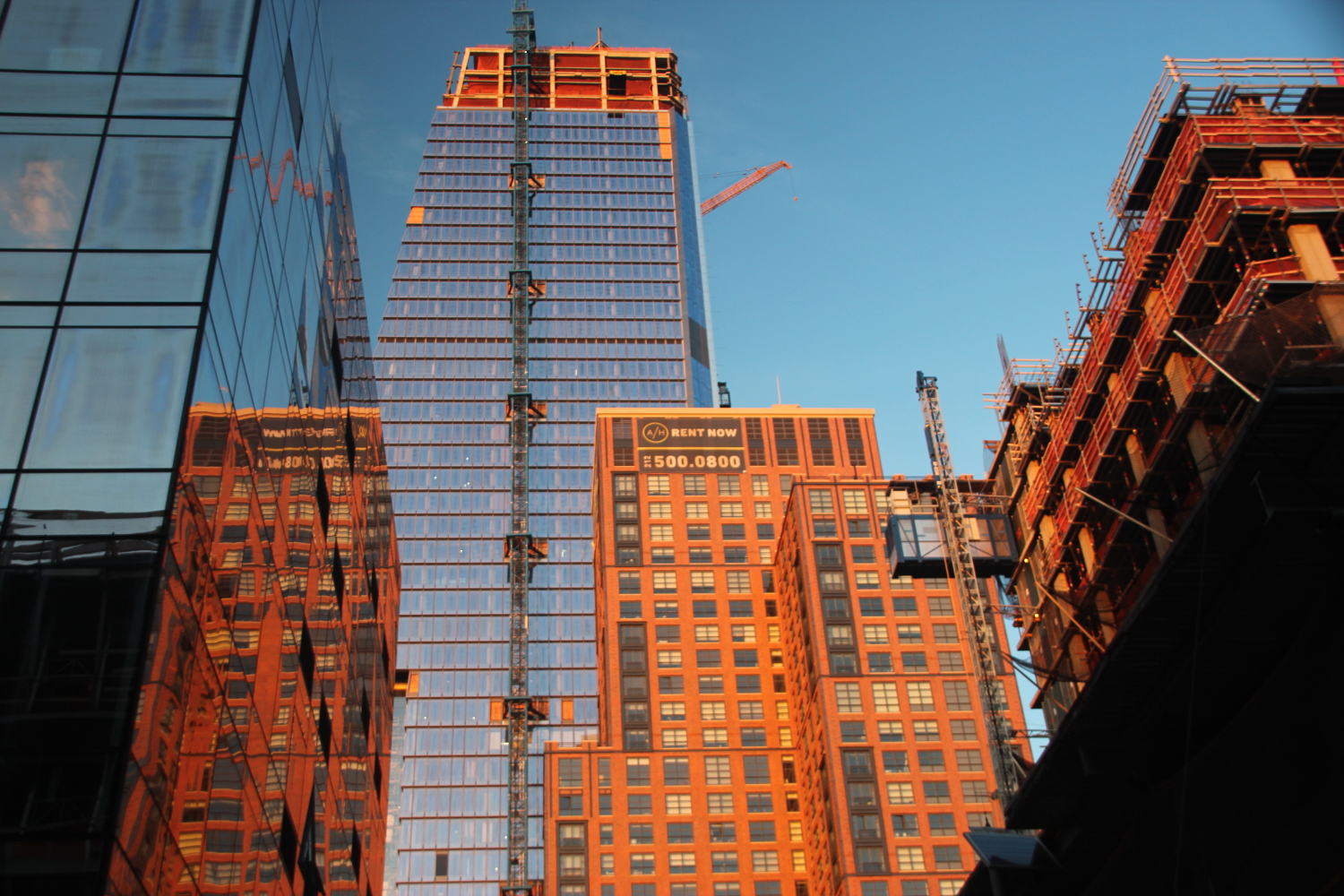
Hudson Yards, NYC
A: I used to use a sketchbook early on, when I was just beginning to find my way as an artist. Sketching on location helped to crystalize my ideas about art, about technique, and about what I hoped to accomplish in the near term. These days I spend so many hours in the studio – it’s my day job – that I often need a mental and physical break from using my eyes and from looking at and composing images.
What I do instead is to walk around New York (and elsewhere) with a camera. Photography for me sometimes serves as an alternative to sketching. It’s a way to continue to think about art, to experiment, and to contemplate what makes an arresting image without actually having to be working in the studio.
Comments are welcome!
Q: Do you have any favorites among the Mexican and Guatemalan folk art figures that you depict in your work?

Idea for an upcoming pastel painting
A: I suppose it seems that way, since I certainly paint some figures more than others. My favorite characters change, depending on what is happening in my work. My current favorites are a figure I have never painted before (the Balinese dragon above) and several Mexican and Guatemalan figures last painted years ago. All will make an appearance in a pastel painting for which I am still developing preliminary ideas (above).
Comments are welcome!
Pearls from artists* # 162

“The Sovereign,” soft pastel on sandpaper, 58″ x 38″
* an ongoing series of quotations – mostly from artists, to artists – that offers wisdom, inspiration, and advice for the sometimes lonely road we are on.
Particle after particle of the living self is transferred into the creation, until at last it is an external world that corresponds to the inner world and has the power of outlasting the author’s life.
I suspect that some such dream is shared by many authors, but among those interviewed it is Faulkner who has come closest to achieving it, and he is also the author who reveals it most candidly. “Beginning with Sartoris,” he says, I discovered that my own little postage stamp of native soil was worth writing about and that I would never live long enough to exhaust it, and that by sublimating the actual into the apocryphal I would have complete liberty to use whatever talent I might have to its absolute top. It opened up a mine of other people, so I created a cosmos of my own. I can move these people around like God, not only in space but in time.” And then he says, looking back on his work as if on the seventh day, “I like to think of the world I created as being a kind of keystone in the universe; that, small as that keystone is, if it were ever taken away the universe itself would collapse. My last book will be the Doomsday Book, the Golden Book, of Yoknapatawpha County. Then I shall break the pencil and I’ll have to stop.”
Malcolm Cowley in Writers at Work: The Paris Review Interviews, First Series
Comments are welcome!
Pearls from artists* # 147

Alexandria, Virginia living room
* an ongoing series of quotations – mostly from artists, to artists – that offers wisdom, inspiration, and advice for the sometimes lonely road we are on.
I am working, every day… on new photographs. This body of work, family pictures, is beginning to take on a life of its own. Seldom, but memorably, there are times when my vision, even my hand, seems guided by, well, let’s say a muse. There is at that time an almost mystical rightness about the image: about the way the light is enfolding, the way the [kids’] eyes have taken on an almost frightening intensity, the way there is a sudden, almost outer-space-like, quiet.
These moments nurture me through the reemergence into the quotidian… through the bill paying and the laundry and the shopping for soccer shoes, although I am finding that I am becoming increasingly distant, like I am somehow living full time in those moments.
Sally Mann in Hold Still: A Memoir with Photographs
Comments are welcome!
Q: Would you talk about how the Judas figures you depict in your pastel paintings function in Mexico?
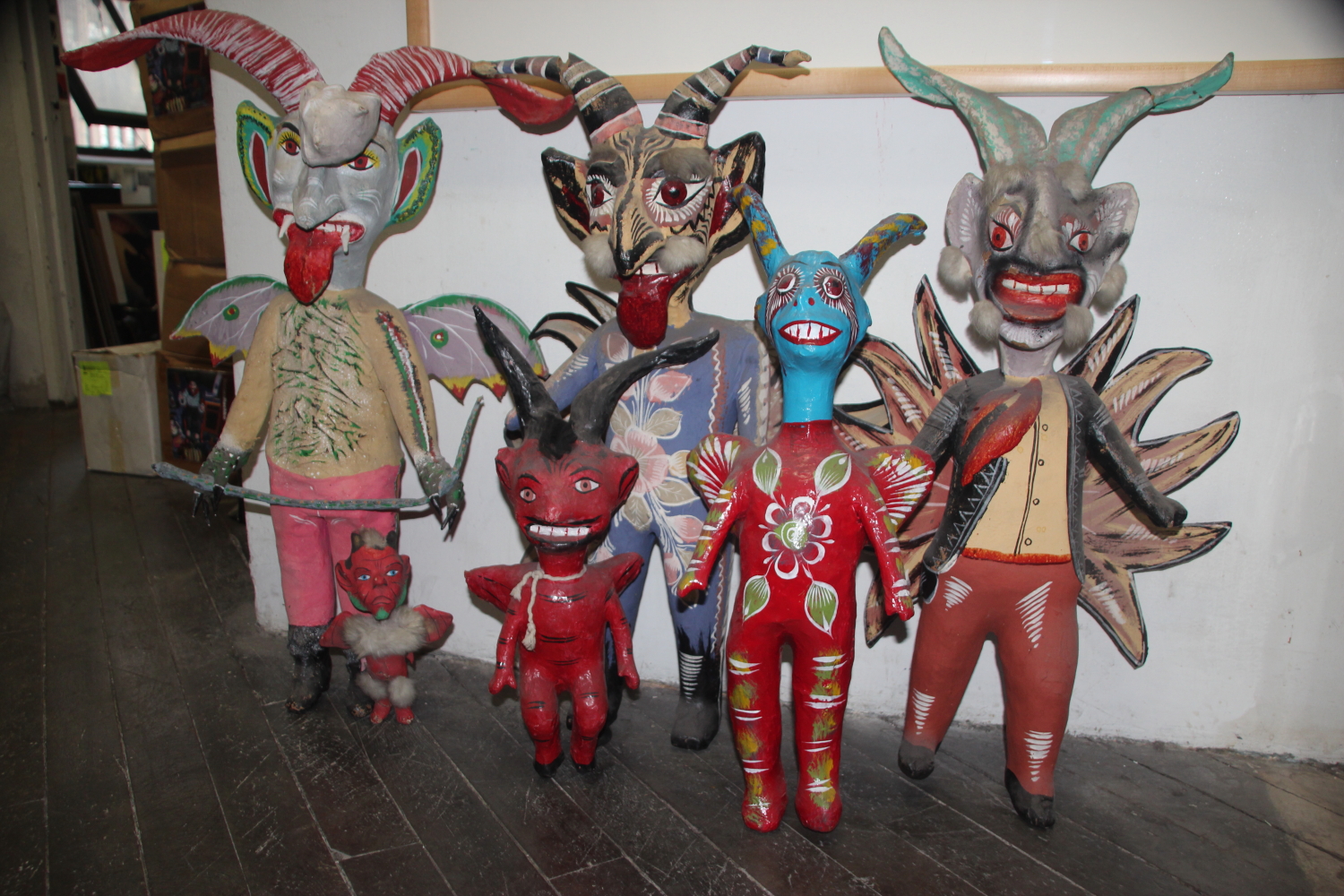
Some Judases
A: Here’s a good explanation from a website called “Mexican Folk Art Guide”:
“La quema de Judas or the Judas burning in Mexico is a celebration held on Sabado de Gloria (Holy Saturday). Papier mache figures symbolizing Judas Iscariot stuffed with fireworks are exploded in local plazas in front of cheerful spectators.
The Judases exploded in public spaces can measure up to 5 meters, while 30 cm ones can be found with a firework in their back to explode at home.
In Mexico la quema de Judas dates from the beginning of the Spanish colony when the Judas effigies were made with hay and rags and burned. Later as paper became available and the fireworks techniques arrived, thanks to the Spanish commerce route from the Philippines, the Judases were made out of cardboard, stuffed with fireworks, and exploded.
After the Independence War the celebration lost its religious character and became a secular activity. The Judas effigies were stuffed with candies, bread, and cigarettes to attract the crowds into the business [establishment] that sponsored the Judas.
Judas was then depicted as a devil and identified with a corrupt official, or any character that would harm people. In 1849 a new law stipulated that it was forbidden to relate a Judas effigy with any person by putting a name on it or dressing it in a certain way to be identified with a particular person.”
This is why whenever I bring home a Judas figure from Mexico, I feel like I have rescued it from a fire-y death!
Comments are welcome!
Q: How do you know when a series has ended?

“A Promise, Meant to be Broken,” soft pastel on sandpaper, 58″ x 38″
A: I suppose it’s when there is nothing left to say within a particular body of work. The urgency to add something I haven’t tried vanishes. Usually I can’t even think of anything I haven’t tried.
I knew with certainty that the “Domestic Threats” series was finished while “A Promise Meant to be Broken” was still on my easel. It’s no accident that I included a self-portrait. This painting was my way of saying good-bye to an important body of work – literally turning my back on it – and summing up where the work had taken me.
For artists each series is a creative journey with a beginning, a middle, and an end. At a certain point it’s over. Then you build on what you’ve accomplished and move on to create something new. The connection between new work and old may not always be obvious, but one thing is certain: all the previous work laid the groundwork for what you make today.
Comments are welcome!
Pearls from artists* # 135

Chalcatzingo (Mexico)
* an ongoing series of quotations – mostly from artists, to artists – that offers wisdom, inspiration, and advice for the sometimes lonely road we are on.
[Meredith Monk on beginning a new piece and whether it gets easier over time].
I always say that the fear is overwhelming at the beginning. It’s like jumping off a cliff. You have absolutely no idea what is going on. It is like being a detective. You try to follow every clue that comes up. Some of them are McGuffins, but I think that is what the process is. It starts out with fear, and I think that’s a good thing. If you know what you are doing already, what is the point in doing it? It is always like hanging out and tolerating pain and the fear of the unknown. Then usually what happens is that a little something will come up. If I am sitting at the piano – and I remember sitting at the piano and almost shaking at the beginning of this piece – one little phrase will come up. And then you get a little interested in that one little phrase. Or I say to myself, “Step by step.” Another thing I say to myself, “Remember playfulness, Meredith?”
What happens at a certain point is that the thing itself starts coming in and you realize that you are more interested than you are afraid. You are in this thing, whatever it is, and fear is useless at a certain point. But at the beginning, it is not bad. It is saying that you are risking. I think that taking the chance on risking is something that keeps you young. I’ll tell you, what you are saying about my skills – I don’t find it easier. It is just as hard as it ever was. I don’t think, “Now I have these skills.” I don’t think in those terms at all.
… When you are making something new, you aren’t going to be able to use the same technique that you used on something else. Maybe other people think it is easier as they go along. I think part of the challenge is not to rely on things that you know, and to keep on listening. It is really a process of listening to what something needs. What’s right for it.
Conversations with Meredith Monk by Bonnie Marranca
Comments are welcome!
Q: How long have you been working in your current studio?
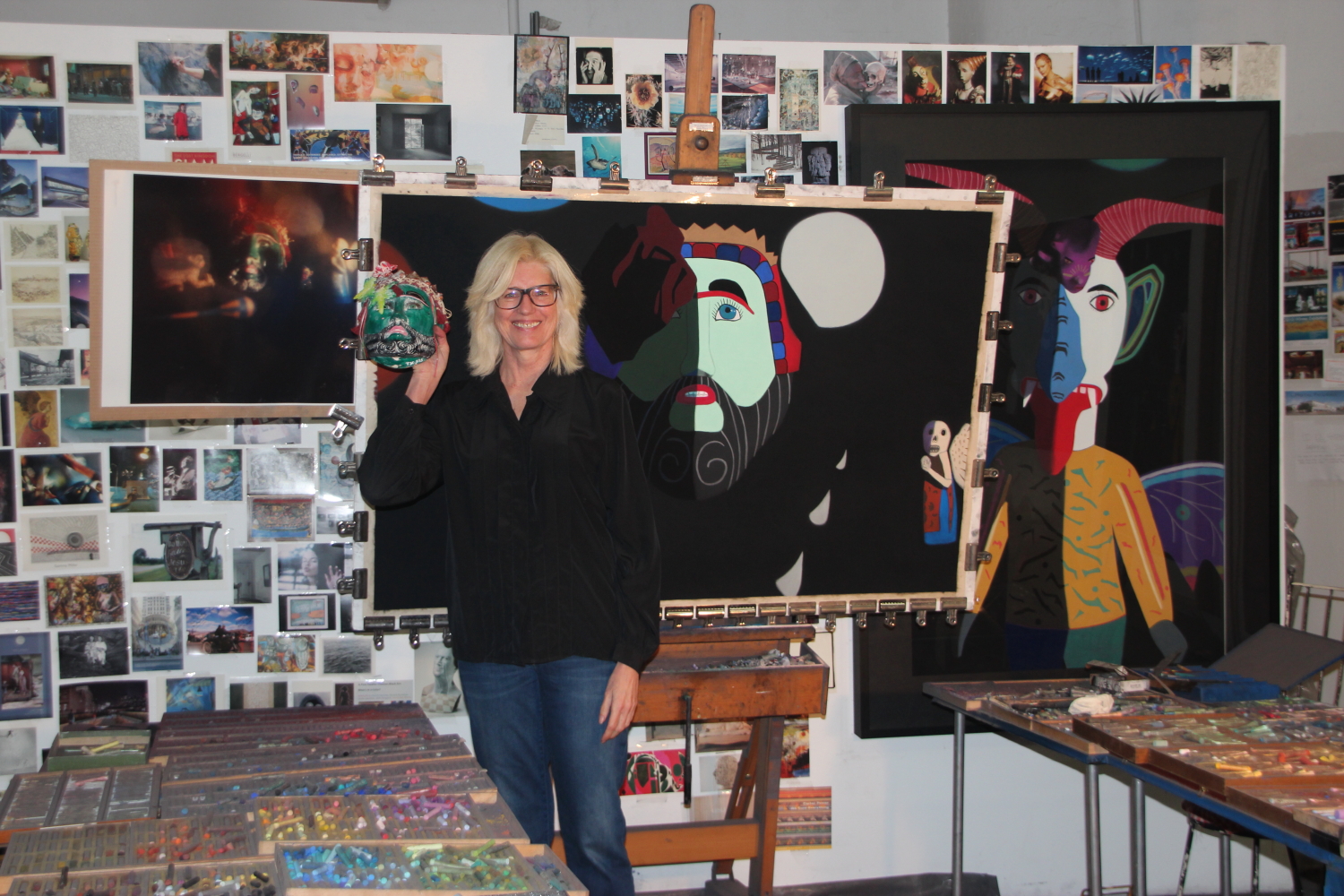
Barbara in her studio; Photo: Elliott Jones
A: I have been in my West 29th Street space for seventeen years, but from the beginning, in the mid-1980’s, I had a studio. My first one was in the spare bedroom of the Alexandria, Virginia, house that I shared with Bryan and that I still own. For about three years in the 1990s I had a studio on the third floor of the Torpedo Factory Art Center, a building in Alexandria that is open to the public. People come in, watch artists work, and occasionally buy a piece of art.
In April 997 an opportunity to move to New York arose and I didn’t look back. By then I was showing in a good 57th Street gallery, Brewster Arts Ltd. (the gallery focused exclusively on Latin American artists; I was thrilled with the company I was in; the only fellow non-Latina represented by owner, Mia Kim, was Leonora Carrington), and I had managed to find a New York agent, Leah Poller, with whom to collaborate. I looked at only one other space before finding my West 29th Street studio. An old friend of Bryan’s from Cal Tech rented the space next door and he had told us it was available. Initially the studio was a sublet. The lease-holder was a painter headed to northern California to work temporarily for George Lucas at the Lucas Ranch. After several years she decided to stay so I was able to take over the lease.
My studio continues to be an oasis in a chaotic city, a place to make art, to read, and to think. I love to walk in the door every morning and always feel more calm the moment I arrive. It’s my absolute favorite place in New York!
Comments are welcome!
Q: How do you select a photograph to use as reference material to make a pastel painting?
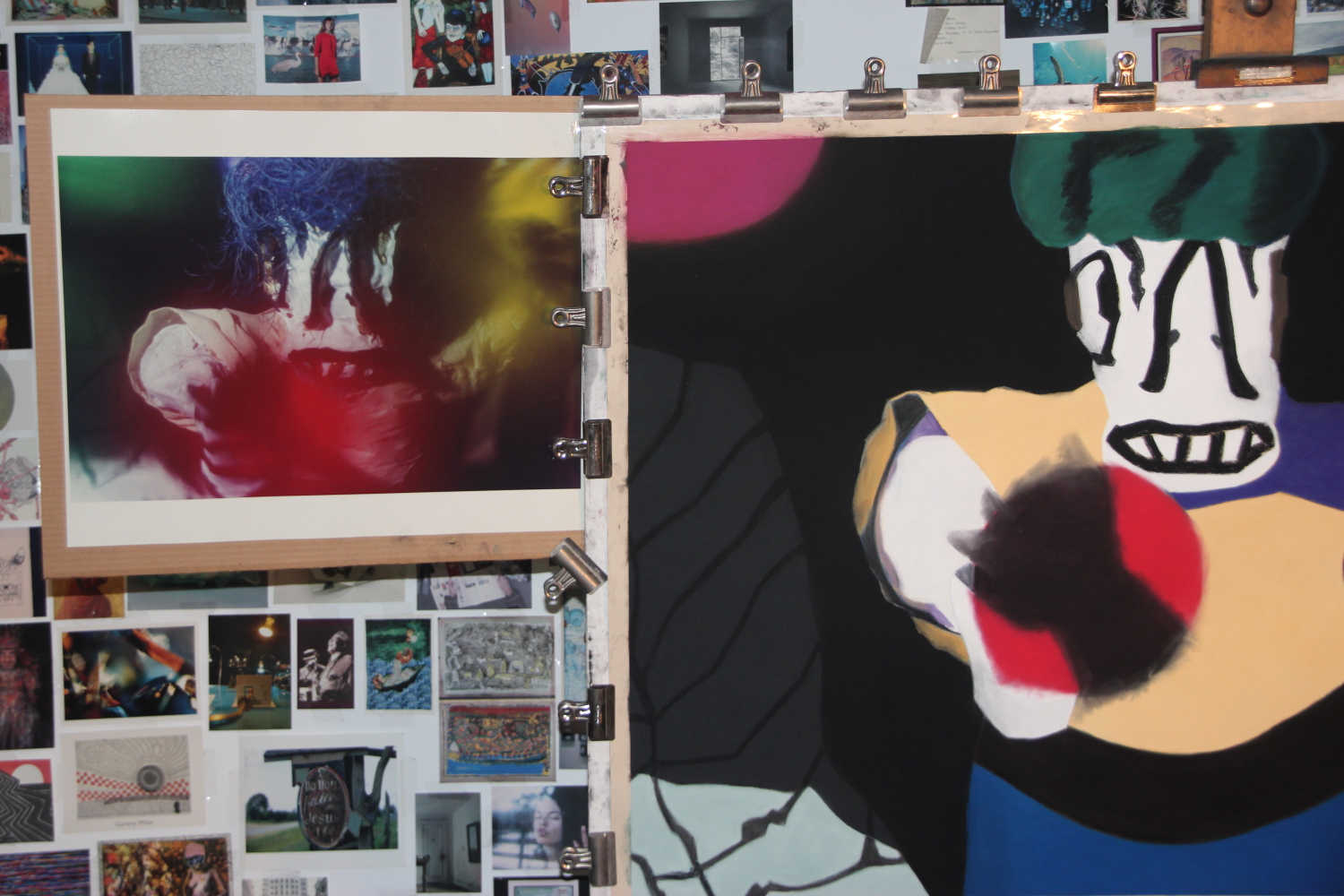
Photograph, left, and work in progress
A: Like everything else associated with my studio practice, my use of photographs from which to work has changed considerably. Beginning in the early 1990s all of the paintings in my first series, “Domestic Threats,” started out as elaborately staged, well-lit scenes that either my husband, Bryan, or I photographed with Bryan’s Toyo Omega 4 x 5 view camera using a wide-angle lens. Depending on where I was living at the time, I set up the scenes in one of three places: our house in Alexandria, VA, a six-floor walkup apartment on West 13th Street in New York, or my current Bank Street condominium. Then one of us shot two pieces of 4 x 5 film at different exposures and I’d usually select the more detailed one to be made into a 20″ x 24″ photo to use as a reference.
Just as the imagery in my paintings has simplified and emptied out over the years, my creative process has simplified, too. I often wonder if this is a natural progression that happens as an artist gets older. More recently I have been shooting photos independently of how exactly I will use them in my work. Only later do I decide which ones to make into paintings; sometimes it’s YEARS later. For example, the pastel painting that is on my easel now is based on a relatively old (2002) photograph that I have always liked, but only now felt ready to tackle in pastel.
Comments are welcome!
Q: Would you share some of your photographs from Sri Lanka?
A: I shot more than 2200 images so I am still sorting through them. Here are a few from the beginning of the trip.
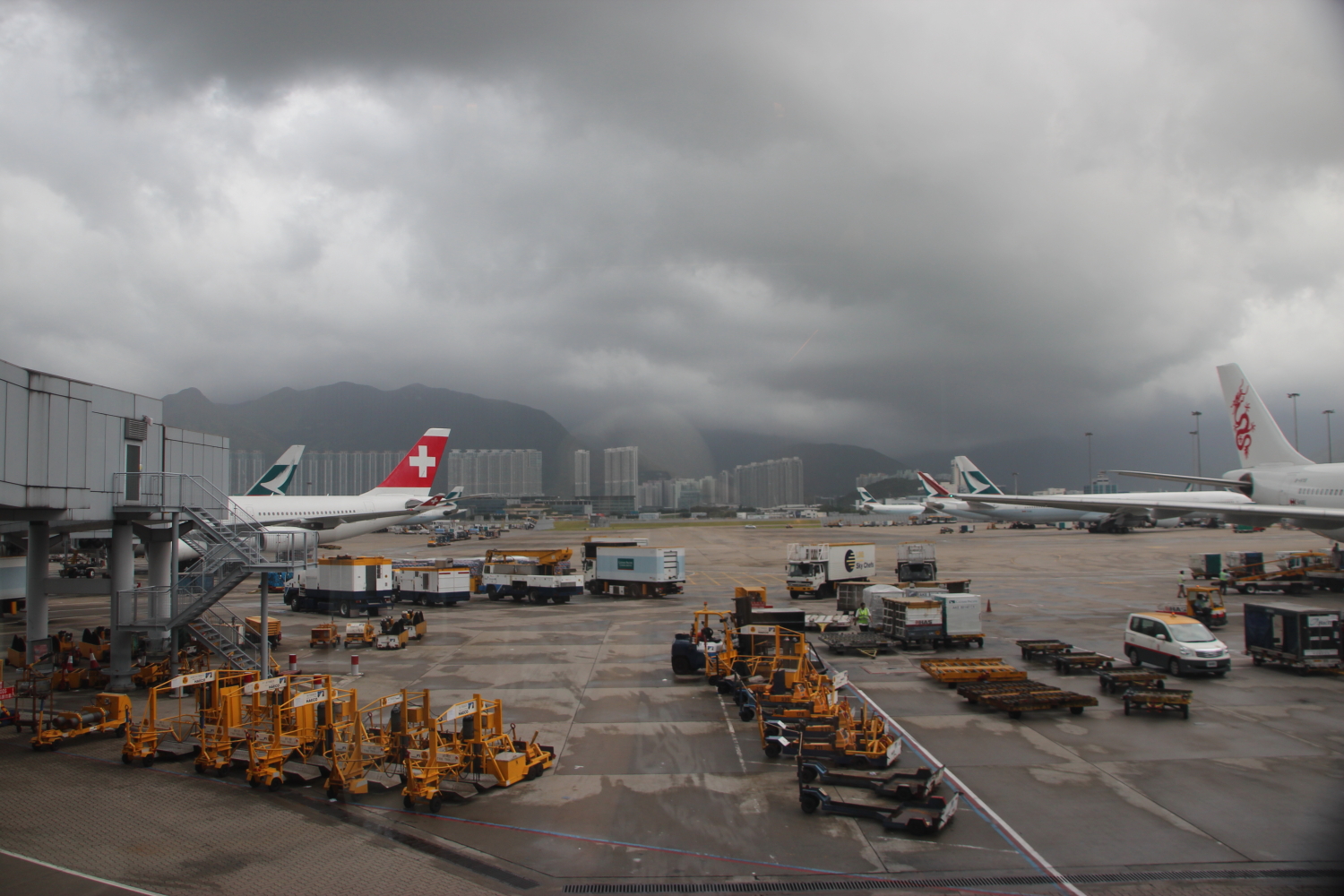
Hong Kong airport after a typhoon
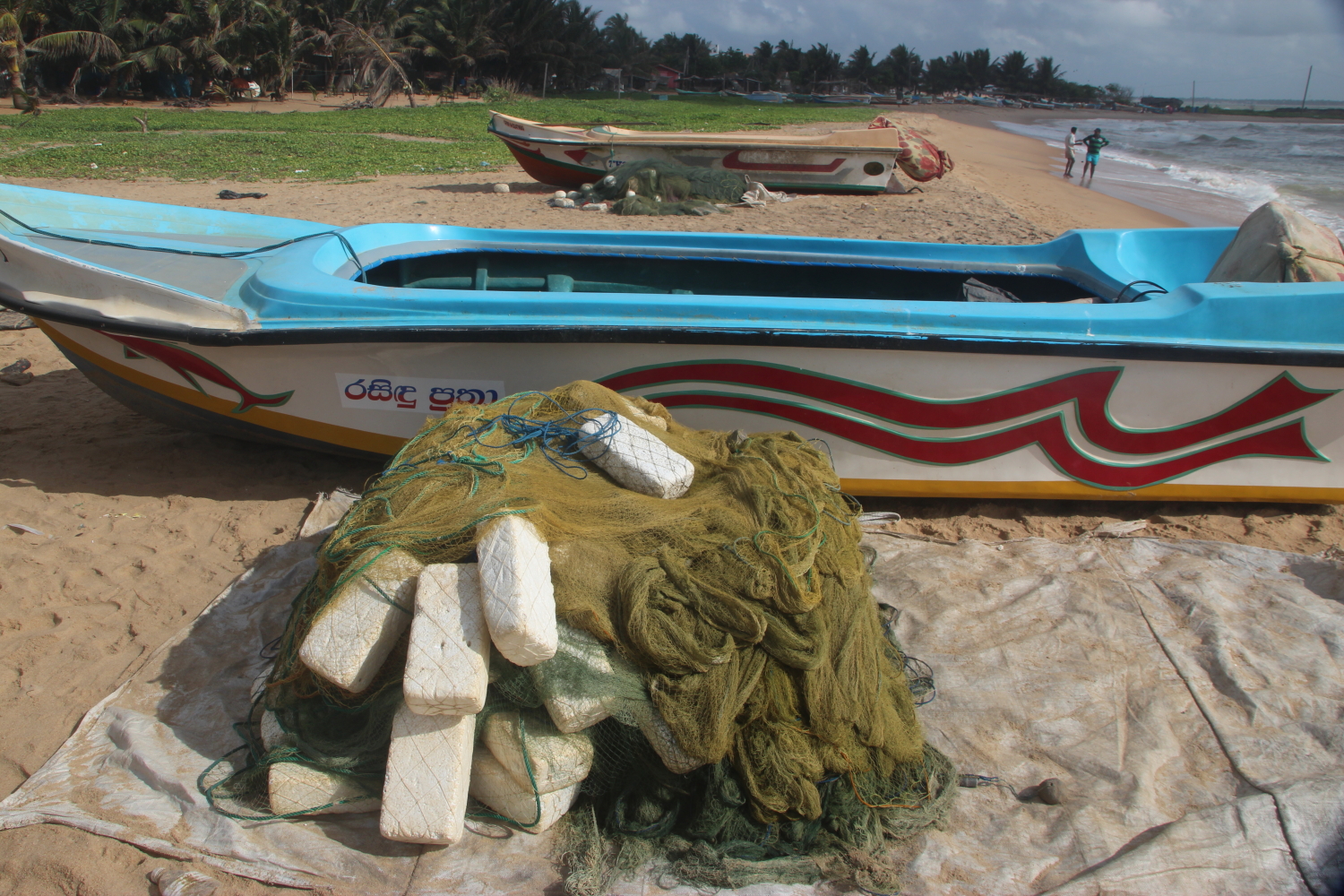
Negombo, Sri Lanka
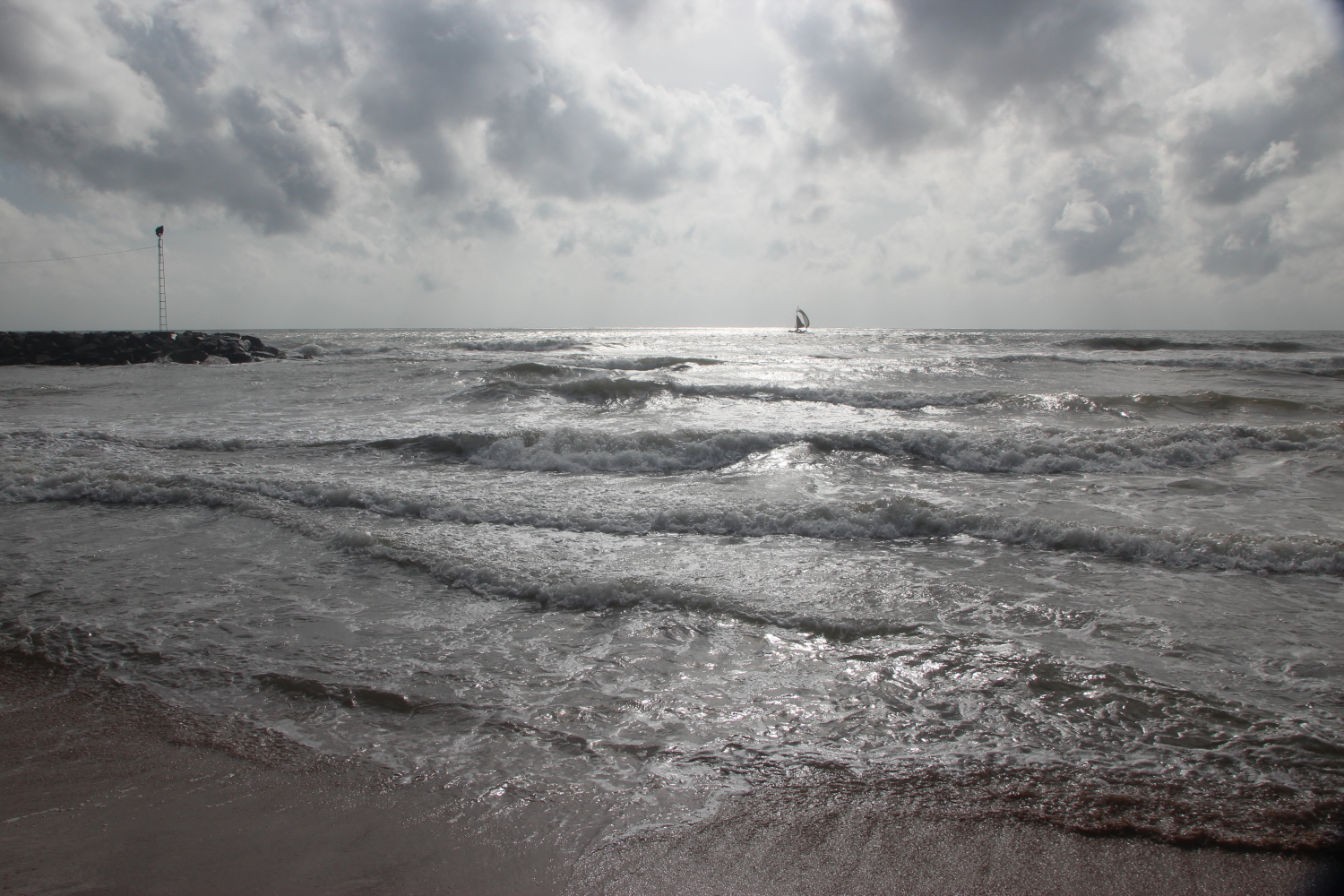
Negombo, Sri Lanka
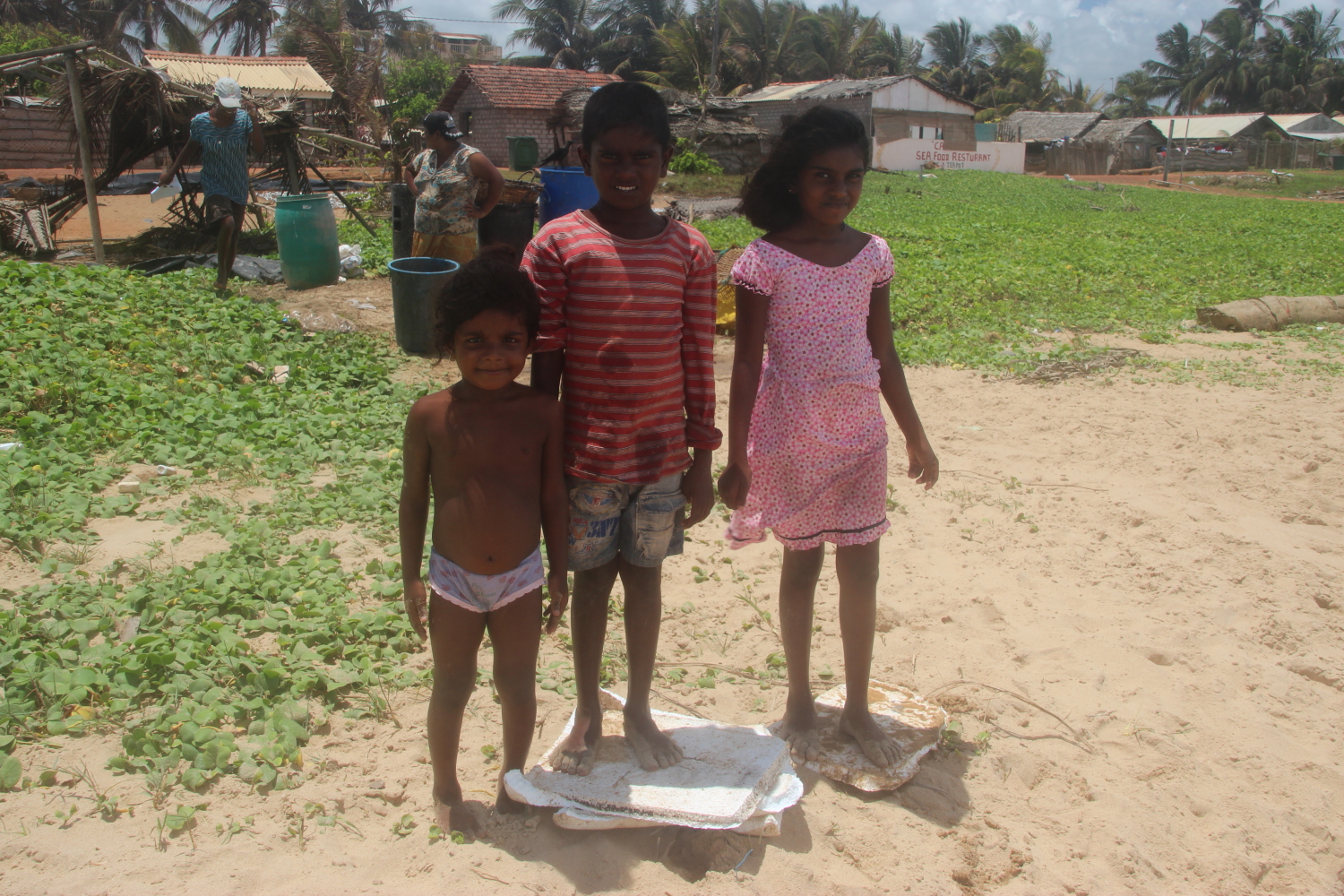
Negombo, Sri Lanka
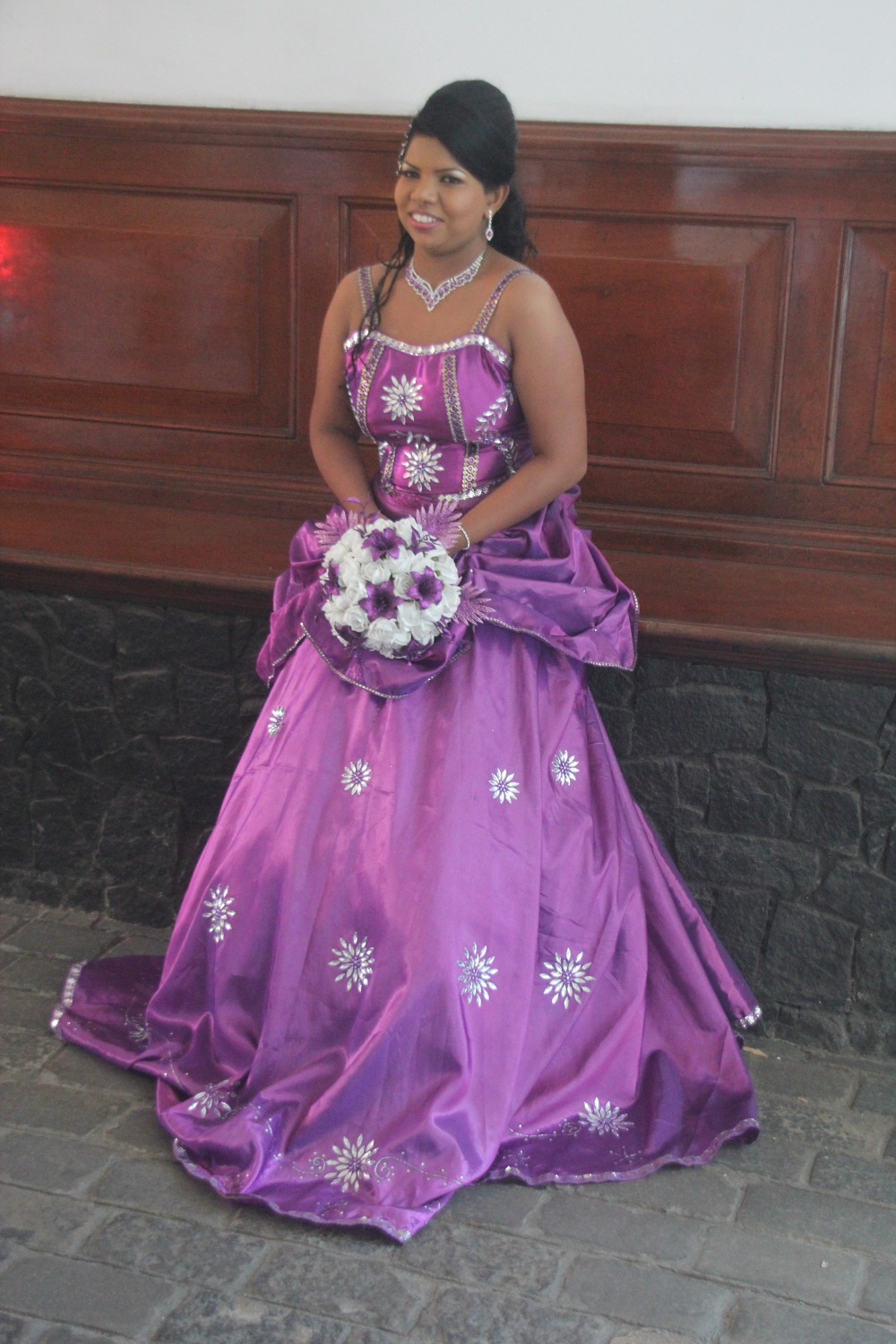
Bride, Kandy, Sri Lanka


 barbararachkoscoloreddust.com