Blog Archives
Pearls from artists* #694
*an ongoing series of quotations – mostly from artists, to artists – that offers wisdom, inspiration, and advice for the sometimes lonely road we are on.
Long ago, when I was in my insecure twenties, I met a clever, independent, creative, and powerful woman in her mid-seventies, who offered me a superb piece of life wisdom.
She said: “We all spend our twenties and thirties trying so hard to be perfect, because we’re so worried about what other people will think of us. Then we get into our forties and fifties, and we finally start to be free, because we’re so worried decide that we don’t give a damn about what anyone thinks of us. But you won’t be completely free until you reach your sixties and seventies, when you realize this liberating truth—nobody was ever thinking about you, anyhow.”
They aren’t. They weren’t. They never were.
People are mostly thinking about themselves. People don’t have time to worry about what you’re doing, or how well you’re doing it, because they’re all caught up in their own dramas. People’s attention may be drawn to you for a moment (if you succeed or fail spectacularly and publicly, for instance), but that attention will soon enough revert back to where it’s always been—on themselves. While it may seem lonely and horrible at first to imagine that you aren’t anyone’s first order of business, there is also a great release to be found in this idea. You are free, because everyone is too busy fussing over themselves to worry that much about you.
Go be whomever you want to be, then.
Do whatever you want to do.
Pursue whatever fascinates you and brings you to life.
Create whatever you want to create—and let it be stupendously imperfect, because it’s exceedingly likely that no one will even notice.
And that’s awesome.
Elizabeth Gilbert in Big Magic: Creative Living Beyond Fear
Comments are welcome!
Pearls from artists* # 692

*an ongoing series of quotations – mostly from artists, to artists – that offers wisdom, inspiration, and advice for the sometimes lonely road we are on.
Claiming space, money, and time to do our work requires fortitude. We need to say ‘no’ to projects and people fighting for our attention. We just follow our work through changes, even when it is comfortable, or in other people’s interests, for our work to stay the same. If we want to expand our careers, we get rejected… a lot. But artists are like sharks; we must keep moving to survive, creating authentic, original work as we outgrow it to evolve as human beings.
Kate Kretz in Art From Your Core: A Holistic Guide to Visual Voice
Comments are welcome!
Q: Would you please share your current bio?

A: Here it is.
Barbara Rachko, born in 1953 in Paterson, New Jersey, is a contemporary painter based in New York City, renowned for her large pastel-on-sandpaper paintings inspired by Bolivian Carnival masks. With nearly 40 years dedicated to revolutionizing pastel as a fine art medium, Rachko’s influential blog, Barbara Rachko’s Colored Dust, has garnered over 229,000 subscribers. She is the subject of the acclaimed documentary “Barbara Rachko: True Grit,” available on YouTube, and her ebook “From Pilot to Painter” captures her inspiring journey from a former pilot to an accomplished artist.
Rachko’s work explores the vibrant cultural heritage of Bolivian Carnival masks, and Mexican and Guatemalan folk art. Her meticulous attention to detail is showcased in notable series such as Bolivianos, Black Paintings, and Domestic Threats. In 2023, she was featured in a documentary that premiered at the Newport Beach Film Festival, earning the Audience Award and Best in Category Award, further cementing her impact on contemporary art.
Her solo exhibitions include the Joy Pratt Markham Gallery at Walton Arts Center (AR), Louise Jones Brown Gallery at Duke University (NC), Olin Gallery (VA), and La MaMa La Galleria (NY). She trained in photography at the International Center of Photography in New York and studied drawing and pastel techniques at the Art League School in Alexandria, VA. Her works are held in private collections worldwide and have been showcased at prestigious art fairs, including Art Basel Miami, Moon Art Fair in Hamburg, and Art Busan in Korea, affirming her global influence in pastel painting.
Comments are welcome!
Pearls from artists* # 655

*an ongoing series of quotations – mostly from artists, to artists – that offers wisdom, inspiration, and advice for the sometimes lonely road we are on.
My creative friends are some of the most hard-working, motivated people I know. While many non-artists have nine-to-five jobs and then relax at home, our work is never done. Yet, we are bombarded with tropes in books, movies, and television suggesting that we have chosen a ‘slacker’ profession. Even wildly successful artists can have family members who think they are self-absorbed, or that they should ‘get a real job.’ According to genius and award-winning filmmaker, Werner Herzog, his brother still routinely makes fun of his profession (Brooks, 2020). Some may call us selfish and tell us that we are only looking for attention, or feeding our egos. They may ask, “When are you going to grow up?” or ignorantly proclaim, “How nice it must be to only work when you want to.” Regardless of intention, this is not support.
Kate Kretz in Art From Your Core: A Holistic Guide to Visual Voice
Comments are welcome!
Q: When did you begin drawing and painting? (Question from “Cultured Focus Magazine”)

A: This is a long story because my path to becoming a professional artist has been unusually circuitous.
I grew up in a blue collar family in suburban New Jersey. My parents were both first-generation Americans and no one in my family had gone to college. I was a smart kid, who showed some artistic talent in kindergarten and earlier. At the age of 6, my sister, my cousin, and I enrolled in Saturday morning painting classes at the studio of a local artist. I continued the classes for about 8 years and became a fairly adept oil painter.
At the age of 15 my father decided that art was not a serious pursuit – he called it a hobby, not a profession – and abruptly stopped paying for my Saturday morning lessons. Unfortunately, there were no artists or suitable role models in my family. So with neither financial nor moral support to pursue art, I turned my attention to very different interests.
Cut to ten years later. When I was 25, I earned my private pilot’s license and spent the next two years amassing other flying licenses and ratings, culminating in a Boeing-727 flight engineer’s certificate.
At 29, I joined the Navy. By then I was an accomplished civilian pilot with thousands of flight hours so I expected to fly jets. However, in the early 1980s women were not allowed in combat. There were very few women Navy pilots and those few were restricted to training male pilots. There were no women pilots landing on aircraft carriers.
In the mid-1980s I was in my early 30s, a lieutenant on active duty in the Navy, working a soul-crushing job as a computer analyst on the midnight shift in a Pentagon basement. It was literally and figuratively the lowest point of my life. I was completely bored and miserable.
Remembering the joyful Saturdays of my youth when I had taken art classes with a local New Jersey painter, I enrolled in a drawing class at the Art League School in Alexandria, Virginia. Initially I wasn’t very good, but it was wonderful to be around other women and a world away from the mentality of the Pentagon. I was having fun again! I enrolled in more classes and became a very motivated full-time art student who worked nights at the Pentagon. As I studied and improved my skills, I quickly discovered my preferred medium – soft pastel on sandpaper.
Although I knew I had found my calling, for more than a year I agonized over whether or not to leave the financial security of a Navy paycheck. Finally I did make up my mind and resigned my commission, effective on September 30, 1989. With Bryan’s (my then boyfriend’s) support, I left the Navy to devote my time to making art.
I’m probably one of the few people who can name THE day I became a professional artist! That day was October 1, 1989. Fortunately, I have never needed another job. I remained in the Navy Reserve for the next 14 years, working primarily at the Pentagon for two days each month and two weeks each year. I commuted by train to Washington, DC after I moved to Manhattan in 1997. Finally on November 1, 2003, I officially retired as a Navy Commander.
Life as a self-employed professional artist is endlessly varied, fulfilling, and interesting. I have never regretted my decision to pursue art full-time.
Comments are welcome!
Q: Do you have any rituals that you do before beginning a day’s work in the studio?

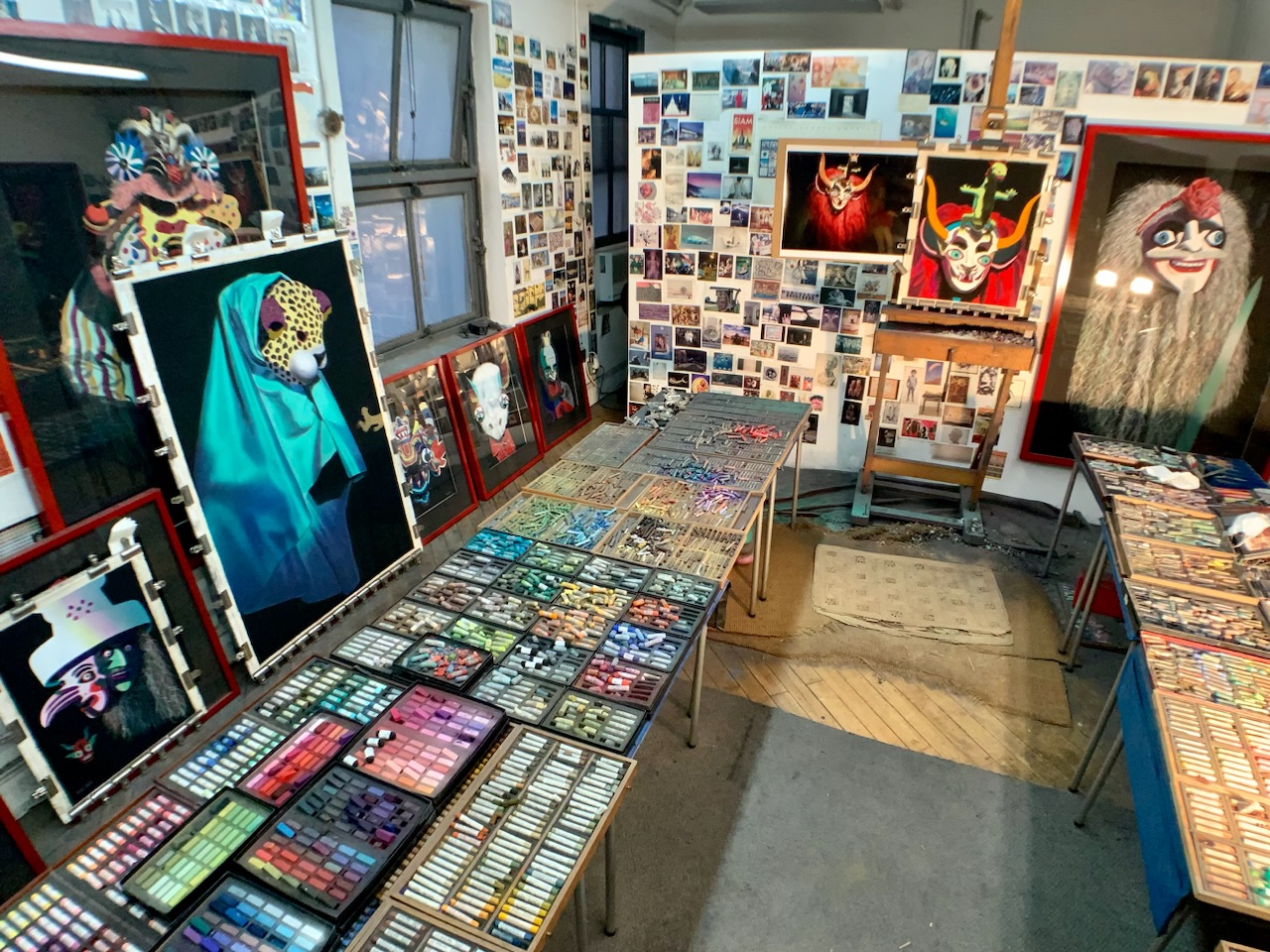
The Studio!
A: When I arrive at the studio in the morning it’s rare for me to immediately start working. Usually I read something art-related – books written by artists, about creativity, etc. At the moment I’m reading The Artist’s Reality: Philosophies of Art by Mark Rothko. As usual I am struggling to understand aspects of the art business and figure out what I need to do next to get my work seen and collected by a wider audience. The Artist’s Reality reminds me why I decided to make art in the first place. It helps reconnect with temporarily forgotten parts of myself and is a much-needed reminder of what I love about being an artist, especially in light of the business side that is becoming so complex and demanding of attention now.
Balancing the creative and business aspects of being an artist is a continual struggle. Both are so important. An artist needs an appreciative audience – very few artists devote their lives to art-making so that the work will remain in a closet – but I also believe this (from a note I wrote years ago and tacked to the studio wall): “Just make the work. None of the rest matters.”
Comments are welcome!
Pearls from artists* # 603

With friends in Alexandria, VA
*an ongoing series of quotations – mostly from artists, to artists – that offers wisdom, inspiration, and advice for the sometimes lonely road we are on.
The annals of art and science are full of studies of men and women who, desperately stuck on an enigma, have worked until they reached their wit’s end, and then suddenly made their longed-for creative leap of synthesis while doing errands or dreaming. The ripening takes place when their attention is directed elsewhere.
Insights and breakthroughs often come during periods of pause or refreshment after great labors. There is a prepatory period of accumulating data, followed by some essential but unforeseeable transformation. William James remarked in the same vein that we learn to swim in winter and skate in summer. We learn that which we do not concentrate on, the part that has been exercised and trained in the past but that is now lying fallow. Not doing can sometimes be more productive than doing.
Stephen Nachmanovitch in Free Play: Improvisation in Life and Art
Comments are welcome!
Pearls from artists* # 598
*an ongoing series of quotations – mostly from artists, to artists – that offers wisdom, inspiration, and advice for the sometimes lonely road we are on.
For art to appear, we have to disappear. This may sound strange, but in fact it is a common appearance. The elementary case, for most people, is when our eye or ear is “caught” by something: a tree, a rock, a cloud, a beautiful person, a baby’s gurgling, spatters of sunlight reflected off some wet mud in the forest, the sound of a guitar wafting unexpectedly out of a window. Mind and sense are arrested for a moment, fully in the experience. Nothing else exists. When we “disappear” in this way, everything around us becomes a surprise, new and fresh. Self and environment unite. Attention and intention fuse. We see things just as we and they are, yet we are able to guide and direct them to be one just the way we want them. This lively and vigorous state of mind is the most favorable to the germination of original work of any kind. It has its roots in child’s play, and its ultimate flowering in full-blown artistic creativity.
Stephen Nachmanovitch in Free Play: Improvisation in Life and Art
Comments are welcome!
Pearls from artists* #571
The Studio
*an ongoing series of quotations – mostly from artists, to artists – that offers wisdom, inspiration, and advice for the sometimes lonely road we are on.
To put it simply, but accurately, artists are often lost to the world because of their obsessions with their art. They may be just as lost as they prepare to work or incubate a new idea as in those feverish days when they make their final cuts on a film or race toward a publishing deadline. They may obsess about artistic questions and feel bursts of creative energy day or night, alone or in the company of others, in the middle of the work week or on vacation in the Bahamas.
Lost in time and space, the artist may feel more connected to Picasso, Emily Dickinson, Ingmar Bergman, Gertrude Stein, Handel, or Tennessee Williams than to the people in his immediate world. The living past holds extraordinary meaning for him. He travels elsewhere, removing his spirit and attention from the present. He may reside, as he works on his novel, in the childhood of a character, walking the garden paths and living the household dramas there. He may come upon a Rembrandt drawing and find himself wrenched, not to any particular place or time, but just elsewhere, as he experiences the greatness of his traditions, measures himself anew, and dreams again of his future.
Eric Maisel in A Life in the Arts: Practical Guidance and Inspiration for Creative and Performing Artists
Comments are welcome!
Q: Many of the world’s cultures have a mask tradition. Is there something special about Bolivian masks that first attracted you to them?

Bolivian Carnival Mask
A: My subject matter emerges directly from my travels. I visited Bolivia in 2017. What I especially liked then – and now – about Bolivian Carnival masks, is that they include additional textures – feathers, fur, costume jewelry, sequins, fabric, etc. that add to their physical presence. Masks from most of the other countries I’ve visited tend to be made of wood and/or paper mache and nothing else. In my view such masks are not as dramatic nor do they offer much expressive potential. They feel dead. They lack a certain “soulfulness.”
Furthermore, textures are challenging to render in soft pastel. For more than three decades I have been striving to improve my pastel techniques. By now I have a vast repertoire from which to select. As was true in my earlier series, with “Bolivianos” an important personal goal is to keep adding to the repertoire.
It takes months to create a pastel painting, which means I need masks that will hold my attention every day over the course of three or four months. I never want to be bored in the studio. If I am bored while making the work, those feelings will be directly transferred and I will make a boring pastel painting, something I hope never to do! The masks need to have a really strong ‘presence.’ Then as I slowly make a pastel painting, one that is exciting to work on from start to finish, I can transform my subject into something surprising and powerful that has never existed before!
Comments are welcome!


 barbararachkoscoloreddust.com