Blog Archives
Pearls from artists* # 688

*an ongoing series of quotations – mostly from artists, to artists – that offers wisdom, inspiration, and advice for the sometimes lonely road we are on.
Many artists see their studio practice as a religion. Like any other faith, it has rituals, beliefs, devotions, visionaries, martyrs, and even miracles. Our souls have a need to position themselves in the giant scheme of the universe, and art, like spiritual conviction, helps us do that. It allows us to decipher and process the complexities of the world around us. It can make us better humans by telling stories and sharing points of view that stoke compassion, understanding, and empathy. It holds the potential to redeem both the maker and the viewer, transcending quotidian dullness by evoking a deep significance we had forgotten.
Kate Kretz in Art From Your Core: A Holistic Guide to Visual Voice
Comments are welcome!
Pearls from artists* # 661

*an ongoing series of quotations – mostly from artists, to artists – that offers wisdom, inspiration, and advice for the sometimes lonely road we are on.
Curiosity and wonder are essential to the art life. Curiosity drives us to look beneath the rocks that others pass by. Wonder helps us recognize the infinite potential of what we find there, so we might spin it into something remarkable. The concepts and visuals that attract me will likely not grab you, but therein lies the beauty. Your job is to keep excavating the things that intrigue you, feeding your head with new ideas. The objective is to build a singular mental stockpile of elements that make up your visual voice. Your brain then makes connections that others would never make because they have assembled a vastly different stockpile of ideas, images, experiences, concepts, beliefs, and concerns.
Kate Kretz in Art From Your Core: A Holistic Guide to Visual Voice
Comments are welcome!

Q: I saw your book of photos. Very nice. How do you keep track of inventory? I have struggled with that. (Question from Laura Fischer Saxon via Facebook).
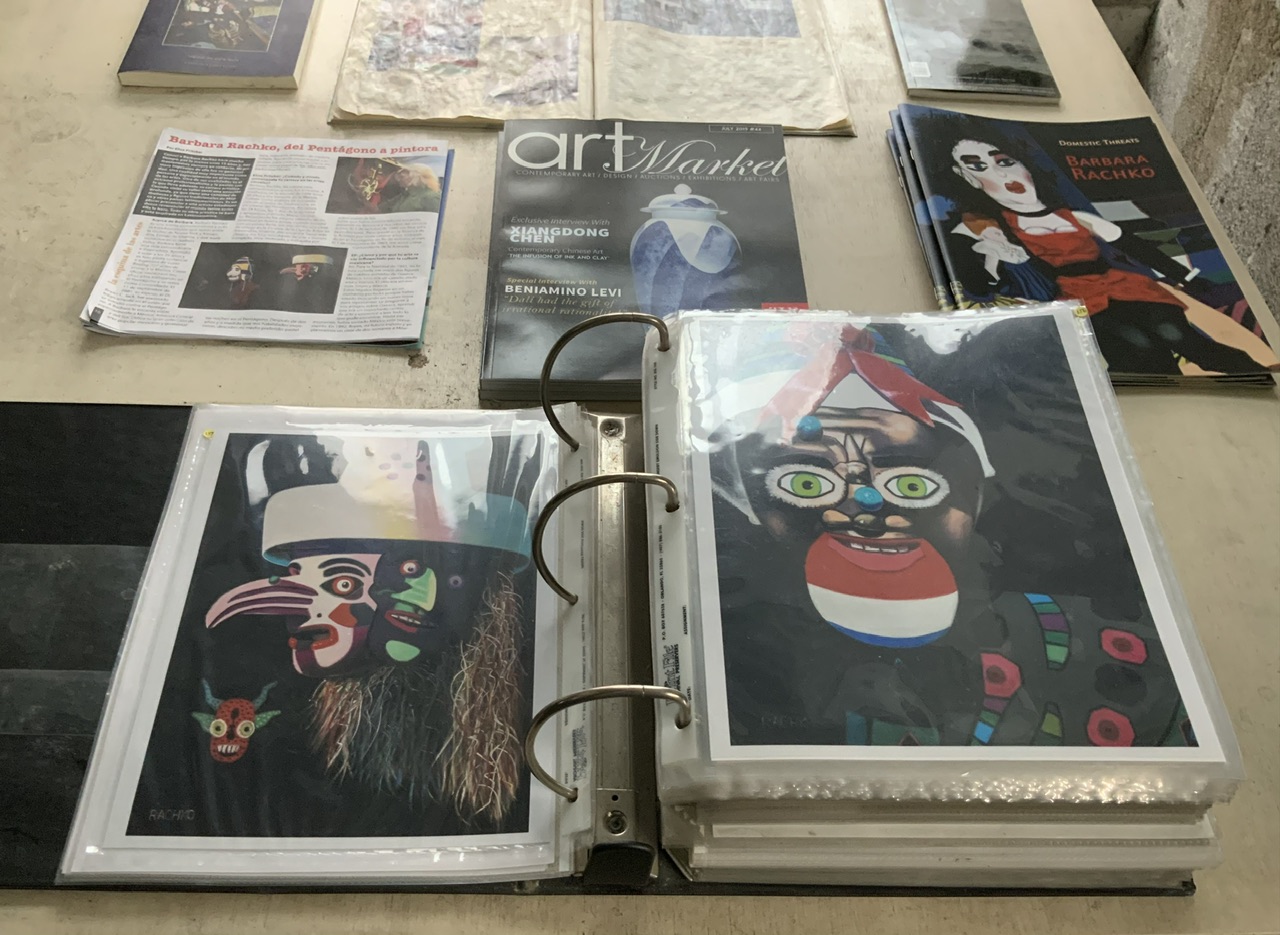
Barbara’s portfolio book
A: Every time I finish a pastel painting I order an 8” x 10” c-print at Duggal Visual Solutions. I started doing this in the 1980s when I was a portrait artist and the company that represented me needed photos of my work to show to potential clients. I’ve just continued making 8” x 10”photos all these years in order to document my work!
Pastel is an extremely slow medium so even though I have been working more than 37 years, the two pastel paintings in progress now are numbers 160 and 161. The portfolio book also has early press clippings, reviews from before the internet (when everything was on paper), and a few photos of early solo exhibitions in the 1990s.
BTW what a great question! No one has ever asked me this before!
Comments are welcome!
Q: Many of the world’s cultures have a mask tradition. Is there something special about Bolivian masks that first attracted you to them?

Bolivian Carnival Mask
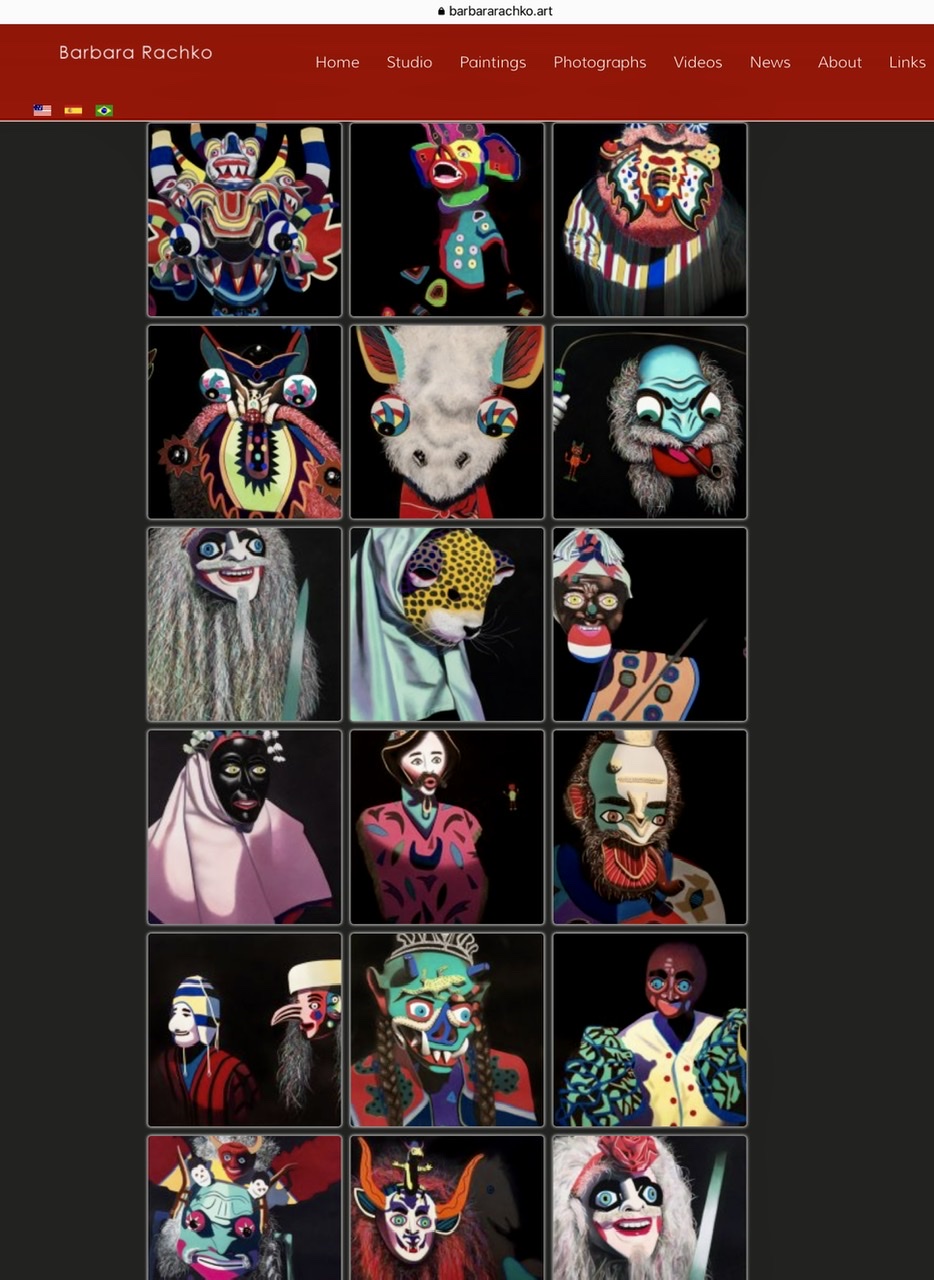
A: My subject matter emerges directly from my travels. I visited Bolivia in 2017. What I especially liked then – and now – about Bolivian Carnival masks, is that they include additional textures – feathers, fur, costume jewelry, sequins, fabric, etc. that add to their physical presence. Masks from most of the other countries I’ve visited tend to be made of wood and/or paper mache and nothing else. In my view such masks are not as dramatic nor do they offer much expressive potential. They feel dead. They lack a certain “soulfulness.”
Furthermore, textures are challenging to render in soft pastel. For more than three decades I have been striving to improve my pastel techniques. By now I have a vast repertoire from which to select. As was true in my earlier series, with “Bolivianos” an important personal goal is to keep adding to the repertoire.
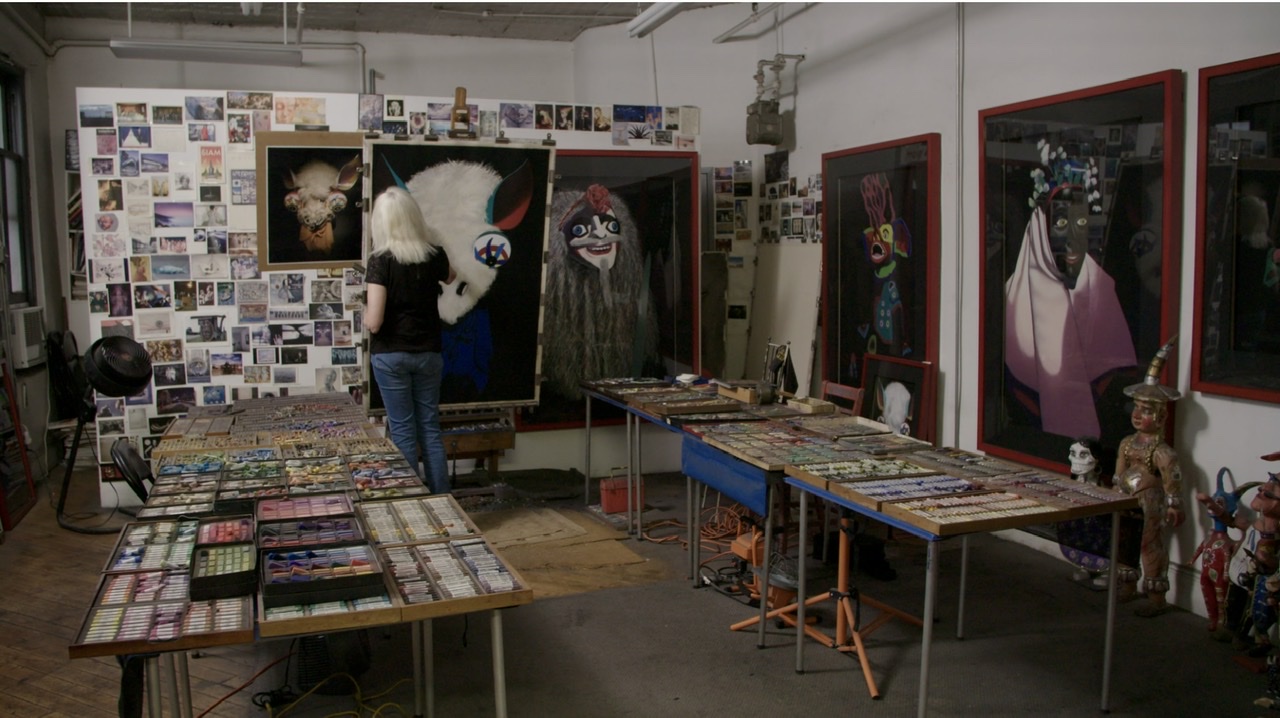
It takes months to create a pastel painting, which means I need masks that will hold my attention every day over the course of three or four months. I never want to be bored in the studio. If I am bored while making the work, those feelings will be directly transferred and I will make a boring pastel painting, something I hope never to do! The masks need to have a really strong ‘presence.’ Then as I slowly make a pastel painting, one that is exciting to work on from start to finish, I can transform my subject into something surprising and powerful that has never existed before!
Comments are welcome!
Pearls from artists* # 562

“Shadow,” soft pastel on sandpaper, 26” x 20,” in progress
*an ongoing series of quotations – mostly from artists, to artists – that offers wisdom, inspiration, and advice for the sometimes lonely road we are on.
Jung observed that complexes could affect groups of people en masse. He saw that certain moments seemed to be expressions of a collective shadow, a bursting forth of a mass psychosis; the repressed side of a whole group coming alive; a tribal Mr. Hyde. He saw this madness first-hand in Germany in the 1930s and wrote about it. But every era carries some measure of collective shadow.
One could argue that no moment in time has seen more of the reality of human darkness than ours. Having witnessed the Holocaust and faced the threat of nuclear war in the twentieth century, and now facing the environmental impact of fossil fuels and plastics in the twenty-first century, we are undoubtedly aware of more of humanity’s potential for destruction than any of our ancestors ever were. Such a view does not come from a moralizing stance. Our era has made forced witnesses of us all.
The shadow is about where we put the Devil – where do we allow darkness to be housed? Racism and bigotry offer the relief of foisting our group’s shadow onto another whom we view as lesser. Doing so enables us not to look at or feel our shadow, and not see our own worst selves. But this collective shadow of our modern culture is also bigger and wider than group-to-group projections. There are culture-wide or civilization expressions of the collective shadow.
Jung saw the widespread loss of connection to the inner life and to a lived spirituality as one of the primary illnesses of our time. He observed that people were no longer animated by the traditional religions… For Jung, this meant that we’ve lost the old way but not yet found the new, and are sitting in a spiritual vacuum.
Into that vacuum, without our awareness, has slipped our fascination with human technology. Observe people closely today and you’ll notice that we have an almost magical faith in our devices. People see their computers and phones as all-knowing and expect them to function perfectly all the time, and view pharmaceuticals as magic cure-alls. Where we used to put God, we now have put technology. Where spirit was, we have unconsciously placed human genius.
Gary Bobroff in Carl Jung: Knowledge in a Nutshell
Comments are welcome!
Q: What advice would you give to a young artist with potential?

Barbara’s studio (since April 1997)
A: I last answered this question in my blog more than ten years ago and I would say similar things now to what I said then.
Be sure that you love your process unconditionally because there is no relationship between how hard you will work and how much money you will earn, period. Indeed, with inflation and rapidly evolving ways of doing business, it seems to cost more money every year to be an artist. As I’ve said often, be prepared to work very, very hard. Really it’s all about making the most of your gifts as an artist. If you don’t feel a deep responsibility to developing your talents as far as possible, you won’t have what it takes to keep going. Countless artists quit and no one can blame them. You absolutely must love your materials and your creative process and be willing to do whatever it takes to continue making art.
This is not a life for slackers!
Comments are welcome!
Pearls from artists* # 544
*an ongoing series of quotations – mostly from artists, to artists – that offers wisdom, inspiration, and advice for the sometimes lonely road we are on.
Creativity is human potential made manifest. But what is talent? The dictionary (in this case Webster’s New World Dictionary) informs us that talent is any natural ability, power, or endowment, and especially a superior, apparently natural ability in the arts or sciences or in the learning or doing of anything.
This definition is revealing on several counts. First of all, it defines talent in terms of abilities and powers. It suggests that an artist can answer the question “Am I talented?” In the affirmative if he can point to certain endowments that he possesses.
But which ones should be point to? What are the important ones in his art discipline? How many of them does he need to do good work? Do they all matter equally? Which, if any, are absolutely necessary? How much of a desired ability does he need – how great a vocal range, how long a leap, how fine a hand as a draftsman?
Eric Maisel in A Life in the Arts: Practical Guidance and Inspiration for Creative and Performing Artists
Comments are welcome!
Q: There are so many instances in the art world where paintings are discovered to be fakes. Do you think this is a potential problem where your work is concerned? Can your pastel paintings be forged?


A: For the record, a little-appreciated fact about my pastel-on-sandpaper paintings is that they can never be forged. To detect a fake, you would only need to x-ray them. If dozens of layers of revisions are not visible under the final pastel painting, you are not looking at an original Rachko, period.
My completed paintings are the results of thousands of decisions. They are the product of an extremely meticulous, labor-intensive, and self-invented process. This is the difference between spending months thinking about and creating a painting, as I do, or a single day. It’s highly doubtful that my rigorous creative process can EVER be duplicated.
Comments are welcome!
Pearls from artists* # 530
* an ongoing series of quotations – mostly from artists to artists – that offers wisdom, inspiration, and advice for the sometimes lonely road we are on.
Samuel Coleridge described the imagination as “the living power and prime agent of all human perception.” It achieves its fullest potential in artistic expression because it is there that it transcends mere representation to bring forth unprecedented images of the world.
JF Martel in Reclaiming Art in the Age of Artifice: A Treatise, Critique, and Call to Action
Comments are welcome!
Pearls from artists* # 520
*an ongoing series of quotations – mostly from artists, to artists – that offers wisdom, inspiration, and advice for the sometimes lonely road we are on.
Ondaatje: Do you think success and failure can distort the lessons an artist is able to learn?
Murch: There’s that wonderful line of Rilke’s, “The point of life is to fail at greater and greater things.” Recognizing that all of our achievements are doomed, in one sense – the earth will be consumed by the sun in a billion years or so – but in another sense the purpose of our journey is to go farther each time. So you’re trying things out in every film you make, with the potential of failure. I think we’re always failing, in Rilke’s sense – we know there’s more potential that we haven’t realized. But because we’re trying, we develop more and more talent, or muscles, or strategies to improve, each time.
In The Conversation: Walter Murch and the Art of Editing Film by Michael Ondaatje
Comments are welcome!


 barbararachkoscoloreddust.com