Blog Archives
Pearls from artists* # 690
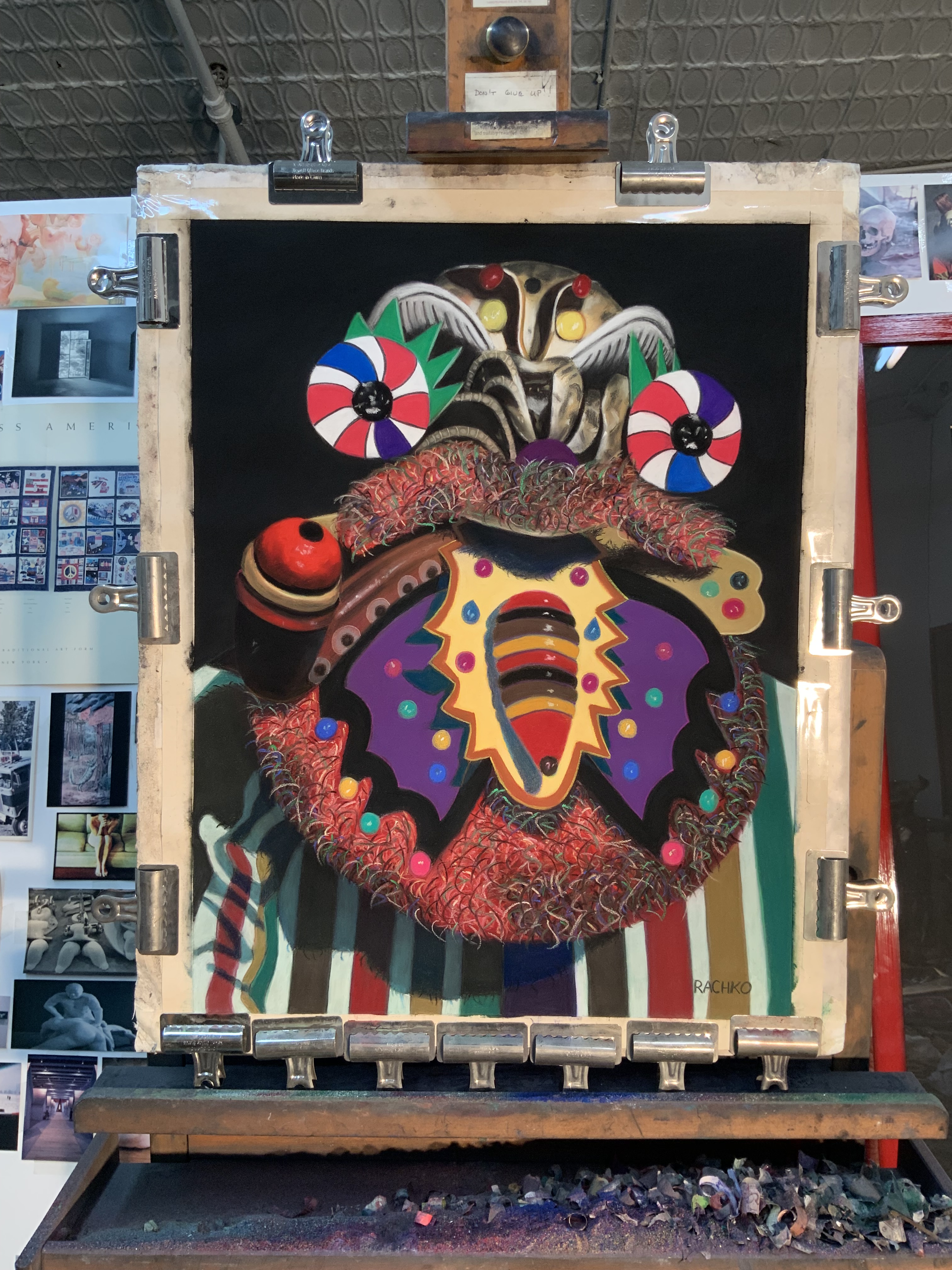
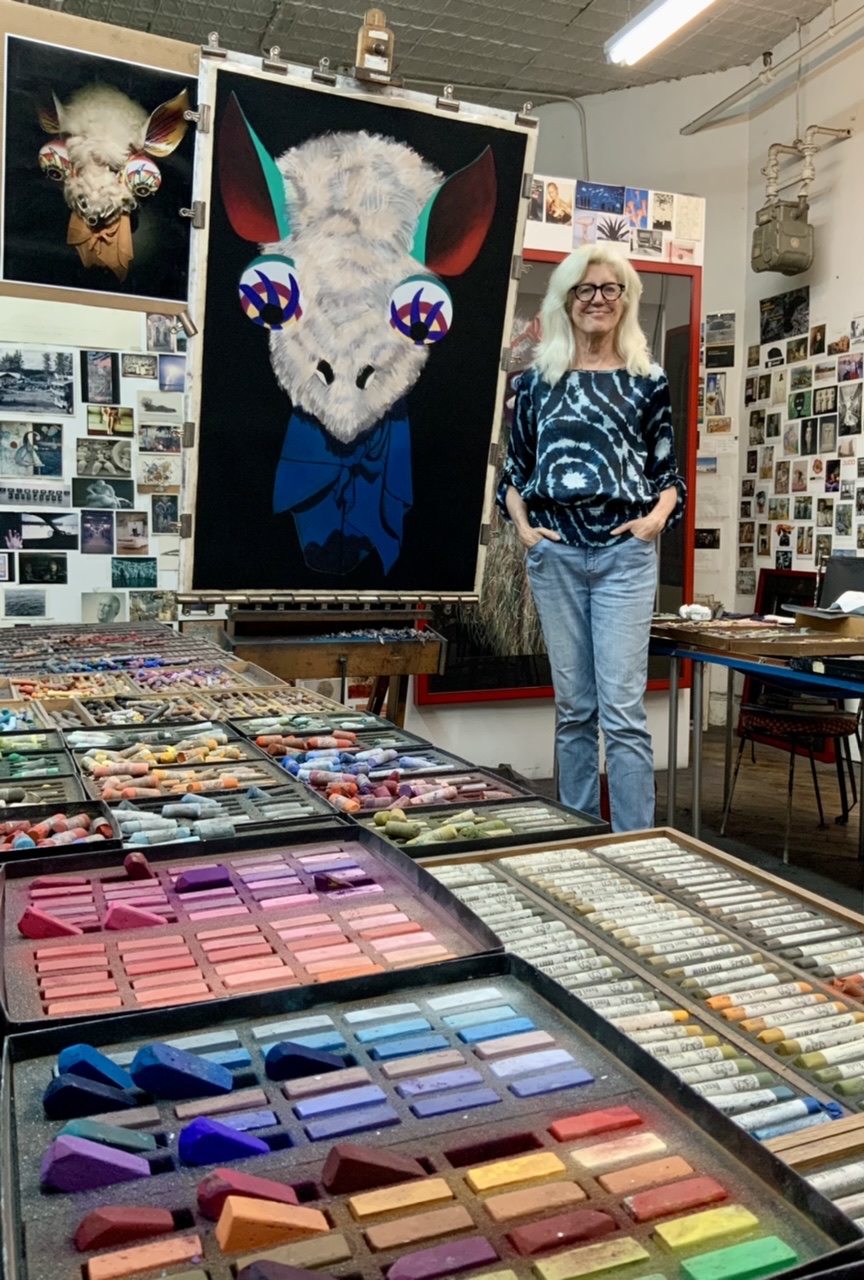
“Showman,” soft pastel on sandpaper, 26” x 20”
*an ongoing series of quotations – mostly from artists, to artists – that offers wisdom, inspiration, and advice for the sometimes lonely road we are on.
PC: And today, don’t you think a picture communicates primarily through its metiére? A mysterious transubstantiation takes place between the thing itself and the way in which our eye receives it. Or, more precisely, a painter’s metiére has life in it, as if it were still laden with the artist’s passion. You feel his pulse beating in it, his need to register the victory of his presence in physical space but outside the reach of time.
HM: Every painter with real talent has his own metiére, a way of laying on the paint with relish, with a certain voluptuous feel, which means that you could say that metiére of this or that painter is like velvet, or satin, or taffeta. As to manner… No one knows where this comes from. It’s magic. It’s not something you can learn. There are very rich paintings, like those of Cézanne, and others very lightly painted that have real density all the same: Velazquez, for example, with his Phillip IV. He uses a scumble for the landscape, which is very beautiful and solid with matiére—the scumble is so well proportioned that it combines with the background and harmonizes perfectly; the Rubens painting on wood in the Louvre, Portrait of Hélène Fourmont and Her Children, is painted mainly in colored oils, yet how deep and solid the colors seem!
Chatting with Henri Matisse: The Lost 1941 Interview, Henri Matisse and Pierre Courthion, edited by Serge Guilbaut
Comments are welcome!
Pearls from artists* # 685
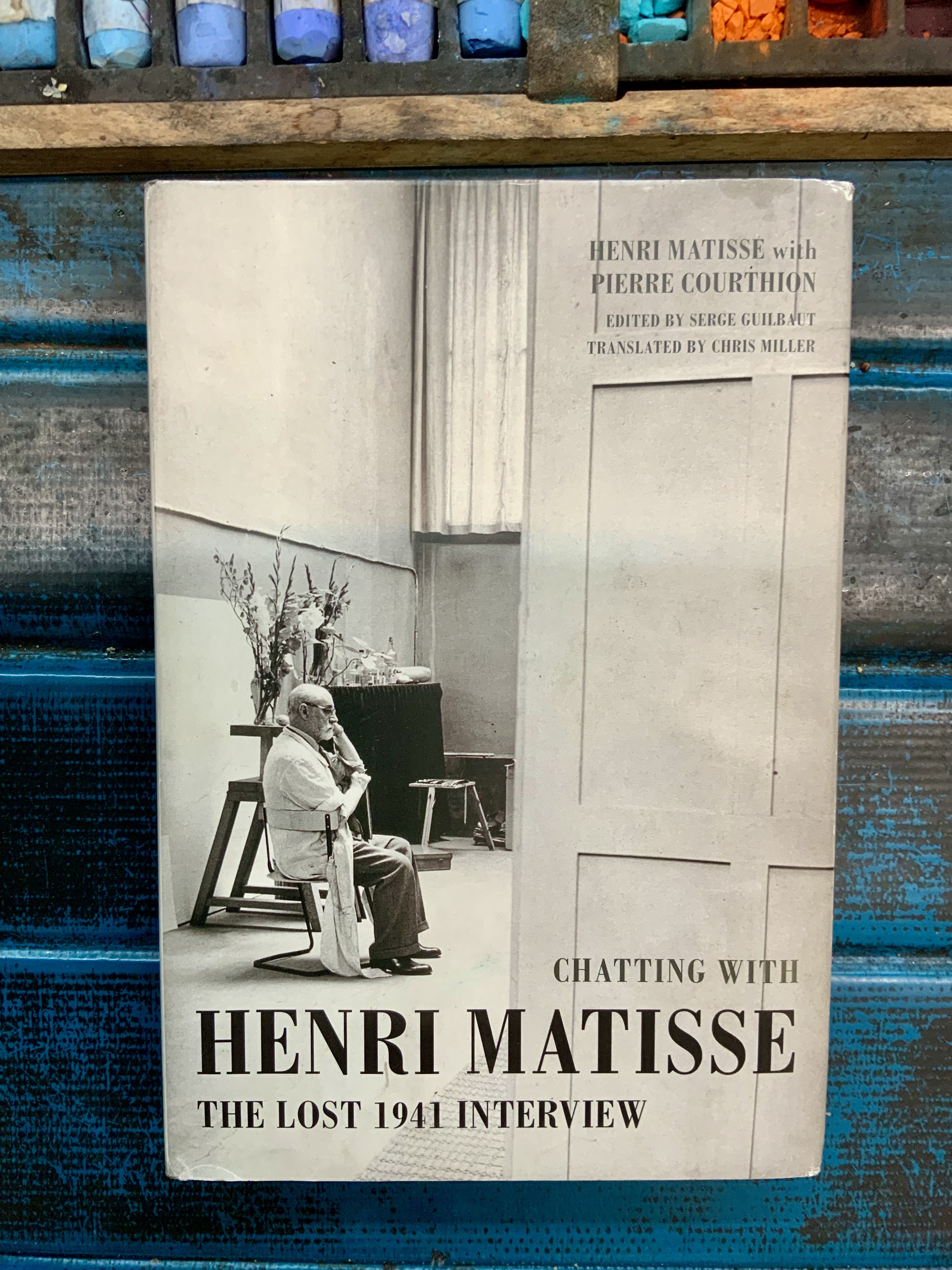
Another of my favorite books!
*an ongoing series of quotations – mostly from artists, to artists – that offers wisdom, inspiration, and advice for the sometimes lonely road we are on.
HM: The great benefit I took from visits with Renoir was realizing that even after a long working life, an artist’s curiosity could remain unquenched. The hope of some further progress, something to be added to his œuvre, was what kept Renoir alive. He was painting a “bathing” picture (now, finally, in the Musée du Louvre) and doing it with some difficulty because the picture was quite big and Renoir’s hands weren’t very nimble. But it’s only now, when I think about it, that I realize he must have found it hard; it would never occur to you when you saw him at his canvas – there was such intellectual urgency about everything he did.
Another big lesson I learned from visiting Renoir was that this man, riddled with pain and infirmity – his legs were so stiff he couldn’t walk a single step – could still be happy working and talking about his work. When you were with him for a while and he’d warmed to the conversation, you hadn’t the least sense that you were talking to an old man; his eyes were so full of life and intelligence that you forgot his age.
Henri Matisse in Chatting With Matisse: The Lost 1941 Interview, Henri Matisse with Pierre Courthion, edited by Serge Guilbault
Comments are welcome!
Pearls from artists* # 677

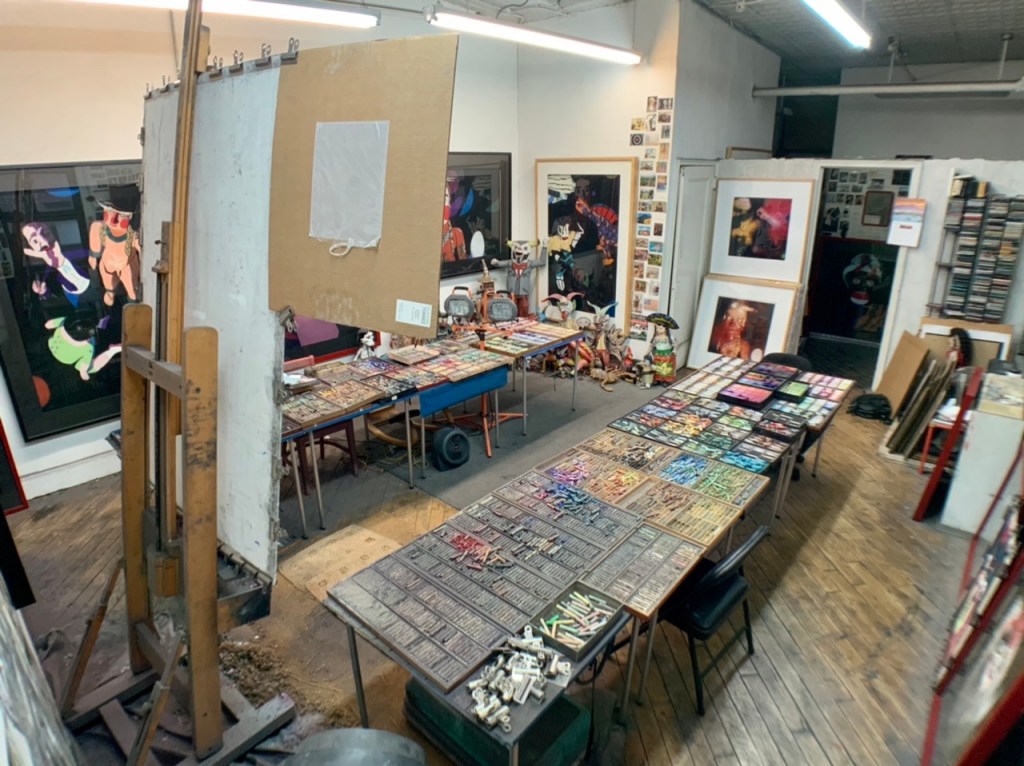
Barbara’s Studio
*an ongoing series of quotations – mostly from artists, to artists – that offers wisdom, inspiration, and advice for the sometimes lonely road we are on.
… in Japan, in the native Shinto religion of the land, where the rites are extremely stately, musical, and imposing, no attempt has been made to reduce their “affect images” to words. They have been left to speak for themselves – as rites, as works of art – through the eyes to the listening heart. And that, I would say, is what we, in our own religious rites, had best be doing, too. Ask an artist what his picture “means,” and you will not soon ask such a question again. Significant images render insights beyond speech, beyond the kinds of meaning speech defines. And if they do not speak to you, that is because you are not ready for them, and words will only serve to make you think you have understood, thus cutting you off altogether. You don’t ask what a dance means, you enjoy it. You don’t ask what the world means, you enjoy it. You don’t ask what you mean, you enjoy yourself; or at least, so you do when you are up to snuff.
Joseph Campbell in Myths to Live By
Comments are welcome!
Pearls from artists* # 612
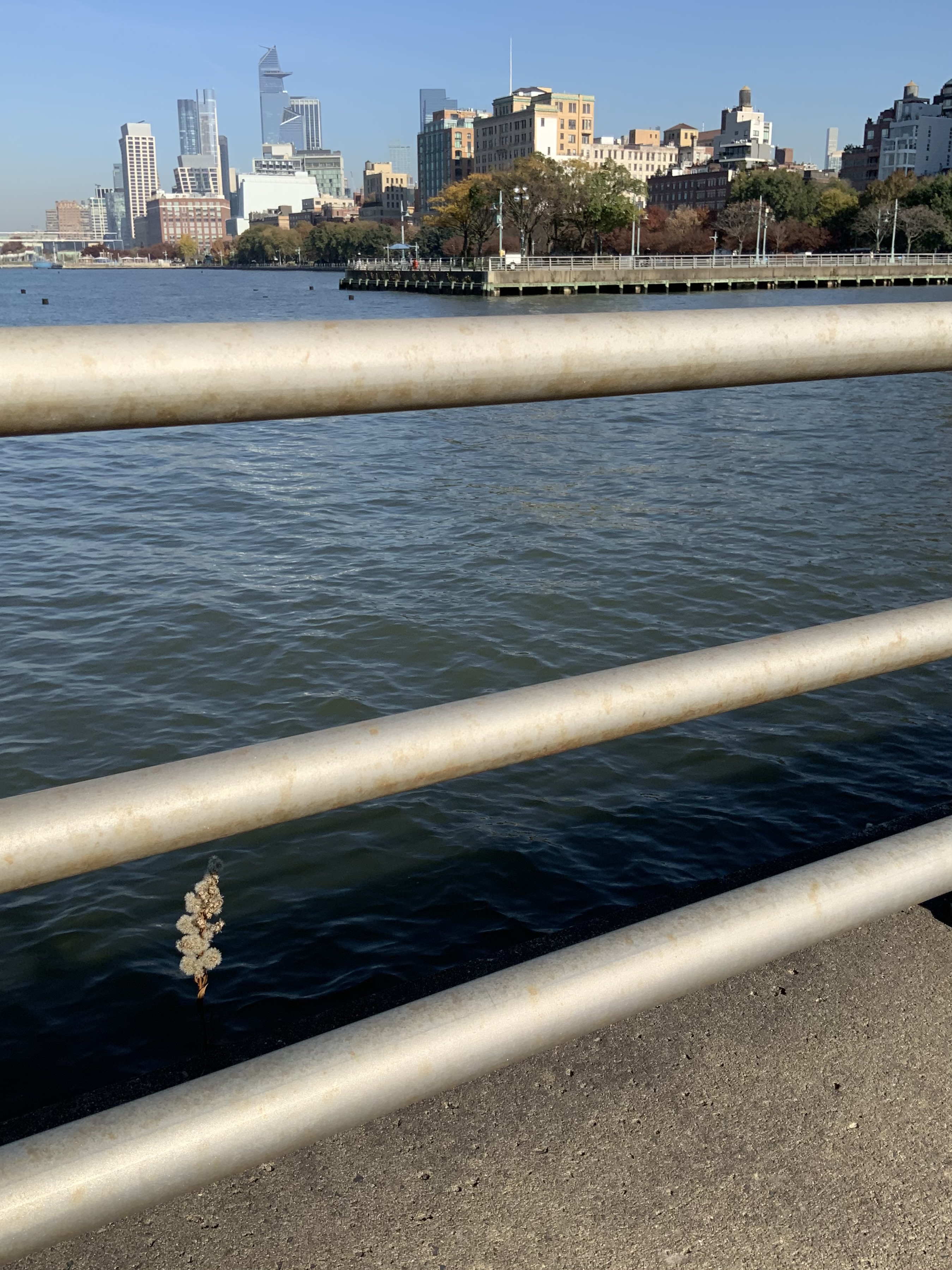
New York, NY
*an ongoing series of quotations – mostly from artists, to artists – that offers wisdom, inspiration, and advice for the sometimes lonely road we are on.
It is the poet and philosopher who provide the community of objectives in which the artist participates. Their chief preoccupation, like the artist, is the expression in concrete form of their notions of reality. Like him, they deal with verities of time and space, life and death, and the heights of exaltation as well as the depths of despair. The preoccupation with these external problems creates a common ground which transcends the disparity of the means used to achieve them. And it is in the language of the philosopher and poet or, for that matter, of other arts which share the same objective that we must speak if we are to establish some verbal equivalent of the significance of art.
Let us not for a moment conceive that the language of one is interchangeable with that of the other: that one can duplicate the sense of a picture by the sense of words or sounds, or that one can translate the truth of words by means of pictorial delineations. Not all odes of Pindar, framed and embroidered, could duplicate the portrayal by Apelles’ brush of the Hero of the Palaestra. The Pandemonium of Milton or Dante’s Inferno can never replace the vision of the Last Judgment by either Michelangelo or Signorelli. No more so than the Pastoral Symphony of Beethoven can be apprehended through the reading of idyllic poems, augmented by descriptions of woodland and fields, of torrents and streams, the study of ornithological sounds, and the laws of harmonics. Neither books on jurisprudence, nor costume plates, can possibly reconstruct Raphael’s School of Athens. And the man who knows a book or a picture through its critics, whatever his experience, has no experience of the art itself. The truth, the reality of each, is confined within its own boundaries and must be perceived in terms of the means generic to itself.
In speaking of art here, there is no thought of recreating the experience of the picture. If we compare one art to another, it is not with the intention of contrasting their actuality, but to speak rather of the motivations and properties such as are admissible to the world of verbal ideas. And if… we are partial to the philosopher – at the expense of those others who share with the artist his common objectives, it is not because we divine in his effort a greater sympathy to the artist, but because philosophy shares with art it’s preoccupation with ideas in the terms of logic.
Mark Rothko in The Artist’s Reality: Philosophies of Art
Comments are welcome!
Pearls from artists* # 577

In the Studio
*an ongoing series of quotations – mostly from artists, to artists – that offers wisdom, inspiration, and advice for the sometimes lonely road we are on.
What is the popular conception of the artist? Gather a thousand descriptions and the resulting composite is the portrait of a moron: he is held to be childish, irresponsible, and ignorant or stupid in everyday affairs.
The picture does not necessarily involve censure or unkindness. These definitions are attributed to the artist’s preoccupation with his particular kind of fantasy and to the unworldly nature of the fantastic itself. The bantering tolerance granted to the absentminded professor is extended to the artist. Biographers contrast the artless news of his judgments with the high attainment of his art, and while his naïveté or rascality are gossiped about, they are viewed as signs of Simplicity and Inspiration, which are the Handmaidens of Art. And if the artist is inarticulate and lacking in the usual repositories of fact and information, how fortunate, it is said, that nature has contrived to divert him from all worldly distractions so he may be single-minded in regards to his special office.
Mark Rothko in The Artist’s Reality: Philosophies of Art, edited and with an introduction by Christopher Rothko
Comments are welcome!
Pearls from artists* # 523
*an ongoing series of quotations – mostly from artists, to artists – that offers wisdom, inspiration, and advice for the sometimes lonely road we are on.
How strange the human mind is! When I first began, I think I should have been willing to work at it from the top of a church steeple, whereas now, even to think of finishing requires a real effort. And all this, simply because I have been away from it for so long. It is the same with my picture and with everything else I do. There is always a thick crust to be broken before I can give my whole heart to anything; a stubborn piece of ground, as it were, that resists the attack of plough and hoe. But with a little perseverance the hardness suddenly gives and it becomes so rich in fruit and flowers that I am quite unable to gather them all.
The Journal of Eugene Delacroix edited by Hubert Wellington
Comments are welcome!
Pearls from artists* # 518
*an ongoing series of quotations – mostly from artists, to artists – that offers wisdom, inspiration, and advice for the sometimes lonely road we are on.
“It’s more than beauty that I feel in music – that I think musicians feel in music. What we know we feel we’d like to convey to the listener. We hope that this can be shared by all. I think, basically, that’s what it is we are trying to do. We never talked about just what we were trying to do. If you ask me that question, I might say this today and tomorrow say something entirely different, because there are many things to do in music.
“But, overall, I think the main thing a musician would like to do is to give a picture to the listener of the many wonderful things he knows of and senses in the universe. That’s what music is to me – it’s just another way of saying this is a big, beautiful universe we live in, that’s been given to us, and here’s an example of just how magnificent and encompassing it is. That’s what I would like to do. I think that’s one of the greatest things you can do in life, and we all try to do it in some way. The musician’s is through his music.”
John Coltrane in Coltrane on Coltrane: The John Coltrane Interviews
Comments are welcome!
Pearls from artists* # 458

*an ongoing series of quotations – mostly from artists, to artists – that offers wisdom, inspiration, and advice for the sometimes lonely road we are on.
When I have painted a fine picture I have not given expression to a thought! That is what they say. What fools people are! They would strip painting of all its advantages. A writer has to say almost everything in order to make himself understood, but in painting it is as if some mysterious bridge were set up between the spirit of the persons in the picture and the beholder. The beholder sees figures, the external appearance of nature, but inwardly he meditates; the true thinking that is common to all men. Some give substance to it in writing, but in so doing they lose the subtle essence. Hence, grosser minds are more easily moved by writers than by painters or musicians. The art of the painter is all the nearer to man’s heart because it seems to be more material. In painting, as in external nature, proper justice is done to what is finite and to what is infinite, in other words, to what the soul finds inwardly moving in objects that are known through the senses alone.
The Journal of Eugene Delacroix edited by Hubert Wellington
Comments are welcome!
Pearls from artists* # 441
*an ongoing series of quotations – mostly from artists, to artists – that offers wisdom, inspiration, and advice for the sometimes lonely road we are on.
The most perennially popular category of art is the cheerful, pleasant, and pretty kind: meadows in spring, the shade of trees on hot summer days, pastoral landscapes, smiling children. This can be deeply troubling to people of taste and intelligence.
… The worries about prettiness are twofold. First, pretty pictures are alleged to feed sentimentality. Sentimentality is a symptom of insufficient engagement with complexity, by which one really means problems. The pretty picture seems to suggest that in order to make life nice, one merely has to brighten up the apartment with a depiction of some flowers. If we were to ask the picture what is wrong with the world, it might be taken as saying ‘You don’t have enough Japanese water gardens’ – a response that appears to ignore all the more urgent problems that confront humanity (primarily economic, but also moral, political, and sexual). The very innocence and simplicity of the picture seems to mitigate against any attempt to improve life as a whole. Secondly, there is the related fear that prettiness will numb us and leave us insufficiently critical and alert to the injustices surrounding us.
Alain de Botton and John Armstrong in Art as Therapy
Comments are welcome!
Pearls from artists* # 433

Chatting with Jenny Holzer. It looks like she did not want her picture taken, but she was actually waiving.
*an ongoing series of quotations – mostly from artists, to artists – that offers wisdom, inspiration, and advice for the sometimes lonely road we are on.
…Two positions exist, the artistic and the commercial. Between these two an abiding tension persists. The eighteenth-century American painter Gilbert Stuart complained, “What a business is that of portrait painter. He is brought a potato and is expected to paint a peach.” The artist learns that the public wants peaches, not potatoes. You can paint potatoes if you like, write potatoes, dance potatoes, and compose potatoes, you can with great and valiant effort communicate with some other potato-eaters and peach-eaters. In so doing you contribute to the world’s reservoir of truth and beauty. But if you won’t give the public peaches, you won’t be paid much.
Repeatedly artists take the heroic potato position. They want their work to be good, honest, powerful – and only then successful. They want their work to be alive, not contrived and formulaic. As the Norwegian painter Edvard Munch put it: “No longer shall I paint interiors, and people reading, and women knitting. I shall paint living people, who breathe and feel and suffer and love.”
The artist is interested in the present and has little desire to repeat old, albeit successful formulas. As the painter Jenny Holzer put it, “I could do a pretty good third generation-stripe painting, but so what?
The unexpected result of the artist’s determination to do his [sic] own best art is that he is put in an adversarial relationship with the public. In that adversarial position he comes to feel rather irrational for what rational person would do work that’s not wanted?
…Serious work not only doesn’t sell well, it’s also judged by different standards. If the artist writes an imperfect but commercial novel it is likely to be published and sold. If his screenplay is imperfect but commercial enough it may be produced. If it is imperfect and also uncommercial it will not be produced. If his painting is imperfect but friendly and familiar it may sell well. If it is imperfect and also new and difficult, it may not sell for decades, if ever.
Ironically enough, the artist attempting serious work must also attain the very highest level of distinction possible. He must produce Crime and Punishment and The Brothers Karamazov but not also The Insulted and Injured or A Raw Youth, two of Dostoevsky’s nearly unknown novels. He is given precious little space in this regard.
I daresay, this last is why I devote my life to creating the most unique, technically advanced pastel paintings anyone will see!
Eric Maisel, A Life in the Arts: Practical Guidance and Inspiration for Creative and Performing Artists
Comments are welcome!


 barbararachkoscoloreddust.com