Blog Archives
Pearls from artists* # 624

View from New York City
*an ongoing series of quotations – mostly from artists, to artists – that offers wisdom, inspiration, and advice for the sometimes lonely road we are on.
Van Gogh’s drawings show a truly remarkable improvement over the course of the two years he set aside to intensely practice drawing. At the start of that period his sketches look clumsy and amateurish. With great ardor, thoughtfulness, and effort – by manifesting his creativity, in short – at the end of those two years Van Gogh was producing drawings that showed not only that he had mastered elements of technique but also that he had educated himself in ways that moved him far ahead of his classically trained peers.
Van Gogh’s progress excites the artist. It seems to hold the clear implication that by acting creatively the artist may significantly increase his talents or make manifest significant talent he didn’t know he possessed. Maybe a brilliant novel is within his grasp. Maybe he can achieve a breakthrough in the visual arts. Maybe he can play his instrument like a god.
Eric Maisel in A Life in the Arts: Practical Guidance and Inspiration for Creative and Performing Artists
Comments are welcome!
Pearls from artists* # 476
*an ongoing series of quotations – mostly from artists, to artists – that offers wisdom, inspiration, and advice for the sometimes lonely road we are on.
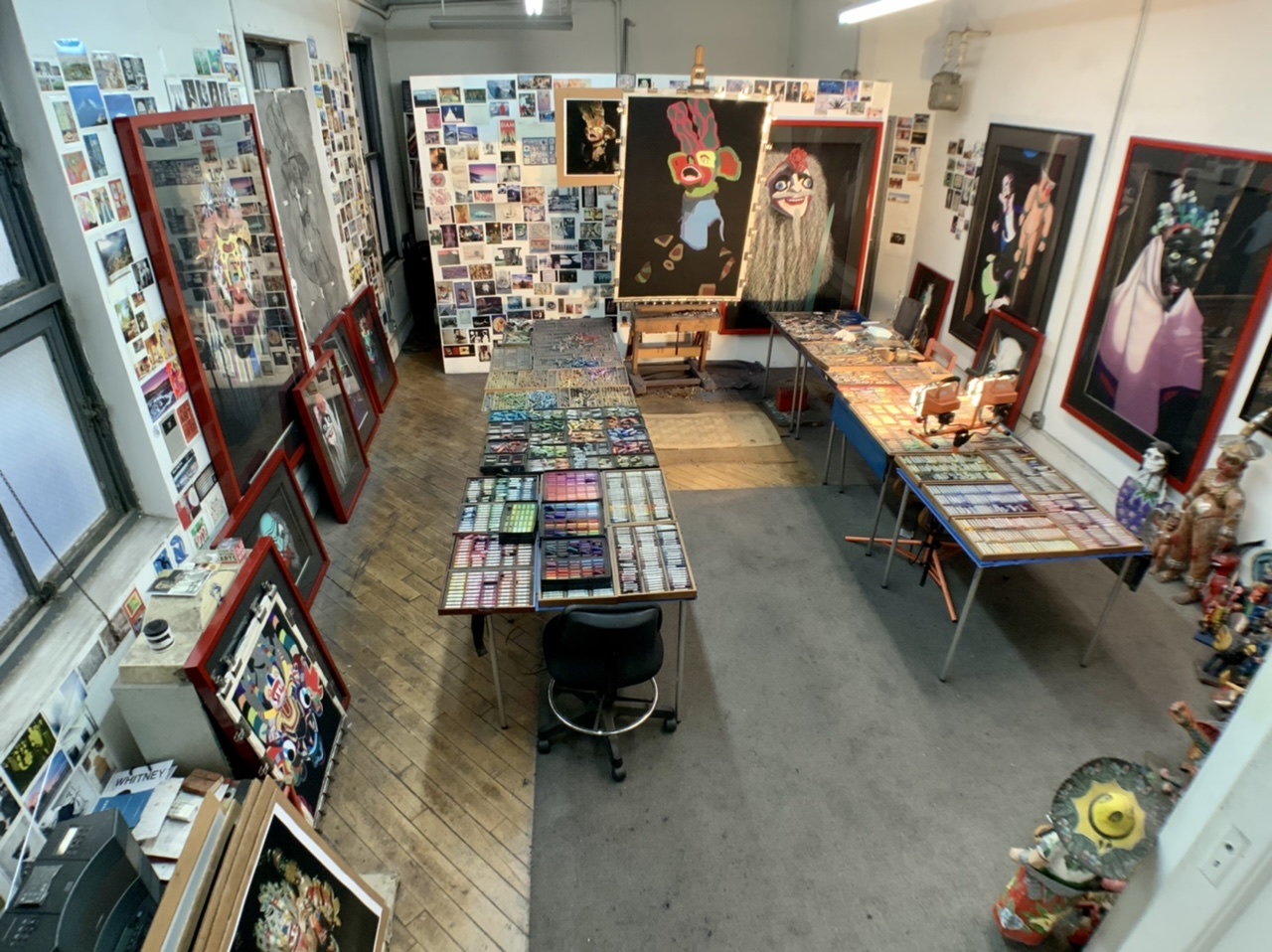
For a great many artists solitude is the time when they feel most real and alive. It is when they have their most intense experiences, when they can vicariously live out any adventure, any dream. Tennessee Williams said, “I’m only really alive when I’m writing.” The painter Robert Motherwell wrote, “I feel most real to myself in the studio.” The young, exuberant Russian painter Marie Bashkirtseff exclaimed at the end of the last century:
In the studio all distinctions disappear. One has neither name nor family; one is no longer the daughter of one’s mother, one is oneself and individual, and one has before one art, and nothing else. One feels so happy, so free, so proud!
We may think of his aliveness as the accumulation of al the above-listed benefits, as the artist working out her life, manifesting her creativity, suiting her personality, playing, avoiding unwanted social interactions, working authentically and integrity, living intensely – as the artist being her grandest self.
Eric Maisel in A Life in the Arts: Practical Guidance and Inspiration for Creative and Performing Artists
Comments are welcome!
Pearls from artists* # 384
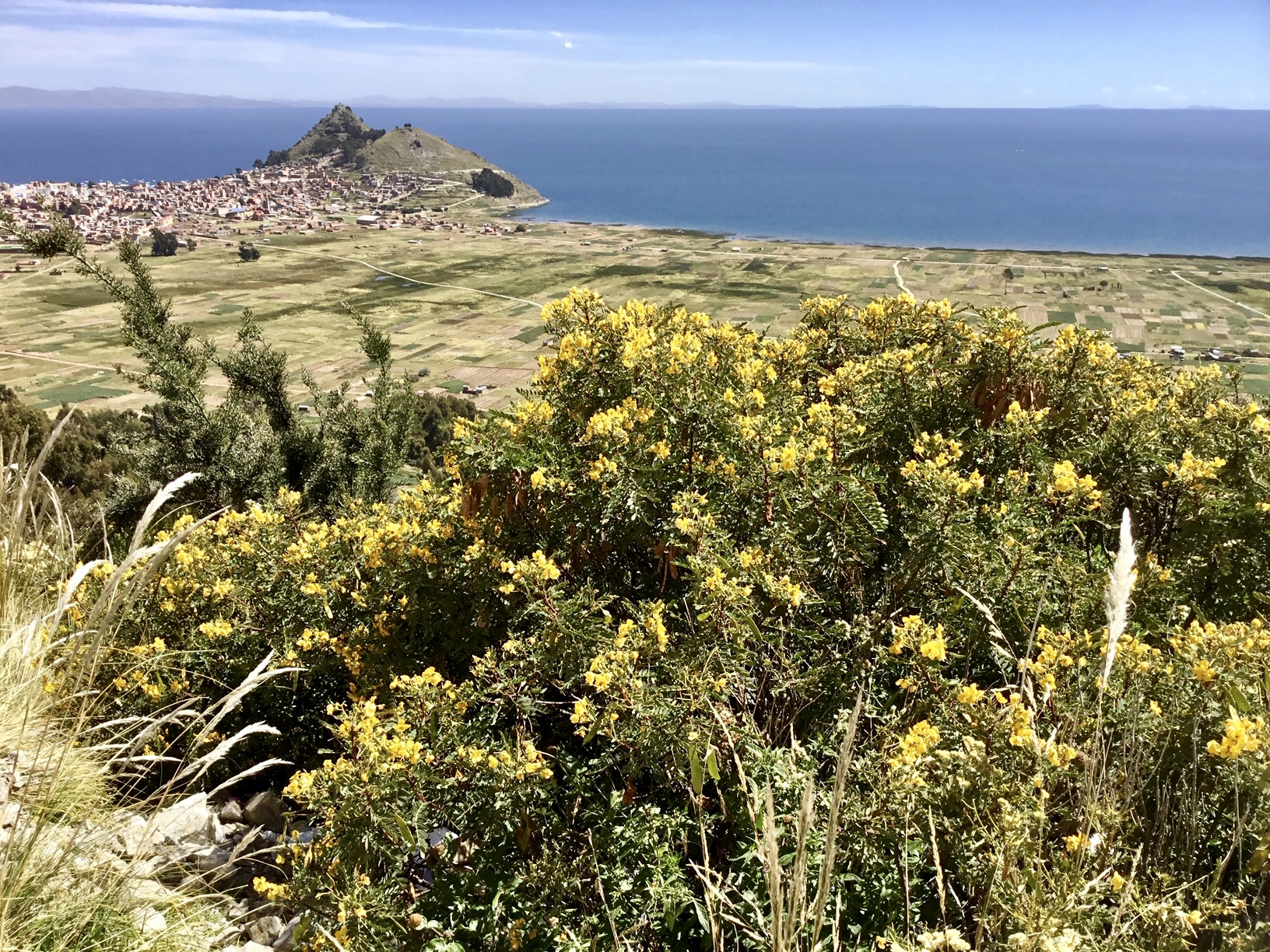
Overlooking Copacabana, Bolivia and Lake Titicaca
* an ongoing series of quotations – mostly from artists, to artists – that offers wisdom, inspiration, and advice for the sometimes lonely road we are on.
Carnival in Oruro [Bolivia] is a glorious spectacle. It’s flash, pomp and brilliance can be enjoyed without understanding its long history and intricate mythologies. Still, the onlooker is left with a thousand questions that are not so easily answered. Behind the glitter of Carnival lie the history, the timeless myths and the distinct traditions of this mining community.
According to the Spanish writer Jean Laude, “The function of the mask is to reaffirm, at regular intervals, the truth and presence of myths in everyday life.” This suggests that masks should be studied in context, noting their association with the individual dancer and the history, myths and traditions of the community that produces them. The mask has to be animated within its ritual, comic or social role.
A first step in appreciating the masks is to understand something of the land and people that crafted them. Oruro is a mining city on the open Altiplano at 3,700 meters (12,144 ft.) above sea level. The sky appears a rarified blue, it is intensely cold and a constant wind lifts dust to the eyes. During the year no more than 125,000 people live in the city. Suddenly in the weeks of Carnival, the population doubles or triples.
Three languages, Quechua, Aymara, and Spanish are spoken in Oruro. Their use reflects an ancient pattern of conquest in the history of this land. It is said that the Urus, whose language is now almost lost, were the first inhabitants. In time they were dominated by the Aymara tribes. Later, Quechua was introduced as the Inca advanced their empire from Cuzco. Ultimately the Spanish arrived and founded the present city in 1601 to exploit rich mineral deposits found in the seven hills.
Today, descendants of the Urus live near Oruro around the shore of Lake Poopo. Elements of their distinctive culture remain but they have no wealth in comparison with the more dominant Aymara and Quechua who surround them. A further change came in the recent past because Oruro has acted as a magnet, attracting many people from the countryside to work in the mines.
On one side were the Urus, ancient owners of all the land which now only carries their name (Uro Uro = Oruro). On the other side were the miners, many of whom were Quechua and Aymara migrants. In the middle is “Carnival.”
El Carnaval de Oruro by Manuel Vargas in Mascaras de los Andes Bolivianos, Editorial Quipus and Banco Mercantil
Comments are welcome!
Pearls from artists* # 177
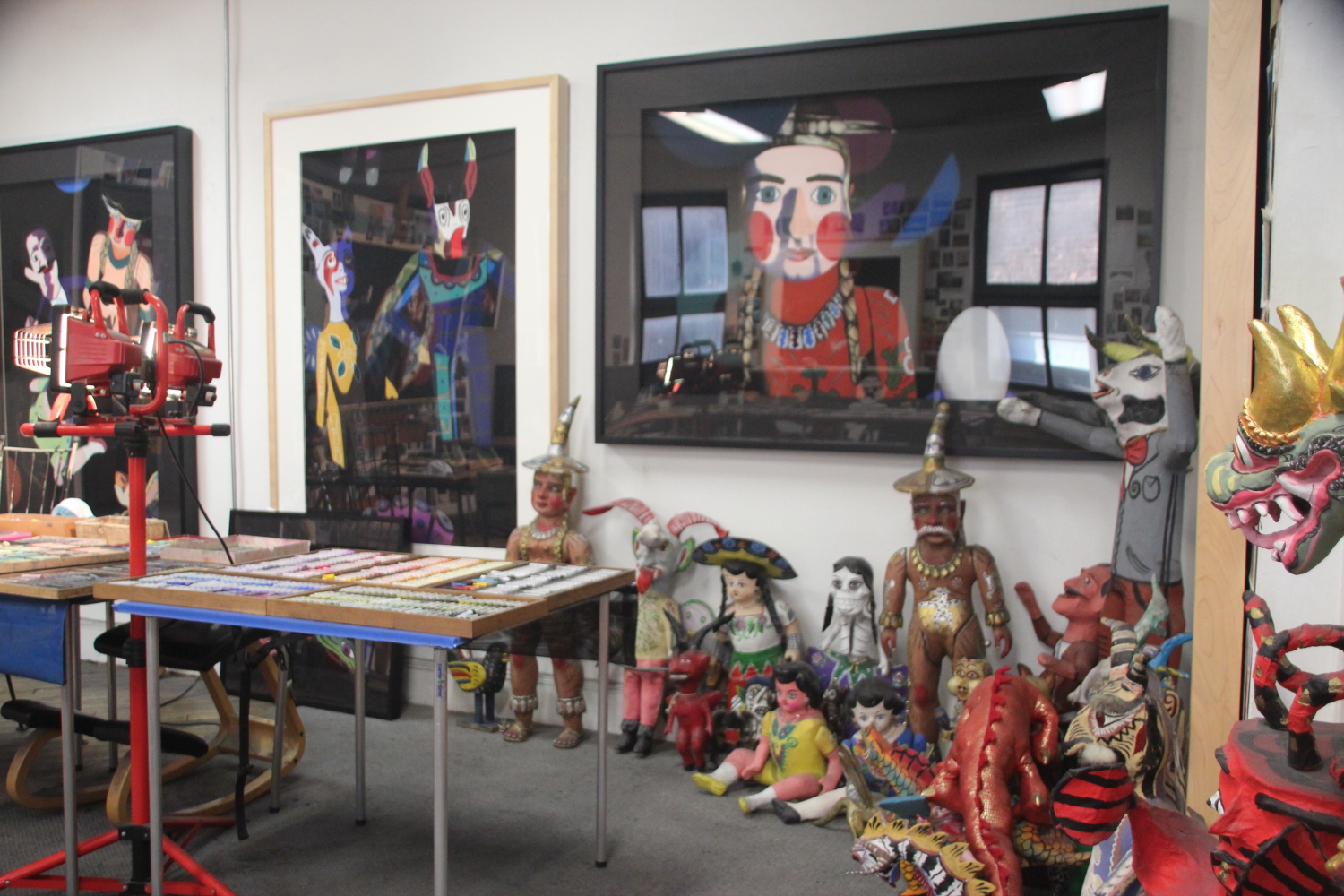
Barbara’s studio
* an ongoing series of quotations – mostly from artists, to artists – that offers wisdom, inspiration, and advice for the sometimes lonely road we are on.
Everyone but a lunatic has a reason for what he does. Yes, in that sense I am a determinist. But I believe, with Kant, that the mind is self-determined. That is, I believe intensely in the creative freedom of the mind. That is indeed absolutely essential to man’s security in a chaotic world of change. He is faced all the time with unique complex problems. To sum them up for action is an act of creative imagination. He fits the different elements together in a coherent whole and invents a rational act to deal with it. He requires to be free, he requires his independence and solitude of mind, he requires his freedom of mind and imagination. Free will is another matter – it is a term, or rather a contradiction in terms, which leads to continual trouble. The will is never free – it is always attached to an object, a purpose. It is simply the engine in the car – it can’t steer. It is the mind, the reason, the imagination that steers.
Joyce Carey in The Paris Review Interviews: Writers at work 1st Series, edited and with an introduction by Malcolm Cowley
Comments are welcome!
Q: You took classes at The Art League School in Alexandria, VA in the late eighties studying intensely with Lisa Semerad and Diane Tesler. How have these experiences impacted on the way you currently produce your artworks? By the way, I sometimes wonder if a certain kind of formal training in artistic disciplines could even stifle a young artist’s creativity. What do you think?
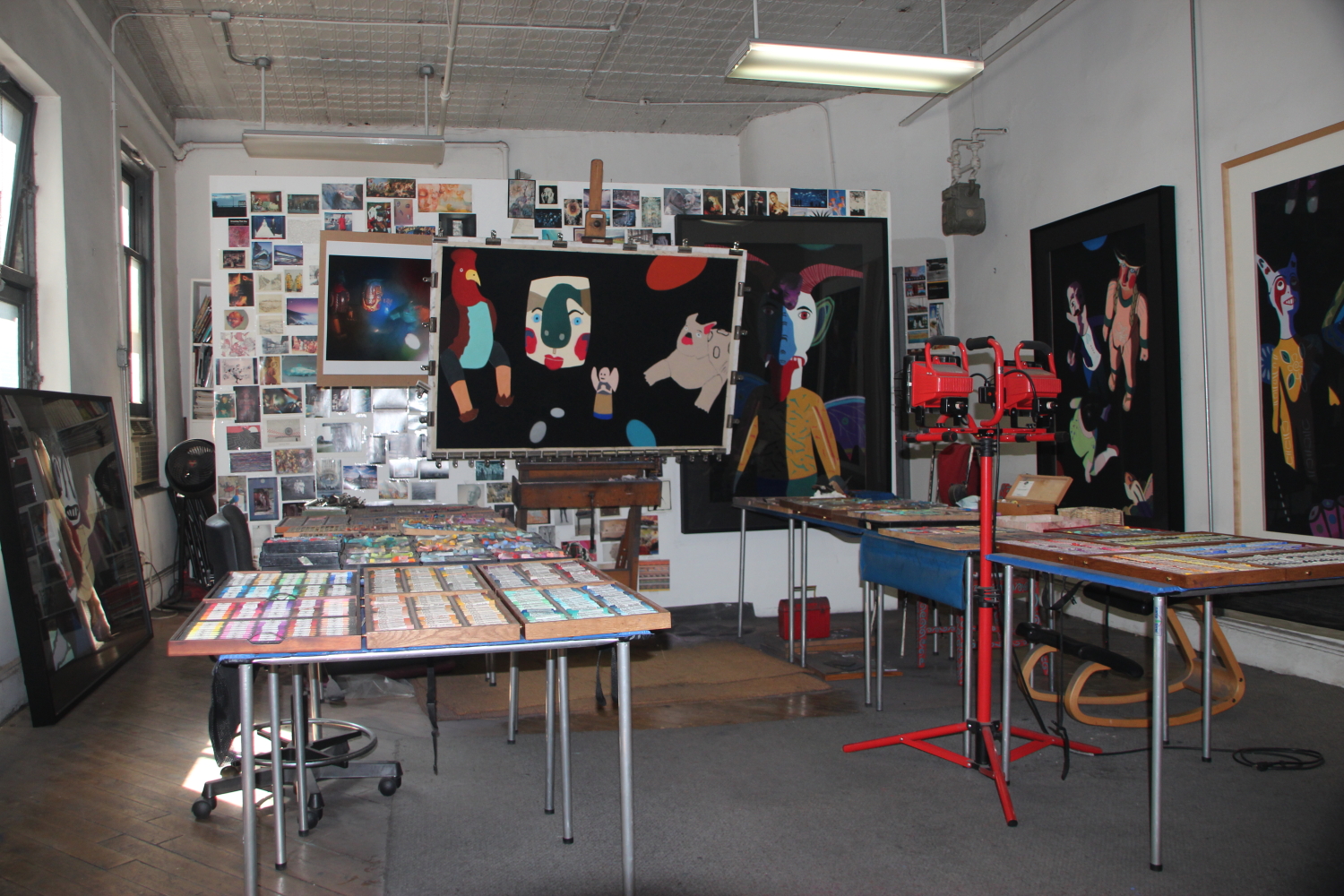
Barbara’s studio
A: From studying with Lisa and Diane I gained an excellent technical foundation and developed my ability to draw and depict just about anything in soft pastel. They were both extremely effective teachers and I worked hard in their classes. I probably got my work ethic from them. Without Diane and Lisa I doubt I would have gained the necessary skills nor the confidence to move to New York to pursue my art career.
Needless to say, I believe developing excellent technical skills is paramount. Artists can, and should, go ahead and break the rules later, but they won’t be able to make strong work, expressing what they want, without a firm foundation. Once you have the skills, you can focus on the things that really make your work come alive and speak to an appreciative audience.
Comments are welcome!
Pearls from artists* # 94
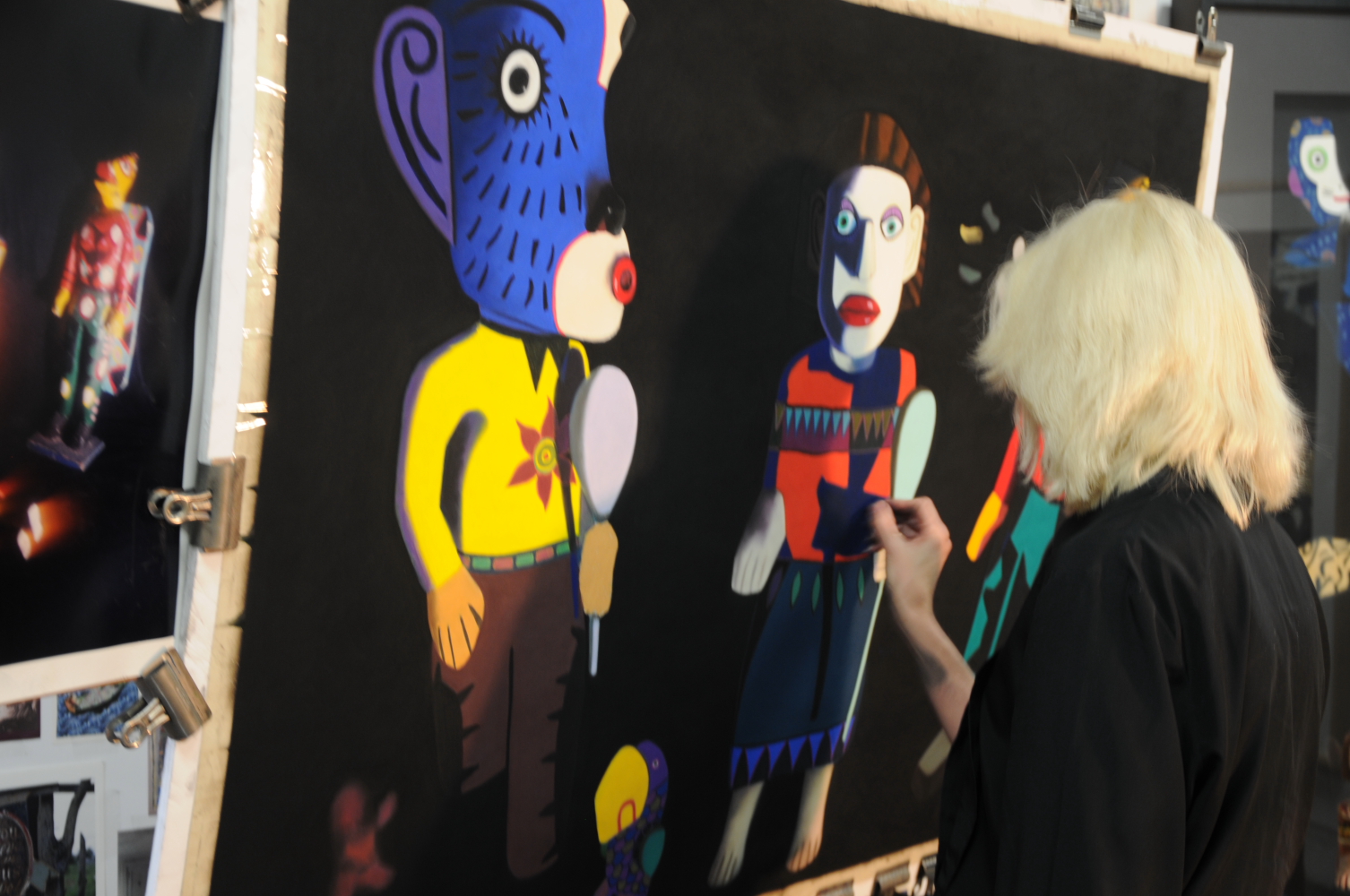
Working on “False Friends” Photo: Diana Feit
* an ongoing series of quotations – mostly from artists, to artists – that offers wisdom, inspiration, and advice for the sometimes lonely road we are on.
A work of art which inspires us comes from no quibbling or uncertain man. It is the manifest of a very positive nature in great enjoyment, and at the very moment the work was done.
It is not enough to have thought great things before doing the work. The brush stroke at the moment of contact carries inevitably the exact state of being of the artist at that exact moment into the work, and there it is, to be seen and read by those who can read such signs, and to be read later by the artist himself, with perhaps some surprise, as a revelation of himself.
For an artist to be interesting to us he must be interesting to himself. He must have been capable of intense feeling, and capable of profound contemplation.
He who has contemplated has met with himself, is in a state to see into the realities beyond the surfaces of his subject. Nature reveals to him, and, seeing and feeling intensely, he paints, and whether he wills it or not each brush stroke is an exact record of such as he was at the exact moment the stroke was made.
The Art Spirit by Robert Henri
Comments are welcome!
Pearls from artists* # 48

“Big Deal,” with double portrait of the author
* an ongoing series of quotations – mostly from artists, to artists – that offers wisdom, inspiration, and advice for the sometimes lonely road we are on.
Until the invention of photography, the painted (or sculptural) portrait was the only means of recording and presenting the likeness of a person. Photography took over this role from painting and at the same time raised our standards for judging how much an informative likeness should include.
This is not to say that photographs are in all ways superior to painted portraits. They are more informative, more psychologically revealing, and in general more accurate. But they are less tensely unified. Unity in a work of art is achieved as a result of the limitations of the medium. Every element has to be transformed in order to have its proper place within these limitations. In photography the transformation is to a considerable extent mechanical. In a painting each transformation is largely the result of a conscious decision by the artist. Thus the unity of a painting is permeated by a far higher degree of intention. The total effect of a painting (as distinct from its truthfulness) is less arbitrary than that of a photograph; its construction is more intensely socialized because it is dependent on a greater number of human decisions. A photographic portrait may be more revealing and accurate about the likeness and character of the sitter; but it is likely to be less persuasive, less (in the very strict sense of the word) conclusive. For example, if the portraitist’s intention is to flatter or idealize, he will be able to do so far more convincingly in a painting than with a photograph.
Geoff Dyer, editor, Selected Essays: John Berger
Comments are welcome!


 barbararachkoscoloreddust.com