Blog Archives
In celebration of the 13th anniversary of my blog three days from now, I am republishing the very first post from July 15, 2012. Q: What does it take to be an artist, especially one living and working in New York?
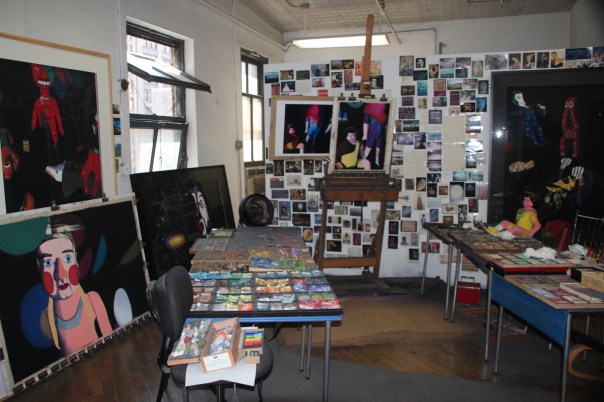
Barbara’s Studio (in 2012) with works in progress.
A: The three Big P’s – Patience, Persistence, and Passion. Without all three you will not have the stamina to work tirelessly for very little external reward. You can expect help from no one.
There are so many obstacles to art-making and countless reasons to just give up. When you really think about it, it’s amazing that great art gets made at all. So why do we do it? Above all it’s about making our time on earth matter, about devotion to our innate gifts and love of our hard-fought creative process.
And, my God, it even gets harder as we get older! So what do we do? We dig in that much deeper. It’s a most noble and sacred calling – you know when you have it – and that’s what separates those of us who are in it for the long haul from the wimps, fakers, and hangers-on. I say to my fellow artists who continue to work despite the endless challenges, we are all true heroes!
These words still ring true and it’s good, even for me, to occasionally be reminded.
Most importantly, THANK YOU to my 222,000+ subscribers for taking this journey with me. When I began this blog in 2012, I had no idea it would prove to be so popular… WOW!
Comments are welcome!
Pearls from artists* # 612
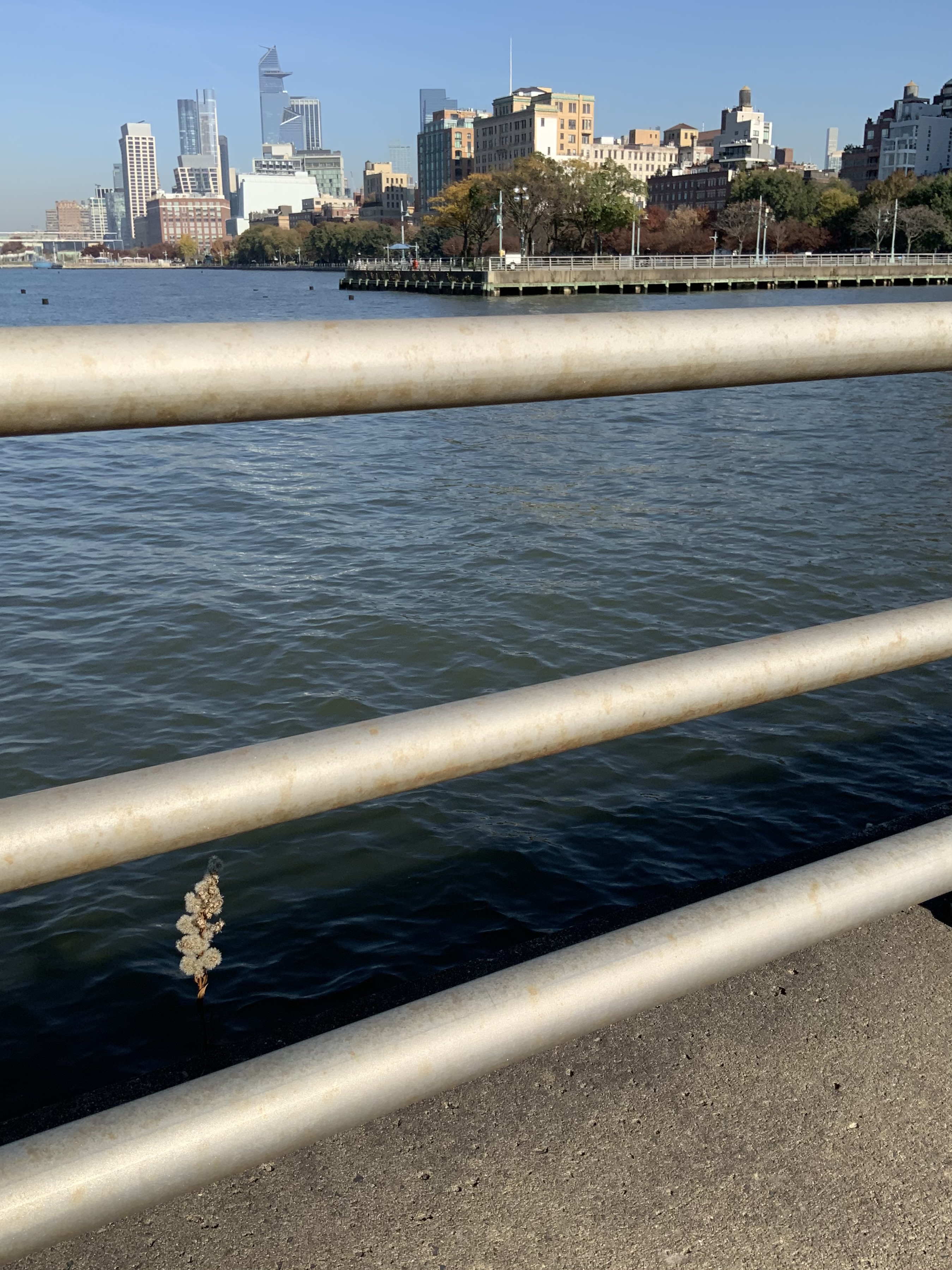
New York, NY
*an ongoing series of quotations – mostly from artists, to artists – that offers wisdom, inspiration, and advice for the sometimes lonely road we are on.
It is the poet and philosopher who provide the community of objectives in which the artist participates. Their chief preoccupation, like the artist, is the expression in concrete form of their notions of reality. Like him, they deal with verities of time and space, life and death, and the heights of exaltation as well as the depths of despair. The preoccupation with these external problems creates a common ground which transcends the disparity of the means used to achieve them. And it is in the language of the philosopher and poet or, for that matter, of other arts which share the same objective that we must speak if we are to establish some verbal equivalent of the significance of art.
Let us not for a moment conceive that the language of one is interchangeable with that of the other: that one can duplicate the sense of a picture by the sense of words or sounds, or that one can translate the truth of words by means of pictorial delineations. Not all odes of Pindar, framed and embroidered, could duplicate the portrayal by Apelles’ brush of the Hero of the Palaestra. The Pandemonium of Milton or Dante’s Inferno can never replace the vision of the Last Judgment by either Michelangelo or Signorelli. No more so than the Pastoral Symphony of Beethoven can be apprehended through the reading of idyllic poems, augmented by descriptions of woodland and fields, of torrents and streams, the study of ornithological sounds, and the laws of harmonics. Neither books on jurisprudence, nor costume plates, can possibly reconstruct Raphael’s School of Athens. And the man who knows a book or a picture through its critics, whatever his experience, has no experience of the art itself. The truth, the reality of each, is confined within its own boundaries and must be perceived in terms of the means generic to itself.
In speaking of art here, there is no thought of recreating the experience of the picture. If we compare one art to another, it is not with the intention of contrasting their actuality, but to speak rather of the motivations and properties such as are admissible to the world of verbal ideas. And if… we are partial to the philosopher – at the expense of those others who share with the artist his common objectives, it is not because we divine in his effort a greater sympathy to the artist, but because philosophy shares with art it’s preoccupation with ideas in the terms of logic.
Mark Rothko in The Artist’s Reality: Philosophies of Art
Comments are welcome!
Pearls from artists* # 583

In the Studio Photo: Susan Erlichman
*an ongoing series of quotations – mostly from artists, to artists – that offers wisdom, inspiration, and advice for the sometimes lonely road we are on.
Let’s return to Michelangelo’s idea of removing apparent surfaces to reveal or liberate the statue that has been buried in the stone since the beginning of time. Michelangelo claimed that he was guided by a faculty he called intelleto. Intelleto is intelligence, not of the merely rational kind, but visionary intelligence, a deep seeing of the underlying pattern beneath appearances. Here the artist is, as it were, an archaeologist, uncovering deeper and deeper strata as he works, recovering not an ancient civilization but something as yet unborn, unseen, unheard except by the inner eye, the inner ear. He is not just removing apparent surfaces from some external object, he is removing apparent surfaces from the Self, revealing his original nature.
Stephen Nachmanovitch in Free Play: Improvisation in Life and Art
Comments are welcome!
Pearls from artists* # 516
*an ongoing series of quotations – mostly from artists, to artists – that offers wisdom, inspiration, and advice for the sometimes lonely road we are on
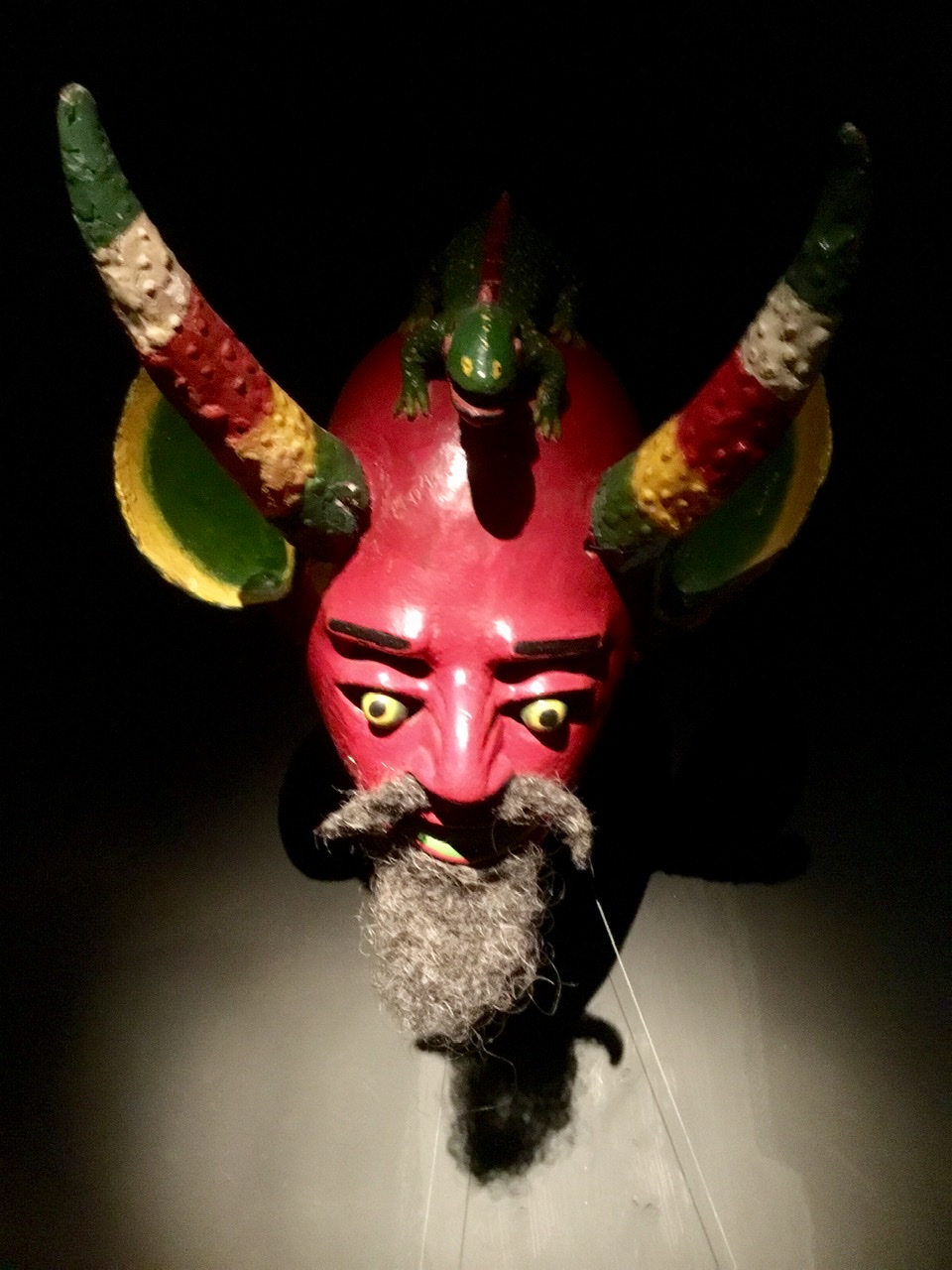
In Oruro, Bolivia, devotion to the Virgin del Socavon (Virgin of the Mineshaft) migrated from the fixed festival of Candlemas (2 February) to the movable feast of Carnival. By delaying their public devotion to the Virgin until the four-day holiday before Ash Wednesday, Oruro’s miners were able to enjoy a longer fiesta than if they had confined it to a single saint’s day. During Oruro’s Carnival, thousands of devils dance through the streets before unmasking in the Sanctuary of the Mineshaft to express devotion to the Virgin.
Evidently, the festive connotation of devils is not always demonic. In Manresa [Spain], the demons and dragons celebrate the restoration of liberty after a brutal civil war and subsequent dictatorship [General Francisco Franco]. In Oruro… the masked devils protest exploitation of indigenous miners by external forces and devote themselves to a Virgin who blesses the poor and marginalized. Festive disorder generally dreams not of anarchy but of a more egalitarian order.
Max Harris in Carnival and other Christian Festivals: Folk Theology and Folk Performance
Comments are welcome!
Pearls from artists* # 458

*an ongoing series of quotations – mostly from artists, to artists – that offers wisdom, inspiration, and advice for the sometimes lonely road we are on.
When I have painted a fine picture I have not given expression to a thought! That is what they say. What fools people are! They would strip painting of all its advantages. A writer has to say almost everything in order to make himself understood, but in painting it is as if some mysterious bridge were set up between the spirit of the persons in the picture and the beholder. The beholder sees figures, the external appearance of nature, but inwardly he meditates; the true thinking that is common to all men. Some give substance to it in writing, but in so doing they lose the subtle essence. Hence, grosser minds are more easily moved by writers than by painters or musicians. The art of the painter is all the nearer to man’s heart because it seems to be more material. In painting, as in external nature, proper justice is done to what is finite and to what is infinite, in other words, to what the soul finds inwardly moving in objects that are known through the senses alone.
The Journal of Eugene Delacroix edited by Hubert Wellington
Comments are welcome!
Pearls from artists* # 363
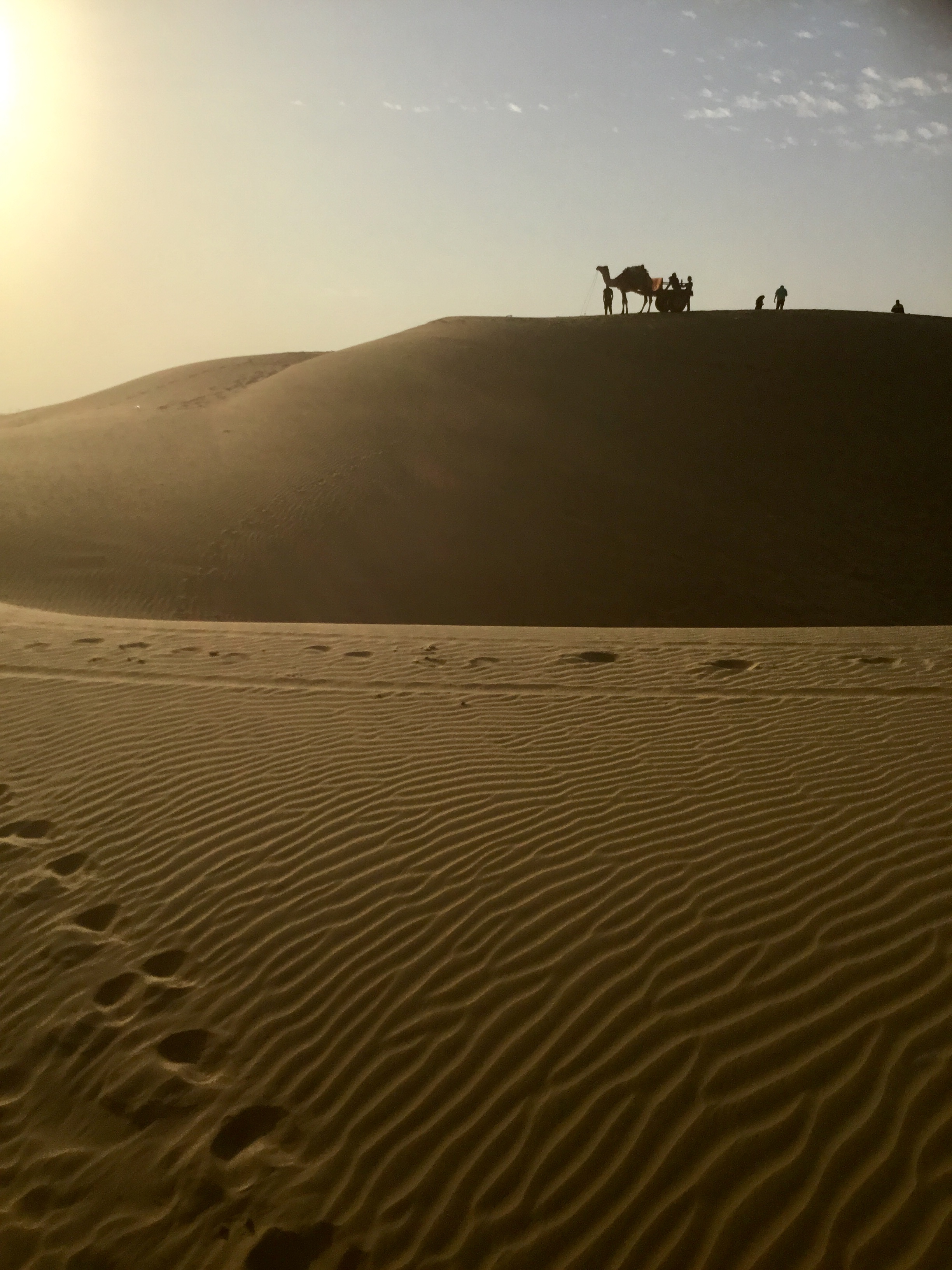
Thar Desert, Rajasthan, India
* an ongoing series of quotations – mostly from artists, to artists – that offers wisdom, inspiration, and advice for the sometimes lonely road we are on.
Beauty seems to need quiet and take patience, both to create it and to experience it.
If our minds are filled with a long and urgent “to do” list, we are not likely to slow down enough to appreciate anything but the next line we can draw through our never-ending list. Yet every now and again something stops us. It arrests our constant external activity and search. We can be stopped by the way the light filters through the trees in our backyard or hits a bowl of fruit on our kitchen table. And we are silenced, even if momentarily. We can be stopped by cave paintings as easily as by a thirteenth-century tapestry or a fifteenth-century Italian painting. We may be impressed by the craft of the artist, but almost always what moves us most deeply is the beauty that is expressed by the craft.
In the face of beauty, we are silenced because beauty expresses silence. In lavishing attention on the object of the artwork, the consciousness of the artist can touch something divine, some transcendental quality, and that transcendent element now resides in the artwork. How do we know it? We feel it. We experience it. Our heart responds to that sublime quality the artist infused into the work.
Ian Roberts in Creative Authenticity: 16 Principles to Clarify and Deepen Your Artistic Vision
Comments are welcome!
Pearls from artists* # 351

Barbara at work on “The Orator”
*an ongoing series of quotations – mostly from artists, to artists – that offers wisdom, inspiration, and advice for the sometimes lonely road we are on.
That art is apolitical does not mean that artists themselves can be excused from the political responsibilities that fall on others. It means rather that as a manifestation of eternal psychic force, each work of art goes farther and deeper than the limited perspective of any individual mind, including that of its author.
No artist can predict how his work will affect the world… The artist invests his entire personality into the work, but he does so as a means of expressing a vision that is transpersonal. Everything that makes him what he is informs the work, but the final result transcends all personal contingencies.
J.F. Martel in Reclaiming Art in the Age of Artifice: A Treatise, Critique, and Call to Action
Comments are welcome!
Pearls from artists* # 333

Studio entrance
*an ongoing series of quotations – mostly from artists, to artists – that offers wisdom, inspiration, and advice for the sometimes lonely road we are on.
… the Greeks and Romans both believed in the idea of an external daemon of creativity – a sort of house elf, if you will, who lived within the walls of your home and who sometimes aided you in your labors. The Romans had a specific term for that helpful house elf. They called it your genius – your guardian deity, the conduit of your inspiration. Which is to say, the Romans didn’t believe that an exceptionally gifted person was a genius; they believed that an exceptionally gifted person had a genius.
It’s a subtle but important distinction (being vs. having) and, I think, it’s a wise psychological construct. The idea of an external genius helps to keep an artist’s ego in check, distancing him somewhat from the burden of taking either full credit or full blame for the outcome of his work. If your work is successful, in other words, you are obliged to thank your external genius for the help, thus holding you back from total narcissism. And if your work fails, it’s not entirely your fault. You can say, “Hey, don’t look at me – my genius didn’t show up today!”
Either way, the vulnerable human ego is protected.
Protected from the corrupting influence of praise.
Protected from the corrosive effects of shame.
Elizabeth Gilbert in Big Magic: Creative Living Beyond Fear
Comments are welcome!
Pearls from artists* # 196

“The Sovereign,” soft pastel on sandpaper, 58″ x 38″
* an ongoing series of quotations – mostly from artists, to artists – that offers wisdom, inspiration, and advice for the sometimes lonely road we are on.
…for me, there’s nothing gratuitous about the least drawing. Every part of me has to be reaching toward that goal: exteriorizing the shock of events and external life.
Chatting with Henri Matisse: The Lost 1941 Interview, Henri Matisse with Pierre Courthion, edited by Serge Guilbaut, translated by Chris Miller
Comments are welcome!
Pearls from artists* # 165
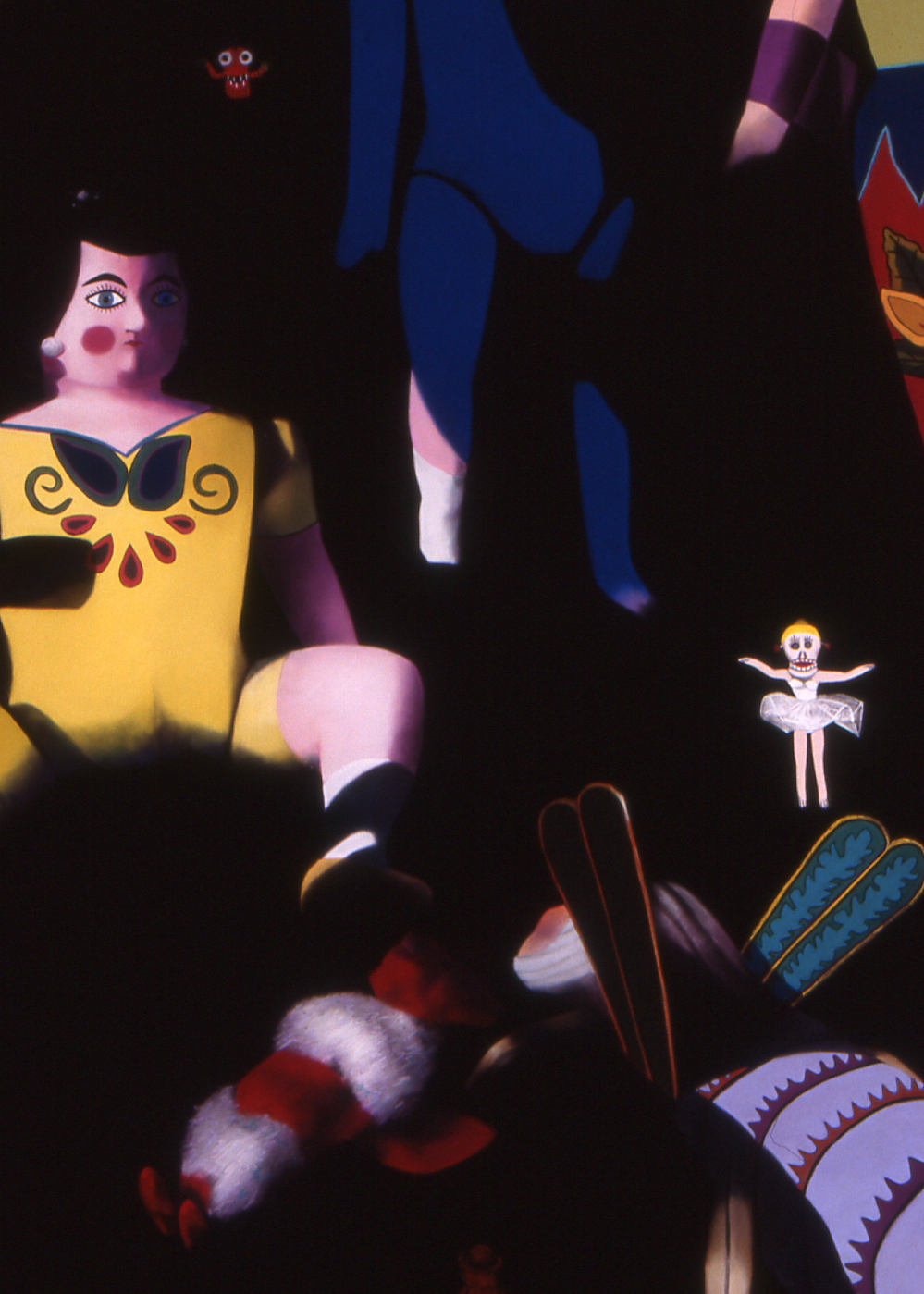
“The Space Between,” soft pastel on sandpaper, 58″ x 38″
* an ongoing series of quotations – mostly from artists, to artists – that offers wisdom, inspiration, and advice for the sometimes lonely road we are on.
When I have painted a fine picture I have not given expression to a thought! That is what they say. What fools people are! They would strip painting of all its advantages. A writer has to say almost everything in order to make himself understood, but in painting it is as if some mysterious bridge were set up between the spirit of the persons in the picture and the beholder. The beholder sees figures, the external appearance of nature, but inwardly he meditates; the true thinking that is common to all men. Some give substance to it in writing, but in so doing they lose the subtle essence. Hence, grosser minds are more easily moved by writers than by painters or musicians. The art of the painter is all the nearer to man’s heart because it seems to be more material. In painting, as in external nature, proper justice is done to what is finite and to what is infinite, in other words, to what the soul finds inwardly moving in objects that are known through the senses alone.
The Journal of Eugene Delacroix edited by Hubert Wellington
Comments are welcome!


 barbararachkoscoloreddust.com